What you'll learn
- How to turn an A View from the Bridge question into a clear argument.
- How to plan paragraphs that analyse Miller’s dramatic methods, not just retell the plot.
- How to choose short, precise quotations and stage directions in an open-book exam.
- How to adapt flexible essay plans for common question areas: Eddie, Alfieri, masculinity, law, and family conflict.
Why essay plans matter
For Edexcel IGCSE English Literature, A View from the Bridge is assessed in Component 2, Section A: Modern Drama. This is open book, so you may use a clean copy of the play. However, open book does not mean you have time to search randomly for quotations. A good plan helps you choose the most relevant moments quickly.
Essay plan
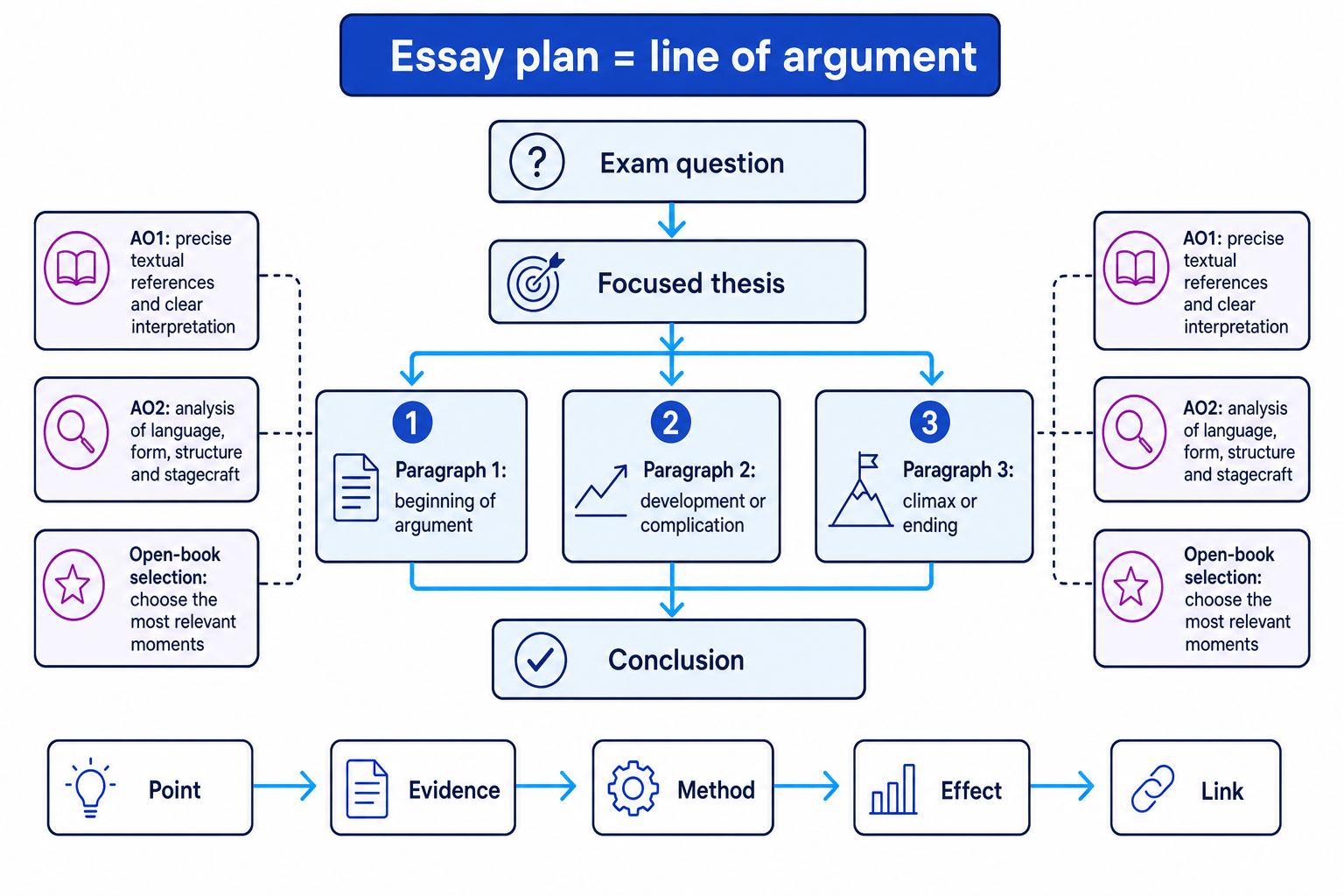
An essay plan is a brief structure for your answer. It sets out your main argument, the order of your paragraphs, and the evidence you will use to prove your interpretation.
The best plans are not “three things I remember about the play”. They are a route through an argument.
The golden rule
Your plan should answer the question from the first line. Every paragraph should develop the same argument, using a different moment or method from the play.
Step 1: Decode the question
Most A View from the Bridge questions ask you to explore how Miller presents a character, relationship, theme, or dramatic idea.
Line of argument
A line of argument is your overall answer to the question. It is the thread that connects your introduction, paragraphs, and conclusion.
When you first read the question, identify:
- the focus: who or what the question is about
- the angle: the key idea you must discuss
- the method: how Miller presents it through language, form, structure, stagecraft, or character interaction
Planning a question on Eddie as a tragic character
Question: Explore how Miller presents Eddie Carbone as a tragic character.
-
Identify the focus: the essay is about Eddie, but not everything about him — specifically his role as a tragic character, meaning someone whose flaws lead to suffering and downfall.
-
Decide the argument: Eddie is not presented as simply evil. Miller makes him disturbing but also pitiable because his possessiveness, pride, and need for respect destroy his family and himself.
-
Choose moments that show development: begin with Alfieri’s foreshadowing that he “watched it run its bloody course”, move to Beatrice’s accusation, “You want somethin’ else, Eddie,” and end with Eddie’s desperate cry, “I want my name, Marco.”
-
Link to methods: Alfieri’s narration gives the play a tragic structure, Beatrice’s dialogue exposes Eddie’s forbidden desire, and the final confrontation turns Eddie’s obsession with reputation into physical violence.
Step 2: Write a thesis, not a vague opening
Thesis
A thesis is a one-sentence answer to the question. It should make a clear, arguable judgement about Miller’s presentation.
A weak thesis sounds like this:
Miller presents Eddie as tragic in many ways.
That is too general. It does not explain how or why.
A stronger thesis sounds like this:
Miller presents Eddie as a tragic protagonist whose downfall comes from the collision between private desire, masculine pride, and the public code of honour in Red Hook.
This is better because it gives you three paragraph directions: desire, masculinity, and honour.
Make your thesis do the planning
If your thesis contains two or three key ideas, those ideas can become your main paragraphs. This stops you drifting into plot summary.
Step 3: Plan by development across the play
Because A View from the Bridge is a drama, structure matters. Miller carefully builds tension from the opening narration to the final death.
Dramatic structure
Dramatic structure means the way events, tensions, entrances, exits, revelations, and turning points are arranged on stage to shape the audience’s response.
A simple but powerful essay plan often follows this pattern:
- Beginning — how Miller introduces the idea.
- Middle — how conflict or tension develops.
- Ending — how the idea reaches crisis or resolution.
Planning Catherine’s growing independence
Question: Explore how Miller presents Catherine’s changing relationship with Eddie.
-
Start with dependence: early in the play, Eddie treats Catherine like a child and comments on her appearance, telling her, “You’re walkin’ wavy!” This shows his controlling gaze and discomfort with her growing maturity.
-
Develop the conflict: Beatrice encourages Catherine to separate emotionally from Eddie, telling her, “You gotta be your own self more.” This shifts the relationship from protection to restriction.
-
End with independence: Catherine’s decision to marry Rodolpho challenges Eddie’s authority. The relationship becomes tragic because Eddie cannot accept that Catherine’s adult identity no longer belongs under his control.
Retelling the plot
Do not write: “First Marco and Rodolpho arrive, then Eddie dislikes Rodolpho, then Eddie calls Immigration.” Instead, explain what Miller is showing through those events: jealousy, betrayal, honour, law, or tragic inevitability.
Step 4: Choose evidence that proves your point
In an open-book exam, you should still use short quotations. Long copying wastes time and usually reduces analysis.
Evidence
Evidence means a brief quotation, stage direction, or precise reference to a moment in the play that supports your point.
Good evidence for A View from the Bridge often includes stage directions, because this is drama. Miller’s meanings are created through movement, silence, entrances, exits, lighting, and physical tension as well as speech.
Useful evidence to plan around includes:
| Essay focus | Useful evidence | What to analyse |
|---|---|---|
| Tragedy | Alfieri “watched it run its bloody course” | foreshadowing, inevitability, narrator as chorus |
| Eddie’s desire | Beatrice: “You want somethin’ else, Eddie” | revelation, taboo, direct confrontation |
| Masculinity | Eddie: “He sings, he cooks, he could make dresses” | listing, gender expectations, insecurity |
| Honour | Eddie: “I want my name, Marco” | symbolism of “name”, reputation, public shame |
| Power | Marco holds the chair “like a weapon” | stagecraft, physical dominance, threat |
| Law | Alfieri: “There is nothing you can do, Eddie” | limits of legal authority, frustration |
Open book does not mean quotation hunting
If you spend too long searching for the “perfect” quotation, your essay loses structure. Plan the key moments first, then find short evidence from those scenes.
Step 5: Build each paragraph analytically
A strong paragraph should usually move through:
point → evidence → method → effect → link
Method
A method is a choice the writer makes to create meaning. In drama, this can include dialogue, stage directions, entrances and exits, pauses, dramatic irony, symbolism, structure, or the use of a narrator.
The method should never be named as a device on its own. Always connect it to meaning.
Turning a point into analysis
Essay focus: honour and reputation
-
Make the point: Miller presents Eddie’s obsession with honour as destructive because Eddie values his public “name” more than peace within his family.
-
Select evidence: near the climax, Eddie demands, “I want my name, Marco.” The word “name” becomes more than personal identity; it represents reputation in the neighbourhood.
-
Analyse method: Miller uses repetition and symbolism. Eddie’s repeated demand for his “name” shows that public shame has become unbearable to him.
-
Explain effect: the audience sees that Eddie’s masculinity depends on being respected by other men, especially Marco. This makes the final confrontation feel tragically inevitable.
-
Link to question: therefore, Miller presents honour not as noble, but as a social pressure that traps Eddie into violence.
Device spotting
Do not write, “This is symbolism, which is effective.” Instead, write what the symbol means: Eddie’s “name” symbolises reputation, masculine pride, and his need to regain public authority.
Mini essay plans you can adapt
These are not scripts to memorise. Use them as flexible structures and reshape them to fit the exact wording of the question.
Plan 1: Eddie as a tragic protagonist
Thesis: Miller presents Eddie as a tragic protagonist whose downfall grows from possessive love, masculine pride, and his refusal to accept legal or moral limits.
-
Alfieri frames Eddie tragically
Use Alfieri’s narration: he “watched it run its bloody course.” Analyse foreshadowing and the sense that the ending is unavoidable. -
Eddie’s private desire becomes visible
Beatrice exposes him: “You want somethin’ else, Eddie.” Analyse direct dialogue and the emotional shock of naming what Eddie tries to deny. -
Eddie destroys himself over reputation
Eddie cries, “I want my name, Marco.” Analyse the symbol of “name” and how the public code of honour drives the final violence.
Plan 2: Alfieri’s role
Thesis: Miller uses Alfieri as both lawyer and narrator, making him a bridge between law and emotion while giving the play its tragic shape.
-
Opening narrator
Alfieri introduces the world of Red Hook and says he “watched it run its bloody course.” This creates dramatic irony because the audience senses disaster before the characters fully do. -
Voice of the law
When Eddie wants to stop Catherine marrying Rodolpho, Alfieri tells him, “There is nothing you can do, Eddie.” This shows the gap between Eddie’s emotional desire and what the law can control. -
Final moral reflection
Alfieri says, “Most of the time now we settle for half and I like it better,” but also admits that “something perversely pure” calls to him from Eddie’s memory. This makes the ending morally complex rather than simple.
Plan 3: Masculinity and honour
Thesis: Miller presents masculinity in Red Hook as a dangerous performance based on control, physical strength, and public reputation.
-
Eddie controls Catherine’s appearance
His comment “You’re walkin’ wavy!” shows his anxiety about Catherine becoming sexually mature and independent. -
Rodolpho challenges Eddie’s idea of manhood
Eddie mocks Rodolpho because “He sings, he cooks, he could make dresses.” Analyse the list as Eddie’s narrow, insecure view of masculinity. -
Marco displays silent physical power
The chair is raised “like a weapon.” This stage direction turns a domestic object into a threat and shows Marco’s dominance without needing a long speech.
Plan 4: Law, justice, and betrayal
Thesis: Miller contrasts official law with the community’s moral code, showing that neither can fully prevent tragedy.
-
Alfieri represents legal order
He tells Eddie, “There is nothing you can do, Eddie,” showing that the law cannot satisfy Eddie’s desire for control. -
Eddie uses the law to betray family
His call to Immigration breaks the Red Hook code of loyalty. Analyse the phone booth as a stage image of isolation and betrayal. -
Marco seeks public justice
Eddie wants his “name” back, while Marco wants revenge for the betrayal of his family. The final violence shows what happens when law fails to resolve shame and anger.
Planning your conclusion
A conclusion should not simply repeat your three points. It should return to the question and explain the overall significance of Miller’s presentation.
A strong conclusion might say:
Ultimately, Miller presents Eddie’s tragedy as both personal and social. Eddie is responsible for his betrayal, but the world of the play also traps him inside codes of masculinity, honour, and silence that make compromise almost impossible.
End with Miller’s purpose
In your final sentence, try to answer: what does Miller want the audience to feel, question, or understand by the end of the play?
In the exam
-
Spend a few minutes planning a thesis and three paragraph focuses before you start writing.
-
Use the open book to select short, precise quotations or stage directions — not to copy long passages.
-
Analyse Miller’s dramatic methods every paragraph: dialogue, stagecraft, structure, symbolism, and the effect on the audience.
-
Keep linking back to the exact question wording so your essay stays focused.
Check yourself
-
Can you write a one-sentence thesis for a question on Eddie, Alfieri, or masculinity?
-
Can each paragraph in your plan name a specific moment from the play and a method Miller uses?
-
Are you analysing the play as drama, including stage directions and audience response, rather than just retelling events?