What you'll learn
- How to separate language, form and structure in A View from the Bridge.
- How Miller uses dialogue, stage directions, symbols and motifs to create meaning.
- How Alfieri’s framing makes Eddie’s story feel like an inevitable tragedy.
- How to turn method-spotting into strong Edexcel AO2 analysis.
First: what are you actually analysing?
In Edexcel IGCSE Literature, A View from the Bridge appears in Component 2 Section A: Modern Drama, which is open book: you are allowed a clean copy of the play. That helps with finding precise quotations, but your marks come from explaining how Miller’s methods create meaning and dramatic effect.
Language, form and structure
- Language means Miller’s word choices: dialogue, imagery, dialect, repeated words, tone, and stage directions.
- Form means the type of text and its conventions: here, a two-act play, a modern realist tragedy, written for performance.
- Structure means the pattern and order of the play: prologue, exposition, rising tension, crisis, climax, epilogue, repetition and contrast.
Method plus meaning
Do not write a list of devices. A strong answer links a method to an effect: Miller uses this choice to make the audience feel, notice or question something about Eddie, the family, the law, or tragedy.
Language: speech under pressure
Dialogue, dialect and subtext
Dialogue is the speech between characters. In drama, dialogue is especially important because there is no ordinary narrator telling us what characters think. We infer character from what people say, how they say it, and what they avoid saying.
Miller often uses colloquial language, meaning informal everyday speech. Eddie’s words include contractions and non-standard forms such as “ain’t”, which make the Brooklyn setting feel realistic and working-class. This helps the play feel like ordinary life — until that ordinary life becomes tragic.
Subtext means the hidden meaning underneath what a character says. Eddie often speaks as if he is only protecting Catherine, but the subtext suggests possessiveness, jealousy and confused desire. When he asks, “What’s the high heels for, Garbo?”, the surface topic is Catherine’s shoes, but the deeper tension is Eddie’s discomfort with her becoming a sexually independent young woman.
Reading Eddie's controlling language
- Notice the surface meaning: Eddie comments on Catherine’s appearance, especially the “high heels”, so the conversation seems domestic and ordinary.
- Analyse the reference to “Garbo”: the allusion to glamorous film star Greta Garbo makes Catherine’s maturity sound theatrical and provocative, as if Eddie thinks she is performing adulthood too boldly.
- Compare this with Eddie’s line “You ain’t ‘all the girls’”: the phrasing separates Catherine from other young women and implies that Eddie wants special control over her choices.
- Link to the wider play: Miller’s language reveals Eddie’s possessiveness before Eddie understands it himself, so the audience begins to sense danger beneath ordinary family talk.
Repetition, motifs and symbolic language
A motif is a repeated image, word, object or idea that gains meaning across a text. A symbol is something concrete that represents a bigger idea.
In this play, “name” becomes a powerful motif. Eddie’s “name” means more than his literal identity: it represents reputation, masculinity, public honour and the respect of the neighbourhood. Near the end, Eddie cries, “I want my name, Marco.” The repeated demand sounds desperate because Eddie thinks his public identity has been stolen.
The image “Wipin’ the neighborhood with my name like a dirty rag!” is a simile, a comparison using “like” or “as”. Eddie imagines his name as something physically dirtied. Miller shows that Eddie’s obsession with honour has become more important to him than truth, family or safety.
Tracking the name motif
- Identify the repeated word: “name” returns at the end of the play when Eddie demands that Marco restore his reputation.
- Analyse the image: “like a dirty rag” turns reputation into a stained object, suggesting shame, contamination and public humiliation.
- Connect the motif to character: Eddie frames the conflict as an attack on his honour, even though he betrayed Marco and Rodolpho by calling Immigration.
- Link to tragic effect: because Eddie cannot accept compromise or private guilt, the motif of “name” drives him towards a public confrontation he cannot survive.
Spotting without analysing
Do not write: “Miller uses a simile.” Instead, explain what the simile makes the audience understand: Eddie sees reputation as something that can be dirtied, so his pride becomes dangerous.
Stage directions are language too
A stage direction is an instruction in the script telling actors how to move, speak, pause, or appear on stage. In drama, stage directions are part of the writer’s method, so you can analyse them just as closely as dialogue.
Miller makes power visible through stage action. The chair-lifting scene between Marco and Eddie begins as a test of strength, but becomes a silent warning. When Marco holds the chair above Eddie, Miller shows the audience a physical image of Marco’s superiority. Eddie’s confidence collapses; his “grin vanishes”.
Analysing a stage direction
- Start with the action: Marco raises the chair above Eddie, turning a domestic object into a display of physical power.
- Contrast the characters: Eddie expects to dominate the room, but Marco’s silent strength makes Eddie look smaller and less secure.
- Analyse the audience effect: because the warning is visual rather than verbal, the audience feels the threat before open violence begins.
- Connect to structure: the moment foreshadows the final confrontation, where Eddie’s attempt to prove masculine authority leads to his death.
Form: a modern realist tragedy
Drama written for performance
A View from the Bridge is a play, so Miller writes not only for readers but for actors, directors and audiences. This means you should think about entrances, exits, pauses, gestures, stage space, and what the audience can see before characters fully understand it.
The play uses realism, meaning it presents believable people, speech and settings. The Carbone apartment, the Brooklyn docks, Immigration, work, family meals and neighbourhood gossip all make the world feel ordinary.
But the form is also tragic.
Modern realist tragedy
A tragedy is a dramatic form in which a central character is driven towards suffering or death by a mixture of personal flaws, social pressures and fate-like forces. A modern realist tragedy applies this pattern to ordinary people in a believable modern setting.
Miller makes Eddie an ordinary longshoreman rather than a king or warrior, but Alfieri gives his story tragic weight: “Eddie Carbone had never expected to have a destiny.” The word “destiny” makes Eddie’s life sound larger than everyday domestic conflict.
Linking form to Eddie's downfall
- Begin with form: Miller presents Eddie as the central figure in a modern tragedy, not simply as a bad man in a family argument.
- Use the quotation: Alfieri says Eddie “had never expected to have a destiny”, which elevates an ordinary dockworker into a tragic protagonist.
- Analyse the effect of “destiny”: it suggests that Eddie’s choices feel both personal and unavoidable, creating pity as well as judgement.
- Link to the play’s meaning: Miller shows that tragedy can grow out of everyday pride, desire and social codes, not only from grand historical events.
Calling Eddie only a villain
Eddie behaves wrongly, especially when he reports Marco and Rodolpho, but the play asks for a more complex response. You can judge him while also recognising him as a tragic protagonist whose need for control destroys him.
Structure: inevitability, framing and escalation
Miller structures the play so the audience senses the ending approaching long before it happens. The timeline below shows how the tragedy builds from ordinary domestic life to public catastrophe.
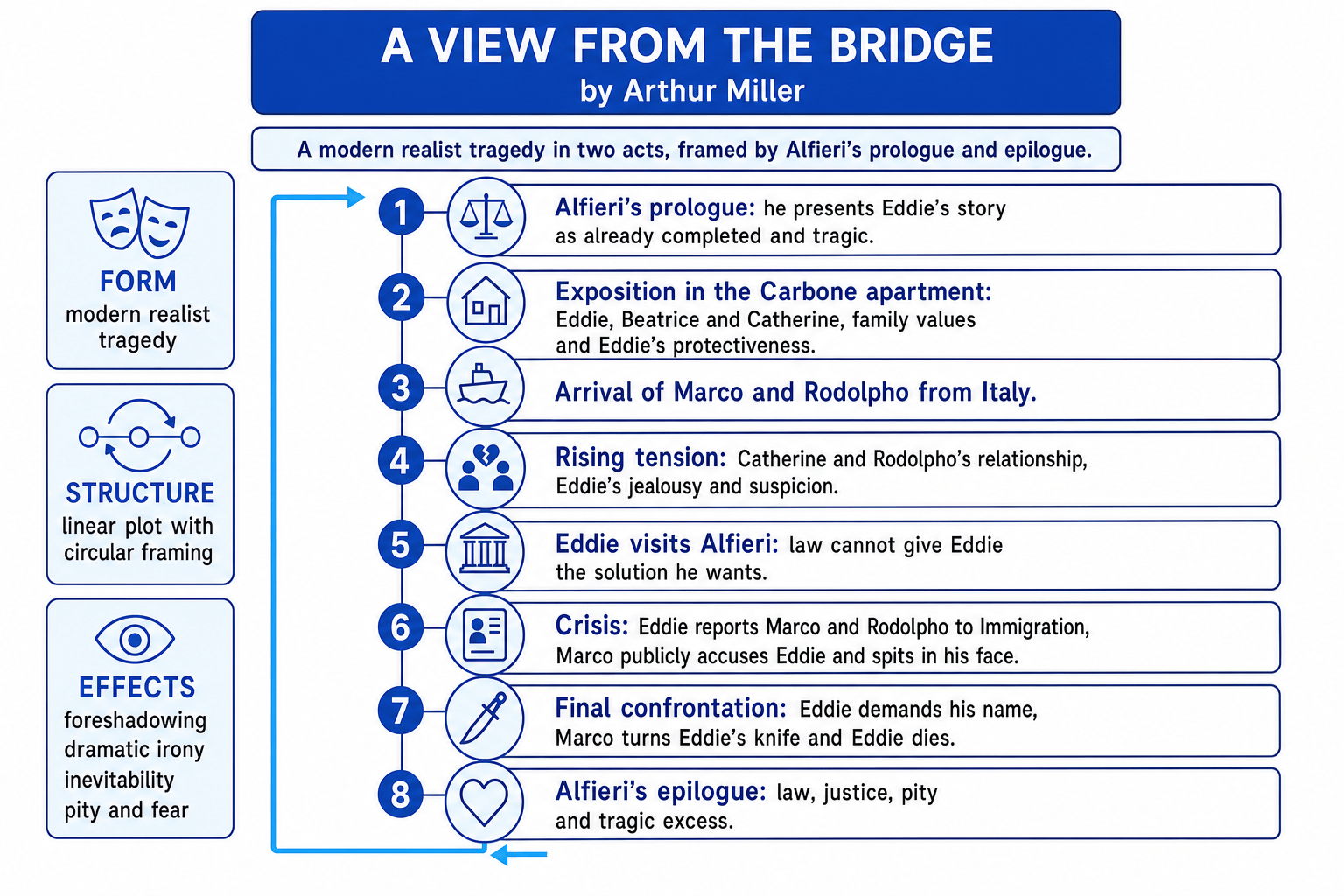
Alfieri’s prologue and epilogue
A prologue is an opening section that introduces or frames the action. An epilogue is a closing section that reflects on what has happened. Alfieri performs a role similar to a chorus in Greek tragedy: he comments on events and guides the audience’s response.
Alfieri tells the story retrospectively, meaning after it has already happened. This creates foreshadowing, where early details hint at later events. His phrase “watched it run its bloody course” tells us from the beginning that violence is coming.
Foreshadowing and dramatic irony
Foreshadowing is a hint about what will happen later. Dramatic irony happens when the audience knows or understands more than the characters do.
Because Alfieri can “see every step coming”, the audience watches Eddie with dread. We understand that Eddie is moving towards disaster even when he insists he is acting reasonably.
Analysing Alfieri's warning
- Identify the structural method: Alfieri frames the play from a later point in time, so he already knows the outcome.
- Analyse the phrase “every step coming”: the repeated idea of steps makes the tragedy feel gradual, deliberate and difficult to stop.
- Connect to dramatic irony: the audience senses the danger before Eddie fully recognises the truth about his own motives.
- Link to effect: Miller creates tension not by hiding the ending, but by making us watch helplessly as Eddie approaches it.
Linear plot with a circular frame
A linear plot moves mostly in chronological order, from earlier events to later ones. A View from the Bridge is largely linear: Marco and Rodolpho arrive, tension rises, Eddie seeks Alfieri’s help, Eddie betrays them, and the final confrontation follows.
However, the play also has a circular structure because it begins and ends with Alfieri. The story returns to the lawyer’s reflective voice. At the end, Alfieri says, “Most of the time now we settle for half,” suggesting that ordinary life depends on compromise. Eddie cannot “settle for half”: he wants absolute respect, absolute possession and absolute justice on his own terms.
Inevitability is constructed
The ending feels inevitable because Miller carefully builds warnings, repetitions and failed chances to stop. Eddie is not killed by one sudden event; he is destroyed by a pattern.
Pacing and turning points
Pacing means the speed at which events unfold. Act One begins with detailed domestic realism: Catherine’s job, Eddie’s worries, Beatrice’s patience, the arrival of the cousins. The pace then tightens as Eddie’s jealousy becomes harder to disguise.
A turning point is a moment when the direction of the plot changes. Eddie’s visits to Alfieri are important turning points because Alfieri repeatedly shows him that the law cannot give him the answer he wants. When Eddie finally reports Marco and Rodolpho to Immigration, the structure reaches a point of no return.
The final confrontation is the climax, the most intense point of conflict. Structurally, it is bitterly ironic that Eddie brings the knife, but Marco turns Eddie’s weapon against him. Eddie’s violence comes back upon himself.
Writing about structure
Use active structural verbs: frames, foreshadows, delays, accelerates, repeats, contrasts, interrupts, escalates. These help you explain what Miller is doing, not just what happens.
Open book does not mean quote-dumping
In Component 2 you can use a clean copy, but do not copy long chunks. Choose short, precise quotations and analyse Miller’s methods closely.
Putting it together in a paragraph
A strong analytical paragraph moves from point to evidence to method to effect. For example:
Miller structures A View from the Bridge as a tragedy that feels unavoidable because Alfieri frames Eddie’s story from the beginning. Alfieri says he “watched it run its bloody course”, and the violent adjective “bloody” immediately foreshadows death. Because this warning comes before the audience fully knows Eddie, Miller creates dramatic irony: we watch Eddie’s ordinary family concerns darken into obsession while knowing that the outcome will be destructive. This makes the audience feel both judgement and pity, which is central to Eddie’s role as a modern tragic protagonist.
In the exam
- Start each paragraph with a clear point about Miller’s method, such as dialogue, stage direction, tragic form, framing or repetition.
- Use short quotations from your clean copy, then zoom in on one or two key words instead of retelling the plot.
- Always link the method to audience effect and meaning: what does Miller make us feel, fear, understand or question?
Check yourself
- How does Alfieri’s prologue change the way the audience watches Eddie?
- What does the repeated idea of Eddie’s “name” reveal about honour and masculinity?
- How does Miller use stage action, not just dialogue, to show power shifting between Eddie and Marco?