Arthur Miller’s A View from the Bridge is a tightly wound, fast-paced modern tragedy. Every line spoken on stage carries dramatic weight. Because your Pearson Edexcel Component 2, Section A exam is open book, you do not need to struggle with blind memorization of long passages. Instead, your success depends on your ability to locate, select, and dissect high-impact quotes that reveal deeper layers of character development, structure, and theme.
What you'll learn
- How to select the most analytically fruitful quotes from A View from the Bridge.
- How to analyze dramatic language, stage directions, and structural motifs to satisfy Assessment Objectives.
- How to integrate quotes smoothly into a high-scoring literary essay.
Why "Key Quotes" Matter in an Open-Book Exam
When preparing for an open-book exam, students often fall into the trap of thinking they do not need to study quotes. This is a significant mistake. Having a clean copy of the play in front of you is only helpful if you already know exactly where the most crucial turn of phrase resides and what literary devices are at play.
To score highly in AO1 (clear understanding, sustained response) and AO2 (analysis of language, form, and structure), you must look beyond the surface level of the plot. You need to analyze the specific, deliberate choices Arthur Miller made.
Dramatic Economy
Dramatic economy is the writer's practice of ensuring that every character, line, stage direction, and prop serves multiple narrative and thematic purposes, leaving no wasted space in the script.
In this play, Miller exercises extreme dramatic economy. Simple lines often double as foreshadowing or heavy psychological indicators.
Thematic Mapping of Key Quotes
To help you organize your textual evidence, we can divide the play's most significant quotes into three major thematic areas.
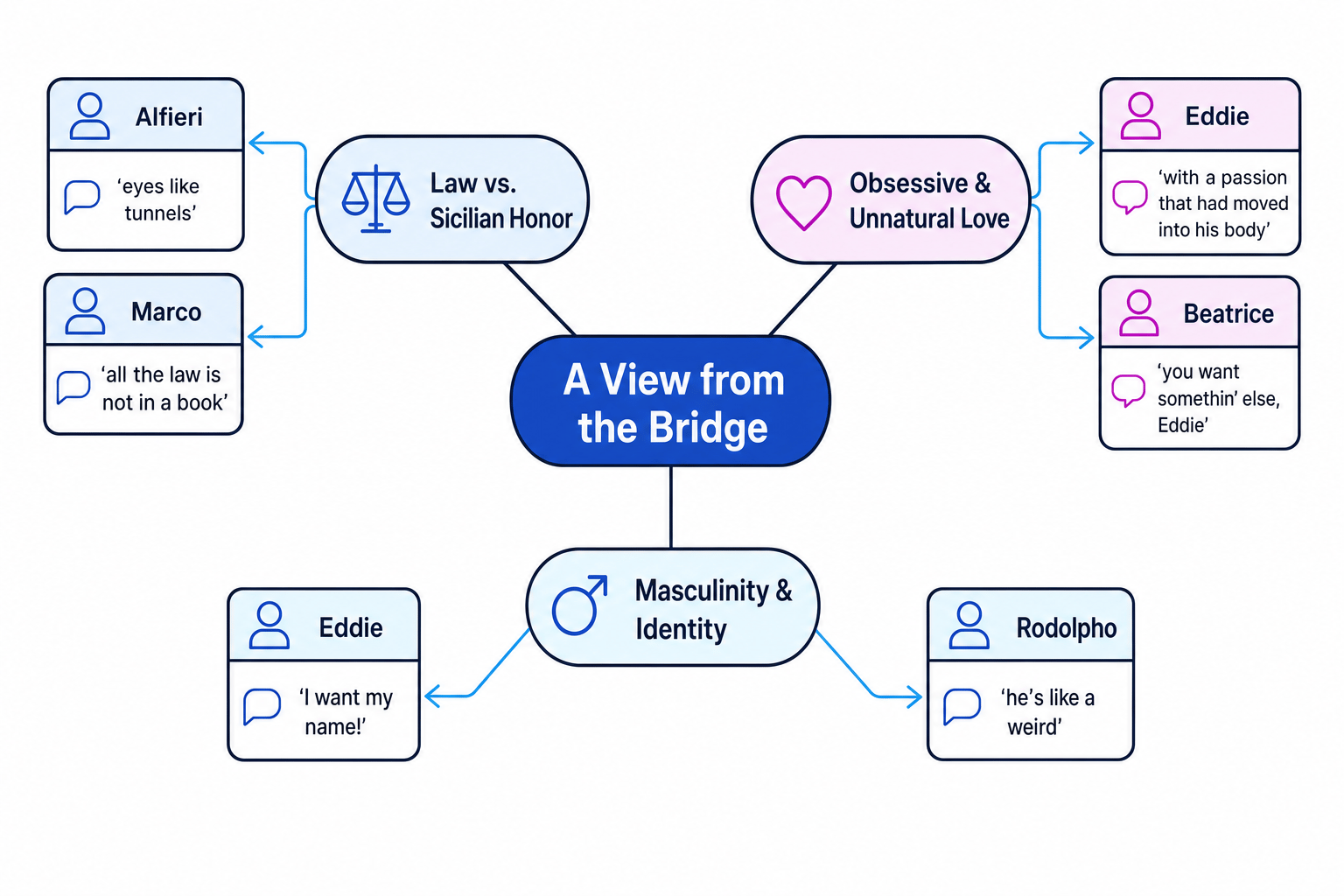
1. Law, Justice, and Sicilian Honor
These quotes focus on the clash between written American law and the unwritten, ancient Sicilian code of honor (omertà).
2. Obsessive and Unnatural Love
These quotes track Eddie’s psychological decay and his incestuous, boundary-crossing fixation on his niece, Catherine.
3. Masculinity and Identity
These quotes explore Eddie’s fragile sense of manhood, his intense jealousy of Rodolpho’s modern masculinity, and his ultimate obsession with protecting his "name" (reputation).
High-Yield Quotes and Analysis
Let's look at four crucial quotes that you can use across multiple essay prompts.
Quote 1: Alfieri on Eddie’s Obsession
"He was as good a man as he had to be... and then the dark figure of the ancient law stood in his tavern." (Act 1)
- The Speaker: Alfieri acts as the modern equivalent of a Greek Chorus. He is a lawyer who bridges the gap between the audience and the action, offering objective commentary on the inevitable tragedy.
- Language Analysis: The metaphor of the "dark figure of the ancient law" refers to the primitive, retributive justice of Sicily. By placing this "figure" in Eddie's ordinary "tavern" (representing his everyday working-class life), Miller highlights the clash of eras and values.
- Structural Significance: This quote comes during Alfieri's opening monologue. It establishes a sense of fate and tragic inevitability—we know Eddie is doomed from the very beginning.
The Greek Chorus
Alfieri is not just a character; he is a structural device. Miller uses him to elevate a domestic family dispute in Red Hook, Brooklyn, into a grand, mythic tragedy.
Quote 2: Beatrice Confronting Eddie
"You want somethin' else, Eddie, and you can never have her!" (Act 2)
- The Speaker: Beatrice, Eddie’s long-suffering wife. She is often the most perceptive character on stage, acting as a voice of painful realism.
- Language Analysis: The euphemistic phrase "somethin' else" is highly charged. Beatrice is the first character to openly articulate the taboo nature of Eddie’s feelings for Catherine. By refusing to name it directly, Miller reflects the 1950s social repression and the sheer horror of incest.
- Dramatic Tension: This line is a major climax in the play’s interpersonal relationships. It shatters the subtext (underlying meaning) and forces Eddie’s unspoken desires into the open.
Quote 3: Marco’s Code of Honor
"All the law is not in a book." (Act 2)
- The Speaker: Marco, whose quiet dignity contrasts sharply with his brother Rodolpho's flamboyant nature.
- Language Analysis: The simple, declarative sentence structure emphasizes Marco's absolute conviction. "The book" represents the formal American legal system, which Marco views as inadequate for dealing with a deep betrayal of family.
- Contextual Link: In Red Hook's Italian-immigrant community, honor is a matter of life and death. To Marco, Eddie's betrayal (calling immigration) cannot be settled in an American courtroom; it demands blood justice.
Confusing Law and Justice
Do not treat "law" and "justice" as synonyms in this play. Miller presents them as opposing forces. The law (represented by Alfieri) is orderly but powerless to stop human passion; justice (demanded by Marco) is satisfying to the community but destructive to social order.
Quote 4: Eddie's Tragic Demand
"I want my name! ... Marco's got my name." (Act 2)
- The Speaker: Eddie, shortly before his fatal confrontation with Marco.
- Language Analysis: The repetition of "my name" acts as a powerful motif representing honor, social standing, and identity. In the Red Hook community, losing one's name is equivalent to social death.
- Tragic Irony: Eddie accuses Marco of stealing his name, but Eddie is the one who destroyed his own reputation by breaking the community's code of silence. His desperate fight to reclaim his name only ensures his literal death.
How to Analyze a Quote in Your Essay
When writing your analysis under exam conditions, you must avoid simply stating what a quote means. Instead, walk through a systematic analysis that links the writer's craft to the wider themes of the play.
Analyzing Eddie's final demands for his name
Here is how to construct a high-impact analytical paragraph using Eddie's demand: "I want my name!"
- State the analytical point (AO1): Identify how Eddie's obsession with his reputation drives the final tragic sequence of the play.
- Introduce the quote and context cleanly (AO1): As the play moves rapidly toward its violent climax, Eddie refuses to compromise with Marco, hysterically demanding, "I want my name!"
- Analyse specific language and dramatic devices (AO2): The imperative verb "want" and the exclamation mark emphasize Eddie's desperation and absolute lack of self-awareness. The noun "name" functions as a physical motif for his lost honor and masculinity.
- Link to the play's dramatic form (AO2): This demand highlights Eddie's tragic downfall. In classical tragedy, the protagonist's stubborn pride (hubris) prevents them from backing down, making Eddie’s death at the hands of Marco structurally inevitable.
- Connect back to the central question: Summarize how this shows that for Eddie, biological survival is worthless without social respect.
Stage Directions are Quotes Too!
Stage directions are written by Arthur Miller and are just as valuable as spoken dialogue. For example, when Marco lifts the chair "like a weapon" over Eddie's head at the end of Act 1, this non-verbal interaction is a "visual quote" that foreshadows Eddie's death. Use stage directions to score highly on AO2 structure!
In the exam
- Annotate your clean text wisely: Before the exam, make sure you know exactly where the key acts start and finish so you don't waste time flipping pages.
- Keep quotes short: Do not write out three lines of dialogue. Select highly concentrated, punchy phrases (e.g., "eyes like tunnels" or "only of a paper doll") and weave them seamlessly into your own sentences.
- Analyze the stage directions: Whenever you select a quote, look at the physical actions associated with it. Drama is meant to be performed, and the physical space (proxemics) often reveals the characters' true feelings.
Check yourself
- Why is Eddie's obsession with his "name" structurally ironic at the end of the play?
- What does Alfieri mean when he describes Eddie's eyes as being "like tunnels"?
- How does the quote "all the law is not in a book" highlight the central cultural conflict in Red Hook?