What you'll learn
- How to identify the most important moments in A View from the Bridge.
- How Miller builds tension from ordinary family life into tragedy.
- How to analyse key scenes using dramatic methods such as stage directions, foreshadowing and symbolism.
- How to use key scenes effectively in an Edexcel IGCSE essay.
What counts as a “key scene”?
In A View from the Bridge, Miller does not divide the play into lots of numbered scenes. Instead, the play is arranged in two acts, with the action flowing almost continuously. So when we talk about “key scenes”, we mean the major dramatic episodes that change the direction of the plot, reveal character, or sharpen the play’s central conflicts.
Dramatic structure
Dramatic structure means the way a playwright organises events, tension, revelations, entrances, exits and turning points across a play.
For Edexcel IGCSE, this matters because A View from the Bridge is assessed in Component 2, Section A: Modern Drama. This is open book, so you can use a clean copy of the play, but you still need strong knowledge of where key moments happen and why they matter. The best answers do not simply retell events: they explain how Miller makes those events dramatic.
Key scenes are turning points
A key scene is important because it changes something: a relationship, the audience’s understanding, the level of tension, or the direction of the tragedy.
The timeline below shows how Miller gradually raises the pressure until Eddie’s private obsession becomes a public disaster.
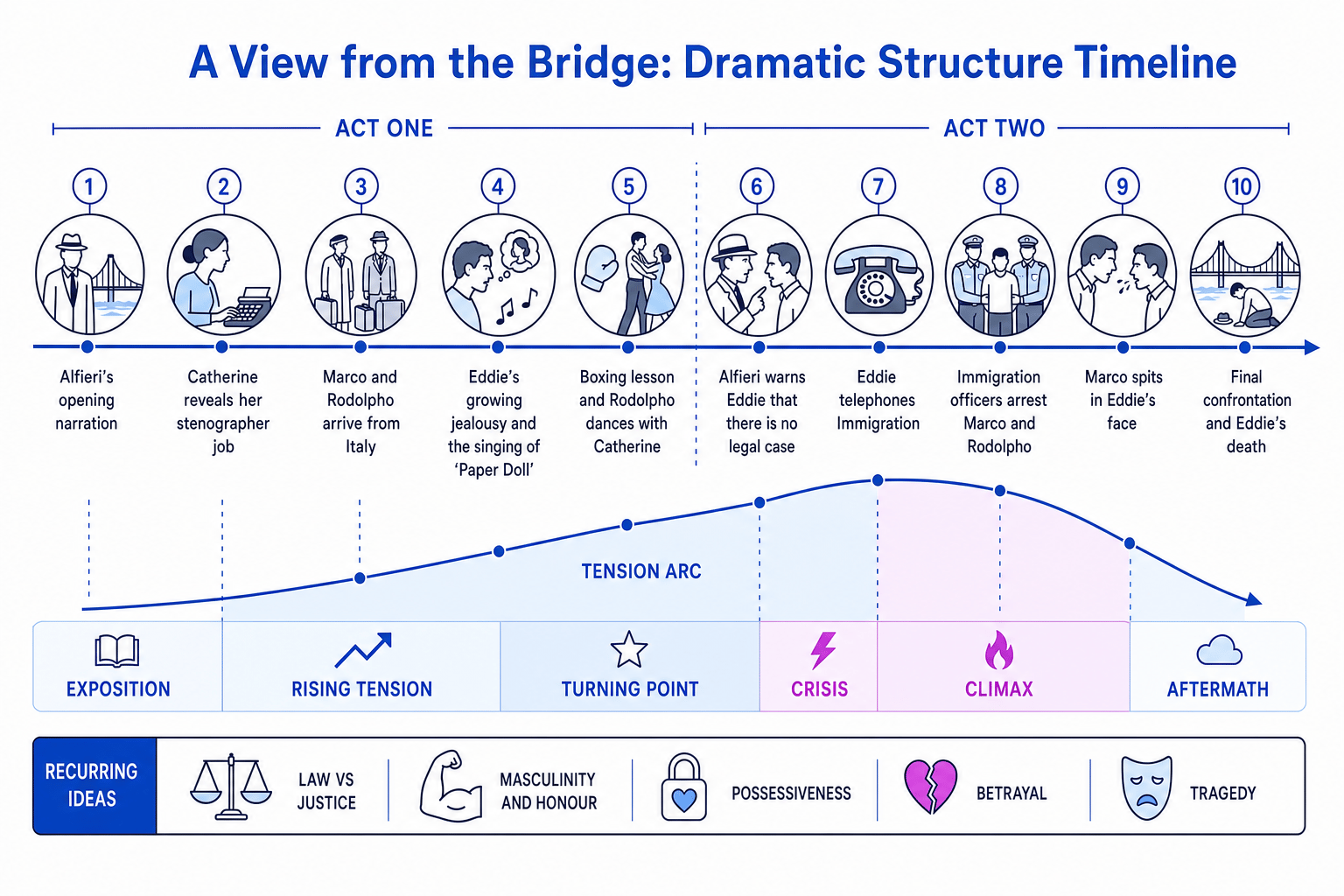
The opening: Alfieri frames the tragedy
The play begins with Alfieri, the lawyer, speaking directly to the audience. He introduces Red Hook as “the slum that faces the bay on the seaward side of Brooklyn Bridge” and describes it as “the gullet of New York swallowing the tonnage of the world”. This immediately connects the personal story of Eddie Carbone to a larger world of immigration, labour and survival.
Frame narrator
A frame narrator is a character who stands partly outside the main action and shapes how the audience understands the story.
Alfieri is not just a narrator. He also works like a modern version of a Greek chorus: he comments on the action, warns us about what is coming, and makes the play feel tragic before the violence happens.
Foreshadowing
Foreshadowing is when a writer hints at events that will happen later, creating expectation or unease.
Alfieri’s tone creates foreshadowing because he speaks as if the story has already happened. When he says, “Now we settle for half, and I like it better,” he introduces one of the play’s biggest conflicts: ordinary compromise versus Eddie’s refusal to accept limits.
Why this scene matters
The opening tells you how to watch the play. This is not just a realistic family drama; it is a tragedy. Miller wants the audience to feel that Eddie’s downfall is both shocking and, in some way, inevitable.
Analysing Alfieri’s opening
-
Start with the dramatic situation: Alfieri speaks directly to the audience before Eddie appears, so he controls our first impression of the world of the play.
-
Link this to method: Miller uses a frame narrator and foreshadowing, especially through Alfieri’s reflective tone and the repeated contrast between law and justice.
-
Explain the effect: the audience feels uneasy because Alfieri seems to know that Eddie’s story will end badly, making later domestic scenes feel loaded with danger.
-
Connect to the whole play: the opening prepares us for Eddie’s refusal to “settle for half”, which becomes central to his tragic fall.
Catherine’s job: ordinary news becomes a threat
Early in Act One, Catherine tells Eddie and Beatrice that she has been offered a stenographer’s job. On the surface, this is good news: Catherine is growing up and becoming independent. But Eddie reacts anxiously and critically, especially about her appearance and the attention she receives outside the home.
This scene is important because it reveals Eddie’s possessiveness before Rodolpho even arrives. He presents his control as protection, but the audience begins to sense something more troubling underneath.
Subtext
Subtext is the hidden meaning beneath what a character says openly. A character may say one thing, while their feelings suggest something else.
When Eddie worries about Catherine’s clothes and the way she walks, the subtext is not simply fatherly concern. Miller shows that Eddie is uncomfortable with Catherine becoming sexually and socially independent. Beatrice notices this earlier than Eddie does, which is why her role in these scenes is so important.
Calling Eddie only protective
Do not describe Eddie as just “protective”. That misses the complexity of the scene. Miller presents his care as mixed with control, jealousy and denial.
Marco and Rodolpho arrive: the household changes
The arrival of Beatrice’s cousins, Marco and Rodolpho, changes the atmosphere of the home. At first, the scene is warm and comic: the cousins are grateful, Catherine is interested, and Eddie seems willing to help. However, this scene also plants the conflict that will destroy the household.
Marco is serious, responsible and focused on supporting his starving family in Italy. Rodolpho is more playful, expressive and openly charming. Catherine is quickly drawn to Rodolpho, and Eddie’s suspicion begins to grow.
Miller uses contrast here. Marco’s quiet strength makes him seem traditionally masculine to Eddie, while Rodolpho’s singing, cooking and blond hair unsettle Eddie’s narrow ideas of manhood. Eddie later says, “The guy ain’t right,” revealing more about Eddie’s prejudice and insecurity than about Rodolpho.
Contrast
Contrast is when a writer places different characters, ideas or moods beside each other so their differences stand out.
Why this scene matters
This is the moment when Eddie’s private unease gains a target. Rodolpho becomes the figure Eddie can blame for Catherine’s independence, even though Catherine’s growing adulthood was already clear before the cousins arrived.
The “Paper Doll”, boxing and dancing sequence
One of the most important Act One sequences is the scene in which Rodolpho sings, dances with Catherine, and then Eddie offers to teach him boxing. This scene is packed with dramatic tension because the family setting looks casual, but the emotional stakes are high.
Stage directions
Stage directions are the playwright’s instructions about movement, gesture, tone, positioning, props and action on stage.
Rodolpho’s singing of “Paper Doll” attracts Catherine and irritates Eddie. The song matters because it presents a fantasy of a woman who can be possessed and controlled, which connects sharply to Eddie’s attitude towards Catherine. The dancing then makes Catherine and Rodolpho’s attraction visible in front of Eddie.
Eddie’s boxing lesson appears friendly, but it becomes a disguised act of aggression. He uses physical contact to establish dominance over Rodolpho. Miller then shifts the power again when Marco asks, “Can you lift this chair?” and raises the chair above Eddie. The ordinary chair becomes a symbol of Marco’s strength and a silent warning.
Symbolism
Symbolism is when an object, action or image represents a larger idea beyond its literal meaning.
Reading the chair-lifting moment
-
Identify the surface action: Marco lifts a chair in front of Eddie, apparently as a physical trick or test of strength.
-
Look at the dramatic context: this happens after Eddie has used boxing to humiliate Rodolpho, so Marco’s action answers Eddie’s aggression without open violence.
-
Analyse the symbol: the chair becomes more than furniture; it represents Marco’s controlled power, family loyalty and warning to Eddie.
-
Explain the audience effect: the audience sees that Eddie is not the only powerful man in the room, so the tension between Eddie and Marco becomes dangerous.
This is a turning point
The boxing and chair-lifting sequence turns Eddie’s jealousy into open rivalry. From this point, the audience can see that conflict with Marco is becoming unavoidable.
Eddie visits Alfieri: the law cannot help him
In Act Two, Eddie goes to Alfieri because he wants to stop Catherine marrying Rodolpho. This is a crucial scene because it exposes the gap between Eddie’s feelings and the law.
Alfieri tells Eddie, “You have no recourse in the law.” In other words, Eddie has no legal case. Catherine is free to marry Rodolpho, and Eddie has no right to control her. Alfieri also warns him that betraying the cousins would destroy his reputation in the community.
Dramatic irony
Dramatic irony happens when the audience understands something that a character does not fully understand.
There is dramatic irony here because Alfieri can see the danger clearly, and so can the audience, but Eddie refuses to accept it. Eddie keeps trying to make his jealousy sound reasonable. He claims Rodolpho is only interested in citizenship, but the deeper issue is Eddie’s inability to let Catherine go.
Use Alfieri scenes as essay anchors
Alfieri’s scenes are excellent for essays because they help you discuss structure. They pause the action, interpret it, and show the audience how close Eddie is to disaster.
Eddie telephones Immigration: private jealousy becomes betrayal
The phone call to Immigration is one of the play’s most decisive scenes. Eddie reports Marco and Rodolpho as illegal immigrants, even though earlier he warned Catherine that betraying immigrants is unforgivable in their community.
This is where Eddie crosses a moral line. His desire to stop Catherine and Rodolpho becomes stronger than loyalty, hospitality and family honour. Miller makes the scene chilling because the action is simple: Eddie picks up the phone. The simplicity makes the betrayal feel even worse.
Motif
A motif is a repeated idea, image or action that gains meaning across a text.
The motif of “naming” and reputation becomes important here. Eddie tries to protect his household and his authority, but his action destroys his own name. Later, his cry for his “name” and “respect” is tragic because he has damaged both himself.
Forgetting Eddie knows the code
Do not write as if Eddie betrays the cousins by accident. Miller has already shown that Eddie understands the community’s code through the story of Vinny Bolzano, so the phone call is a conscious betrayal.
The arrest: Marco makes betrayal public
When the Immigration officers arrive, Eddie’s betrayal becomes visible to everyone. The scene is painful because the home, which should be a place of shelter, is invaded by state authority. Miller turns Eddie’s private decision into a public exposure.
Marco’s accusation is devastating: “That one stole the food from my children.” This line matters because Marco does not think of immigration as an abstract legal issue. To him, Eddie has attacked his family’s survival. Marco then spits in Eddie’s face, publicly shaming him.
This scene also develops the conflict between law and justice. Legally, Marco and Rodolpho can be arrested. Morally, the audience is pushed to question Eddie’s action, because he has used the law for selfish revenge.
The final confrontation: Eddie’s tragic ending
The final scene brings together the play’s main conflicts: family, masculinity, law, honour and self-deception. Eddie demands his reputation back, crying for his “name” and “respect”. But his language shows the tragedy: he wants public honour without accepting responsibility for his private betrayal.
Beatrice finally names the truth when she tells him, “You want somethin’ else, Eddie, and you can never have her!” This is one of the clearest moments in the play because the hidden subtext becomes spoken aloud. Eddie’s desire for Catherine, which he has denied and disguised, is finally exposed.
The ending is tragic because Eddie dies by his own knife during the struggle with Marco. Miller makes this symbolically powerful: Eddie’s violence turns back on himself. He is not simply killed by another man; he is destroyed by the forces he has unleashed.
Tragedy
A tragedy is a drama in which a central character is brought to suffering or death, often because of a serious flaw, destructive choice or conflict with forces larger than themselves.
Alfieri’s closing reflection does not excuse Eddie, but it does complicate him. He admits that Eddie was wrong, yet he is still drawn to the intensity of Eddie’s refusal to compromise. This is why the ending feels unsettling rather than simple.
How to write about key scenes
A strong paragraph on a key scene should move from what happens to how Miller presents it and why it matters. Think: event → method → effect → whole-play link.
For example, if you are writing about Eddie’s jealousy, the boxing scene is stronger evidence than a general statement such as “Eddie dislikes Rodolpho”. The scene lets you analyse stage action, symbolism and tension.
Building a paragraph from a key scene
-
Choose a precise moment: Eddie’s “boxing lesson” with Rodolpho, followed by Marco lifting the chair.
-
Make an argument: Miller presents Eddie’s jealousy as a threat to the household because his aggression hides behind ordinary masculine behaviour.
-
Add method: the stage action turns a friendly lesson into a power display, while the chair becomes symbolic of Marco’s controlled strength.
-
Explain effect: the audience senses that Eddie’s authority is being challenged, making the later conflict with Marco feel inevitable.
-
Link back to the question: this scene reveals that Eddie’s possessiveness is not only emotional but also physical and public.
In the exam
-
Use the open-book copy wisely: find the key scene quickly, then select short quotations or stage directions rather than copying long chunks.
-
Always move beyond plot: explain how Miller uses form, structure, dialogue or stage directions to make the moment dramatic.
-
Link scenes together: show how an early moment, such as Eddie warning about informers, makes a later moment, such as the phone call to Immigration, more tragic.
Check yourself
- Which key scene first shows that Eddie’s concern for Catherine is more than ordinary protectiveness?
- How does Marco’s chair-lifting moment change the power balance on stage?
- Why is Eddie’s phone call to Immigration such an important turning point in the play?