What you'll learn
- What Zephaniah’s article is about and why it matters in Component 1 Section A.
- How to analyse his language, structure, tone and perspective.
- How themes such as education, identity, self-belief and stigma develop through the text.
- How to compare this anthology text with an unseen non-fiction text for AO3.
Where this text fits in the course
Young and Dyslexic? You've got it going on is one of the Part 1 non-fiction anthology texts for Pearson Edexcel International GCSE English Language A.
In Component 1, which is worth 60% of the qualification, Section A is Non-fiction Reading and is worth 45 marks. You answer questions on one anthology text and one unseen non-fiction text. Section B is Transactional Writing, also worth 45 marks.
For this text, you mainly need:
- AO1: understand, select and interpret information.
- AO2: analyse how language and structure create meaning.
- AO3: compare writers’ ideas, perspectives and methods.
Component 2 or 3 makes up the remaining 40% of the qualification and focuses on Poetry and Prose from Anthology Part 2, plus Imaginative Writing.
First understanding: what is the text about?
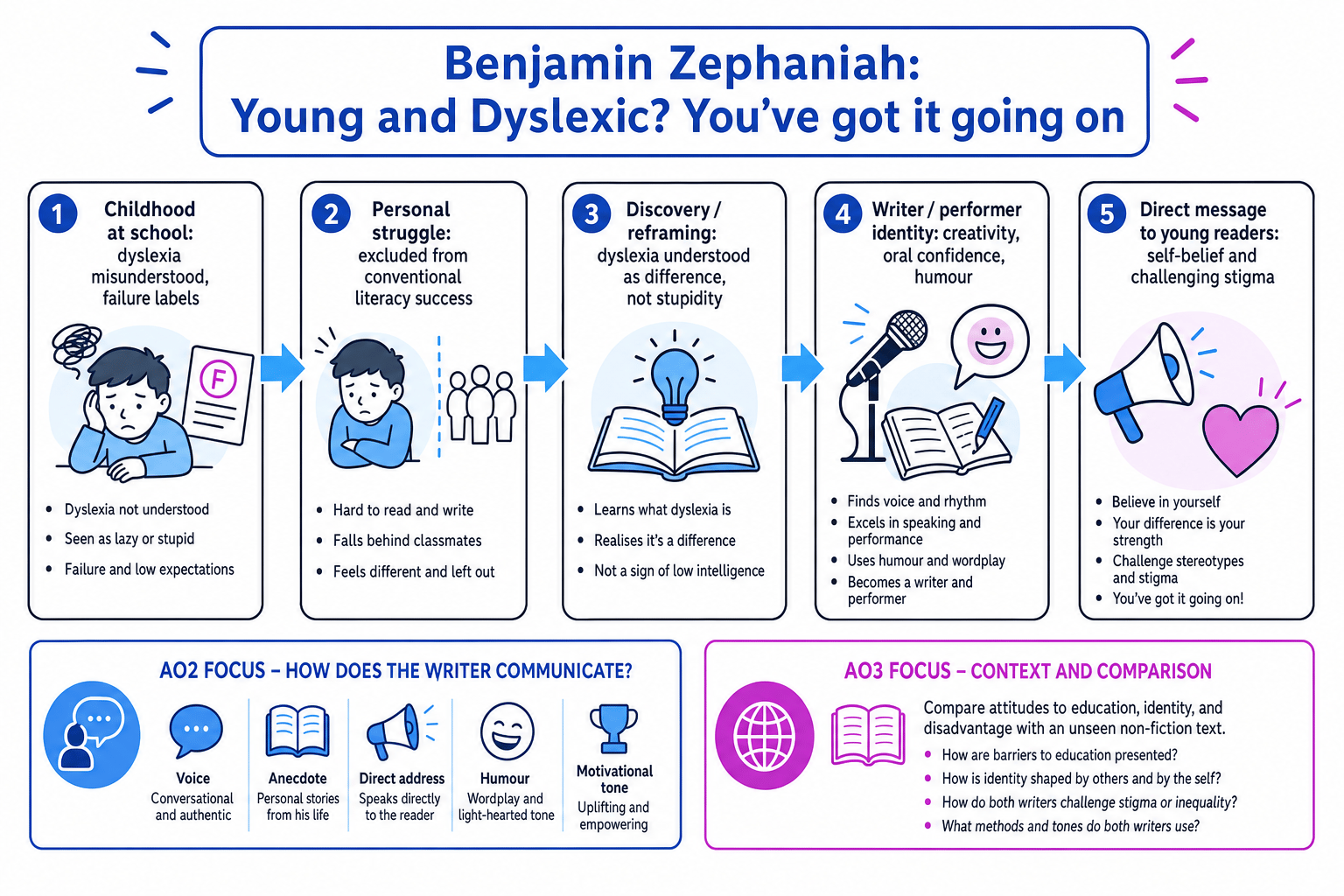
Benjamin Zephaniah writes about growing up with dyslexia, especially the way school treated him as if he had failed because he struggled with reading and writing. Instead of presenting dyslexia as something shameful, he reframes it as part of his identity and creative strength.
Dyslexia
Dyslexia is a learning difference that can affect reading, spelling, writing and processing written language. It is not a measure of intelligence.
The title gives you the whole argument in miniature. The question “Young and Dyslexic?” identifies a specific audience, while the upbeat phrase “You’ve got it going on” turns that label into something confident and positive.
The text moves from personal experience to encouragement: Zephaniah begins with his own difficulties, shows how misunderstanding harmed him, then speaks more widely to young dyslexic readers.
The big message
Zephaniah challenges the idea that dyslexia means failure. He argues that being different from the school “norm” can become a source of creativity, confidence and identity.
Themes to know
Education and failure
A theme is a central idea that runs through a text. Here, one major theme is the way education can make a young person feel like a failure when it does not understand their needs.
Zephaniah shows that the problem is not simply dyslexia itself, but the way others respond to it. School is presented as a place where narrow measures of success — especially reading, spelling and writing — can lead adults to misjudge a student’s intelligence.
This matters because the text criticises a system, not just individual teachers. Zephaniah’s experience becomes evidence that education should recognise different kinds of ability.
Self-belief and identity
Identity means your sense of who you are. Zephaniah’s article is about refusing to let other people’s labels define you.
The title’s direct confidence — “You’ve got it going on” — suggests that dyslexic young people should see themselves as capable and valuable. He presents dyslexia not as the whole of a person, but as one part of a wider identity that may include imagination, rhythm, performance, humour and original thinking.
Challenging stigma
Stigma
Stigma is a negative social label attached to a person or group, often unfairly making them feel ashamed or inferior.
Zephaniah challenges the stigma around dyslexia by writing openly and proudly. He uses his own success as a poet, performer and public figure to question the assumption that conventional school achievement is the only route to success.
Turning a theme into analysis
- Start with the idea that the text criticises education when it mistakes difference for failure.
- Connect that idea to Zephaniah’s personal narrative: he writes from lived experience, so the criticism feels authentic rather than abstract.
- Explain the effect: readers are encouraged to question labels such as “failure” and to see dyslexia as a difference that needs understanding, not shame.
Writer’s methods: how Zephaniah communicates
Direct address
Direct address
Direct address is when a writer speaks straight to the reader, often using second-person pronouns such as “you” or “your”.
The title directly addresses the reader: “Young and Dyslexic?” This sounds personal, as though Zephaniah is speaking to an individual student rather than writing a distant article.
The contraction “You’ve” is also informal and friendly. It helps create a supportive relationship between writer and reader.
Analysing direct address in the title
- The question “Young and Dyslexic?” immediately identifies the intended audience, making young dyslexic readers feel seen.
- The second-person form “You’ve” creates a direct, encouraging connection between Zephaniah and the reader.
- The phrase “got it going on” uses relaxed, confident slang, so dyslexia is framed positively rather than medically or negatively.
Colloquial and conversational voice
Colloquial language means informal, everyday language. Zephaniah’s voice often feels conversational, as if he is talking to the reader rather than delivering a formal lecture.
This suits his purpose. He wants to motivate young people, not intimidate them. A highly academic tone might make the article feel like the same education system that misunderstood him. Instead, the relaxed voice makes the message accessible.
Link voice to purpose
When you analyse Zephaniah’s informal voice, connect it to his purpose: he wants to reassure, empower and include young readers who may already feel judged by formal education.
Anecdote and personal experience
An anecdote is a short personal story used to make a point. Zephaniah’s own childhood experiences are important because they give the article emotional weight.
Rather than only saying “dyslexia is misunderstood”, he shows what misunderstanding feels like for a young person. This helps the reader understand the human impact of labels, low expectations and educational failure.
His personal experience also builds credibility. Because he has lived through the issue, his advice to young dyslexic readers feels earned.
Humour
Zephaniah uses humour and lightness to avoid making the article feel gloomy. This does not mean the topic is unserious. Instead, humour becomes a form of resistance: it helps him take control of the story and refuse shame.
In analysis, you can say that humour makes the text warmer and more memorable. It also supports the motivational tone.
Motivational tone
Tone means the writer’s attitude or mood. Zephaniah’s tone is encouraging, confident and uplifting. Even when he discusses difficult experiences, the overall direction of the text is towards hope.
This is important because the article is not just a complaint about the past. It is a message to present and future readers: do not accept narrow definitions of intelligence or success.
Naming a method without effect
Do not write only, “Zephaniah uses direct address.” Add what it does: it makes the reader feel personally included, reassured and encouraged to rethink dyslexia.
Structure: from personal story to public message
Structure
Structure is the way a writer organises a text: the order of ideas, shifts in focus, beginnings, endings and changes in tone or perspective.
The structure of this article is important because it mirrors Zephaniah’s journey. It moves from difficulty to understanding, and from personal experience to a wider message.
At first, the focus is on growing up with dyslexia and being misunderstood. Later, the focus widens: Zephaniah turns his story into encouragement for others. This creates a clear movement from pain to power.
Tracing the personal-narrative-to-message structure
- In the early part of the text, Zephaniah focuses on his own school experience, showing how dyslexia was misunderstood.
- In the middle, the meaning of dyslexia is reframed: it becomes a difference rather than proof of failure.
- By the end, the focus broadens to young dyslexic readers, so the article becomes motivational and collective rather than only autobiographical.
Key moments to remember
You do not need to memorise huge chunks of quotation. Short, accurate references are more useful.
Useful moments include:
- The title’s contrast between “Dyslexic” and “got it going on”, which turns a possible label into confidence.
- The descriptions of school misunderstanding, where difficulty with literacy is treated as failure.
- The shift from past struggle to present success, showing that school labels do not decide a person’s future.
- The direct message to young dyslexic readers, which makes the article feel supportive and purposeful.
Use short quotations
A short quotation like “Young and Dyslexic?” can be analysed closely. You can discuss the direct address, the question form, the named audience and the way the title sets up the article’s purpose.
How to compare this text with an unseen text
AO3 rewards you for exploring links and connections between writers’ ideas and perspectives. In Component 1 Section A, you may need to compare Zephaniah’s text with an unseen non-fiction text.
Do not just say both texts are “about education” or “about young people”. Compare the writers’ attitudes and methods.
For example, if the unseen text is about school, disability, identity or disadvantage, you could compare:
| Focus | Zephaniah’s text | Possible unseen connection |
|---|---|---|
| Education | School can misunderstand difference | Another writer may defend or criticise education |
| Identity | Dyslexia is reframed positively | Another writer may explore labels, confidence or belonging |
| Method | Personal anecdote and direct address | Another writer may use statistics, formal argument or emotional description |
| Tone | Motivational and conversational | Another text may be angry, reflective, serious or humorous |
Building an AO3 comparison
- Identify the shared concern: both writers may explore how young people are judged by others.
- Separate their perspectives: Zephaniah writes as someone who experienced dyslexia personally, while an unseen writer might write as a journalist, parent, teacher or campaigner.
- Compare methods: Zephaniah’s direct address and anecdote create intimacy; another writer might use facts, expert opinion or a more formal tone.
- Link effects: Zephaniah mainly empowers the reader, whereas the unseen text might aim to inform, criticise, persuade or provoke sympathy.
A short model paragraph
Zephaniah presents dyslexia as something that should not limit a young person’s identity. The title directly addresses the reader through “Young and Dyslexic?”, making the article feel personal and inclusive from the start. However, the second half of the title, “You’ve got it going on”, uses colloquial language to create a confident and encouraging tone. This challenges the stigma around dyslexia because the phrase sounds celebratory rather than apologetic. As a result, Zephaniah immediately reframes dyslexia from a possible source of shame into a sign of individuality and potential.
In the exam
- Start with the writer’s idea or attitude, not just the method: for example, “Zephaniah challenges the idea that dyslexia equals failure.”
- Use short quotations from the title or key moments, then zoom in on individual words or phrases.
- For AO3 comparison, compare both what the writers think and how they communicate it: voice, tone, structure, evidence and audience.
Check yourself
- How does the title immediately create a positive message for young dyslexic readers?
- Why is Zephaniah’s personal experience important to the article’s impact?
- How could you compare Zephaniah’s conversational tone with a more formal unseen text?
