What you'll learn
- How Emma Levine presents a fast, chaotic donkey race as exciting, funny and unfamiliar.
- How to analyse her language, structure and tone for AO2.
- How to explain the writer’s outsider perspective without sounding judgemental.
- How this anthology text can be compared with an unseen non-fiction text for AO3.
Where this text fits in the course
A Game of Polo with a Headless Goat is one of the Part 1 non-fiction anthology texts for Pearson Edexcel International GCSE English Language A. You study it for Component 1: Non-fiction Reading and Transactional Writing, which is worth 60% of the qualification.
In Component 1 Section A, you read one anthology text and one unseen non-fiction text. Section A is worth 45 marks and rewards AO1, AO2 and AO3.
Non-fiction
Non-fiction is writing based on real people, places, events or experiences. This extract is travel writing: Levine describes an experience from her travels and shapes it to entertain, inform and reflect.
Quick summary of the extract
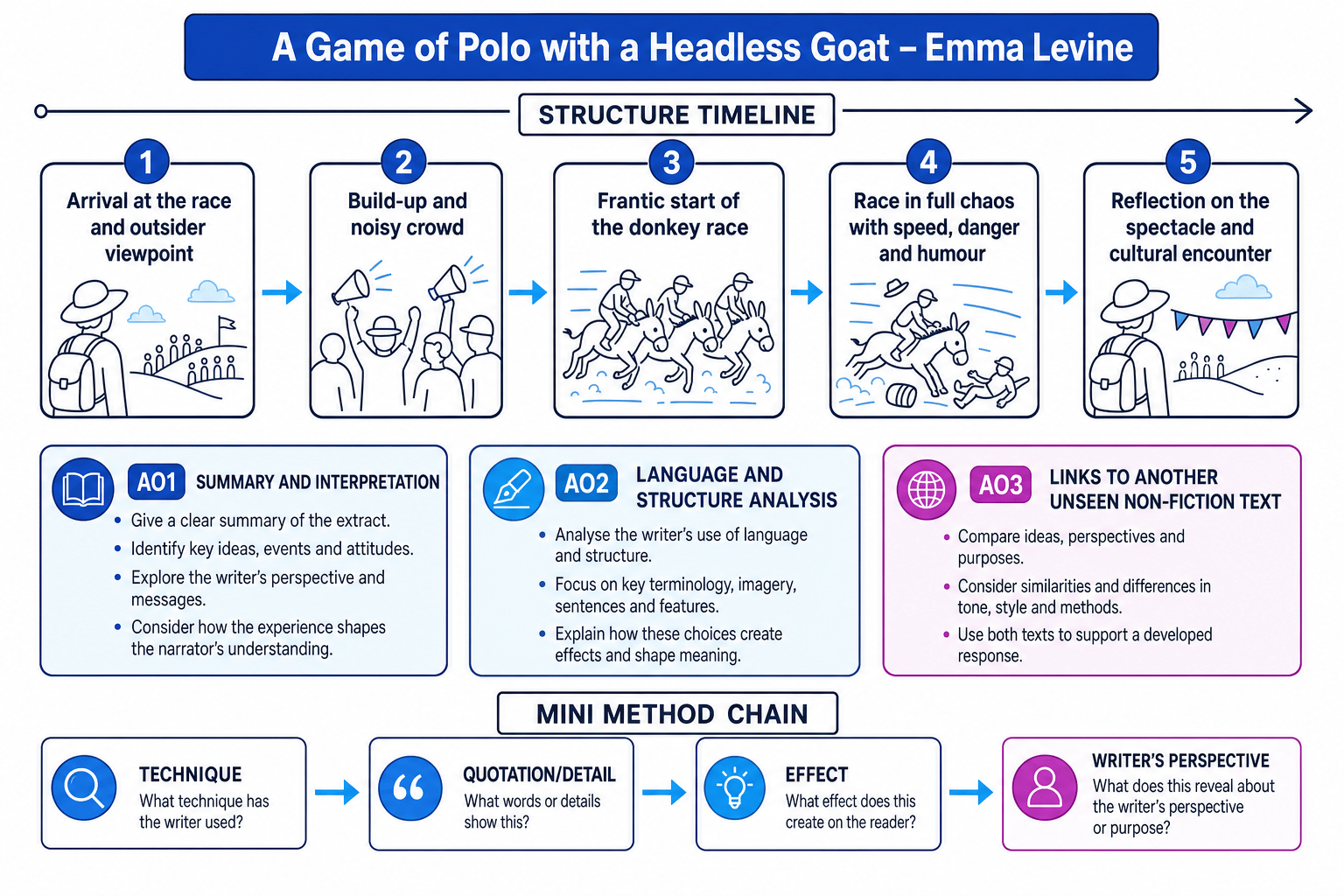
Emma Levine describes watching an unusual traditional sport: a donkey race in Asia. The race is not presented like a tidy, controlled sporting event. Instead, it feels noisy, crowded, dusty, dangerous and thrilling.
Levine writes as an outsider: she is fascinated by what she sees, but she is also surprised by it. The extract builds energy as the race begins, speeds up, becomes chaotic, and turns into a vivid spectacle.
Core idea
The extract is not just “about a donkey race”. It is about the excitement of encountering a different culture and trying to capture the speed, danger and humour of that experience in words.
The writer’s perspective
Perspective
A writer’s perspective is their viewpoint: what they notice, how they feel about it, and the attitude they encourage the reader to share.
Levine’s perspective is that of a curious traveller. She is not completely at home in the culture she observes, so she often notices things that might seem ordinary to local spectators. This creates a sense of cultural difference.
However, you should be careful: Levine is not simply mocking the event. Her humour comes from amazement, surprise and the sheer strangeness of the scene from her point of view. She also presents the race as skilful, energetic and exciting.
Making the writer sound superior
Do not write as if Levine thinks the sport is “stupid” or “backward”. A stronger answer explains that she finds it unfamiliar, chaotic and funny, but also thrilling and impressive.
Main themes
Cultural difference
The race seems unusual to Levine because it does not match the controlled, organised sports culture many readers might expect. The title itself, with the shocking phrase “headless goat”, prepares us for a world of unfamiliar customs and startling images.
This theme is useful for AO3 comparison. If the unseen text also presents travel, culture or an unusual place, you can compare how each writer responds to difference: with fear, admiration, confusion, humour, criticism or wonder.
Spectacle and excitement
Spectacle
A spectacle is an impressive or striking event that people gather to watch.
Levine presents the race as a public performance. The crowd, the noise, the movement and the danger all make the experience feel larger than an ordinary race. The reader is placed in the middle of the action, almost as if watching through a camera.
Chaos and danger
The race feels uncontrolled. The donkeys, racers, vehicles and crowd create a sense of disorder. This danger is part of the excitement: the reader enjoys the scene because it feels unpredictable.
Humour
The humour often comes from contrast. Donkeys are usually associated with slowness and stubbornness, but here they become racing animals. That unexpected contrast makes the event comic, while the frantic pace keeps it exciting.
Language methods
Dynamic verbs
Dynamic verb
A dynamic verb is an action word that suggests movement, energy or change, such as verbs of rushing, pushing, crashing or swerving.
Levine’s action description makes the race feel fast and unstable. Instead of calmly explaining every rule, she focuses on movement. This helps the reader feel the event rather than simply understand it.
When analysing this, avoid just saying “the verbs make it exciting”. Explain what kind of excitement: sudden, chaotic, dangerous, comic, competitive or breathless.
Turning movement into AO2 analysis
-
Choose a detail that shows movement, such as Levine’s focus on racing, crowding or sudden action.
-
Link the movement to the reader’s experience: the description makes the reader feel rushed and surrounded, as if there is no time to pause.
-
Connect this to the writer’s perspective: Levine’s fast-moving description shows both her excitement and her lack of control as an outsider caught up in the event.
Sensory detail
Sensory detail
Sensory detail is description that appeals to the senses: sight, sound, smell, taste or touch.
Levine’s description is vivid because it is physical. The reader can imagine the noise, dust, speed and crowd pressure. This makes the race feel immersive.
Sound is especially important in a race scene because it suggests energy and disorder: cheering, shouting, animal movement and traffic-like noise can all make the atmosphere feel overwhelming.
Analyse the senses precisely
Instead of writing “this creates imagery”, name the sense: auditory imagery for sound, visual imagery for sight, or tactile imagery for touch and physical sensation.
Humorous contrast
Levine uses humour by placing unexpected ideas together. The title’s “polo” suggests a formal, perhaps elite, sport, while “headless goat” is shocking and grotesque. In the extract, the donkey race similarly overturns expectations: a humble animal becomes part of a dramatic sporting spectacle.
Analysing the title’s contrast
-
Notice the contrast between “polo”, which suggests order, rules and tradition, and “headless goat”, which suggests violence, shock and unfamiliarity.
-
Explain the effect: the title immediately makes the reader curious because it combines the recognisable with the bizarre.
-
Link to the extract: this prepares us for Levine’s travel-writing style, where cultural difference is presented as surprising, energetic and memorable.
Lists and accumulation
Accumulation
Accumulation is the building up of many details, often in a list, to create a strong overall impression.
In a chaotic scene, lists can make the reader feel crowded by detail. If Levine piles up images of people, animals, vehicles, movement or noise, the sentence itself begins to feel packed and breathless.
This is a strong AO2 point because it connects a structural-language choice — the piling up of detail — to the meaning: the race is not neat or controlled; it is overwhelming.
Structure: how the extract builds pace
Structure
Structure means how a text is organised: the order of events, shifts in focus, paragraphing, openings and endings, and changes in pace.
The extract follows a broadly chronological structure: it moves through the experience in the order it happens. This is important because it allows the race to build naturally.
Stage 1: Set-up
At first, Levine establishes the situation. The reader needs to understand where she is and what kind of event she is watching. This stage creates curiosity.
Stage 2: Build-up
The atmosphere intensifies. The crowd, setting and anticipation prepare the reader for action. This works like the moments before a race starts: tension gathers.
Stage 3: The race begins
The pace quickens. Sentences may become more urgent, and the focus shifts from explanation to action. The reader is no longer calmly learning about the event; they are experiencing it.
Stage 4: Chaos in motion
The middle of the race is the most energetic part. Levine’s writing may feel crowded, fast and unstable, matching the scene itself.
Stage 5: Reflection
After the intensity, the writing can step back slightly. This allows Levine’s perspective to come through: she has witnessed something strange, funny, dangerous and memorable.
Structure mirrors experience
The structure moves from curiosity to anticipation to chaos, so the reader experiences the race as Levine experiences it: first as an observer, then almost as a participant.
Tone
Tone
Tone is the attitude or mood created by the writer’s language, such as amused, anxious, excited, critical or reflective.
The tone of this extract is mixed, which makes it interesting. It is:
- Amused, because the event is unusual and full of comic contrasts.
- Excited, because the race is fast and unpredictable.
- Overwhelmed, because the scene is crowded and noisy.
- Respectful, because the skill and energy of the racers are clear.
A top answer will not reduce the tone to one word. It will show how the tone changes as the race develops.
Key moments to remember
The unusual title
The title is memorable because it combines sport with shock. It signals that this travel writing will take the reader into unfamiliar cultural territory.
The first impression of the race
Levine’s early observations establish her outsider status. She has to make sense of what she is seeing, and the reader learns through her reactions.
The race in full speed
This is the extract’s central action sequence. Focus on language of movement, noise, crowding and danger.
The comic energy of the scene
The race is not presented as solemn. Its strangeness and speed create humour, but that humour sits alongside real admiration.
How to write about this text for AO1, AO2 and AO3
AO1: understand and interpret
For AO1, show that you understand what happens and what Levine feels about it. Do not retell the whole extract. Select the details that best support your point.
A useful AO1 sentence might be:
Levine presents the race as a chaotic but thrilling cultural experience, showing her surprise as an outsider while also communicating her fascination with the event.
AO2: analyse methods
For AO2, focus on how Levine creates effects through language and structure. Use terminology only when it helps.
Strong AO2 phrases include:
- “The dynamic verbs create a sense of sudden movement…”
- “The sensory detail immerses the reader in the noise and dust…”
- “The accumulation of details makes the scene feel crowded…”
- “The shift from build-up to action increases the pace…”
Feature spotting
Do not write: “Levine uses verbs and adjectives.” Instead, explain how specific choices shape the reader’s view of the race and of Levine’s experience.
AO3: compare with the unseen text
AO3 asks you to explore links and connections between texts. In Component 1 Section A, this often means comparing the anthology text with an unseen non-fiction extract.
You might compare:
- how both writers present unfamiliar places or cultures;
- whether the tone is excited, fearful, critical, humorous or reflective;
- how each writer uses sensory description;
- how each text structures a journey or experience;
- whether the writer feels like an outsider or insider.
Comparing perspectives
-
Identify Levine’s perspective: she presents the race as unfamiliar and chaotic, but also exciting and impressive.
-
Identify the unseen writer’s perspective: decide whether they respond to their experience with admiration, anxiety, criticism, humour or curiosity.
-
Compare the methods: for example, Levine may use fast-paced action and sensory detail, while the unseen writer might use calmer reflection or more direct argument.
-
Link the comparison to purpose: Levine’s purpose is to entertain and immerse the reader in a travel experience; the unseen writer’s purpose may be to inform, persuade, describe or reflect.
A simple paragraph structure
Use this when writing about Levine’s methods:
- Point: Make a clear claim about what Levine presents.
- Evidence: Use a short quotation or precise reference.
- Method: Name the technique if useful.
- Effect: Explain what the reader imagines, feels or understands.
- Perspective: Link back to Levine’s attitude as an outsider traveller.
A model sentence pattern:
Levine presents the race as both comic and thrilling. The shocking contrast in the title, “polo” and “headless goat”, immediately combines the familiar with the bizarre. This prepares the reader for a travel experience in which cultural difference is presented as surprising, energetic and memorable.
In the exam
-
Start with Levine’s overall perspective: she is fascinated, amused and overwhelmed by the race.
-
For AO2, analyse the effect of language and structure, especially movement, sensory detail, humour and pace.
-
For AO3, compare attitudes and methods, not just subject matter: ask how each writer presents experience, culture, danger or excitement.
Check yourself
- Can you explain why the donkey race is presented as both funny and dangerous?
- Which language methods make the scene feel fast, noisy and chaotic?
- How could you compare Levine’s outsider perspective with an unseen travel text?
