What you'll learn
- What happens in the anthology extract from Aron Ralston’s Between a Rock and a Hard Place.
- How Ralston uses first-person narration, physical detail, technical language and pacing to create tension.
- How to write about the extract for AO1, AO2 and AO3 in Component 1 Section A.
- How to avoid simple “he is scared” answers and build sharper analysis.
Where this text fits in the course
This is one of the Part 1 non-fiction anthology texts for Pearson Edexcel International GCSE English Language A.
In the full qualification, Component 1 is worth 60% and includes Section A: Non-fiction Reading, worth 45 marks, plus Section B: Transactional Writing, worth 45 marks. Component 2 or Component 3 makes up the remaining 40%.
For this text, you mainly need to show:
- AO1: you understand what is happening and can select relevant evidence.
- AO2: you can analyse how Ralston uses language and structure.
- AO3: you can compare his ideas and perspective with an unseen non-fiction text.
Quick summary of the extract
Aron Ralston is canyoneering alone in a remote canyon in Utah. As he moves through the narrow space, a boulder shifts and traps his arm against the canyon wall. The extract presents the terrifying moment of entrapment and the beginning of his struggle to survive.
The situation is extreme: he is physically trapped, isolated from help, and forced to think clearly under huge pressure. Ralston’s writing makes the reader feel both the shock of the accident and the strange calmness needed for survival.
Non-fiction memoir
A memoir is a non-fiction text in which a writer recalls real experiences from their own life. It is factual, but it can still use vivid description, suspense and carefully shaped structure.
The central situation: trapped and alone
The power of the extract comes from a simple but frightening situation: a person is stuck in a place where normal help cannot reach him.
Ralston is not in danger because of an enemy or villain. He is trapped by landscape, rock, distance and time. That makes the danger feel especially cold and unavoidable. Nature is not “trying” to hurt him, but it is still deadly.
The title Between a Rock and a Hard Place also works on two levels. Literally, Ralston is trapped by a rock in a canyon. Figuratively, the phrase means being stuck between two terrible choices.
The big idea
Ralston presents survival as a battle between panic and control: his body is trapped, but his mind keeps trying to understand, calculate and endure.
Key moments to remember
You do not need to memorise the whole extract word for word, but you should know the main movement of the narrative.
1. Movement through the canyon
At first, Ralston appears experienced and physically capable. He notices the landscape, the rock formations and the practical problem of moving through the canyon.
One important term is chockstone: a rock wedged between the walls of a narrow canyon. Ralston refers to a “chockstone”, and the technical term helps make the account feel authentic.
Technical detail
Technical detail means specialised or precise information linked to a particular activity, subject or environment. In this extract, climbing and canyoning details show Ralston’s expertise and make the danger feel real.
2. The boulder shifts
The accident happens suddenly. Ralston’s ordinary movement turns into crisis as the rock moves and traps him. This sharp change is important structurally because it breaks the reader’s sense of safety.
3. Time seems to slow down
Ralston writes that “The next three seconds play out at a tenth of their normal speed.” This is one of the extract’s most useful quotations because it shows how trauma changes perception.
The moment lasts only seconds in real time, but Ralston expands it in the narration so the reader experiences the shock with him.
4. Panic becomes calculation
After the first shock, Ralston begins to assess the situation. This shift matters: he does not become fearless, but he tries to become logical. That contrast between terror and thoughtfulness is one of the most important features of the extract.
Structure: how tension is built
The extract is structured like a tightening trap. It begins with movement, then sudden accident, then a slowed-down moment of impact, then the dreadful realisation that escape will not be simple.
This timeline is useful because it shows how Ralston controls pace: some moments are quick and shocking, while others are slowed down and analysed.
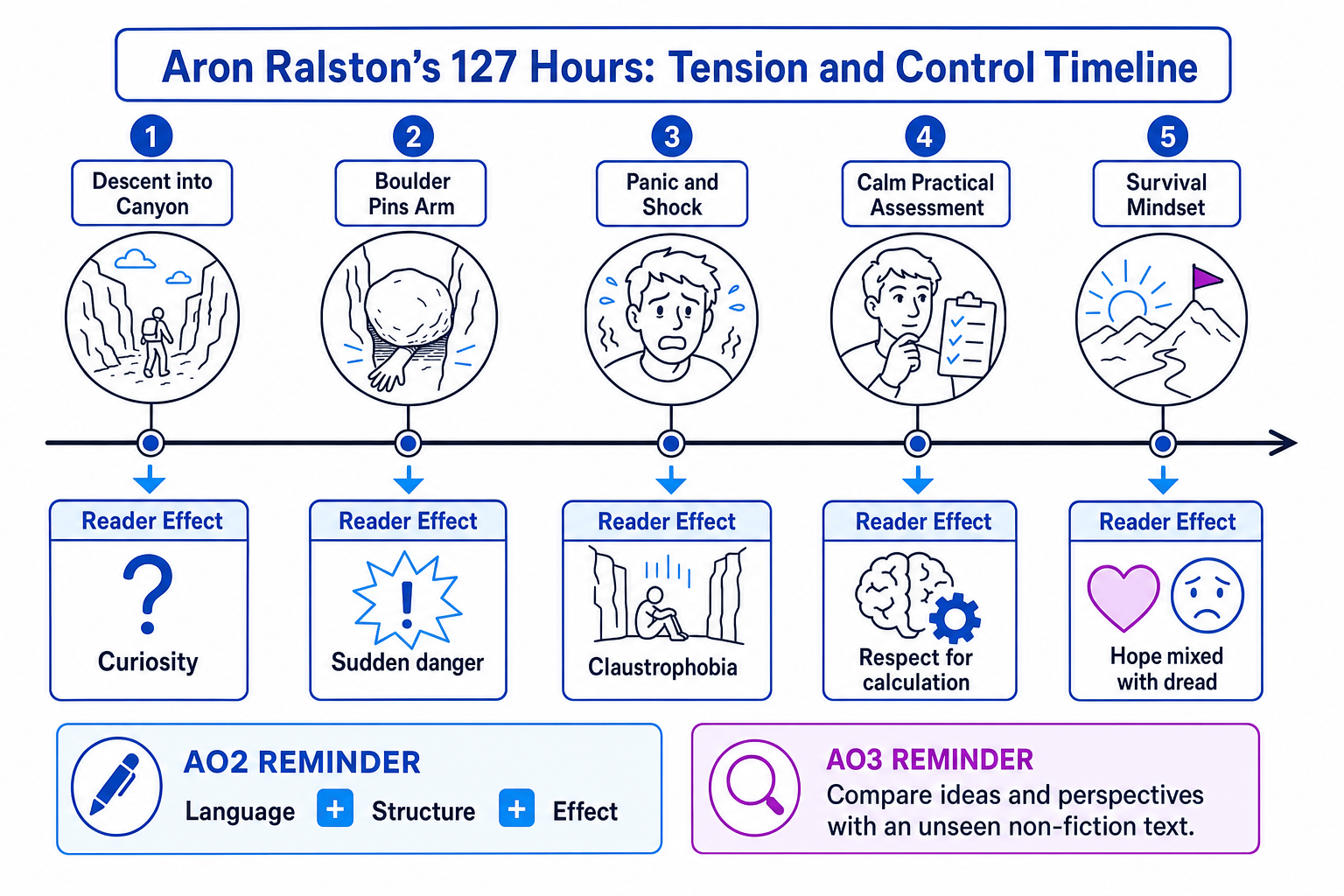
Pacing
Pacing means the speed at which events are presented in a text. Writers can speed up action with short, rapid events, or slow it down by adding detail, reflection and description.
Why the pacing works
The slowed-down accident makes the reader feel trapped inside Ralston’s perception. Instead of simply saying, “the rock fell,” he stretches the moment. This creates suspense because the reader understands what is happening before the full consequences have settled.
Analysing slowed-down time
- Start with the quotation: Ralston says, “The next three seconds play out at a tenth of their normal speed.”
- Identify the method: he uses time distortion, making a very brief moment feel unnaturally long.
- Link method to effect: this suggests shock, because extreme fear can make the mind focus intensely on tiny details.
- Connect to the wider text: the slowed pacing makes the reader experience the accident almost in real time, creating tension and sympathy for Ralston.
- Turn it into analysis: Ralston slows the moment of impact so that the accident feels unavoidable and horrifying, showing how quickly control can be lost in a hostile environment.
Language: first-person immediacy
Ralston writes from a first-person perspective, using “I” to tell his own experience. This is crucial because the reader is locked into his viewpoint.
First-person narration
First-person narration is when a writer tells events using pronouns such as “I”, “me” and “my”. It can create intimacy because the reader experiences events through the narrator’s mind and senses.
The first-person voice makes the extract feel immediate and personal. We do not watch the accident from a safe distance; we experience his confusion, pain and decision-making from inside the crisis.
Retelling instead of analysing
A weak answer says, “He gets trapped and is scared.” A stronger answer explains how Ralston makes us feel the fear, such as through first-person narration, slowed pacing, technical detail and physical description.
Physical detail: the body under pressure
Ralston’s writing often focuses on the body: hands, arms, pressure, movement and pain. This makes the danger concrete. The reader understands that survival is not abstract; it is physical and immediate.
The physical detail also creates claustrophobia. The canyon is narrow, the rock is heavy, and Ralston’s body is pinned in place. The setting becomes part of the threat.
Why this matters for AO2
For AO2, do not just name a technique. Explain how the language makes meaning.
For example, if you write about physical detail, ask:
- Which part of the body is being described?
- What does the detail make the reader imagine?
- Does it show pain, panic, helplessness, control, or endurance?
- How does it connect to the theme of survival?
Technical detail: expertise under pressure
Ralston’s use of technical language shows that he is not careless or foolish. He understands the landscape and the activity. That makes the accident more frightening, because even an experienced person can be overwhelmed by nature.
The technical detail also helps create a calm, almost clinical tone at points. Ralston can sound like he is reporting or assessing the problem, even though the situation is terrifying.
A useful interpretation
When Ralston uses precise technical or physical detail, you can argue that it shows both control and vulnerability: he understands the situation clearly, but understanding it does not automatically free him.
Tone: panic, shock and calm calculation
Tone
Tone means the attitude or emotional feeling created by the writer’s language. In this extract, the tone shifts as Ralston moves from action to shock to survival thinking.
The tone is not the same all the way through. At different points, it can feel:
- confident, when Ralston is moving through the canyon;
- shocked, when the accident happens;
- claustrophobic, as the reader realises he is trapped;
- controlled, when he begins assessing his situation;
- grimly determined, as survival becomes the focus.
This shifting tone is important because it stops the extract from becoming one-note. Ralston is frightened, but he is also practical. He is vulnerable, but not passive.
Themes in the extract
Endurance
Ralston’s survival depends on continuing to think and act even when the situation seems hopeless. Endurance here is mental as well as physical.
Isolation
He is alone in a remote canyon. This isolation increases the tension because there is no immediate rescuer, no easy communication, and no quick escape.
The will to live
The extract presents the will to live as something practical, not sentimental. It is shown through observation, calculation and attempts to survive.
Human limits
Ralston’s body has limits. His knowledge has limits. His control over nature has limits. The extract is powerful because it shows a capable person meeting a situation that is bigger than him.
Theme link
The extract is not simply about “being brave”. It is about how a human mind responds when the body is trapped and ordinary choices disappear.
How to write about this extract
A strong paragraph usually moves from idea, to evidence, to method, to effect. You can use this structure for AO1 and AO2, and then extend it for AO3 when comparison is required.
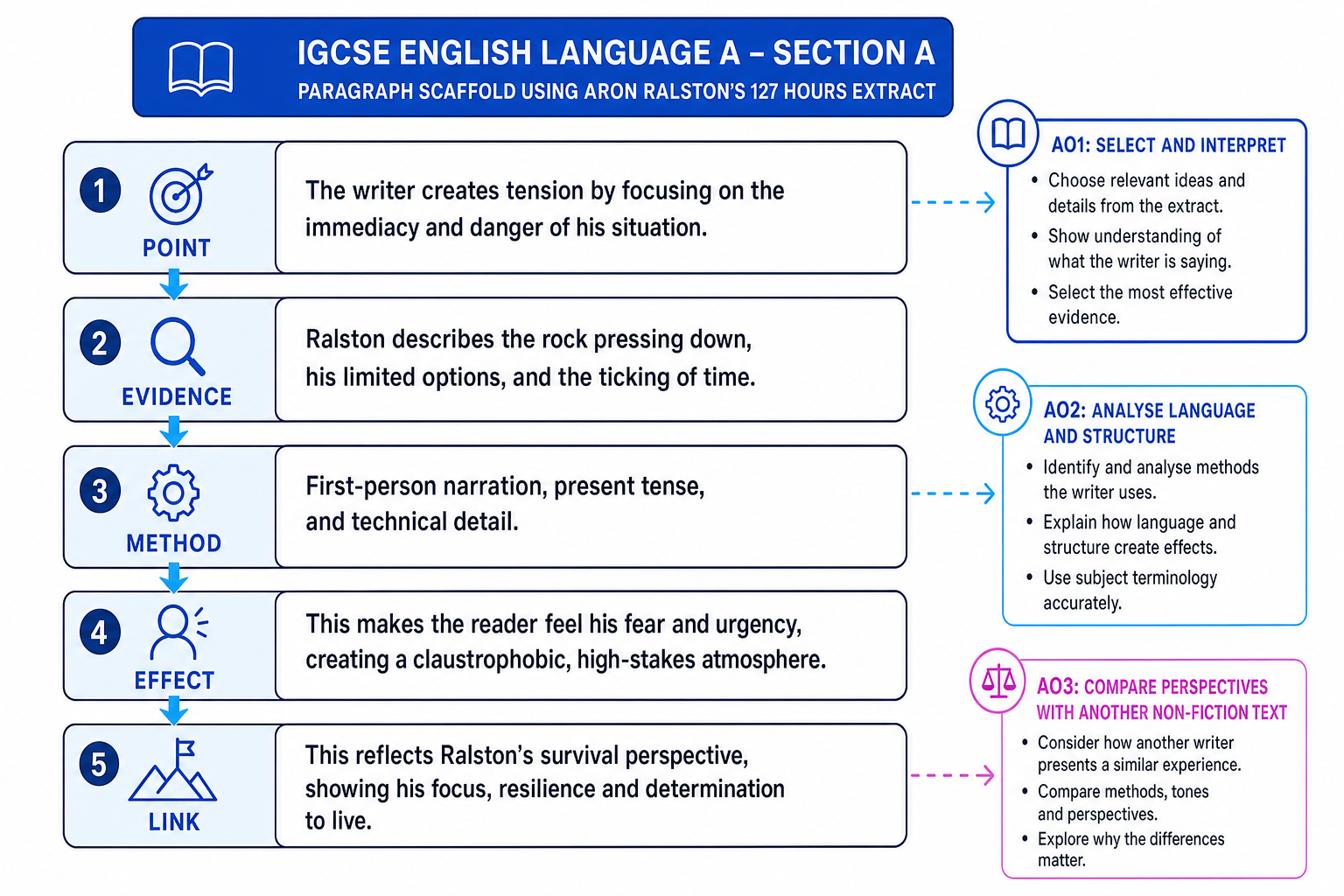
A model analytical move
You might write:
Ralston creates tension by slowing down the moment of accident. When he says that “The next three seconds play out at a tenth of their normal speed,” the precise reference to time shows how shock changes his perception. The structure stretches a brief moment into something terrifyingly slow, making the reader feel the danger as if it is unfolding in front of them. This also introduces one of the extract’s central ideas: survival begins with the mind trying to process what the body is suffering.
Notice that this paragraph does not just spot a quotation. It explains what the method does.
AO3: comparing Ralston with another non-fiction text
In Component 1 Section A, you may need to compare this anthology text with an unseen non-fiction extract. AO3 rewards links and connections between writers’ ideas and perspectives.
For Ralston, useful comparison points include:
- how danger is presented;
- whether the writer is alone or with others;
- whether the tone is emotional, factual, reflective or urgent;
- whether nature is presented as beautiful, hostile, indifferent or powerful;
- how the writer presents human resilience.
Do not force comparison
For AO3, do not write, “Both texts use adjectives.” That is too vague. Compare ideas and perspectives first, then use methods to support the comparison.
A good comparison might say that Ralston presents danger as immediate and physically trapping, while another writer might present danger as distant, remembered or shared by a group. Then you can compare how each writer’s tone and structure shape the reader’s response.
Quotations to keep in mind
Use short quotations accurately. You do not need long chunks.
Useful brief evidence includes:
- “chockstone” — shows technical precision and the canyon environment.
- “The next three seconds play out at a tenth of their normal speed” — shows shock, slowed pacing and time distortion.
- References to his trapped hand, arm or wrist — useful for physical detail and vulnerability.
Using quotations without explanation
Do not drop in a quotation and move on. After evidence, always explain the method and effect: what does the quotation make the reader understand, feel or question?
In the exam
- Start by making sure you understand the situation: Ralston is alone, trapped, injured and forced into survival thinking.
- For AO2, analyse methods such as first-person narration, pacing, physical detail, technical vocabulary and tonal shifts.
- For AO3, compare perspectives on danger and survival, not just individual words or techniques.
Check yourself
- How does Ralston make a short accident feel slow and tense?
- Why is the technical detail important to the reader’s view of him?
- What comparison could you make between Ralston’s isolation and another writer’s experience of danger?
