What you'll learn
- What happens in this extract and why it is unsettling.
- How Susan Hill builds suspense through setting, sound, mist and uncertainty.
- Key themes: fear, isolation, the supernatural and the unknown.
- How to write about the extract for AO1 and AO2 in Component 2 Section A.
1. Big picture: what is this extract about?
This prose extract comes from Susan Hill’s gothic novel The Woman in Black. The narrator is Arthur Kipps, a young solicitor who has been sent to Eel Marsh House to deal with the papers of the dead Mrs Drablow.
In this section, Arthur is isolated at Eel Marsh House. The house is cut off from the mainland by marshes and the causeway, and the natural world around him becomes increasingly threatening. Sounds, mist and darkness make him feel that something unseen is close by. Hill does not immediately explain everything, so the reader shares Arthur’s uncertainty.
For Edexcel IGCSE English Language A, this text belongs to Anthology Part 2 and can be assessed in Component 2 Section A, which is worth 30 marks. Your main focus is AO1, showing clear understanding and using evidence, and AO2, analysing language and structure.
First-person narrator
A first-person narrator tells the story using “I”. This means the reader only knows what that narrator sees, hears, thinks and feels.
Core idea
Hill makes fear grow because Arthur is not only physically isolated at Eel Marsh House; he is also mentally trapped by what he cannot understand.
2. Summary of the extract
Arthur is alone in a remote, hostile place. Eel Marsh House already feels cut off from ordinary life because of its location on the marshes. As the mist gathers, the landscape becomes harder to read. Sounds seem more alarming because Arthur cannot clearly see their source.
The title, “Whistle and I’ll Come to You”, also suggests a frightening call-and-response pattern: if someone whistles, something may come. That “something” is not comforting or fully explained. Hill uses this uncertainty to create suspense.
By the end of the extract, the important feeling is not simply “a ghost appears”. It is more subtle than that: Arthur senses a presence. The fear comes from atmosphere, suggestion and the possibility that the supernatural is near.
3. The gothic setting
Gothic
Gothic writing often uses dark or isolated settings, mystery, fear, death, the past and supernatural forces. The setting usually feels emotionally charged, not just decorative.
Eel Marsh House is a classic gothic setting. Even the name “Eel Marsh House” sounds unsettling. “Marsh” suggests wet, unstable ground, while “house” should suggest safety and shelter. Hill puts those ideas together, so the home becomes threatening rather than comforting.
The house is also cut off. This matters because isolation removes help, witnesses and ordinary explanations. Arthur cannot simply step back into normal society. The setting becomes a trap.
Analysing the setting
-
Start with the place name: “Eel Marsh House” combines something domestic, “House”, with something unstable and bleak, “Marsh”.
-
Link that detail to genre: in gothic writing, houses often store secrets from the past, so the setting feels as if it has a history Arthur does not yet understand.
-
Explain the effect on the reader: because Arthur is cut off in a strange place, the reader expects danger before anything openly supernatural happens.
4. Themes in the extract
Fear and the supernatural
The supernatural means events or beings that seem beyond normal human explanation, such as ghosts. Hill’s ghost story is effective because she does not rely only on direct horror. Instead, she makes ordinary things — a house, a sound, mist — feel abnormal.
Arthur’s fear develops gradually. At first, he tries to understand what is happening rationally. However, the more he listens and watches, the less secure he feels. This makes the supernatural more convincing because it seems to invade the real world slowly.
Isolation
Isolation is both physical and emotional. Arthur is physically separated from other people by the marshland and the causeway. He is emotionally isolated because he cannot fully share or confirm what he experiences.
This links strongly to the first-person narration. We are trapped inside Arthur’s perceptions. If he is unsure, we are unsure too.
The power of the unknown
Hill understands that what is hidden can be more frightening than what is shown. The mist prevents clear vision. Strange sounds cannot immediately be explained. The reader has to imagine what might be there.
That is why the unknown is so powerful in this extract: the reader’s imagination becomes part of the horror.
The gothic past
Although this extract focuses on Arthur’s immediate experience, it also hints at a larger, darker history connected to the house and the woman in black. Gothic stories often suggest that the past has not stayed buried. It returns, haunts and disturbs the present.
5. How Hill builds suspense
Suspense means a feeling of anxious waiting: the reader senses that something may happen, but does not yet know what. Hill builds suspense in layers rather than through one sudden shock.
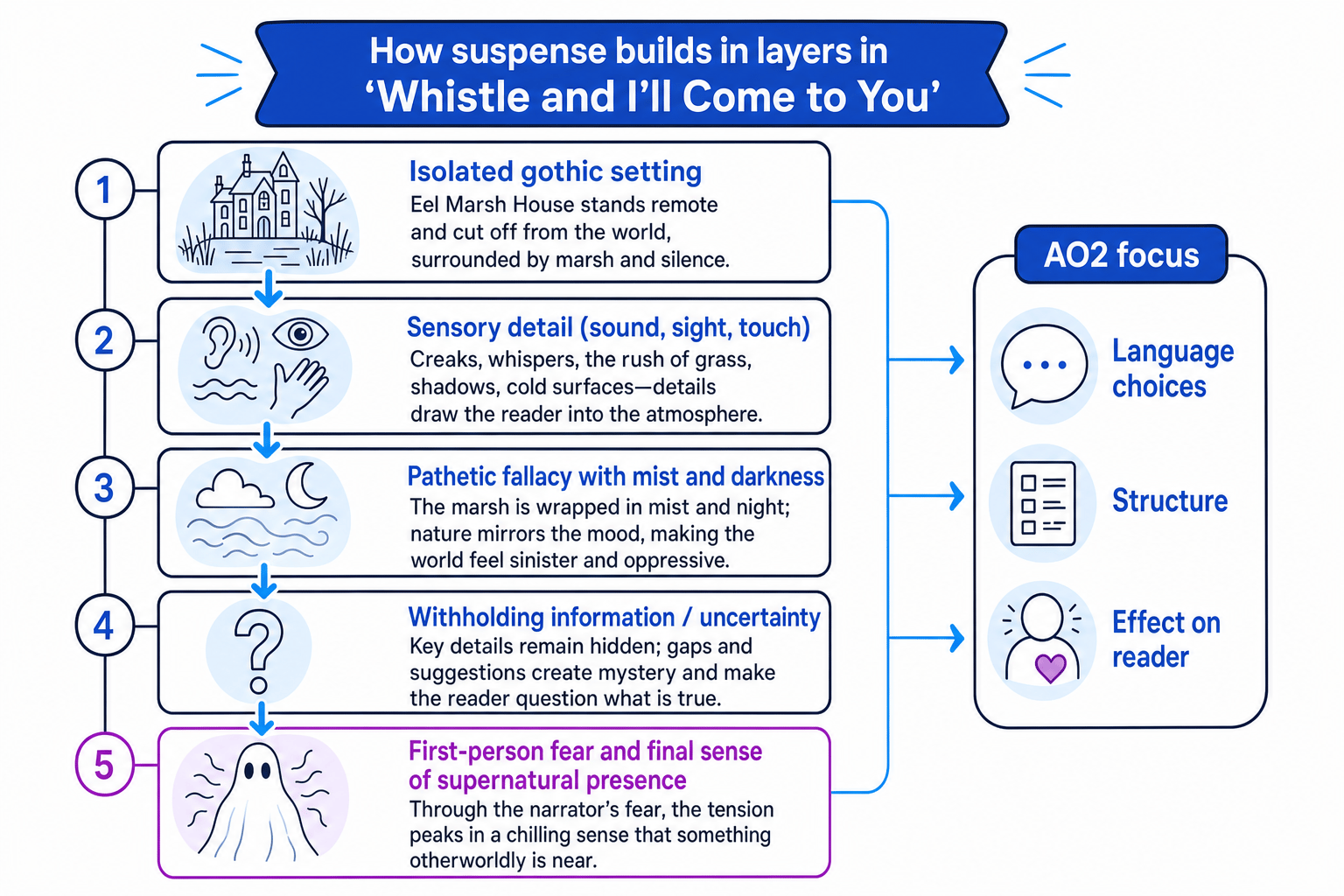
Sensory description
Sensory description is writing that appeals to the senses: sight, sound, touch, smell or taste. In this extract, sound is especially important. The title word “Whistle” immediately draws attention to hearing.
This matters because sound can be frightening when its source is hidden. If Arthur cannot see clearly through the mist, then a noise becomes more powerful. He has to interpret it without enough information.
AO2 shortcut
When analysing Hill’s suspense, ask: What sense is being used, and why does that sense make Arthur less secure? Sound often increases fear because it proves something is nearby without revealing exactly what it is.
Pathetic fallacy
Pathetic fallacy
Pathetic fallacy is when the weather or natural world reflects, intensifies or seems to respond to human emotions.
The mist and darkness are not just background details. They create a mood of confusion and threat. The “mist” makes the world less visible, so it reflects Arthur’s uncertain state of mind. He cannot see clearly, and he cannot understand clearly.
Hill uses the landscape almost like a living force. The natural world seems to close in on Arthur, making the supernatural feel as if it belongs to the setting.
Withholding information
Withholding information means deliberately delaying explanation. Hill does not immediately tell the reader exactly what is making a sound, what Arthur has sensed, or what the ghostly presence fully means.
This is important for AO2 because it is a structural method, not just a language choice. The order of information controls the reader’s fear.
Only saying 'it creates tension'
Do not stop at “this creates tension”. Explain how: Hill withholds clear information, so the reader shares Arthur’s uncertainty and imagines threats that may be worse than anything directly described.
Imagery and atmosphere
Imagery means descriptive language that creates a picture or sensory impression in the reader’s mind. Hill’s imagery is atmospheric because it builds a whole mood, not just a single image.
The house, marshes, mist and sounds all work together. The effect is cumulative: each detail adds another layer of unease. This is why the extract feels slow but gripping. Hill is not rushing; she is making dread gather.
6. Structure and form
Structure means how a text is organised: the order of events, shifts in focus, pacing and beginnings/endings. Form means the type of writing and its conventions; here, it is a first-person gothic prose narrative.
The extract’s structure moves from setting and observation towards fear and supernatural suggestion. Hill often begins with details that seem realistic, then makes them increasingly strange. This gradual movement is important because it makes the haunting feel believable.
The first-person form also limits what we know. Arthur cannot explain everything, so the reader cannot either. This narrow viewpoint keeps the suspense alive.
Explaining the structure of dread
-
Notice the opening focus on place: Arthur is positioned in an isolated setting, so the reader understands that escape and help are limited.
-
Track the shift into sensory unease: mist and sound make the setting harder to interpret, so ordinary perception becomes unreliable.
-
Connect the ending to the overall effect: the sense of a ghostly presence feels more frightening because Hill has slowly prepared the reader for something unseen.
7. Tone and key moments
Tone means the mood or attitude created by the writing. In this extract, the tone is tense, watchful and increasingly fearful.
Key moments to remember include:
- Arthur’s isolation at Eel Marsh House.
- The mist making the marshland feel threatening.
- Sounds that seem to come from somewhere unseen.
- The growing sense that a supernatural presence is nearby.
- Arthur’s inability to fully explain or control what is happening.
If your anthology extract includes Spider, the dog, notice how an animal’s reaction can intensify fear. Animals in gothic writing often seem instinctively aware of danger before humans can explain it.
8. Writing about AO1 and AO2
For AO1, you need to show that you understand the extract and can select relevant evidence. For AO2, you need to analyse Hill’s methods: language, structure and form.
A strong paragraph should not just identify a technique. It should connect evidence, method and meaning.
Building a close-analysis paragraph
-
Make an interpretive point: Hill makes the setting frightening because it prevents Arthur from understanding what is around him.
-
Select brief evidence: a short quotation such as “mist” can be enough if you analyse it closely.
-
Analyse the method: the mist is part of the atmospheric description and also works as pathetic fallacy, reflecting Arthur’s confusion and fear.
-
Link to reader effect: because Arthur cannot see clearly, the reader also feels uncertain, so the supernatural presence seems more threatening.
-
Combine the ideas: Hill uses the “mist” to make the landscape obscure and oppressive. As pathetic fallacy, it reflects Arthur’s confused state of mind, while structurally delaying clear explanation. The reader is forced to share his uncertainty, which makes the possibility of a ghostly presence more disturbing.
9. Key vocabulary for this text
You do not need to use every term in an essay, but these are useful if you connect them to meaning:
- Gothic: writing associated with fear, mystery, death, isolation and the supernatural.
- Atmosphere: the mood or feeling created by the writing.
- Pathetic fallacy: weather or setting reflecting emotion.
- Sensory description: description linked to sight, sound, touch, smell or taste.
- Suspense: anxious anticipation created by delayed information.
- First-person narration: a story told from the “I” perspective.
- Withholding information: delaying explanation to create mystery.
- Cumulative effect: the way several details build up to create a stronger overall impact.
In the exam
-
Start with a clear argument about Hill’s overall effect, such as how she builds fear through isolation and uncertainty.
-
Use short quotations and analyse individual words or methods; do not retell the whole plot.
-
Cover both AO1 and AO2 by showing understanding of what happens and explaining how language, structure and first-person narration shape the reader’s response.
Check yourself
- How does Eel Marsh House work as a gothic setting?
- Why is sound so important in creating fear in this extract?
- How does Hill’s first-person narration make the supernatural feel more unsettling?
