What you'll learn
- What happens in Night and why the father’s response matters so much.
- How Munro presents adolescence, intrusive thoughts, guilt and family understanding.
- How to analyse Munro’s first-person narration, restrained language and night/day contrast.
- How to write about the text for Edexcel IGCSE English Language A Component 2 Section A.
Where this text fits
Night is a prose text, meaning it is written in sentences and paragraphs rather than poetic lines. It appears in Part 2 of the Pearson Edexcel International GCSE English Anthology, which is used for the Poetry and Prose section.
If you sit the examined route, Component 2 is worth 40% of the qualification. Section A is the 30-mark Poetry and Prose essay, and it mainly rewards AO1 and AO2: showing you understand the text, selecting evidence, and analysing how the writer’s language and structure create meaning.
AO1 and AO2
AO1 means understanding and interpreting the text, using relevant references. AO2 means analysing the writer’s methods: for example, language choices, narrative voice, structure, tone and contrast.
Big picture: what happens in Night
The adult narrator looks back on a frightening period in her adolescence. She cannot sleep properly, and at night her thoughts become intense and disturbing. Most shockingly, she experiences an intrusive impulse connected with harming her younger sister. The fear is not just of the act itself, but of what the thought seems to reveal about her own mind.
Eventually, she speaks to her father. His response is quiet, practical and non-judgemental. He does not dramatise or punish her. Instead, he helps her understand that strange, unwanted thoughts do not necessarily define who a person is.
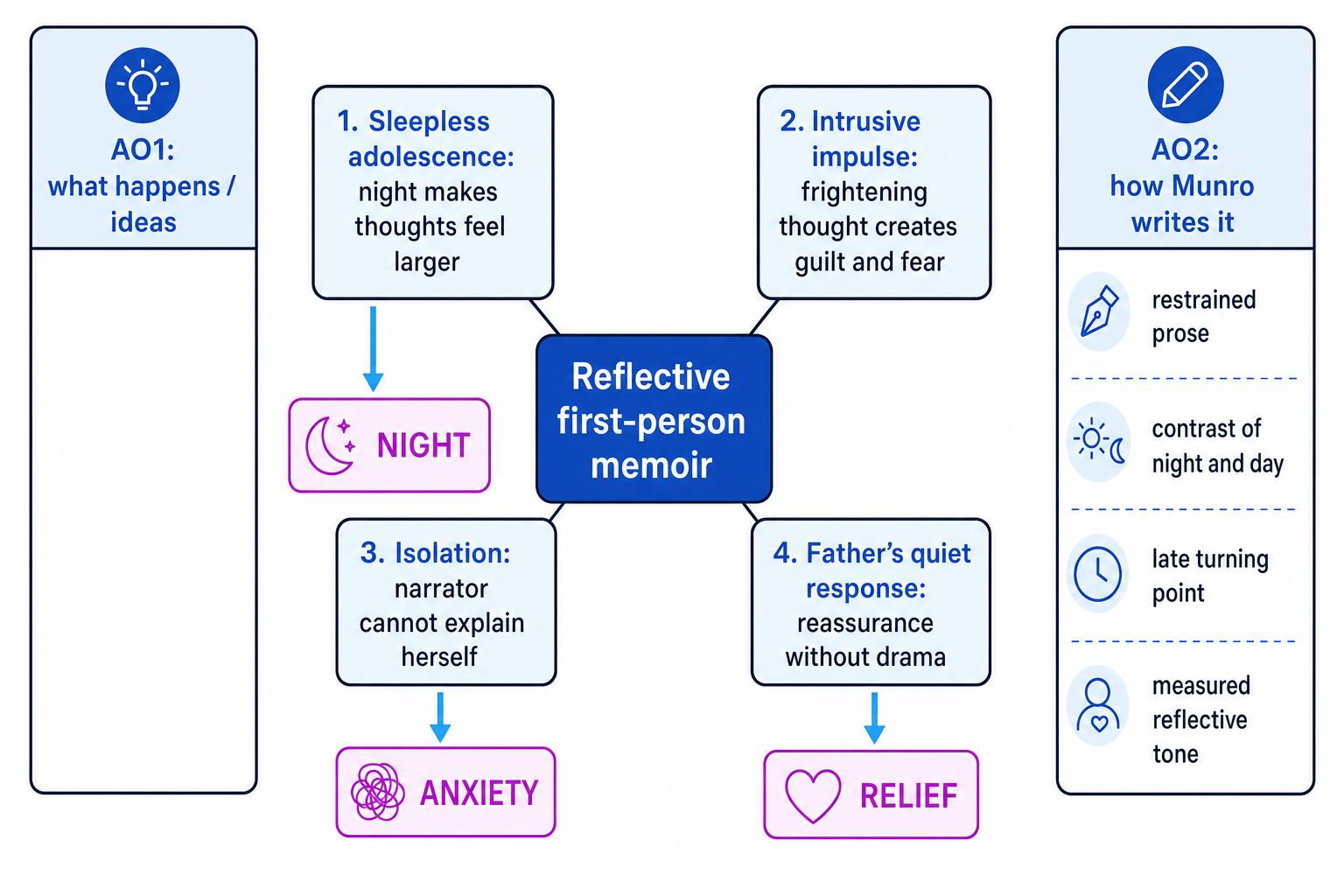
The central tension
Munro’s main focus is not physical danger but psychological fear: the narrator is terrified by the strangeness of her own thoughts, and her father’s calm response gives her a way back into ordinary life.
Form: memoir and reflective narration
Memoir
A memoir is a form of autobiographical writing in which a writer looks back on personal experience and shapes it into a meaningful recollection.
Night feels like memoir because the narrator is not simply reporting events as they happen. She is looking back from adulthood. This matters because the adult voice can describe the teenage fear with calmness and precision.
The narrator is the voice telling the story. Here, Munro uses first-person narration, meaning the story is told using “I”. This creates intimacy: you are close to the narrator’s private fear. But because the voice is reflective, you also feel the distance of time. The adult narrator can understand what the younger self could not.
Reflective first-person narration
Reflective first-person narration uses “I” while looking back on past events, often adding adult understanding to an earlier experience.
Theme: adolescence and the troubled mind
A theme is a central idea that runs through a text. One major theme in Night is the difficulty of adolescence. Munro presents adolescence as a time when the mind can feel unfamiliar, unstable and frightening.
The narrator is not shown as “evil” or naturally violent. Instead, she is disturbed because she cannot explain why such a thought has entered her mind. The verb “strangle” is especially shocking because it is blunt, physical and violent. Munro places this kind of word within otherwise controlled prose, making the thought feel even more alarming.
Intrusive thought
An intrusive thought is an unwanted idea or image that enters the mind suddenly. It can be frightening precisely because the person does not want it and does not feel in control of it.
Turning the thought into an action
Do not write as if the narrator actually carries out the violent impulse. The important point is that she is horrified by the thought itself, which reveals her guilt, fear and confusion.
Analysing a frightening intrusive thought
-
Start with the interpretation: the narrator’s fear comes from feeling that her own mind has become strange to her, not from a clear plan to hurt anyone.
-
Focus on Munro’s language: the violent verb “strangle” is direct and shocking, especially because the surrounding narration is usually controlled and understated.
-
Link the language to the theme: the contrast between the calm style and the violent idea shows how frightening intrusive thoughts can be when they appear inside ordinary family life.
-
Connect to the reader’s response: we feel the narrator’s guilt and isolation because the thought seems unspeakable, even though it is not the same as an action.
Theme: guilt, secrecy and self-judgement
The narrator’s suffering is intensified by secrecy. She cannot easily confess what is happening because she fears being judged. This is where Munro is very subtle: the narrator’s guilt is not caused by anything she has done, but by what she imagines she might be capable of.
That makes the piece psychologically complex. Munro explores the gap between a person’s outward life and their inner life. From the outside, the narrator is still part of a family and a daily routine. Inside, she is living with a terrifying private question: what kind of person am I, if such a thought can occur to me?
Theme: family understanding
The father’s response is one of the most important moments in the text. He does not give a dramatic speech. He does not treat the narrator as monstrous. His calmness matters because it changes the meaning of the experience.
Before this moment, the narrator is trapped inside her own fear. After it, she has another person’s perspective. The father’s quiet understanding suggests that compassion can be more powerful than explanation.
Why the father matters
The father does not “solve” the narrator by analysing her. He reassures her by treating her as human, not abnormal.
Language: restrained and precise prose
Munro’s prose is restrained, meaning controlled and not overly emotional. She does not use melodramatic horror language. This restraint makes the piece more believable and, in some ways, more unsettling.
Her language is also precise. She gives enough detail to make the experience vivid, but she avoids over-explaining. This suits the subject: the narrator herself cannot fully explain the impulse, so the prose leaves some mystery around it.
A useful AO2 point is that Munro’s plainness increases the shock. If every sentence were dramatic, the violent thought might feel exaggerated. Because the style is calm, the sudden violence of the idea stands out.
Use small quotations well
For Night, short quotations are often stronger than long ones. A single word such as “strangle” can support detailed AO2 analysis if you explain its connotations and effect.
Contrast: night and day
Contrast
Contrast is when a writer places different ideas, settings or moods side by side so that each one appears more strongly.
The title Night is literal because much of the narrator’s fear is connected to sleeplessness and darkness. But it is also symbolic. Symbolic means that something concrete stands for a larger idea. Night suggests secrecy, isolation and the unknown parts of the self.
Daytime, by contrast, is connected with ordinary life: routine, family, work and speech. The father belongs to that calmer world of practical understanding. Munro uses the movement from night-time fear towards human conversation to suggest a movement from isolation towards relief.
Structure: from private terror to late reassurance
Structure
Structure means the way a text is arranged: the order of events, shifts in focus, turning points and the ending.
The structure of Night is important because Munro delays reassurance. The narrator first describes sleeplessness and fear, so the reader spends time inside her anxiety before the father offers a different perspective.
A turning point is a moment when the direction or meaning of a text changes. In Night, the father’s response is the turning point. It does not erase the earlier fear, but it changes how the narrator understands it.
Explaining the late reassurance
-
Notice the order: Munro first presents the narrator’s isolation, so the reader experiences the fear before any comfort arrives.
-
Analyse the delay: because reassurance comes late, the narrator’s shame and secrecy feel more intense.
-
Consider the shift: the father’s calm response contrasts with the narrator’s private terror, making his ordinary kindness feel powerful.
-
Link to the whole text: the structure turns the piece from a story of fear into a reflection on understanding, maturity and compassion.
Tone and key moments
Tone
Tone is the attitude or feeling created by the writer’s style, such as calm, anxious, bitter, amused or reflective.
The tone of Night is mainly reflective, honest and restrained. Munro does not invite the reader to judge the narrator harshly. Instead, she encourages careful attention to a difficult inner experience.
Key moments to revise:
- The sleepless nights, where ordinary life becomes strange.
- The intrusive thought, which makes the narrator fear herself.
- The secrecy and guilt, which isolate her.
- The conversation with her father, where calm understanding changes everything.
- The reflective adult perspective, which gives shape and meaning to the memory.
Writing about Night in the exam
For Component 2 Section A, you need to balance AO1 and AO2. That means you should not just retell the plot. You need to explain what Munro presents and how she presents it.
A strong paragraph might begin with a clear idea about guilt, adolescence or family understanding. Then use a brief quotation or reference. Then analyse a method: first-person narration, restrained language, contrast, tone, or structure. Finally, link the method back to the question.
In the exam
-
Keep returning to the question’s key word, such as “fear”, “family”, “adolescence” or “understanding”.
-
Use brief, accurate references rather than long copied quotations; analyse individual words and methods closely.
-
Track the structure: sleeplessness, intrusive thought, secrecy, confession, father’s reassurance.
-
Avoid diagnosing the narrator. Focus on how Munro presents the experience through language, tone and structure.
Check yourself
-
How does the title Night work both literally and symbolically?
-
Why is the narrator frightened by the thought even though she does not act on it?
-
How does the father’s response change the tone and meaning of the text?
