What you'll learn
- What happens in the extract and how to summarise Lev’s situation clearly.
- How Tremain presents migration, displacement, grief, memory and hope.
- How to analyse methods such as close third-person narration, symbolism, sensory language and structure.
- How to write about this text for AO1 and AO2 in Component 2 Section A.
The big picture
Significant Cigarettes is a prose extract from Rose Tremain’s novel The Road Home. It appears in Part 2 of the Pearson Edexcel International GCSE English Anthology, so it belongs to the Poetry and Prose part of the course.
In the extract, Lev, an Eastern European migrant, travels by coach towards Britain. He is leaving behind his home, his past life and the people and places that shaped him. The journey is practical — he needs a new start and work — but Tremain also makes it emotional and symbolic.
For the examined route, Component 2 is 40% of the qualification. Section A is worth 30 marks and rewards your reading of the anthology text: mainly AO1, which is understanding and interpreting, and AO2, which is analysing language and structure.
Quick summary of the extract
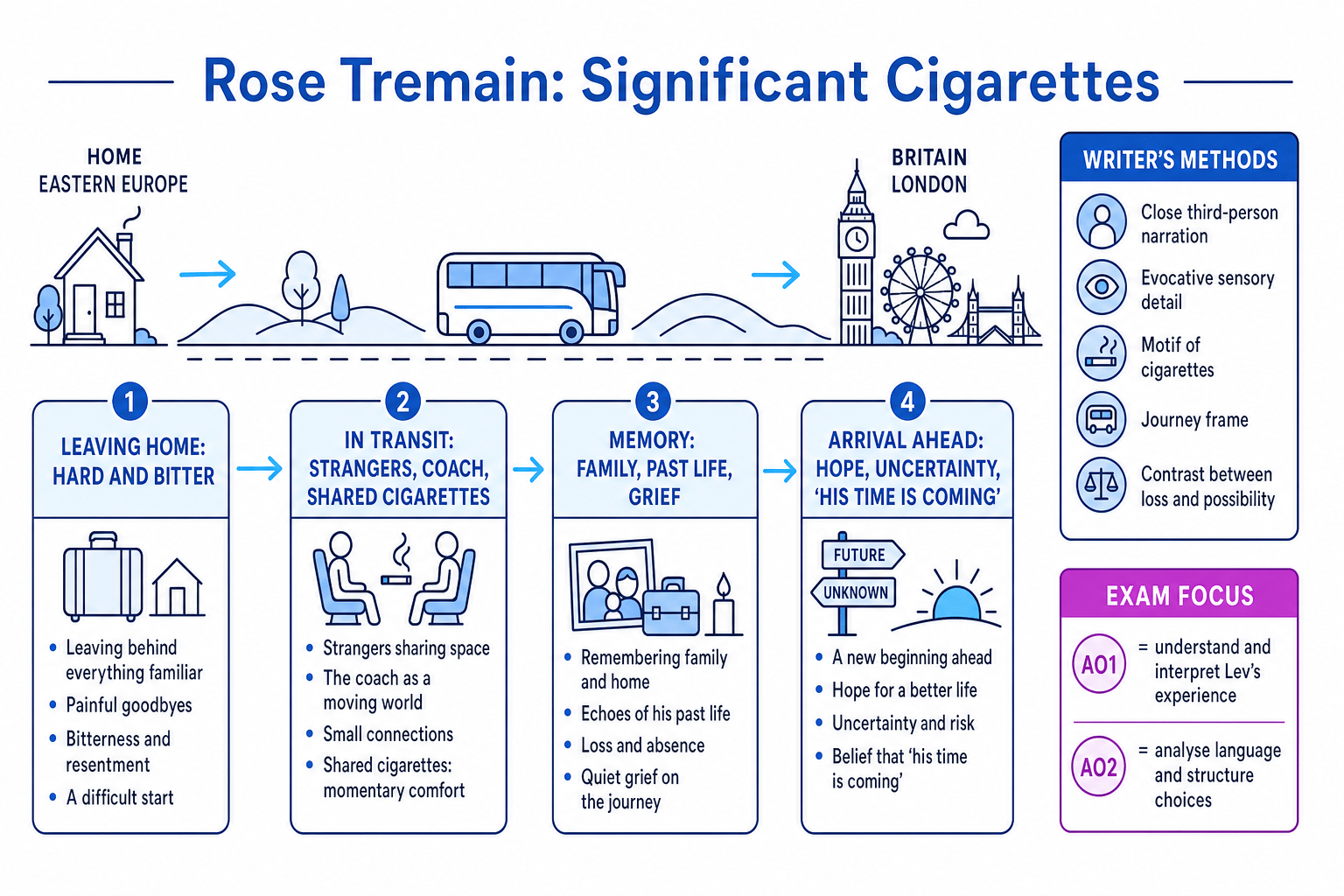
Lev is on a coach journey to Britain, moving away from his familiar life in Eastern Europe. The coach is full of other passengers, so he is physically surrounded by people, yet he is emotionally isolated. He carries memories of home with him, and the small details of the journey — including cigarettes and encounters with fellow travellers — become important because they give him temporary comfort and connection.
The key emotional tension is that leaving home is described as “hard and bitter”, but Lev also believes that his “time is coming”. In other words, Tremain does not present migration as simply exciting or simply tragic. It is both painful and full of possibility.
Core interpretation
This extract is not just about a coach journey. Tremain uses the journey to show Lev caught between a lost past and an uncertain future.
Use this route map to connect the plot, themes, methods and exam focus.
Key terms you need first
Theme
A theme is a central idea explored by a text, such as migration, grief, hope or memory. A theme is not just a topic; it is what the writer seems to suggest about that topic.
Structure
Structure means how a text is organised: the order of events, shifts in focus, openings and endings, contrasts, repeated ideas and the overall shape of the writing.
Narrative viewpoint
Narrative viewpoint means the perspective from which a story is told. It affects how close we feel to a character and how much of their inner life we can access.
Theme 1: migration and displacement
Displacement
Displacement means being removed from a familiar place, community or identity. In literature, it often creates feelings of uncertainty, loneliness and being “in between” worlds.
Lev’s journey is a form of migration: he is travelling to another country in search of a new life. Tremain avoids making this feel glamorous. The phrase “hard and bitter” suggests that leaving home is physically and emotionally painful. “Hard” implies something tough and unyielding; “bitter” can suggest an unpleasant taste, but also resentment or sorrow.
The coach becomes a moving space of displacement. Lev is neither fully at home nor settled in Britain. He is suspended between the two.
Analysing Lev's mixed feelings
- Start with the emotional tension: Lev is leaving home because he needs change, but the departure wounds him.
- Use the phrase “hard and bitter” to show the pain of migration. The adjectives make the experience feel harsh and almost physical.
- Contrast this with his belief that his “time is coming”. The phrase suggests opportunity moving towards him, as if the future may finally open.
- Combine the ideas: Tremain presents migration as a painful break from the past, but also as a possible route towards dignity, work and renewal.
Flattening Lev's feelings
Do not describe Lev as only “sad” or only “hopeful”. The power of the extract comes from the clash between grief and possibility.
Theme 2: loss, grief and memory
Lev is not travelling as a blank slate. He carries his past with him. Memory makes the journey heavier because home is not simply a place on a map; it is connected to identity, relationships, habits and emotional history.
Tremain presents grief as quiet rather than dramatic. Lev’s sorrow is shown through his thoughts, the objects he notices and the atmosphere of the journey. This makes the writing feel controlled and realistic.
Memory also gives the extract depth. The present journey keeps pulling Lev back towards what he has left behind. That movement between present and past helps the reader understand that migration is psychological as well as physical.
Writing about memory
When you discuss memory, link it to structure. Tremain often makes the present journey feel interrupted or deepened by Lev’s thoughts of home, so the reader experiences his divided state of mind.
Theme 3: hope and uncertainty
The phrase “his time is coming” is crucial because it introduces hope. Lev is not merely escaping; he is trying to move towards a future. However, the hope is uncertain. “Coming” suggests movement, but not arrival. He has not yet reached success; he is travelling towards the possibility of it.
This is why the tone of the extract is balanced. It is not sentimental, because Tremain does not pretend that everything will be easy. But it is not hopeless either, because Lev still imagines that life may change.
Writer’s method: close third-person narration
Close third-person narration
Close third-person narration is when a story is told using third-person pronouns such as “he”, but the narrator stays close to one character’s thoughts, feelings and perceptions.
Tremain uses close third-person narration to keep us near Lev’s inner life. We observe him from the outside, but we also feel the pressure of his private thoughts. This is useful because Lev is in a public place — a coach full of people — while experiencing deeply personal emotions.
This method helps the reader understand the loneliness of migration. Lev is not literally alone, but his memories and worries separate him from the people around him.
Using narrative viewpoint in analysis
- Notice the contrast between public setting and private feeling: Lev is on a shared coach, but the narration focuses closely on his inner experience.
- Explain the effect of this viewpoint: the reader sees migration not as a statistic or news story, but as one individual’s emotional reality.
- Link to AO2: by choosing close third-person narration, Tremain controls our sympathy and keeps Lev’s uncertainty at the centre of the extract.
Writer’s method: cigarettes as a motif
Motif
A motif is a repeated object, image or idea that gains significance because it appears in an important way across a text or extract.
The cigarettes are ordinary objects, but the title tells us they matter. They can be read as small anchors in an unstable situation. For Lev and the passengers, cigarettes may suggest habit, comfort, social exchange or a moment of pause during movement.
They are “significant” because they help Tremain turn a huge life change into something concrete. Migration can feel abstract, but a cigarette is small, visible and physical. Through this object, Tremain shows how people under pressure cling to routines and brief connections.
Symbol
A symbol is an object, person or place that represents a bigger idea beyond its literal meaning.
The cigarettes can therefore work symbolically. They may represent temporary comfort, the need for control, or the fragile connections between strangers travelling towards uncertain futures.
Analysing the cigarettes
- Begin with the literal role: cigarettes are small objects connected to habit, travel and interaction.
- Ask what feelings they carry: they suggest comfort, stress, dependence and brief human connection.
- Connect them to Lev’s situation: because he has left the familiar world of home, even small routines become emotionally important.
- Link to the title: calling them “Significant Cigarettes” encourages the reader to treat an ordinary object as a clue to Lev’s deeper emotional state.
Writer’s method: evocative detail and sensory language
Sensory language
Sensory language is language that appeals to the senses: sight, sound, smell, taste or touch.
The phrase “hard and bitter” is a good example of Tremain’s compact, evocative style. “Hard” can suggest touch: something resistant or painful. “Bitter” suggests taste, but it also carries emotional meaning. Together, the words make leaving home feel like something Lev can physically endure.
This is efficient writing. Tremain does not need a long explanation of Lev’s sadness. The sensory force of the words does the work.
Analyse small quotations
For AO2, short quotations are often best. A phrase like “hard and bitter” gives you more to analyse than a long copied sentence.
Structure and form: the journey frame
Journey frame
A journey frame is a structure where movement from one place to another shapes the narrative. The physical journey often reflects an emotional or psychological journey.
The extract is framed by travel: Lev is moving away from home and towards Britain. This gives the writing a clear direction, but it also creates suspense. He is not settled at either end. The coach becomes an in-between space where memory, fear and hope all meet.
The structure also lets Tremain contrast past and future. Home represents familiarity, loss and memory. Britain represents work, possibility and uncertainty. Lev’s journey connects these two worlds, but it does not yet resolve the tension between them.
Analysing the journey structure
- Identify the physical movement: Lev travels by coach from Eastern Europe towards Britain.
- Interpret the emotional movement: he is also moving from a known past towards an unknown future.
- Notice the unresolved structure: because he is still travelling, the reader feels his uncertainty rather than a completed transformation.
- Explain the effect: Tremain makes the journey itself symbolise displacement, transition and fragile hope.
Tone: sad, restrained and cautiously hopeful
Tone
Tone is the attitude or mood created by the writer’s language, details and structure.
The tone of the extract is melancholic, meaning sad and reflective, but it is also controlled. Tremain does not exaggerate Lev’s suffering. Instead, she lets small details suggest the size of what he has lost.
At the same time, the tone is not entirely bleak. The idea that his “time is coming” creates cautious hope. The word “time” suggests a moment of opportunity, while “coming” suggests that it is close but not guaranteed.
So, if you are writing about tone, aim for balance: sorrow, uncertainty and hope exist together.
Key moments to remember
Leaving home
This is the emotional foundation of the extract. Lev’s departure is “hard and bitter”, showing that migration involves pain, not just ambition.
The coach journey
The coach is important because it physically carries Lev between worlds. It also places him among strangers, which highlights both isolation and shared human experience.
Cigarettes and fellow passengers
Cigarettes and small interactions with passengers act as emotional anchors. They show how ordinary objects and brief contact can matter intensely when someone is far from home.
Looking towards the future
The belief that Lev’s “time is coming” prevents the extract from becoming hopeless. Tremain presents uncertainty, but she also leaves space for renewal.
Writing about AO1 and AO2
For this text, you need to show two skills together.
AO1 means you understand what is happening and can interpret Lev’s experience. You might explain that he is a migrant leaving home for Britain, and that Tremain presents this as emotionally complex.
AO2 means you can analyse how Tremain creates that meaning. You should discuss methods such as close third-person narration, sensory language, symbolism, motifs and the journey structure.
A strong paragraph does both: it explains an idea about Lev, then proves it by analysing Tremain’s choices.
Building a focused analytical paragraph
- Make an interpretive point: Tremain presents Lev’s departure as both painful and hopeful.
- Choose precise evidence: use “hard and bitter” for pain and “his time is coming” for hope.
- Analyse method: the sensory adjectives make loss feel physical, while the future-facing phrase suggests approaching opportunity.
- Link to the whole extract: this contrast reflects Lev’s position between the home he has lost and the new life he has not yet reached.
Listing techniques without meaning
Do not write, “Tremain uses adjectives and symbolism” and then stop. Always explain what the method reveals about Lev, migration or the reader’s response.
In the exam
- Start with a clear argument about Lev’s experience, such as: Tremain presents migration as a painful but hopeful transition.
- Use short quotations and analyse individual words, especially “hard”, “bitter” and “coming”.
- Link every method to meaning: explain how narration, cigarettes, fellow passengers or the journey structure shape our understanding of Lev.
- Keep the balance of the text in mind: grief and hope are both present, so avoid one-sided interpretations.
Check yourself
- How does Tremain make Lev seem both isolated and surrounded by people?
- Why are the cigarettes more than just ordinary objects?
- How does the coach journey reflect Lev’s emotional movement from past to future?
