What you'll learn
- What Assignment B asks you to write for Edexcel International GCSE English Language A.
- How the 30 marks connect to imaginative communication and accurate writing.
- How to choose a topic that gives you enough material for a strong piece.
- How to meet the authenticity rules for independent coursework.
Where Assignment B fits
For Pearson Edexcel International GCSE English Language A, Component 1 is the Non-fiction Reading and Transactional Writing exam and is worth 60% of the qualification. Component 2, the examined route, or Component 3, the coursework route, is worth 40%.
If your centre is doing Component 3, you complete coursework instead of the Component 2 exam. Component 3 contains two assignments:
- Assignment A: Poetry and Prose response.
- Assignment B: Imaginative Writing.
This note is only about Assignment B: how to understand the requirements and choose a workable topic.
Imaginative writing
Imaginative writing is writing designed to narrate, describe or entertain. It may be based on real experience, completely invented experience, or a mixture of both, but it should be shaped deliberately for a reader.
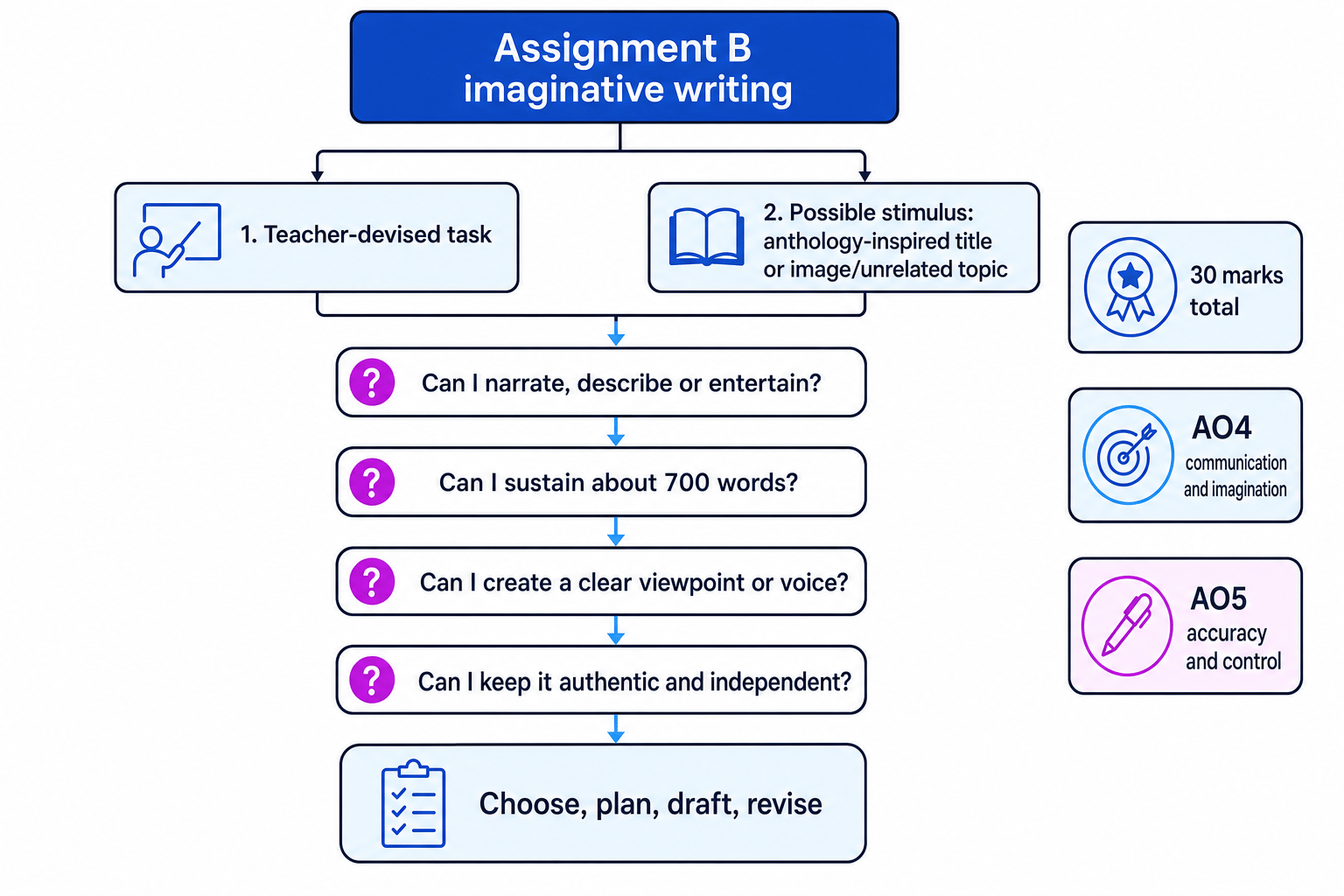
Assignment B is worth 30 marks. It mainly rewards AO4 and AO5. AO4 is about communicating effectively and imaginatively, adapting your form, tone and register. AO5 is about writing clearly and accurately, including vocabulary, sentence structures, paragraphing, spelling, grammar and punctuation.
The main goal
Assignment B is not a literature essay or a summary of an anthology text. It is your own crafted imaginative piece, written in response to a task set by your teacher.
What “teacher-devised task” means
A teacher-devised task is a writing task created or selected by your teacher for coursework. You do not simply write anything you like; you respond to the task you have been given.
The task may be linked to the Pearson Edexcel International GCSE English Anthology, especially Part 2 poetry and prose. For example, your teacher might set a task inspired by a moment, character or phrase, such as:
- writing a piece titled “The moment had passed”
- continuing Lev’s story from “Significant Cigarettes”
- beginning with a line such as “During the night the wind rose”
Your teacher may also set an unrelated topic, sometimes using images as a stimulus. A stimulus is something that gives you an idea to write from, such as a picture, title, phrase or situation. Possible image or title prompts might include:
- “The visitor”
- “A frightening experience”
- “My most embarrassing moment”
What your piece should try to do
Assignment B usually asks you to write for one or more of these purposes:
Narrate
To narrate means to tell a story or sequence of events. A narrative usually has a character, a situation, a moment of tension or change, and some kind of ending.
Describe
To describe means to create a vivid impression of a person, place, object, memory or atmosphere. Description does not need lots of events, but it does need careful detail and control.
Entertain
To entertain means to hold the reader’s interest. This might be through suspense, humour, surprise, emotion, mystery, atmosphere or a distinctive voice.
A strong Assignment B often combines these. For example, a story about a visitor might narrate the visitor’s arrival, describe the strange atmosphere of the house, and entertain through suspense.
Trying to cover too much
A common weak topic is “my whole holiday”, “my entire childhood” or “everything that happened after the disaster”. Around 700 words is usually better suited to one important moment, not a whole life story.
The advisory length: around 700 words
The recommended length for Assignment B is about 700 words. This is advisory, so there is no automatic penalty for writing more than this.
However, longer is not automatically better. If a piece becomes too long, it can lose focus, become repetitive, or contain more errors. A controlled 700–900 word piece is often stronger than a 1,500 word piece that wanders.
Think in scenes, not sagas
Instead of planning “a story about a haunted house”, plan “the five minutes after the narrator hears footsteps upstairs”. A smaller time frame usually gives you more control over detail, tension and structure.
What the 30 marks reward
The 30 marks are awarded for the quality of your imaginative writing. You are not being rewarded for choosing the most dramatic topic. You are being rewarded for what you do with the topic.
AO4: communication and imagination
AO4 rewards how effectively you shape the writing for the reader. This includes:
- a clear voice or viewpoint
- an appropriate tone
- interesting detail
- control of structure
- a sense of purpose
- adaptation to the task
A viewpoint is the position from which the writing sees the events, such as first person “I” or third person “he/she/they”. A voice is the personality or attitude that comes through in the writing. Tone means the mood or attitude of the writing, such as tense, reflective, comic or bitter. Register means the level of formality or informality.
AO5: accuracy and control
AO5 rewards the technical quality of your writing. This includes:
- accurate spelling, punctuation and grammar
- varied sentence structures
- precise vocabulary
- secure paragraphing
- controlled expression
You do not need to use complicated words all the time. Precise, well-chosen words are better than forced vocabulary.
Choosing a strong topic
A good topic gives you enough room to show imagination, but not so much that you lose control. Before choosing, test the topic with five questions.
1. Can I focus it?
A focused topic has a clear centre. For example, “A frightening experience” is very broad. You could narrow it to:
- being trapped in a lift during a power cut
- hearing someone enter the house at night
- losing sight of a younger sibling in a crowd
2. Can I create a clear voice?
Some topics work best because they give you a strong narrator. For example, “My most embarrassing moment” might work well if the narrator is self-conscious, dramatic or funny.
3. Can I build atmosphere or tension?
Atmosphere is the feeling created by the writing, such as unease, excitement, sadness or calm. Tension is the sense that something important or uncertain is about to happen.
4. Can I control it in about 700 words?
If the idea needs ten chapters to explain, it is probably too big. If it can be shaped into a beginning, development and ending, it is more manageable.
5. Can I make it genuinely mine?
Even if the task is inspired by an anthology text, the writing must be your own. You can borrow a situation, theme or starting point, but you must not copy chunks of wording.
Choosing between topic options
Suppose your teacher offers three possible tasks: continue Lev’s story from “Significant Cigarettes”, write from the title “The visitor”, or write about “My most embarrassing moment”.
-
Compare the scope of each idea. Continuing Lev’s story needs careful control because you must respect an existing character. “The visitor” is flexible and can become mystery, comedy or drama. “My most embarrassing moment” may be easier if you have a strong real memory.
-
Test each topic against the 700-word shape. A whole life after migration may be too large for Lev, but one scene after an important conversation could work. “The visitor” could fit well if it focuses on one arrival. “My most embarrassing moment” works best if it builds to one central mistake.
-
Judge the chance to show AO4. “The visitor” may offer strong atmosphere and suspense. The embarrassing moment may offer a distinctive comic voice. Lev’s story may show empathy and control if you can write sensitively.
-
Choose the topic with the strongest balance of control and interest. If you have a clear scene, voice and ending for “The visitor”, that may be stronger than choosing the most “serious” topic without a plan.
Using an anthology-inspired task
If your task is inspired by an anthology piece, remember that you are writing creatively, not analysing the original.
You might be asked to continue a story, write from another character’s viewpoint, or use a phrase as a title. In these cases, your writing should show that you understand the original starting point, but it should still become an independent piece.
For example, if you continue Lev’s story from “Significant Cigarettes”, you would need to think about his situation, mood and possible future. However, you should not copy the original writer’s sentences or simply retell the same events.
Do not imitate too closely
If your writing becomes a patchwork of borrowed phrases from the anthology, it risks losing independence. Use the original as a springboard, not as a script.
Using an image or unrelated topic
Image prompts can be excellent because they give you concrete details. Look closely at the image and ask:
- What happened just before this moment?
- What might happen next?
- Who is watching or remembering this?
- What mood does the image suggest?
- What detail could become symbolic?
A symbol is an object, image or detail that suggests a bigger idea. For example, a locked door might suggest secrecy, fear or exclusion.
Turning a broad prompt into a focused idea
Take the broad topic “A frightening experience”.
-
Narrow the situation to one specific moment: a narrator is alone in a house when the electricity cuts out and a phone begins ringing upstairs.
-
Choose the viewpoint that gives most control: first person allows immediate fear and uncertainty, while third person could create distance and suspense. First person is better if you want the reader inside the panic.
-
Shape the structure into stages: normal evening, first disturbance, attempt to explain it, second disturbance, final reveal or unresolved ending.
-
Decide the main effect: if the aim is suspense, hold back information; if the aim is shock, build towards one sudden discovery; if the aim is psychological fear, make the narrator doubt their own senses.
Authenticity and independent work
Because Assignment B is coursework, your centre must be able to confirm that the work is authentically yours. Authenticity means the writing genuinely comes from you. Independent work means you make the key choices yourself and write the sentences yourself.
Your teacher can guide you, explain the task and give general advice, but they cannot rewrite your work for you. You should not submit writing produced by someone else, copied from online sources, or generated for you by artificial intelligence.
This does not mean you cannot plan, draft and improve. Drafting is part of good writing. The important point is that the ideas, wording and revisions must be your own.
Letting feedback become rewriting
It is fine to act on advice such as “develop the ending” or “check your tense control”. It is not fine for another person to supply improved sentences for you to copy into your final piece.
A quick topic-choice checklist
Before you commit to a topic, you should be able to answer “yes” to most of these:
- I understand exactly what the task asks me to do.
- I can explain my idea in one or two sentences.
- I know whether I am mainly narrating, describing or entertaining.
- I have a clear narrator or viewpoint.
- I can control the idea in about 700 words.
- I can include some vivid detail without overloading the piece.
- I can make the work independent and authentic.
If you cannot explain the idea simply, it may not be ready yet. A strong coursework idea usually sounds clear before it sounds impressive.
In the exam
Although Assignment B is coursework, use these final-submission habits as if you were under assessment conditions:
-
Check that your final piece clearly responds to the exact task your teacher set, not just a similar idea you preferred.
-
Spend revision time improving control: paragraphing, tense consistency, sentence variety, punctuation and precise vocabulary.
-
Keep the writing independent by using feedback as guidance, not as replacement wording.
Check yourself
- Can you explain the difference between an anthology-inspired task and an anthology analysis essay?
- Why is one focused scene often better than a whole-life story for Assignment B?
- What are two ways you can show independence when drafting and improving your coursework?
