What you'll learn
- How Component 2 Section B rewards imaginative writing through AO4.
- How to turn a prompt into a controlled narrative or description.
- How to use craft choices: setting, atmosphere, character, viewpoint, imagery and tension.
- How to plan openings, shifts and endings that feel deliberate rather than random.
Where this fits in the course
For Pearson Edexcel International GCSE English Language A, Component 2 / 3 is worth 40% of the qualification. In the examined route, Component 2 Section B is the Imaginative Writing section: one 30-mark task chosen from three prompts.
This note focuses on AO4: communicating effectively and imaginatively, adapting form, tone and register for purpose and audience. The sibling note on AO5 deals with technical accuracy: spelling, punctuation, grammar, sentence control and paragraphing.
AO4
AO4 is the writing assessment objective for effective and imaginative communication. It rewards how well you shape ideas for a reader, choose an appropriate form, tone and register, and create an engaging piece.
The basic job: give the reader an experience
Imaginative writing is not just “making up a story”. Your aim is to create an experience for the reader: suspense, wonder, discomfort, nostalgia, humour, sadness, surprise, or another clear effect.
A high-level piece usually has a controlled focus. That means it does not try to include everything. It chooses a moment, mood, character or conflict and develops it carefully.
The big AO4 idea
Strong imaginative writing is not about having the wildest plot. It is about making deliberate choices so the reader feels, sees and understands what you want them to.
Form, purpose, audience, tone and register
These terms come up often, so learn them properly.
Form, purpose, audience, tone and register
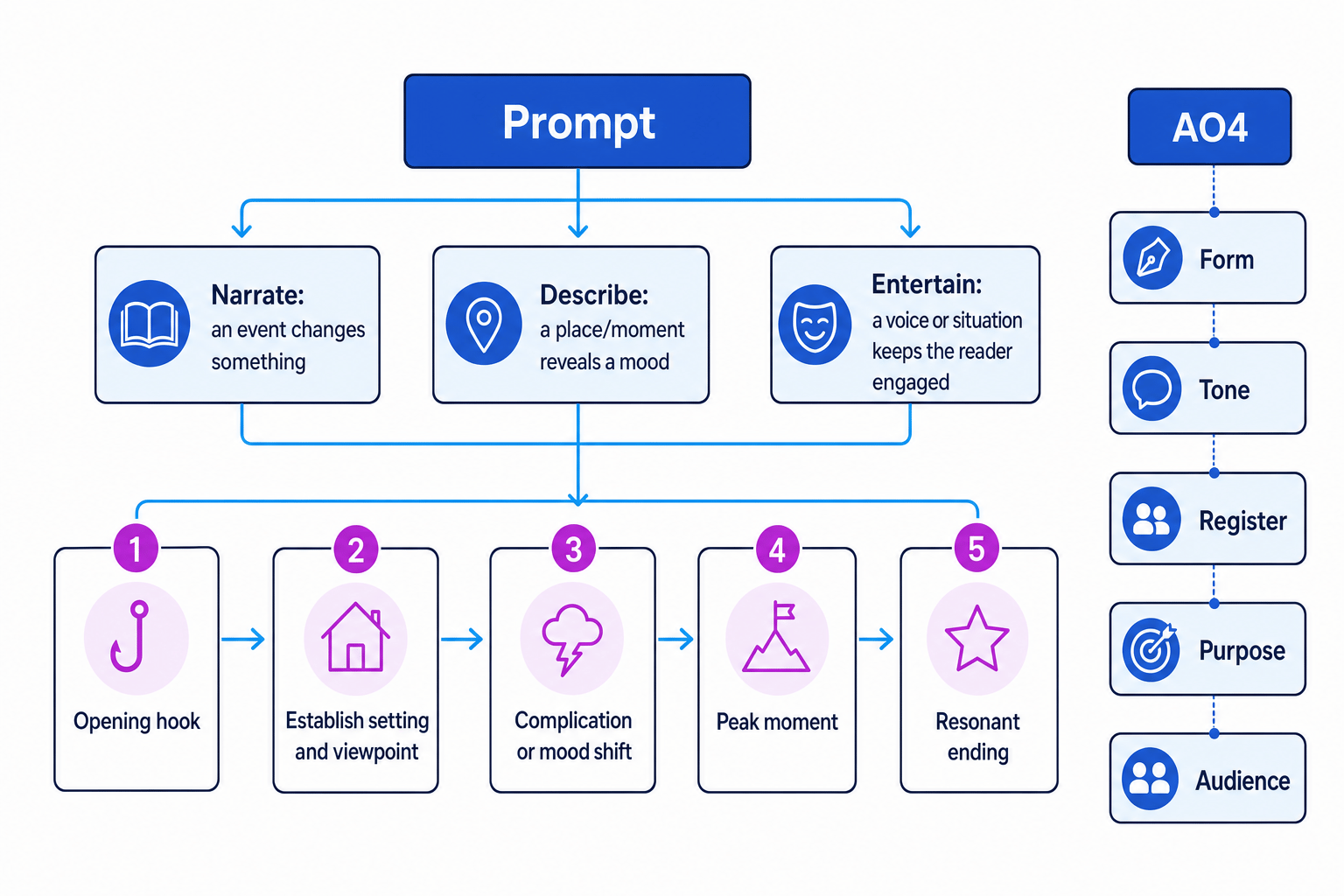
- Form means the type of writing you choose, such as a short story opening, a complete short narrative, a description, a monologue, or a memory.
- Purpose means what the writing is trying to do: narrate, describe, entertain, unsettle, move, amuse or intrigue.
- Audience means the reader you are writing for. In the exam, this is usually a general reader, not your friend in a text message.
- Tone means the attitude or mood of the writing, such as tense, reflective, comic, mysterious or bitter.
- Register means the level of formality and style of language, from informal and conversational to polished and literary.
In Component 2 Section B, your form may be flexible, but it must suit the prompt. If the prompt suggests “a difficult journey”, you might write a tense narrative, a reflective memory, or a symbolic description of a walk through a storm. The key is that your choice must feel intentional.
Using the prompt as a springboard
A common misunderstanding is to treat the prompt literally and mechanically. If the prompt is an image of a door, you do not have to spend the whole piece describing hinges, paint and a handle. The door could become a symbol of escape, fear, opportunity, secrecy, or growing up.
A springboard is a starting point that launches your own idea. You still connect clearly to the prompt, but you develop it imaginatively.
Turning a prompt into a controlled premise
Suppose the prompt is based on the idea of waiting.
-
Choose the purpose. If your purpose is to create tension, “waiting” could become a scene where a character listens for footsteps outside a hospital room, a courtroom, or a locked house.
-
Choose the form. A short first-person narrative would work well because the reader can experience the character’s thoughts as time slows down.
-
Choose the focus. Instead of covering a whole day, focus on ten minutes. A narrow time frame lets you build atmosphere through small details: the clock, the chair, the silence, the character’s breathing.
-
Choose the shift. Something must change. The footsteps stop. The phone lights up. The door opens. This gives the piece shape rather than leaving it as a static description.
-
Shape the ending. End on a meaningful image or moment, not a rushed explanation: for example, the character finally stands up just as the handle begins to turn.
Narrative and description: know the difference
A narrative is writing that tells a sequence of events. It usually involves a character, a situation, a change and some kind of ending.
A description is writing that presents a person, place, object or moment in vivid detail. It may not have a full plot, but it should still have movement: a shift in mood, focus or perspective.
Story or scene?
If you struggle to finish stories, write a scene with a strong shift rather than a huge plot. One room, one character, one problem and one change can be more effective than five locations and an unexplained dramatic twist.
Setting and atmosphere
Setting means where and when the writing takes place. Atmosphere means the feeling created by the setting and details.
A beach at noon can feel peaceful, lonely, threatening or magical depending on your choices. AO4 rewards the way you control those choices.
To create atmosphere, use:
- Weather: rain, heat, fog, wind, stillness.
- Light: glare, shadow, flickering lamps, dawn, dusk.
- Sound: distant traffic, dripping water, silence, laughter.
- Objects: abandoned shoes, cracked tiles, unopened letters.
- Movement: swaying trees, crawling traffic, a curtain twitching.
Pathetic fallacy
Pathetic fallacy is when weather or nature reflects a mood, such as a storm during a moment of anger or grief.
Use it carefully. A thunderstorm every time someone is upset can feel obvious. Sometimes contrast is more interesting: a character receives terrible news on a bright, ordinary morning.
Character: reveal, do not explain everything
A character is a person or figure in your writing. In a short exam response, you do not need a full biography. You need a few precise details that suggest personality, conflict or emotion.
Instead of writing, “Maya was nervous,” you might show nervousness through action: Maya rubs the same coin between finger and thumb until the date disappears.
This is often called showing rather than telling. It does not mean you can never tell the reader anything. It means important feelings are usually stronger when the reader can infer them from behaviour, dialogue or imagery.
Showing character through detail
Imagine you want to present an old man as proud but lonely.
-
Choose a revealing object. A polished pair of shoes suggests pride and self-respect. An untouched second cup on the table suggests loneliness.
-
Connect action to emotion. He straightens his tie before answering the door, even though no one has knocked. This implies hope without directly stating it.
-
Let the reader infer. The detail “two cups, one cold” allows the reader to sense absence. That is usually more powerful than writing, “He felt very lonely.”
Viewpoint: who tells the story?
Viewpoint means the perspective from which the piece is told.
The main options are:
- First person: “I walked into the room.” This feels intimate and immediate.
- Third person limited: “She walked into the room.” The reader follows one character closely.
- Third person omniscient: the narrator can move between characters’ thoughts, though this is harder to control in a short exam piece.
Narrative voice
Narrative voice is the personality and style of the narrator. It includes what the narrator notices, how they describe things, and what they hide or misunderstand.
First person is powerful, but it can become repetitive if every sentence begins with “I”. Third person limited is often a safe choice because it gives you closeness and control.
Changing viewpoint by accident
Do not start inside one character’s mind and then suddenly reveal another character’s private thoughts unless you are deliberately using an omniscient narrator. Accidental viewpoint shifts make the piece feel uncontrolled.
Sensory detail and imagery
Sensory detail appeals to the senses: sight, sound, smell, taste and touch. It helps the reader experience the scene.
However, do not overload all five senses in a checklist. Choose the most useful details for the mood. A hospital scene might use the smell of antiseptic, the squeak of shoes, and the cold plastic chair. A summer memory might use cut grass, warm pavement and the stickiness of melted ice cream.
Imagery
Imagery is descriptive language that creates a picture or sensation in the reader’s mind. It often includes techniques such as simile, metaphor and personification.
A simile compares one thing to another using “like” or “as”. A metaphor describes something as if it is something else. Personification gives human qualities to non-human things.
Use imagery to sharpen meaning, not to decorate every sentence.
Random simile overload
Avoid piling up comparisons that do not fit the mood. “The moon was like a coin, like a face, like a plate, like a ghost” feels uncontrolled. Choose one image and develop it.
Tension: make the reader want the next line
Tension is the feeling of uncertainty, pressure or anticipation that keeps the reader engaged. It does not always mean danger. A secret, an awkward conversation, an approaching deadline or an unanswered question can create tension.
Ways to build tension include:
- Delaying information: reveal the important detail slowly.
- Narrowing focus: zoom in on a sound, object or gesture.
- Varying sentence length: shorter sentences can quicken pace.
- Using contrast: calm surroundings can make fear feel stronger.
- Creating unanswered questions: why is the door open, or why has the character returned?
Use the zoom lens
Move between wide focus and close focus. Start with the whole street, then zoom in on one lit window; start with the crowd, then zoom in on one hand gripping a letter.
Structure: give the piece a shape
Structure means how the writing is organised. In imaginative writing, structure includes the opening, order of events or details, shifts in mood, paragraph movement and ending.
A simple five-beat structure works well:
- Opening hook: a striking image, action, voice or mystery.
- Establish setting and viewpoint: place the reader somewhere specific.
- Complication or mood shift: something becomes uncertain or changes.
- Peak moment: the most intense or meaningful point.
- Resonant ending: an ending that leaves an echo, image or thought.
Resonant ending
A resonant ending is an ending that feels meaningful beyond the final sentence. It may leave the reader with an image, question, contrast or emotional after-effect.
You do not always need a twist. In fact, forced twists can weaken your writing. A quiet but well-shaped ending is often more convincing.
Avoid the panic ending
Do not end with “and then I woke up” unless you have built a genuinely original reason for it. It often makes the whole piece feel pointless because the events no longer matter.
Openings that work
A strong opening should quickly establish interest. You could begin with:
- Action: “The suitcase split open halfway across the road.”
- Atmosphere: “By dusk, the whole street had turned the colour of old metal.”
- Voice: “I should have left when the dog stopped barking.”
- Contrast: “Everyone was smiling except my father.”
- A precise object: “The ticket was still warm from the machine.”
Notice that these openings create questions. Why did the suitcase split? Why did the dog stop barking? Why is the father not smiling?
Mood shifts: make the writing move
A mood shift is a change in emotional atmosphere. It stops your piece becoming flat.
For example:
- Calm to threatening.
- Excited to disappointed.
- Comic to awkward.
- Lonely to hopeful.
- Ordinary to mysterious.
Creating a mood shift
Suppose your scene begins in a quiet library.
-
Establish the first mood. Use soft details: dust in sunlight, pages turning, a chair creaking. The atmosphere feels calm and controlled.
-
Introduce a disrupting detail. A book falls from a shelf although no one is nearby. This creates a small break in the calm.
-
Intensify the change. The narrator notices the book is open at a page with their own name written on it. The mood shifts from peaceful to unsettling.
-
End the paragraph on pressure. A final short sentence, such as “Then the lights went out,” pushes the reader into the next moment.
Borrowing craft from anthology fiction
You study poetry and prose in Anthology Part 2, and those texts are useful models for craft. You are not expected to copy them, but you can borrow techniques:
- How writers establish voice quickly.
- How settings reflect conflict or mood.
- How endings leave questions or emotional impact.
- How small details reveal character.
- How structure controls what the reader knows and when.
When reading anthology fiction, ask: What has the writer made me feel, and how have they made that happen? That is the same question you should ask about your own writing.
Planning a controlled piece
A good plan can take three to five minutes. It does not need to be long.
Use this quick planning frame:
- Prompt link: What idea, image or word from the prompt will I use?
- Main mood: What should the reader feel?
- Viewpoint: Who tells or observes this?
- Setting: Where and when does it happen?
- Shift: What changes?
- Ending image: What will the reader be left with?
Plan the ending early
If you know your final image before you start, your whole piece becomes easier to control. You can plant details that make the ending feel earned.
A short model opening
Here is a brief example of controlled craft. The prompt idea is a return.
The house had not changed, which made everything worse. The same brass number leaned crookedly on the door; the same lavender pushed through the path, wild and stubborn; the same upstairs curtain hung half-open, as if someone had just stepped away from the window. I kept my hand around the key until its teeth marked my palm. Behind me, the taxi coughed once, impatient, and rolled back down the lane. Only then did I hear it: three slow knocks from inside the empty house.
Why it works for AO4:
- The purpose is to intrigue and unsettle.
- The tone is tense and reflective.
- The setting is specific but not over-explained.
- The first-person viewpoint creates closeness.
- The ending of the paragraph creates a question, pulling the reader forward.
In the exam
-
Choose the prompt that gives you a clear mood and ending, not just the one with the most exciting plot idea.
-
Plan one controlled shift before writing: ordinary to strange, hopeful to disappointed, calm to tense, or lonely to connected.
-
Use the prompt as a springboard, but keep a visible link to it through an image, object, setting or idea.
-
Prioritise quality over quantity: a focused scene with vivid details is usually stronger than a rushed story covering years of events.
-
Check your AO4 choices as you write: form, tone, register, purpose and audience should all feel deliberate.
Check yourself
- Can you explain the difference between a narrative and a description?
- What mood shift could you use for a piece about “an unexpected visitor”?
- How could one object reveal a character’s personality without directly explaining it?
