What you'll learn
- How Component 1 Section B is marked for AO4 and AO5.
- How to decode a task using audience, form and purpose.
- How to control tone, register, paragraphs, rhetorical methods and sentence variety.
- How to plan and proofread so your writing is clear, accurate and purposeful.
Where this fits in the Edexcel IGCSE
Pearson Edexcel International GCSE English Language A is split into Component 1, worth 60%, and Component 2 or 3, worth 40%. In Component 1, Section A is Non-fiction Reading worth 45 marks, and Section B is Transactional Writing, also worth 45 marks.
Section B assesses AO4 and AO5. AO4 rewards how effectively you communicate for a particular reader and purpose. AO5 rewards accurate, controlled writing: vocabulary, sentences, paragraphing, spelling, grammar and punctuation.
Transactional writing
Transactional writing is writing designed to achieve a real-world purpose, such as persuading a council, advising younger students, reviewing an event, explaining an issue or arguing a point of view.
The big idea
A strong transactional answer does not just “write nicely”. It makes deliberate choices for the reader, the form and the purpose, then controls accuracy all the way through.
Start with the task: audience, form and purpose
Before you write, break the prompt into three parts.
Audience means the person or group who will read or hear your writing. This affects examples, vocabulary and tone.
Form means the type of writing required, such as a letter, article, speech, review, report or leaflet. Each form has conventions: a speech may use direct address and spoken signposting; a letter may need a greeting and a clear closing; an article may need a headline and engaging opening.
Purpose means what your writing is trying to do: persuade, argue, inform, explain, advise, describe, review or comment.
Use the task like a control panel: every writing choice should come from audience, form and purpose.
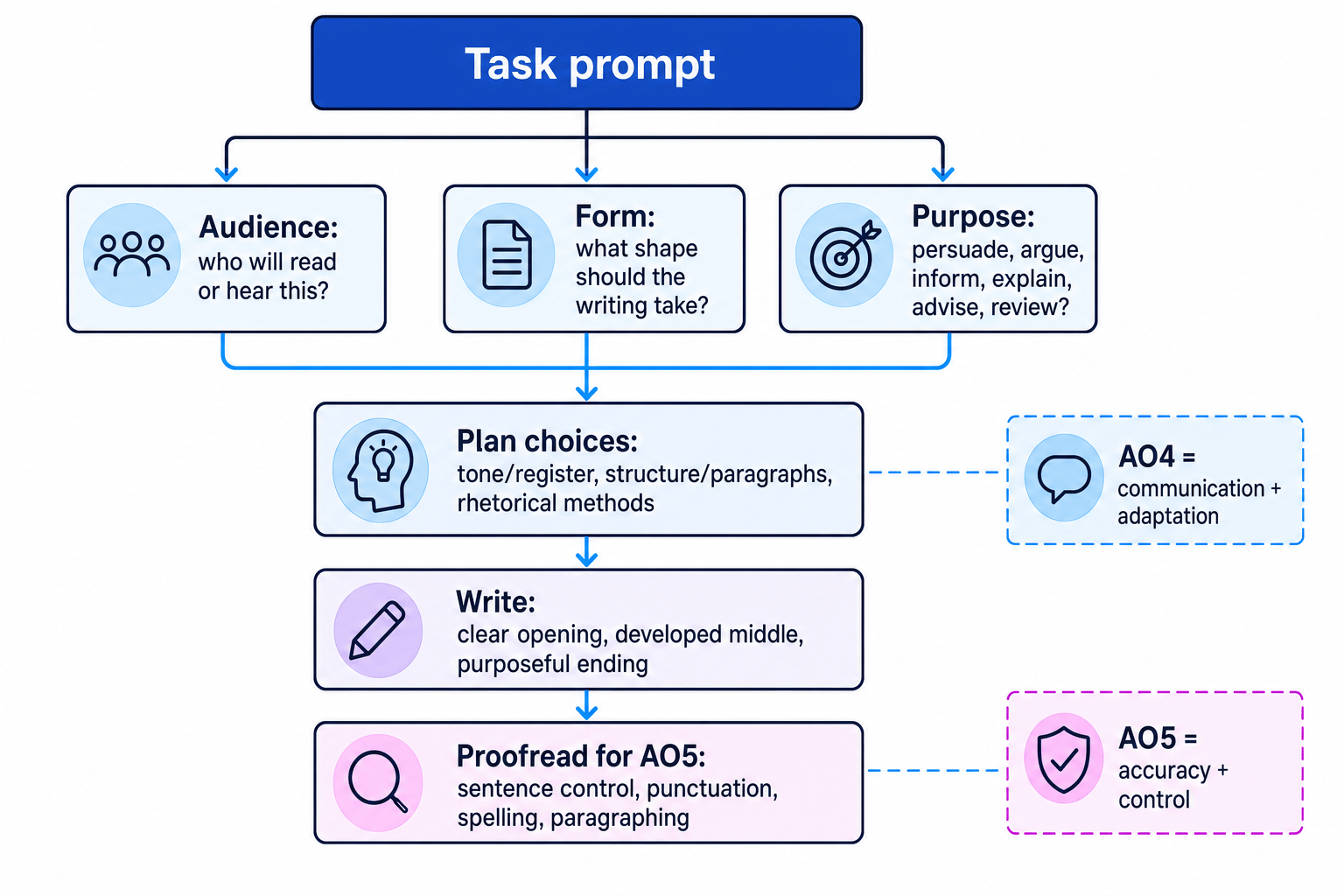
Turning a task into choices
Task: Write a speech for younger students advising them on how to manage exam stress.
- Audience: The readers/listeners are younger students, so the writing should be supportive, clear and not patronising. School-based examples will feel relevant.
- Form: It is a speech, so it needs a direct opening, spoken markers such as “firstly” or “let’s be honest”, and moments of direct address like “you”.
- Purpose: The main purpose is to advise, with some gentle persuasion. You need practical suggestions, not just emotional encouragement.
- Tone and register: The tone should be friendly but sensible. The register should be semi-formal: not slangy, but not stiff.
- Plan: Open by acknowledging stress, develop three pieces of advice, then end with a memorable encouragement or call to action.
AO4: communicate and adapt
For AO4, the examiner is asking: does this writing work for this situation?
You show AO4 by adapting:
- content — what ideas and examples you include;
- tone — the attitude your writing creates, such as serious, humorous, urgent, reassuring or critical;
- register — the level of formality;
- form — the conventions of the type of writing;
- structure — the order and development of your ideas.
Tone and register
Tone is the feeling or attitude created by your word choices and sentence style. Register is how formal or informal the language is.
For example, writing to the headteacher about school lunches probably needs a respectful but confident tone: “I believe there is a practical opportunity to improve the system.” Writing a speech to classmates can be warmer and more direct: “We all know the lunch queue can feel endless.”
Using one default voice
A common mistake is writing every task in the same “generic essay” voice. Transactional writing should sound different depending on whether you are addressing parents, students, readers of a magazine, local residents or a formal organisation.
Purpose drives your methods
A rhetorical method is a writing technique used to influence the reader’s response. In transactional writing, methods should never be decoration; they should help you achieve the purpose.
Useful methods include:
| Method | What it means | What it can do |
|---|---|---|
| Direct address | Speaking to the reader as “you” or “we” | Creates involvement and pressure |
| Rhetorical question | A question that does not need an answer | Makes the reader think or feel challenged |
| Emotive language | Words chosen to create feeling | Builds sympathy, anger, hope or urgency |
| Triplet | A list of three linked words or phrases | Creates rhythm and emphasis |
| Statistic | A numerical detail | Can make an argument sound concrete |
| Anecdote | A brief personal story | Makes an idea feel human and relatable |
Use methods with restraint
One well-placed rhetorical question is stronger than five in a row. Aim for control: choose the method that suits the point, then move on.
Making a point persuasive
Basic point: The library should stay open later.
- Choose the audience benefit: If writing to school leaders, focus on learning, safety and equal access to quiet study space.
- Add direct address: Bring the reader into the issue: “If we want every student to revise properly…”
- Use a concrete detail: Make the problem specific: students who share rooms or travel far may not have a quiet place at home.
- Shape the sentence: “If we want every student to revise properly, we must give them a quiet place to work after lessons — not just those lucky enough to have silence at home.”
- Check the effect: The sentence is persuasive because it combines direct address, fairness and contrast.
Structure: guide the reader through your thinking
Good transactional writing usually has a clear beginning, middle and ending.
The opening should establish the topic, purpose and tone quickly. In an article, this might be an engaging hook. In a speech, it might be direct address. In a letter, it might be a concise statement of why you are writing.
The middle should develop separate ideas in paragraphs. A paragraph is a group of sentences focused on one main idea. Each paragraph should move the argument or explanation forward.
The ending should feel purposeful. It might summarise, make a final appeal, offer a recommendation or leave the reader with a clear action.
Cohesion means the way writing holds together. You create cohesion through connectives, repeated key words, pronouns, parallel phrasing and logical ordering.
Building a coherent paragraph
Point: Students need better access to quiet study spaces.
- Set the paragraph focus: Start with a topic sentence: “Quiet study space is not a luxury; it is a basic condition for effective revision.”
- Develop the reason: Explain why it matters: some students cannot concentrate at home because of noise, caring duties or lack of space.
- Add a rhetorical method: Use contrast to sharpen the point: “At school, silence can be shared; at home, it is often impossible.”
- Link to the purpose: If you are persuading the school, end with a practical recommendation: “Keeping the library open twice a week would be a small change with a serious academic benefit.”
AO5: accuracy, clarity and control
AO5 is not just about avoiding mistakes. It is about writing in a way that is easy to follow, varied and precise.
Technical accuracy means correct spelling, grammar, punctuation and paragraphing. Sentence variety means using different sentence structures for effect.
A main clause is a group of words with a subject and verb that makes sense on its own: “The library closes early.” A subordinate clause adds extra information but does not usually make complete sense alone: “although many students need it.”
You can vary sentences by using:
- simple sentences for clarity or emphasis: “This must change.”
- compound sentences to link equal ideas: “The demand is clear, and the solution is realistic.”
- complex sentences to show cause, contrast or condition: “Although budgets are limited, a trial period would test whether the idea works.”
- minor sentences for controlled impact in speeches or articles: “No noise. No pressure. Just space to think.”
Editing for AO5
Original sentence: Many students skip breakfast, they are tired in lessons and this is bad for learning.
- Find the sentence problem: “Many students skip breakfast” and “they are tired in lessons” are both main clauses, so joining them with only a comma creates a comma splice.
- Choose a clearer structure: Use a subordinating word such as “when” to show cause and effect.
- Improve vague vocabulary: Replace “bad for learning” with a more precise phrase such as “damages concentration”.
- Write the improved version: “When students skip breakfast, they often arrive tired, and their concentration suffers before the first lesson has properly begun.”
Comma splicing
A comma splice happens when two complete sentences are joined with only a comma. Fix it with a full stop, semicolon, conjunction, or by making one part subordinate.
Planning and proofreading
A short plan saves time because it stops your writing drifting. Before you begin, note:
- the audience, form and purpose;
- your overall tone;
- three or four main ideas;
- one or two methods you will use deliberately;
- how you will end.
Proofreading means checking your writing before you finish. Do not try to fix everything at once. Look for high-impact issues: missing full stops, tense slips, repeated words, apostrophes, unclear sentences and paragraph breaks.
In the exam
- Spend a few minutes decoding the task: audience, form, purpose, tone and register.
- Plan a clear route before writing: opening, three or four developed sections, purposeful ending.
- Use rhetorical methods because they fit your purpose, not just to “show off”.
- Leave time to proofread for AO5: sentence boundaries, punctuation, spelling and paragraphing.
- If you are unsure, prioritise clarity. A controlled, accurate answer usually beats an overcomplicated one.
Check yourself
- Can you explain the difference between tone and register?
- If a task asks you to write for parents, what choices might change compared with writing for students?
- Which AO5 issue do you most need to check in your own writing: punctuation, sentence control, spelling or paragraphing?
