What you'll learn
- How to summarise Disabled clearly for AO1.
- How Owen uses contrast, imagery, irony and semantic fields for AO2.
- How the poem’s shifts in time and ending shape its meaning.
- How to write about the recruiting-office moment: “Smiling they wrote his lie; aged nineteen years.”
The exam focus
Disabled is in Anthology Part 2 for Pearson Edexcel International GCSE English Language A. If you take the examined route, Component 2 is worth 40% of the qualification: Section A is 30 marks on poetry/prose from Anthology Part 2, and Section B is 30 marks for imaginative writing.
An assessment objective, or AO, is a skill the exam rewards. For a Component 2 Section A essay on Disabled, the key reading objectives are AO1 and AO2: AO1 means understanding the poem and selecting evidence; AO2 means analysing Owen’s language, structure and form.
The core argument
Owen presents war not as glory, but as a force that steals a young man’s body, youth, confidence, sexuality, independence and future.
First understanding: what happens in the poem?
The poem focuses on a young ex-soldier who sits in a “wheeled chair” after returning from war. He has lost limbs and is dependent on others. In the present, he is isolated, cold, and waiting to be put to bed.
The poem then moves into memories of his past: the town was lively, girls admired him, he played football, and he had a strong, attractive body. He joined the army partly because soldiering seemed glamorous and masculine. The famous recruiting-office line — “Smiling they wrote his lie; aged nineteen years” — suggests that adults helped record his false age so he could enlist.
By the end, the heroic image has collapsed. He is not celebrated properly. He will live in “Institutes”, accepting whatever “pity” is given to him, while women look past him towards “the strong men that were whole.”
The speaker and point of view
The poem is written in the third person, meaning the soldier is described as “he” rather than “I”. This creates some distance, as if society is looking at him from the outside.
However, Owen also lets us feel close to the soldier’s thoughts. The final questions — “Why don’t they come / And put him into bed? Why don’t they come?” — sound like his own anxious, childlike voice breaking through.
Free indirect thought
Free indirect thought is when a third-person narrator slips into a character’s thoughts or feelings without using direct speech marks. In Disabled, the ending feels as if we are hearing the soldier’s private distress from inside his mind.
Contrast: past energy against present emptiness
Contrast means placing two very different ideas, images or situations side by side so that each one seems stronger. Owen builds the poem around contrast: before the war, the soldier is active, desired and full of movement; after the war, he is still, dependent and ignored.
Before the war, the town “used to swing so gay”, suggesting brightness and social energy. In the present, he waits for “dark”, dressed in a “ghastly suit of grey”. That contrast makes his loss feel more brutal because we can measure what has been taken away.
Analysing the past and present contrast
-
Compare the present image “He sat in a wheeled chair” with the memory of football, where he was “carried shoulder-high” after matches. One image shows stillness and dependence; the other shows movement, admiration and physical strength.
-
Link the contrast to Owen’s message. The soldier has not simply lost limbs; he has lost the social identity that made him feel admired and masculine.
-
Connect the method to the reader’s response. Because Owen shows the lively past before returning us to the bleak present, the reader feels the damage of war more sharply.
Colour imagery: life draining into grey
Imagery means language that creates a picture, sensation or association in the reader’s mind. Owen uses colour imagery to show the difference between life before war and the drained, damaged present.
The present is dominated by “grey”, a colour linked with lifelessness, coldness and dullness. His face is described as having “lost his colour very far from here”, suggesting both physical weakness and emotional emptiness.
In the memories, colour is more vivid: “light-blue trees”, “glow-lamps”, and the shocking “purple” of blood. Owen turns colour into a measure of life: the soldier’s vitality has been poured away “down shell-holes”.
Writing about colour
Do not just say “grey shows sadness.” Push further: in this poem, grey suggests the soldier’s life has become institutional, drained and prematurely old.
Semantic fields of loss and damage
A semantic field is a group of words linked by meaning. Owen creates a semantic field of physical loss through words and phrases such as “legless”, “sewn short”, “lost”, “lapsed”, “sick years” and “dole”.
This field matters because it shows that the damage is not a single injury. War has reduced every part of his life: his body, independence, confidence, future relationships and social value.
Tracing the semantic field of loss
-
Select several connected words rather than one isolated quotation: “legless”, “lost”, “lapsed” and “sick years” all point towards absence and decline.
-
Notice the range of loss. “Legless” is physical, “lost” is emotional and social, while “sick years” points towards a damaged future.
-
Form an AO2 sentence: Owen’s repeated vocabulary of loss presents disability as life-altering, not temporary, so the soldier’s suffering continues long after the battlefield.
Bitter irony: the gap between promise and reality
Irony is when there is a gap between what is expected, promised or claimed and what actually happens. Owen’s irony is bitter because the gap is painful and morally shocking.
The recruiting-office line is one of the poem’s key moments: “Smiling they wrote his lie; aged nineteen years.” The smile should suggest friendliness, but here it becomes disturbing. The recruiters seem to know he is too young, yet they help turn his lie into official permission.
The phrase also criticises a society that romanticises war. Adults, propaganda and social pressure encourage boys to imagine uniforms, “drums and cheers”, and admiration. The reality is amputation, neglect and pity.
Analysing the recruiting-office line
-
Start with the verb “Smiling”. It creates a friendly surface, but the context makes it sinister because the recruiters are enabling a young person to enter a deadly war.
-
Focus on “his lie”. Owen shows that the soldier is partly responsible, but the phrase “they wrote” shifts blame onto the officials who record and authorise it.
-
Explain the effect of the semicolon in “his lie; aged nineteen years”. The pause makes the false age sound coldly official, as if a human life is being reduced to paperwork.
Blaming only the soldier
Do not write as if the poem simply says “he made a foolish choice.” Owen presents a wider system of pressure: masculinity, romance, recruiting practices, public cheers and patriotic expectations all help push him towards war.
Masculinity and the romantic image of soldiering
Masculinity means ideas about what society expects men to be like. In the poem, the soldier’s pre-war identity is tied to physical strength, sport, girls and public admiration.
He joins partly because “Someone had said he’d look a god in kilts.” This shows how the uniform is imagined as attractive and heroic. The phrase “To please his Meg” suggests he is influenced by romance and the desire to impress.
Owen then destroys this fantasy. The women’s eyes now pass “from him to the strong men that were whole.” The adjective “whole” is devastating: it implies he is seen as incomplete by a society that once encouraged him to prove his manhood through war.
Structure and form: memories framed by reality
Structure means how a text is organised. Form means the type and overall shape of the poem. A stanza is a group of lines in a poem, like a paragraph.
Disabled moves between the soldier’s present and his memories. The poem begins in the present, moves back into the lively past, then returns to the present at the end. This creates a frame: memory is surrounded by harsh reality.
The diagram below shows the poem’s movement through time and the main AO2 methods attached to each stage.
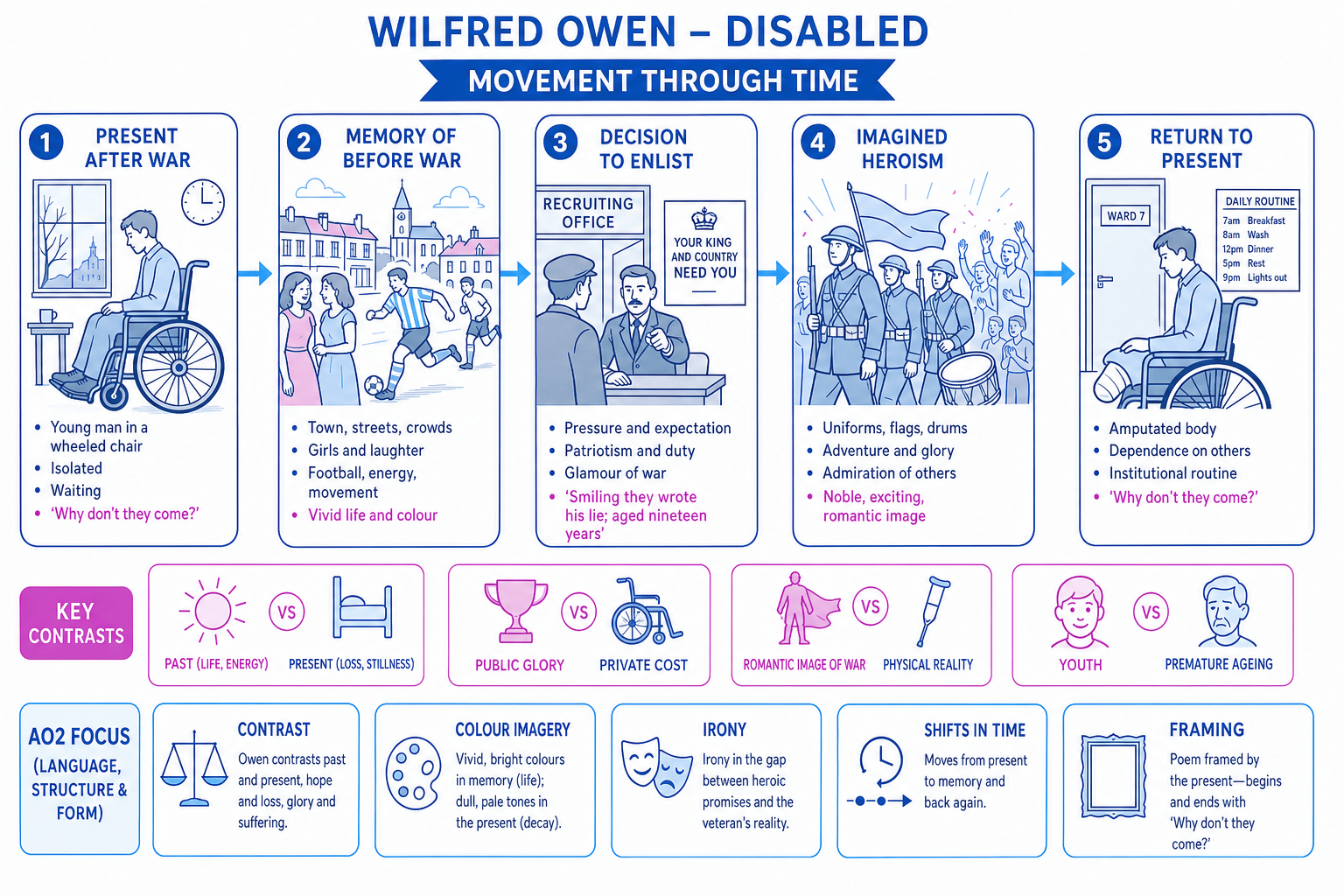
The stanza movement matters because the memories do not comfort him. Instead, they make the present more painful. The reader experiences the contrast as a kind of emotional trap: every memory of youth leads back to what has been lost.
Framing
Framing is when a text begins and ends with related images, settings or ideas. In Disabled, the soldier’s memories are framed by the present reality of waiting, coldness and dependence.
Tone: sorrow, anger and bleakness
Tone means the attitude or feeling created by the writer’s choices. The tone of Disabled is not just sad. It is also bitter, critical and bleak.
The opening is quietly tragic: the soldier is “waiting for dark”, which suggests loneliness and the end of life as well as evening. The middle becomes more ironic and angry as Owen exposes the shallow reasons for enlistment. The ending is deeply bleak because the repeated “Why don’t they come?” leaves him powerless and dependent.
The ending
The final repeated question makes the soldier seem abandoned. Owen does not end with patriotic pride; he ends with a young man waiting for basic care.
Writing about Disabled in an essay
A strong paragraph should combine AO1 and AO2. That means you should make a clear point about Owen’s meaning, support it with a short quotation, and analyse how the language or structure creates that meaning.
Building an analytical paragraph
-
Make a focused point: Owen presents the soldier as prematurely aged by war, even though he is still young.
-
Choose evidence that supports the point: “Now, he is old” is direct and blunt, while “younger than his youth, last year” shows how recently his life changed.
-
Analyse the method: the contrast between “now” and “last year” compresses time, making the transformation feel sudden and shocking.
-
Link back to the whole poem: this supports Owen’s wider criticism of war because the soldier has lost not only limbs but the normal progress of youth into adulthood.
In the exam
-
Begin with a clear argument about Owen’s message: war is exposed as physically destructive and socially hypocritical.
-
Use short quotations and zoom in on individual words such as “grey”, “lie”, “whole”, “pity” and “waiting”.
-
Cover both language and structure: write about imagery and irony, but also the movement from present to past and back again.
Check yourself
- How does Owen contrast the soldier’s life before and after the war?
- Why is “Smiling they wrote his lie; aged nineteen years” such a bitter moment?
- How does the final repeated question shape your view of the soldier’s future?
