What you'll learn
- How to understand the plot, key moments and emotional shifts in The Story of an Hour.
- How Chopin presents freedom, marriage, grief and female independence.
- How to analyse methods such as dramatic irony, symbolism, free indirect discourse and the twist ending.
- How to link your ideas to AO1 and AO2 in a Component 2 Section A essay.
Where this text fits in the course
The Story of an Hour is a prose text from Part 2 of the Pearson Edexcel International GCSE English Anthology.
In the examined route, Component 2 is worth 40% of the qualification. Section A is the Poetry and Prose section, worth 30 marks, and Section B is Imaginative Writing, also worth 30 marks. For this story, your essay mainly rewards:
- AO1: understanding the text, selecting relevant evidence and interpreting ideas.
- AO2: analysing how language, structure and form create meanings and effects.
Theme
A theme is a big idea explored in a text, such as freedom, confinement, marriage, identity or death. In an essay, you should connect themes to the writer’s methods, not just list them.
Quick plot summary
Louise Mallard is told that her husband, Brently Mallard, has died in a railway accident. Because she has “heart trouble”, her sister Josephine and Brently’s friend Richards break the news gently.
At first, Louise reacts with intense grief: she “wept at once, with sudden, wild abandonment”. She then goes upstairs alone to her room. Sitting before an open window, she notices signs of spring and life outside.
Gradually, her feelings shift. Instead of only feeling sorrow, she begins to feel a powerful sense of freedom. She whispers, “free, free, free!” and imagines future years that “would belong to her absolutely”.
Finally, Louise comes downstairs, seeming transformed. But Brently Mallard suddenly enters the house alive. Louise dies. The doctors say she died from “joy that kills”, but the reader understands the bitter irony: the shock is not simply joy, but the destruction of her newly imagined freedom.
This diagram shows the story’s compressed movement from shock to liberation to reversal:
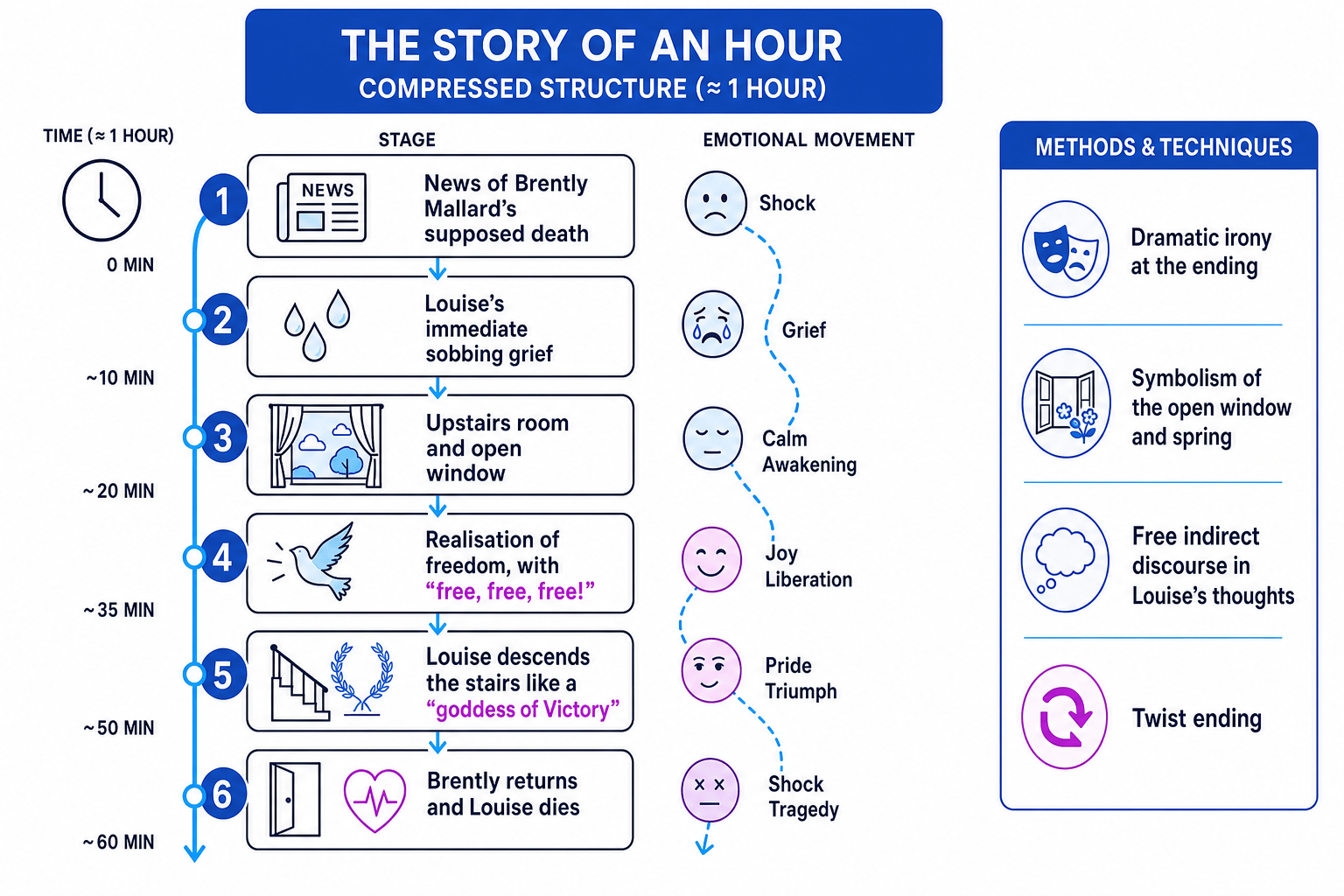
The central movement
The story is not just about a woman receiving bad news. It is about a woman briefly discovering an inner life and future of her own — and then losing it almost immediately.
Context: why marriage matters here
Kate Chopin was writing in the late nineteenth century, when women’s legal, social and financial independence was often limited. Marriage could offer security, but it could also restrict a woman’s freedom and identity.
You do not need to write a history essay. However, it helps to understand that Louise’s reaction is shocking because society expects a wife to feel only grief when her husband dies. Chopin explores the private feelings that might exist beneath socially acceptable behaviour.
Turning context into a separate paragraph
Do not write a paragraph that only says “women had fewer rights in the nineteenth century”. Instead, attach context to a quotation or method, such as Louise imagining years that “would belong to her absolutely”.
Character: Louise Mallard
Louise is introduced through vulnerability: she has “heart trouble”, and others treat her carefully. At first, this makes her seem physically fragile.
However, Chopin complicates this. Louise’s most intense experience in the story is not weakness but awakening. Alone in her room, she recognises a desire for independence that she may not have admitted before.
Her response is morally complex. She does not hate Brently. The narrator says she had loved him “sometimes. Often she had not.” This blunt contrast suggests that the issue is not personal cruelty; it is the structure of marriage itself, where one person’s will may be imposed on another.
Theme: freedom and confinement
Louise’s house becomes a space of both confinement and possibility. Downstairs, she is surrounded by social expectations: family, marriage, news, sympathy. Upstairs, alone, she can recognise her real feelings.
The phrase “free, free, free!” is central. The repetition suggests that the idea is overwhelming, almost physical. It is not a calm political statement; it bursts out of her.
Repetition
Repetition is when a word, phrase or structure is used more than once. Writers use it to create emphasis, rhythm or emotional intensity.
Analysing Louise’s repeated cry
- Start with the exact words: Louise whispers “free, free, free!” after hearing of her husband’s supposed death.
- Notice the method: the repetition of “free” makes the idea feel urgent and uncontrollable, as if it is arriving before she can fully judge it.
- Link to meaning: Chopin suggests that Louise’s deepest response is not simple happiness at Brently’s death, but a sudden recognition of life without control by another person.
- Connect to theme: the moment exposes the conflict between outward marriage and inward independence.
Symbolism: the open window and spring
Symbolism
Symbolism is when a person, object, place or detail represents a larger idea. A symbol still exists literally in the story, but it also carries extra meaning.
The open window is one of the most important symbols in the story. Louise sits facing it after going upstairs. Through it, she sees “the tops of trees that were all aquiver with the new spring life”. Spring suggests renewal, growth and fresh beginnings.
Chopin also includes sensory details: “the delicious breath of rain”, “patches of blue sky”, and birds singing. These images make the outside world feel alive and inviting. The open window therefore symbolises possibility — a future beyond the confined role of wife.
Analysing the open window
- Choose a focused quotation: “open window” and “new spring life” both point towards openness and renewal.
- Identify the pattern: Chopin surrounds Louise’s private awakening with images of fresh air, blue sky, birds and spring.
- Explain the effect: the natural world seems to mirror Louise’s inner change, as if her mind is opening at the same time as the view before her.
- Develop the interpretation: the window is not just scenery; it symbolises the possibility of a life that “would belong to her absolutely”.
The gap between outward grief and inner feeling
At first, Louise behaves as others expect: she cries dramatically. But when she is alone, her feelings become more complicated. Chopin is interested in the difference between public performance and private truth.
This is why the story can feel uncomfortable. Louise’s joy is not presented as simple cruelty. Instead, Chopin asks whether a person can grieve someone and still feel released from the role that person represented.
Complex emotion
Chopin presents Louise’s feelings as mixed: grief, shock, guilt, excitement and liberation can exist together. Strong essays avoid judging her too simply.
Free indirect discourse: entering Louise’s mind
Free indirect discourse
Free indirect discourse is a narrative technique where a third-person narrator slips close to a character’s thoughts and feelings without using direct quotation such as “she thought”.
The story is told in the third person, but the narration often moves very close to Louise’s consciousness. For example, the thought that there would be “no powerful will bending hers” feels like Louise’s inner realisation, even though it is not written as direct speech.
This technique matters because it lets the reader experience her awakening from the inside. We are not simply told that Louise wants freedom; we feel the idea forming and growing inside her.
How to write about free indirect discourse
If you are unsure, describe it simply: “Chopin’s third-person narration moves closely into Louise’s thoughts.” That is often clearer than using terminology without explaining it.
Dramatic irony and the ending
Dramatic irony
Dramatic irony happens when the reader or audience understands something that one or more characters do not.
The ending depends on dramatic irony. The doctors believe Louise died of “joy that kills” because they assume she was overwhelmed by happiness when Brently returned alive. The reader knows this explanation is painfully incomplete.
We understand that Louise has just imagined a life of freedom. Brently’s return destroys that imagined future in an instant. The phrase “joy that kills” is therefore bitterly ironic: the characters name her death as joy, while the story has shown us a much darker truth.
Structure and form: why “an hour” matters
Structure
Structure means how a text is organised: the order of events, shifts in focus, beginnings and endings, pace, contrasts and turning points.
The title tells us that the story’s action takes place within a very short period. This compressed time makes Louise’s emotional journey feel intense and dramatic. In roughly an hour, she moves from shock, to grief, to freedom, to death.
The structure is built around reversals:
- bad news seems to bring grief;
- grief unexpectedly becomes liberation;
- liberation is destroyed by Brently’s return;
- the official explanation of her death is the opposite of what the reader understands.
Twist ending
A twist ending is a conclusion that suddenly changes the reader’s understanding of the story. It often creates surprise, irony or a new interpretation of earlier events.
The twist ending is not only there to shock you. It reveals the gap between how society interprets Louise and what the reader has learned about her inner life.
Tone: sympathy, tension and irony
Tone
Tone is the attitude or mood created by the writer’s language, such as sympathetic, bitter, tense, ironic or celebratory.
The tone shifts across the story. At the start, it is serious and cautious because Louise’s “heart trouble” makes the news seem dangerous. In the bedroom scene, the tone becomes almost lyrical, full of spring imagery and emotional expansion. At the end, the tone becomes sharply ironic.
This tonal movement helps Chopin control the reader’s response. We begin by pitying Louise as a grieving widow, then understand her as someone discovering independence, then feel the cruelty of the final reversal.
Key quotations to know
Use short quotations accurately. You do not need long chunks.
- “heart trouble” — introduces fragility and foreshadows the ending.
- “wept at once, with sudden, wild abandonment” — shows immediate grief.
- “open window” — symbol of possibility and freedom.
- “new spring life” — suggests renewal and awakening.
- “free, free, free!” — central moment of liberation.
- “no powerful will bending hers” — presents marriage as control.
- “would belong to her absolutely” — shows desire for self-ownership.
- “goddess of Victory” — suggests triumph just before the reversal.
- “joy that kills” — final dramatic irony.
Quote briefly but precisely
Do not overload your essay with long quotations. A short phrase such as “free, free, free!” is enough if you analyse the method and effect closely.
Building an AO1 and AO2 paragraph
A strong paragraph should combine interpretation and method. Think: point → evidence → method → effect → link.
Writing about Chopin’s irony
- Make an interpretive point: Chopin uses the ending to expose how little the other characters understand Louise’s inner life.
- Select evidence: the doctors claim she died of “joy that kills”.
- Analyse the method: this is dramatic irony because the reader knows Louise has just experienced the possibility of freedom, while the characters assume she is simply happy to see her husband.
- Explain the effect: the phrase becomes bitter rather than comforting, because it shows society misreading Louise even at the moment of her death.
- Link to the whole story: Chopin therefore presents female independence as so hidden and restricted that it cannot be recognised by the people around Louise.
In the exam
- Begin with a clear argument about the story, such as: Chopin presents Louise’s brief freedom as powerful but tragically fragile.
- Use short quotations and analyse specific methods: symbolism, repetition, free indirect discourse, structure, tone and irony.
- Keep linking back to AO1 and AO2: show that you understand what happens, but focus on how Chopin’s writing shapes the reader’s response.
Check yourself
- How does the “open window” help present Louise’s changing feelings?
- Why is the final phrase “joy that kills” ironic?
- How does Chopin make Louise’s reaction seem complex rather than simply heartless?
