What you'll learn
- How to summarise The Necklace clearly for AO1.
- How Maupassant uses symbol, irony, contrast and structure for AO2.
- How the story explores vanity, class, pride and fate.
- How to write about the final twist without just retelling the plot.
Where this text fits
The Necklace is one of the prose texts in Part 2 of the Pearson Edexcel International GCSE English Anthology. It belongs to the Poetry and Prose part of the course: Component 2 or Component 3 is worth 40% overall. If you are taking the examined Component 2 route, Section A is the 30-mark reading essay, where you need to show understanding of the text and analyse how the writer creates meaning.
AO1 and AO2 for this text
AO1 means showing that you understand the story, can select relevant evidence, and can interpret characters and ideas. AO2 means analysing how Maupassant uses language, structure and literary methods to shape the reader’s response.
The story in a nutshell
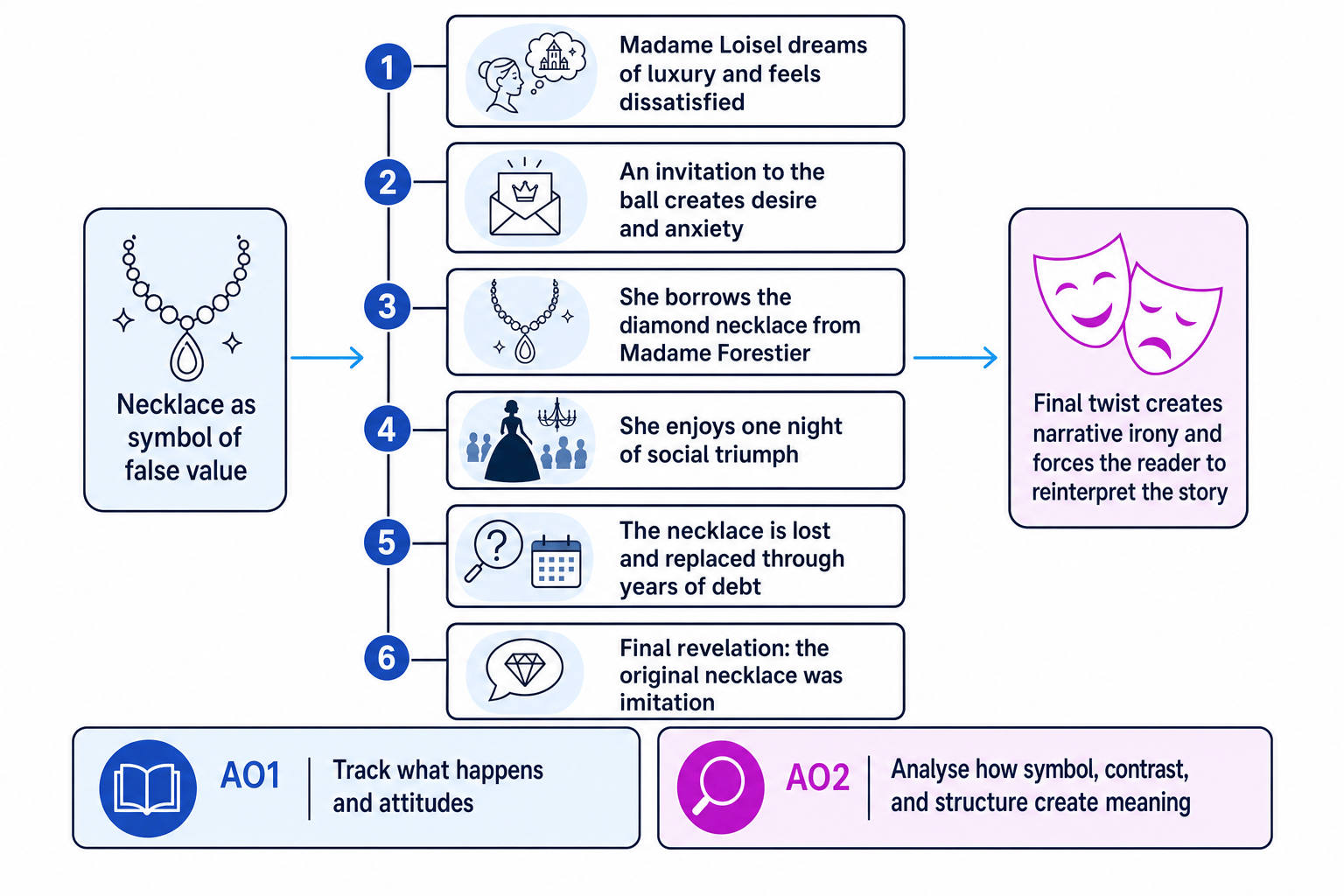
Madame Mathilde Loisel is dissatisfied with her ordinary middle-class life. She longs for luxury, admiration and social importance. When her husband gets an invitation to an important ball, she is unhappy because she has no suitable dress or jewellery. Her husband gives her money for a dress, and she borrows a diamond necklace from her wealthy friend, Madame Forestier.
At the ball, Madame Loisel is admired and feels briefly triumphant. Afterwards, she discovers that the necklace has been lost. Instead of telling Madame Forestier the truth, the Loisels buy a replacement necklace and spend years in poverty repaying the debt. At the end, Madame Forestier reveals that the original necklace was an imitation, worth only a small fraction of the replacement.
The central idea
Maupassant builds the story around a cruel mismatch between appearance and reality: Madame Loisel gives up ten years of her life for an object that only looked valuable.
Characterisation: Madame Loisel
Characterisation
Characterisation is the way a writer presents a character’s personality, values and changes through description, actions, speech and relationships.
Madame Loisel is presented as attractive but deeply unhappy. She believes she deserves a more glamorous life and feels humiliated by ordinary surroundings. Maupassant’s opening makes her dissatisfaction seem intense and constant: she “suffered endlessly” because she felt born for “delicacy and luxury”.
This does not make her purely villainous. She is vain and materialistic, but she is also trapped by a society where women’s status is strongly linked to marriage, appearance and wealth. Her tragedy is that she believes seeming rich will make her truly valuable.
Making Madame Loisel too simple
Do not write only “Madame Loisel is greedy.” A stronger answer sees her as vain, yes, but also insecure, socially ambitious and shaped by a class-conscious society.
The necklace as a symbol
Symbol
A symbol is an object, person or detail that represents a bigger idea beyond its literal meaning.
The necklace is the most important symbol in the story. At first, it seems to represent wealth, beauty and social success. Madame Loisel believes that wearing it will complete the image she wants to present at the ball. However, the final revelation shows that the necklace was fake, so it also represents false value, illusion and the danger of judging by appearances.
The key borrowing scene is especially important. Madame Loisel looks at elegant jewellery such as “bracelets”, “a pearl necklace” and “a Venetian cross”, but she keeps searching until she finds the diamond necklace. Her reaction is physical and emotional: her “heart” beats and her “hands” tremble. Maupassant shows that this is not a calm choice; it is desire taking control.
Analysing the necklace as a symbol
- Start with the precise moment: Madame Loisel rejects several beautiful items and is drawn to the “diamond necklace”, showing that she wants the object that looks most impressive.
- Link the method to character: the list of jewellery suggests abundance, but her continued searching shows restlessness and dissatisfaction rather than gratitude.
- Analyse the physical reaction: references to her “heart” and “hands” show desire affecting her body, as if the necklace has power over her.
- Connect to the ending: when the necklace is revealed as imitation, Maupassant exposes the emptiness of the values Madame Loisel has been chasing.
Themes
Vanity and materialism
Materialism
Materialism is the belief that possessions, wealth and outward display are extremely important.
Madame Loisel’s problem is not simply that she wants comfort. She wants admiration. The ball matters to her because it allows her to be seen as elegant and important. Maupassant criticises a society where appearance can feel more powerful than truth.
Social class and aspiration
Madame Loisel is not destitute at the beginning. Her husband has a respectable job, but she compares herself to richer women and feels deprived. This makes the story more uncomfortable: her suffering partly comes from poverty, but partly from comparison.
The ball briefly allows her to cross class boundaries. She looks like she belongs among the wealthy, but only through borrowed jewellery and borrowed status.
Pride and secrecy
After the necklace is lost, the couple could confess. Instead, they hide the truth and replace it. Their decision seems honourable because they repay what they think they owe, but it is also driven by pride and fear of embarrassment.
A sharper theme sentence
Instead of saying “the story is about lying”, try: Maupassant shows how pride can turn a mistake into a life-changing disaster.
The irony of fate
Irony
Irony is when there is a gap between appearance and reality, expectation and outcome, or what characters understand and what the reader later realises.
The ending is ironic because the Loisels’ huge sacrifice was unnecessary. The necklace that looked priceless was almost worthless. Maupassant makes fate seem cruel: one glamorous evening leads to ten years of hardship.
Structure and form
Linear narrative
A linear narrative tells events mostly in chronological order, from earlier events to later events.
The Necklace is a short story with a clear linear structure: dissatisfaction, invitation, borrowing, ball, loss, debt, revelation. This direct structure helps the twist ending hit harder because the reader follows the Loisels’ suffering step by step.
Twist ending
A twist ending is a final revelation that changes how the reader understands earlier events.
The final line forces the reader to reinterpret the whole story. What seemed like a moral tale about paying for a mistake becomes something more painful: a story about illusion, pride and wasted life.
Explaining the effect of the final twist
- Before the twist, the reader sees the Loisels’ poverty as the consequence of losing a valuable necklace.
- The revelation that the necklace was imitation changes the meaning of the sacrifice: the years of debt were based on a false assumption.
- This creates narrative irony because the ending exposes the gap between what the characters believed and what was actually true.
- The effect is both tragic and satirical: we pity Madame Loisel, but we also see the foolishness of valuing appearances so highly.
Language and tone
Tone
Tone is the attitude or mood created by the writer’s choice of words and details.
Maupassant’s tone shifts across the story. At the start, there is a satirical tone: Madame Loisel’s dreams of luxury are described in a way that exposes her dissatisfaction. During the loss and repayment, the tone becomes harsher and more tragic. The final revelation is brief and devastating, which makes it feel even crueller.
Satire
Satire is writing that criticises human weakness or society, often through irony, exaggeration or humour.
The story satirises a world obsessed with appearances. Madame Loisel wants to look wealthy; the necklace looks valuable; the ball looks like success. But the truth underneath these appearances is fragile.
Because this is a translation
Maupassant wrote in French, and you are studying an English translation. It is still valid to analyse the wording in your anthology, but avoid making big claims about sound patterns or individual word roots unless they clearly work in the translated text you have in front of you.
Key moments to know well
1. The opening dissatisfaction
Madame Loisel’s unhappiness is established before the necklace appears. This matters because the necklace does not create her vanity; it reveals and intensifies it.
2. The invitation to the ball
The invitation should be good news, but she reacts with distress because she has nothing suitable to wear. Maupassant shows that social opportunity can become social anxiety.
3. Choosing the necklace
This is the central symbolic moment. She overlooks other fine jewels and chooses the diamond necklace because it best fits her fantasy of status.
4. The ball
For one evening, she receives the admiration she has dreamed of. This success is temporary and depends on illusion.
5. The years of poverty
The couple’s life changes completely. Madame Loisel becomes physically hardened by work, which contrasts sharply with her earlier dreams of elegance.
6. The revelation
The final reveal is sudden and brief. Maupassant does not give a long moral explanation; he lets the shock do the work.
Writing about the story in Component 2 Section A
A strong paragraph should combine AO1 and AO2: make a clear point about meaning, support it with a short quotation or precise reference, then analyse the writer’s method.
For example, if the question asks about ambition or desire, you could write about the borrowing scene. Madame Loisel’s trembling hands and beating heart show that the necklace has become more than an accessory: it is a fantasy of a different life. The later revelation that it is imitation makes this desire seem tragically misplaced.
In the exam
- Start each paragraph with an idea about Maupassant’s meaning, not just a plot event.
- Use short evidence: one word or phrase is often enough if you analyse it closely.
- Keep linking methods to themes: symbol, contrast, irony, characterisation, structure and tone.
- For the ending, explain how the twist changes the reader’s understanding of the whole story.
Check yourself
- Why is the necklace a symbol of false value?
- How does Maupassant make Madame Loisel both flawed and pitiable?
- What changes in the reader’s understanding after the final revelation?
