What you'll learn
- What happens in Kari Herbert’s extract and why her feelings are divided.
- How Herbert uses language, structure and tone to present the narwhal hunt.
- How the extract explores survival, nature, culture and moral conflict.
- How to write about this text for AO1, AO2 and AO3 in Component 1 Section A.
The basics: what kind of text is this?
The Explorer’s Daughter is a non-fiction text, meaning it is based on real people, places and experiences. Kari Herbert writes partly as a traveller, partly as a memoir writer, and partly as an observer of a culture she knows personally.
Memoir
A memoir is a form of life writing in which a writer recalls real experiences, often shaping them to explore memory, identity, place and personal reflection.
This extract is from Anthology Part 1, so it can appear in Component 1: Non-fiction Reading and Transactional Writing. Component 1 is worth 60% of the qualification. In the exam, Section A is worth 45 marks and assesses reading: AO1, AO2 and AO3.
Quick summary of the extract
Herbert describes watching an Inughuit narwhal hunt in the Arctic. The Inughuit rely on hunting for survival in an extreme environment, so the hunt is not presented as sport or cruelty for its own sake.
At the same time, Herbert is emotionally troubled. She sees the narwhal as beautiful, rare and almost magical — often associated with the idea of the “unicorn of the sea” — so watching it being hunted creates a powerful moral conflict.
The central conflict
The extract is powerful because Herbert does not give a simple opinion. She understands the Inughuit need to hunt, but she also feels sympathy for the narwhal.
AO1: understanding Herbert’s viewpoint
AO1 rewards your ability to understand, select and interpret information from the text. For this extract, that means you must show that Herbert’s attitude is balanced rather than one-sided.
Viewpoint
A viewpoint is the writer’s attitude or perspective towards a subject. In this extract, Herbert’s viewpoint is divided: she respects the hunters but feels sorrow for the animal.
You should be able to explain:
- The Inughuit live in a harsh Arctic environment.
- Hunting is connected to food, tradition and survival.
- Herbert admires their skill, patience and knowledge of nature.
- Herbert also finds the death of the narwhal upsetting.
Explaining Herbert’s divided feelings
- Start with what is explicit: Herbert is observing a narwhal hunt carried out by Inughuit hunters in the Arctic.
- Interpret the cultural context: because the hunters depend on animals for food and survival, the hunt is presented as necessary rather than casual violence.
- Balance this with Herbert’s emotional response: her admiration for the narwhal’s beauty makes the killing difficult for her to witness.
- Combine both sides into a clear AO1 interpretation: Herbert respects the hunters’ way of life while feeling personally disturbed by the suffering of the narwhal.
Main themes
Survival
The Arctic setting is extreme. Food is difficult to obtain, and traditional hunting is part of how the Inughuit survive. Herbert encourages the reader to see the hunt in its real context, not through a comfortable outsider’s assumptions.
This matters because the extract challenges a simple modern reaction such as “hunting is wrong”. Herbert asks you to consider necessity, not just emotion.
Humans and nature
The Inughuit are shown as closely connected to the natural world. They understand animal movements, weather, sea conditions and the patience required to hunt successfully.
This relationship is not sentimental. Nature is beautiful, but it is also demanding. Humans depend on it, and animals may die so people can live.
Cultural understanding
Herbert writes with respect for Inughuit culture. She avoids presenting herself as morally superior. Instead, she tries to understand the hunt from within its own environment and traditions.
Judging instead of analysing
Do not write only, “The hunt is cruel.” That may be your personal view, but the exam rewards analysis of Herbert’s writing. Show how she presents both the need for the hunt and her emotional discomfort.
Moral conflict
The most important theme is moral conflict, which means being pulled between two opposing ethical feelings. Herbert knows the hunt has a purpose, but she cannot ignore the beauty and vulnerability of the narwhal.
AO2: language methods
AO2 rewards analysis of how writers use language and structure to create meanings and effects. You should name techniques only when they help you explain Herbert’s ideas.
Imagery
Imagery is descriptive language that helps the reader imagine something vividly, often by appealing to the senses or using comparisons such as metaphor and simile.
Vivid landscape description
Herbert presents the Arctic as vast, beautiful and remote. Descriptions of the sea, ice, light and animal movement help create a setting that feels both magnificent and fragile.
This makes the hunt feel more intense. The natural world is not just a background; it is the environment that controls the lives of both humans and animals.
Contrast between beauty and brutality
A major method in the extract is contrast.
Contrast
Contrast is when a writer places two different ideas, images or feelings close together so that the difference between them becomes more striking.
Herbert contrasts:
- the grace and beauty of the narwhal with the violence of the hunt
- the stillness of waiting with the sudden action of pursuit
- her respect for the Inughuit with her sadness for the animal
- the practical need for food with the emotional cost of killing
This contrast is why the extract feels tense and uncomfortable.
Analysing contrast in Herbert’s viewpoint
- Identify the two sides being contrasted: the narwhal is presented as extraordinary and beautiful, while the hunt is practical, physical and violent.
- Link the contrast to Herbert’s feelings: the more wonderful the narwhal seems, the harder it is for her to accept its death.
- Connect the method to meaning: Herbert uses contrast to show that survival in the Arctic involves moral complexity, not simple right and wrong.
- Extend the effect on the reader: we are encouraged to feel both admiration for the hunters and sympathy for the hunted animal.
Specific detail and authenticity
Herbert includes precise details about the hunt, the environment and the Inughuit way of life. These details make the writing feel authentic and respectful.
Specific detail also supports her balanced viewpoint. She does not just describe her emotions; she gives the reader enough context to understand why the hunt matters.
Balanced language
Herbert’s language does not turn the hunters into villains. Instead, she often presents them as skilled, patient and deeply connected to their environment. This balanced language is important because it prevents the extract from becoming a simple anti-hunting argument.
Best AO2 habit
Use the pattern method → meaning → effect. Name the method, explain what it suggests, then explain how it shapes the reader’s response.
Structure: how the extract builds tension
The structure of the extract moves from context, to waiting, to action, to reflection. This helps the reader experience the hunt as a slow build-up rather than a sudden event.
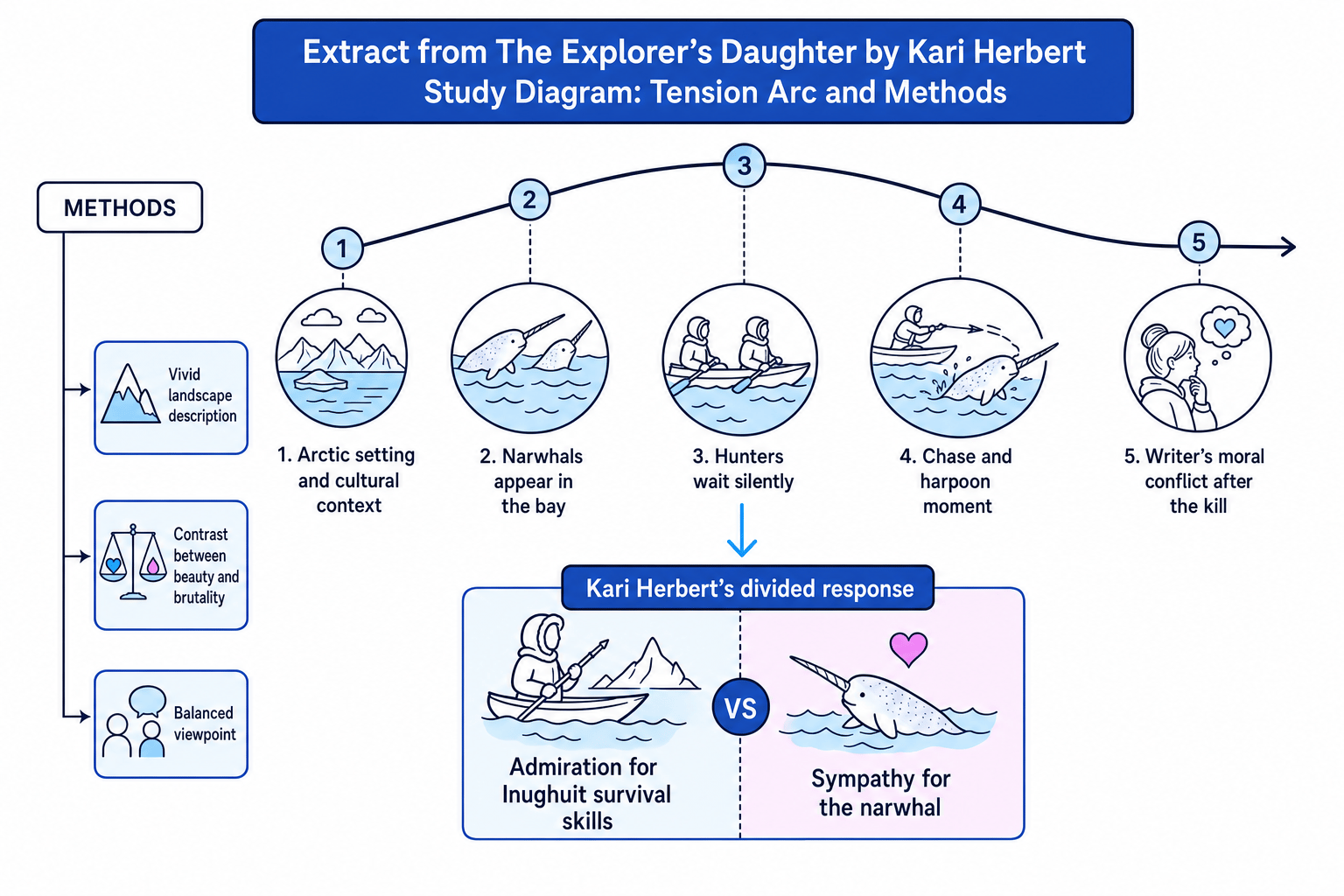
Opening: context and understanding
The extract first helps us understand the Arctic environment and the Inughuit relationship with hunting. This slows the pace and gives the reader background before the hunt itself.
Middle: waiting and anticipation
The waiting creates tension. The hunters must be patient and alert. Herbert’s focus on stillness makes the reader expect something sudden to happen.
Climax: the hunt
When the narwhals appear and the hunt begins, the pace becomes more urgent. The movement from stillness to action makes the violence more dramatic.
Ending: reflection
After the hunt, the focus returns to Herbert’s thoughts. This reflective ending is important because the extract is not just about what happened; it is about what the experience made her feel and question.
Explaining how tension is built
- Notice the structural shift: Herbert begins with context and observation rather than immediate action, so the reader understands the importance of the hunt before it happens.
- Track the pace: the slow waiting makes the moment when the narwhals appear feel more dramatic.
- Analyse the contrast: calm sea and patient hunters make the sudden chase feel sharper and more unsettling.
- Link to the ending: the reflective conclusion leaves the reader thinking about the moral difficulty rather than simply the excitement of the hunt.
Tone: what the writing feels like
Tone
Tone is the mood or attitude created by the writer’s language, such as respectful, tense, reflective or shocked.
The tone changes across the extract:
- Respectful when Herbert explains Inughuit culture.
- Awe-filled when she presents the Arctic landscape and the narwhal.
- Tense during the waiting and hunt.
- Reflective and uneasy when she considers the moral problem.
This shifting tone mirrors Herbert’s divided feelings.
Key moments to remember
The Arctic setting
The landscape establishes scale, danger and beauty. It reminds us that the hunt happens in a place where survival is difficult.
The appearance of the narwhal
The narwhal is not presented as ordinary prey. Its beauty and rarity make the hunt emotionally charged.
The hunters waiting
This moment shows discipline, patience and traditional skill. It also builds suspense.
The kill and aftermath
This is where Herbert’s moral conflict becomes strongest. She understands why the hunt happens, but she cannot be emotionally detached from the animal’s death.
AO3: making comparisons
AO3 rewards your ability to explore links and connections between writers’ ideas and perspectives. In Component 1 Section A, you may need to compare this anthology text with an unseen non-fiction text.
For The Explorer’s Daughter, useful comparison angles include:
- attitudes to nature
- presentation of danger
- respect for different cultures
- emotional conflict
- survival in extreme conditions
- whether the writer is an insider, outsider or both
A strong comparison does not just say “both texts are about nature”. It explains how each writer presents nature and why their perspectives differ.
Comparison phrase bank
Useful phrases include: Whereas Herbert…, Similarly, the unseen writer…, In contrast…, Both writers present…, but Herbert focuses more on…
Mini paragraph model
Herbert presents the hunt as morally complex by contrasting the beauty of the narwhal with the practical needs of the Inughuit. The association of the narwhal with the “unicorn of the sea” makes the animal seem rare, magical and innocent, which increases the reader’s sympathy for it. However, Herbert also gives cultural and environmental context, showing that hunting is connected to survival rather than entertainment. This balanced presentation encourages the reader to respect the hunters while still feeling the emotional discomfort that Herbert herself experiences.
In the exam
- For AO1, show that you understand Herbert’s divided viewpoint: respect for the Inughuit and sympathy for the narwhal.
- For AO2, analyse methods such as contrast, vivid imagery, tension, pace and reflective tone — always link them to meaning.
- For AO3, compare perspectives, not just topics: ask how each writer feels about nature, survival, danger or moral responsibility.
Check yourself
- Can you explain why Herbert does not present the hunt as simply cruel?
- Which language methods make the narwhal seem beautiful or special?
- How does the structure move from context, to tension, to reflection?
