What you'll learn
- How to summarise Morris’s article clearly for AO1.
- How the headline, quotations, tone and structure shape the reader’s judgement for AO2.
- How to discuss the article’s themes: risk, responsibility, public money and heroism.
- How to connect this text to an unseen non-fiction text for AO3 in Component 1 Section A.
Where this text fits in the exam
This article is from Part 1 of the Pearson Edexcel International GCSE English Anthology, so it can appear in Component 1: Non-fiction Reading and Transactional Writing. Component 1 is worth 60% of the qualification. In that paper, Section A is 45 marks for reading and Section B is 45 marks for transactional writing.
For this text, the most relevant reading skills are:
- AO1: understanding the article and selecting relevant details.
- AO2: analysing how Morris uses language and structure.
- AO3: comparing Morris’s ideas and perspective with an unseen non-fiction text.
Quick summary of the article
Steven Morris reports on the rescue of two adventurers whose expedition has gone wrong. The rescue raises an uncomfortable question: should daring individuals be praised as brave explorers, or criticised as reckless people whose risks create costs for the public?
The article does not simply say “adventure is bad”. Instead, Morris frames the incident as a debate. He presents facts about the rescue, includes voices and viewpoints, and encourages the reader to consider who should pay when private adventure requires public rescue.
The central debate
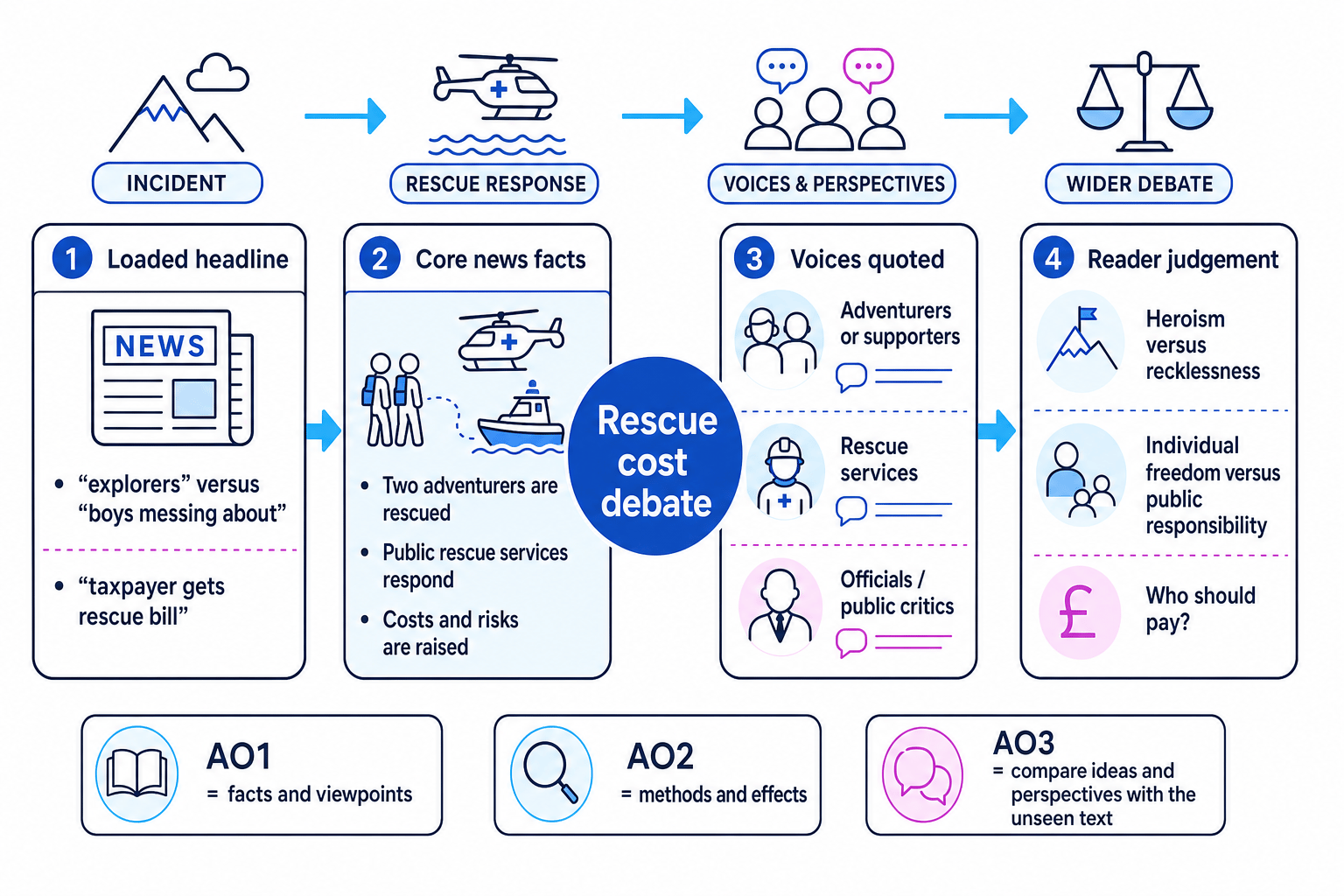
Morris turns a rescue story into a public argument: adventurous risk may look heroic, but when rescue services and taxpayers become involved, it also becomes a question of responsibility.
The diagram below shows how the article moves from a single incident to a wider debate about public cost and personal freedom.
The headline: loaded, balanced and judgemental
The headline is the most important starting point:
“Explorers, or boys messing about? Either way, taxpayer gets rescue bill”
A headline is the title of a newspaper article. It is designed to catch attention, but it also signals the article’s angle — the way the topic is being presented.
Loaded language
Loaded language means words or phrases that carry strong associations and push the reader towards a particular reaction.
The word “Explorers” suggests courage, ambition and discovery. It sounds noble. By contrast, “boys messing about” sounds childish, casual and irresponsible. Morris places these two possible labels side by side, forcing the reader to ask which one is more accurate.
Juxtaposition
Juxtaposition means placing two contrasting ideas close together so that the difference between them becomes more noticeable.
Here, the juxtaposition of “Explorers” and “boys messing about” creates the article’s main tension: are these men heroic adventurers or immature risk-takers?
Analysing the headline
- The noun “Explorers” has positive connotations of bravery, discovery and human ambition, so it offers one possible heroic view of the men.
- The phrase “boys messing about” uses informal, dismissive language, making the adventurers sound immature rather than impressive.
- The phrase “Either way” reduces the importance of that heroic-versus-foolish debate, suggesting the practical consequence is the same.
- The phrase “taxpayer gets rescue bill” shifts attention from the adventurers’ experience to the public cost, making the reader consider fairness and responsibility.
Only spotting the technique
Do not just write “the headline uses juxtaposition”. Explain what is being contrasted, then connect it to the article’s debate about heroism, recklessness and public expense.
Themes in the article
Risk and adventure
The article recognises that exploration involves danger. Without risk, adventure would not seem impressive. However, Morris questions whether all risks deserve admiration, especially when others must respond if something goes wrong.
The article therefore presents risk as double-edged: it can be exciting and courageous, but it can also be selfish if the consequences fall on rescuers and taxpayers.
Responsibility
A major theme is responsibility, meaning who should be accountable for the consequences of an action. The adventurers choose to take the risk, but the rescue services must act when they are in danger.
This creates an ethical problem: rescue services exist to save lives, but should people who deliberately take extreme risks contribute to the cost?
Public expense
The phrase “taxpayer gets rescue bill” makes money central to the article. Morris frames the rescue not just as a dramatic survival story, but as something funded by ordinary members of the public.
This makes the issue feel wider than one failed expedition. The article asks whether public resources should be used for private adventures.
Heroism versus recklessness
Morris does not present one simple answer. The title’s question — “Explorers, or boys messing about?” — sets up two possible interpretations. The men can be seen as brave because they attempt something difficult, but they can also be seen as reckless because their actions create danger and cost.
Theme sentence starter
A strong theme sentence could begin: Morris presents exploration as admirable only when it is balanced with responsibility for its consequences.
Writer’s methods: how Morris shapes the reader’s view
1. Factual reporting with implied judgement
Implied judgement
Implied judgement means the writer does not directly state an opinion, but guides the reader towards one through selection, wording and structure.
Morris writes in the form of a newspaper report, so he includes factual information and references to real people and services. However, the angle of the article is not neutral. By foregrounding the “rescue bill”, he encourages the reader to judge the adventurers through the lens of cost and responsibility.
This is more subtle than simply insulting the men. Morris allows the facts, headline and selected viewpoints to do much of the judging.
2. Quotation of sources
A source is a person, organisation or document that provides information for a news article. A direct quotation gives someone’s exact words.
Morris uses quoted voices to make the article feel balanced and credible. Quotation can also create debate because different people may represent different viewpoints: the adventurers’ perspective, the rescue services’ duty, and the public concern about cost.
Quotations are important in non-fiction because they can:
- add authority;
- show different perspectives;
- make the issue feel real rather than abstract;
- allow the writer to imply judgement without stating it directly.
Assuming quotations are automatically neutral
Including different voices can make an article look balanced, but the writer still controls which quotations appear, where they appear, and what effect they have on the reader.
3. Contrast in tone
Tone
Tone means the writer’s attitude towards the subject, created through word choice, sentence style and selection of detail.
The tone of this article is partly factual, because Morris is reporting a real rescue. But it is also sceptical and lightly ironic. The headline’s contrast between “Explorers” and “boys messing about” makes the reader question the glamour of adventure.
A useful tone description would be: measured but sceptical. Morris does not rant, but he does make the reader doubt whether the adventurers should be treated as heroes.
Choosing tone words
Avoid vague tone words like “good” or “bad”. For this article, better options include sceptical, questioning, ironic, critical, balanced or matter-of-fact — but always support the word with evidence.
Structure: how the article develops
The article uses a typical news-report structure. It begins with the dramatic issue: the rescue and the cost. It then widens out into a debate about responsibility.
Structure
Structure means the order and organisation of ideas across a text, including openings, shifts, contrasts, endings and the placement of viewpoints.
The opening frames the issue
The headline frames the whole article before the report even begins. The reader is prepared to judge the adventurers through two competing labels: heroic explorers or childish risk-takers.
The body develops competing perspectives
As the article continues, Morris moves between facts and viewpoints. This gives the piece momentum: it is not only “what happened?” but also “what should we think about what happened?”
The wider debate becomes more important than the rescue
By focusing on the rescue bill, Morris shifts the article from individual drama to public consequence. The ending leaves the reader thinking about policy, fairness and moral responsibility, not just the survival of the two men.
Explaining structural development
- At the start, the headline creates a binary choice between admiration and criticism: “Explorers” or “boys messing about”.
- The article then grounds that debate in a real rescue, so the issue becomes practical rather than purely theoretical.
- As Morris introduces cost and public services, the focus widens from the adventurers themselves to the people affected by their choices.
- This structure encourages the reader to move from curiosity about the incident to judgement about whether such risks are fair on others.
Key moments to remember
The headline’s question
The question in the headline is the article’s clearest expression of its central issue. It makes the reader decide how the adventurers should be framed.
The phrase “Either way”
This is a small phrase, but it matters. It suggests that whether the men are heroic or foolish, the result is still a public rescue cost. It makes the financial consequence seem unavoidable.
The focus on “taxpayer”
The word “taxpayer” turns the public into a character in the story. Instead of the rescue being only about the adventurers and rescuers, it becomes about ordinary people paying for the consequences.
How to write about this text for AO2
For AO2, do not retell the article. Analyse how Morris creates meaning.
A strong analytical paragraph usually does three things:
- identifies a method;
- uses a short quotation;
- explains the effect in relation to the writer’s viewpoint.
For example:
Morris uses juxtaposition in the headline to frame the adventurers in two sharply different ways. The term “Explorers” suggests courage and ambition, while “boys messing about” sounds childish and dismissive. This contrast makes the reader question whether the men deserve admiration or criticism. However, the phrase “taxpayer gets rescue bill” shifts attention away from their personal bravery and towards the public cost, suggesting that private adventure becomes morally complicated when others have to pay for the rescue.
Best AO2 focus
The strongest point to make is that Morris’s judgement is created through framing: he uses contrast, loaded language, structure and quoted viewpoints to make the reader weigh admiration against criticism.
How this helps with AO3 comparison
In Component 1 Section A, you may need to compare this anthology text with an unseen non-fiction text. AO3 rewards your ability to explore links and connections between writers’ ideas and perspectives.
For this article, the most useful comparison areas are:
- attitudes to adventure;
- whether risk is presented as admirable or irresponsible;
- how writers present public duty or personal freedom;
- whether the writer sounds celebratory, critical, balanced or questioning.
Do not simply write, “Both texts are about adventure.” That is too broad. Instead, compare the writers’ viewpoints.
A stronger comparison would be: Morris presents adventure as socially accountable because the public may bear the cost, whereas another writer might present exploration as personally inspiring or morally valuable.
In the exam
- Start with the writer’s viewpoint: decide whether Morris is admiring, critical, sceptical or balanced about the adventurers.
- Use short quotations from the headline and article; focus on words like “Explorers”, “boys messing about” and “taxpayer” because they carry the debate.
- For AO2, always link method to meaning: explain how language, quotation or structure shapes the reader’s judgement.
- For AO3, compare perspectives, not just topics: ask how each writer frames risk, responsibility and public cost.
Check yourself
- How does the headline create two different ways of seeing the adventurers?
- Why is the word “taxpayer” important to the article’s argument?
- How could you compare Morris’s view of adventure with a text that presents exploration more positively?
