Welcome to your study guide for George Alagiah’s powerful autobiographical extract, A Passage to Africa. This text is a key part of your Pearson Edexcel International GCSE English Language A Anthology (Part 1) and is assessed in Component 1, Section A (Non-fiction Reading).
In the exam, you will need to apply your reading skills to answer detailed analysis questions on this text (specifically the 12-mark AO2 Question 4) and compare its themes and perspectives with an unseen non-fiction extract (the 22-mark AO3 Question 5).
What you'll learn
- How Alagiah structures his text to shift from a detached report to a deeply personal moral confession.
- How to analyse Alagiah’s linguistic choices, including sensory imagery, juxtaposition, and rhetorical questions (AO2).
- How to link the writer's presentation of suffering, dignity, and journalistic ethics directly to the Edexcel assessment objectives.
Context and Overview (Prerequisites)
Before diving into the language, you must understand the context. George Alagiah (1953–2023) was a highly respected BBC foreign correspondent. In 1992, he travelled to Gedo, Somalia, to report on the devastating famine and civil war.
While news reports typically focus on the cold statistics of a crisis, Alagiah's written account is highly reflective. It moves beyond the clinical reporting of tragedy to question the very morality of his profession.
The Paradox of the Journalist
Alagiah explores a profound moral conflict: to do their job and provoke public action, journalists must hunt down and exploit the most shocking images of human misery. In doing so, they risk stripping their subjects of their dignity, turning suffering into a spectator sport.
Key Themes: Exploring AO1 and AO3
To hit your AO1 (understanding and selection) and AO3 (comparison of perspectives) criteria, you must be comfortable discussing the primary thematic threads running through the extract.
1. Suffering and the Loss of Dignity
Alagiah does not sanitise the horrors of the famine. He presents suffering not as an abstract concept, but as a physical, degrading reality.
- The physical decay: He describes people "dying in the heat", the "smell of decaying flesh", and bodies that are "gently rotting".
- Loss of bodily control: The description of Habib Adan’s daughter, who has "dirt on her hot cheek" and whose mother wipes her bottom with a "few old leaves", highlights how extreme poverty robs humans of their most basic hygiene and privacy.
2. The Ethics of Journalism (The 'Ghoulish' Observer)
Alagiah uses unsettling language to describe himself and his colleagues. He portrays journalists as predators who feed on the misery of others.
- He notes that "the comfort received from the ghoulish manner of journalists" is a strange phenomenon.
- The word "ghoulish" suggests a dark, monster-like figure that feeds on the dead.
- He refers to the reporter's job as a "hunt" for "the most disgusting, the most degenerate, the most terrible images." This hunting metaphor frames the victims as prey and the journalists as predators.
The Gaze
In media and literary studies, the "gaze" refers to the power dynamic established when one person (typically wealthy, secure, or Western) looks at another (typically vulnerable, suffering, or marginalized). The "gaze" can objectify the subject, reducing them to a two-dimensional symbol of pity.
3. Power Dynamics and the Power of the 'Smile'
The structural and emotional pivot of the entire piece is Alagiah's encounter with an unnamed Somali man. For a brief second, their eyes meet, and the man smiles. This smile completely reverses the traditional power dynamic:
- Typically, the journalist holds the power (health, wealth, the ability to leave).
- The man’s smile is not one of joy, but of embarrassment at his own physical degradation.
- This sudden flash of shared humanity humbles Alagiah, forcing him to see his own relative privilege as "an insult" to the man's suffering.
Structural Journey: From Observer to Equal
Alagiah structures his memoir beautifully, moving from a wide-angle, clinical lens to an intensely intimate, self-reflective focus.
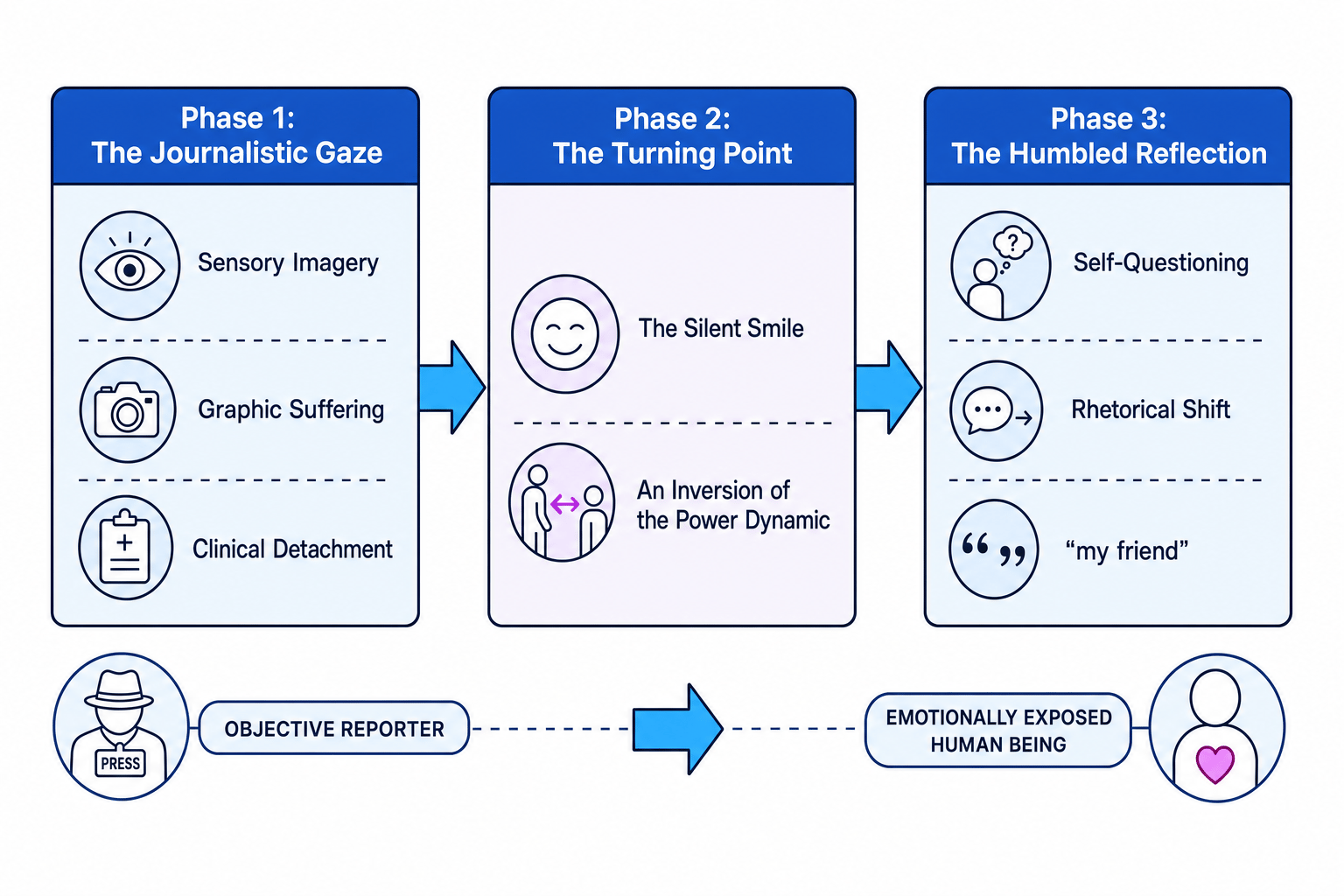
This structural journey can be broken down into three distinct phases:
- Phase 1: The Collective Gaze (Paragraphs 1–2): Alagiah starts with the scale of the tragedy ("a thousand hungry, lean, scared and betrayed faces") but immediately tells us that only "one face" remains with him. This structural hook prepares us for a transition from the general to the specific.
- Phase 2: The Vignettes of Suffering (Paragraphs 3–10): He introduces us to individual stories (Habib Adan, the grandmother, Amina Moghe Liran). This humanises the statistics, using raw sensory descriptions to shock the reader's conscience.
- Phase 3: The Internal Shift (Paragraphs 11–18): The introduction of the "smiling man" shifts the narrative focus from physical suffering to Alagiah's internal moral crisis. The final paragraph marks a complete emotional surrender, ending with a direct address to his "friend."
Writer’s Methods: AO2 Language and Style
To score highly on Question 4 (AO2), you must show how Alagiah uses language and structure to create meaning. Do not just name-drop techniques; show how they construct Alagiah's perspective.
Sensory Imagery
Alagiah relies heavily on olfactory (smell) and tactile (touch) imagery to break through the reader's complacency.
- The olfactory impact: "the smell that draws you to her... the smell of decaying flesh." Smell is the hardest sense to ignore; it bypasses intellectual detachment and forces a visceral, physical reaction from the reader.
- The contrast of temperature: He describes a "cold, cold hand" and "dirt on her hot cheek", using simple, stark tactile contrasts to emphasize the threshold between life and death.
Rhetorical Questions and Syntax
As Alagiah’s professional certainty crumbles, his sentences become more fragmented, and he begins to question himself.
- Short, dramatic sentences: "And then there was the face I will never forget." This monosyllabic simplicity halts the reader and signals a major shift in tone.
- Rhetorical questioning: "What was it about that smile? I had to find out. I ordered my photographer to stop...". This sequence of short, urgent sentences and questions mirrors his internal disorientation. He is no longer the calm, collected reporter directing the scene; he is unsettled and searching for answers.
The Power of Juxtaposition and Word Choice
Alagiah uses highly deliberate word pairings to highlight the moral dissonance of his work.
- "The craving for a soft target": The word "craving" suggests an almost addictive, primal hunger on the part of the media, contrasting sharply with the literal hunger of the Somali people.
- "A rich man's luxury": He describes feeling "pity" as a luxury. This provocative oxymoron forces the reader to realize that even our feelings of sadness for others are a product of our safe, wealthy lifestyles.
Analysing language and structure for AO2
Read the following extract from Paragraph 10:
"the hunt for the most disgusting, the most degenerate, the most terrible images"
Here is a step-by-step walk-through of how to construct a high-scoring analytical point for your 12-mark AO2 question.
- Identify the core technique and state its immediate effect: Locate the key linguistic feature—here, the metaphorical noun "hunt" combined with the tripartite structure (rule of three) of superlative adjectives ("most disgusting, most degenerate, the most terrible"). State how this reveals Alagiah's critical perspective on his own profession.
- Analyse the specific word choices in detail: Focus on the word "hunt". This noun carries strong connotations of predatory behavior, bloodsports, and tracking down helpless prey. By framing photojournalism as a "hunt," Alagiah implies that the media dehumanises the vulnerable Somali people, viewing them merely as targets or trophies to be captured on camera.
- Connect the grammar and syntax to the writer’s purpose: Look at the cumulative effect of the superlative adjectives "most disgusting, most degenerate, the most terrible". The repetition of "most" creates an escalating tone of desperation and sensationalism. It highlights how the media's appetite is never satisfied; journalists must constantly find increasingly extreme levels of misery to shock a desensitised Western audience. This structural buildup emphasizes Alagiah’s underlying feelings of shame and complicity.
Feature Spotting without Purpose
A common pitfall is listing techniques (e.g., "Alagiah uses an oxymoron when he says 'comfort received from the ghoulish manner'") without explaining how that technique shapes meaning. Always ask yourself: "Why did the writer choose this specific word, and what does it make the reader feel or realize?"
Preparing for the AO3 Comparison
When comparing this text to an unseen non-fiction piece in Question 5, look at how both writers position themselves. Is Alagiah an active participant or a passive observer? How does his attitude change from the beginning to the end compared to the writer of the unseen text?
In the exam
- Track the shift in tone: When writing about structure, clearly divide your essay to show how Alagiah moves from clinical, descriptive paragraphs (AO2 sensory language) to intense, introspective reflection (the moral climax of the smile).
- Deconstruct the final sentence: Spend time analyzing the closing line: "I resolved to write the story of Gedo with all the power and purpose I could muster. It’s custom, also, to inquire about the writer. I videoed him, I spoke to him, but in the end, I was humbled. To the man who smiled, my friend: I owe you one." Note the transition from professional terminology ("write the story", "custom") to a deeply personal, intimate colloquialism ("my friend", "I owe you one"), which breaks down the professional distance completely.
- Integrate short, precise quotes: Avoid long block quotes. Instead, weave single words or short phrases directly into your sentences (e.g., Alagiah describes himself as a "journalist" who feels "shame" when confronted by the quiet "dignity" of his subject).
Check yourself
- Why does Alagiah use the word "ghoulish" to describe himself and other foreign correspondents?
- How does the structure of the text mirror the movement from a wide-angle news report to a deeply personal, singular encounter?
- What are the three distinct meanings behind the "smile" of the dying man, and why did this smile affect Alagiah so profoundly compared to all the other suffering he witnessed?
