What you'll learn
- What Adichie means by “a single story” and why it is dangerous.
- How she uses anecdote, repetition, irony and rhetorical patterning to persuade.
- How the structure of the speech builds from personal memory to a global argument.
- How to write about this text for AO1, AO2 and AO3 in Component 1 Section A.
Where this text fits in the exam
This is a Part 1 anthology non-fiction text for Pearson Edexcel International GCSE English Language A.
In Component 1, Section A is worth 45 marks and tests non-fiction reading. You will answer on an unseen non-fiction text and one of the Part 1 anthology texts, such as Adichie’s The Danger of a Single Story. Section B is transactional writing, also worth 45 marks. Component 1 is worth 60% of the qualification.
For this text, you mainly need to show that you can understand Adichie’s ideas and perspectives for AO1, analyse her language and structure for AO2, and connect her perspective with another writer’s ideas for AO3.
The big idea: what is a “single story”?
Single story
A single story is a narrow, repeated version of a person, place or group that makes them seem simpler than they really are. It becomes dangerous when it is treated as the whole truth.
Adichie’s central argument is that stereotypes are not always completely false; the problem is that they are incomplete. She says, “The single story creates stereotypes,” and “they make one story become the only story.”
That distinction is important. She is not saying stories are bad. She is saying that when one story dominates, it can remove complexity, dignity and equality from the people being described.
The main message
Adichie argues that we need many stories about people and places, because many stories restore complexity and help us see others as fully human.
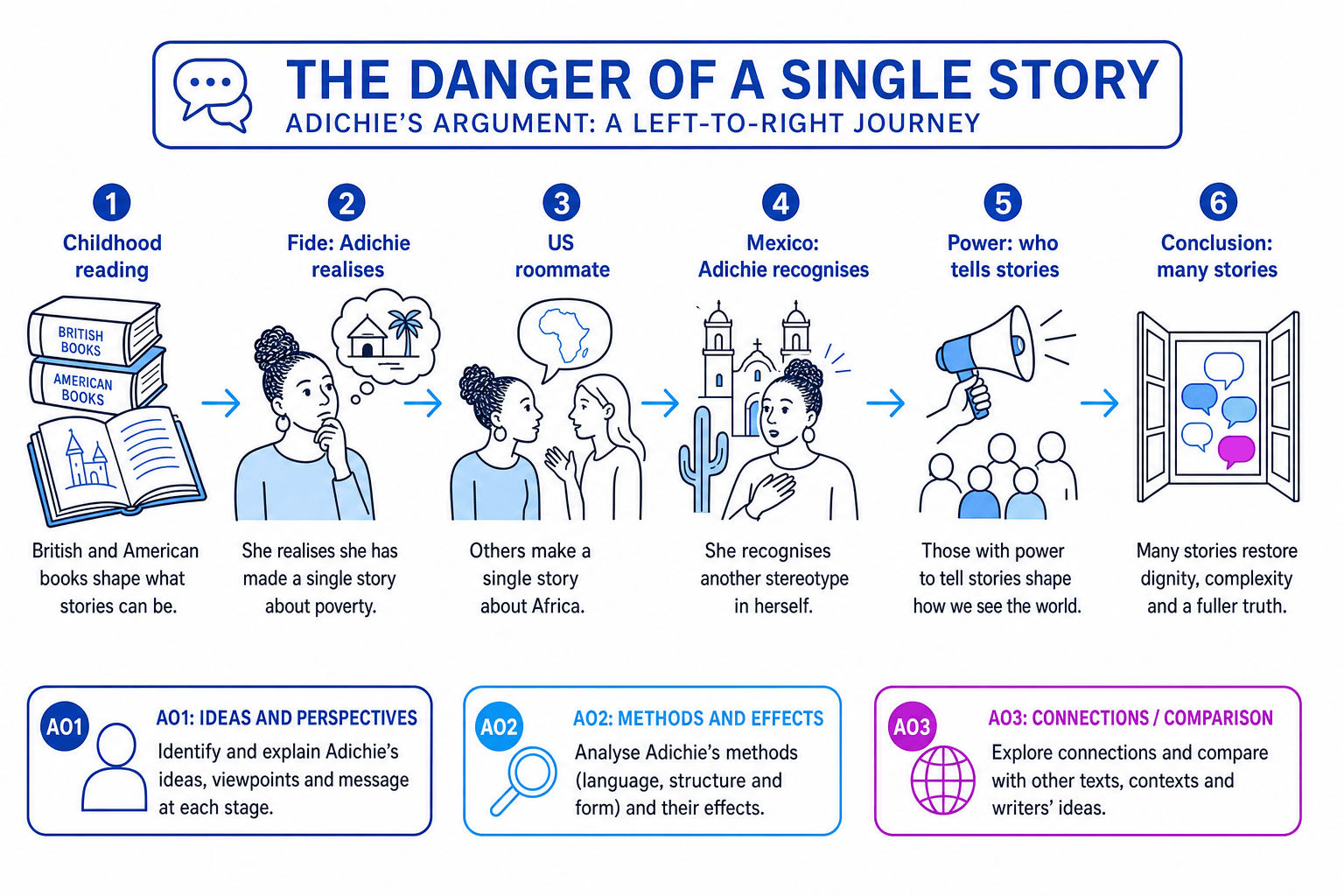
Summary of the extract
Adichie begins with herself as a child reader and writer in Nigeria. She explains that she read British and American children’s books, so her own early stories contained characters who were “white and blue-eyed,” played “in the snow” and ate “apples,” even though these details did not match her own life.
This shows how easily stories shape imagination, especially when you are young. Adichie later discovers African writers, which helps her realise that “people like me could exist in literature.”
She then gives a story about Fide, a boy whose family worked for her family. Because she had only heard that his family was poor, she was surprised when his brother made a beautiful basket. She realises that poverty had become her “single story” of them.
Later, when she moves to the United States, her American roommate has a single story of Africa. The roommate assumes Adichie will not speak English well, will listen to “tribal music,” and may not know how to use a stove. Adichie describes this as “patronizing, well-meaning pity.”
Adichie also turns the criticism on herself. She admits that she absorbed a single story about Mexicans from US media coverage, and then felt “shame” when she saw ordinary people working, laughing and living full lives in Mexico.
Finally, she links storytelling to power. She argues that those with power can make one version of a story seem final. Her conclusion is hopeful: “Stories matter. Many stories matter.”
Key themes
Identity
Identity
Identity means the qualities, experiences, culture and background that shape who a person or group is.
Adichie shows that identity cannot be reduced to one label. She is Nigerian, African, a reader, a writer, a middle-class university student, a speaker of English, and many other things at once.
This matters because the single story flattens identity. Her roommate sees her mainly as “African” through a lens of pity, rather than as an individual.
Prejudice and stereotype
Stereotype
A stereotype is an oversimplified assumption about a group of people, often repeated until it feels natural or “true”.
The text explores prejudice in a subtle way. Adichie does not only blame others. She shows herself making the same mistake with Fide’s family and with Mexicans. This honesty makes her argument more convincing, because she presents stereotyping as a human habit that everyone must challenge.
Writing as if Adichie only criticises Western people
Adichie does criticise Western stereotypes of Africa, but her argument is broader than that. She also shows that she has created single stories herself, which makes the message more balanced and self-aware.
The power of stories
Stories shape what people think is normal, possible or valuable. When Adichie only reads foreign children’s books, she believes books must contain foreign characters. When she discovers African literature, her sense of possibility changes.
This is why literature is not just entertainment in the speech. Stories influence imagination, identity and power.
Writer’s methods: language and voice
Anecdote
Anecdote
An anecdote is a short personal story used to illustrate a larger idea.
Adichie builds much of her speech through anecdotes: her childhood reading, Fide’s family, her American roommate and her visit to Mexico. These stories make the argument concrete. Instead of beginning with an abstract lecture about prejudice, she lets you see how single stories work in real life.
The anecdotes also create a warm, conversational voice. You feel that she is thinking with the audience, not simply instructing them.
Personal voice
Personal voice
A personal voice is the individual sound of a writer or speaker, created through choices such as first-person pronouns, honesty, humour and tone.
Adichie often uses the first person: “I,” “me,” “my.” This helps the speech feel intimate and reflective. She does not present herself as morally perfect. When she says she felt “shame” about her assumptions in Mexico, the honesty strengthens her credibility.
Irony
Irony
Irony is when there is a gap between what is expected and what actually happens, often exposing a mistaken assumption.
There is irony in the roommate’s assumptions. She imagines Adichie as unfamiliar with English or modern life, but Nigeria has English as an official language, and Adichie listens to Mariah Carey. The irony exposes how absurd and limited the roommate’s “single story” is.
Repetition and rhetorical patterning
Rhetorical patterning
Rhetorical patterning is the deliberate use of repeated structures, phrases or contrasts to make an argument memorable and persuasive.
Adichie repeats key words such as “story,” “single,” “power” and “possibility.” This gives the speech unity and makes the message memorable.
One powerful pattern is her repetition of “no possibility” when describing her roommate’s view of Africa: “No possibility of feelings more complex than pity. No possibility of a connection as human equals.” The repeated phrase makes the stereotype feel restrictive and closed.
Analysing repetition and contrast
-
Adichie repeats the idea of “possibility” to show what the single story removes. The phrase “No possibility” suggests a door being shut: the roommate’s view leaves no room for similarity, equality or complexity.
-
The phrase “feelings more complex than pity” contrasts emotional richness with a narrow response. “Pity” sounds unequal because it places one person above another.
-
The final phrase, “connection as human equals,” reveals the moral effect of the stereotype. Adichie is not just annoyed by inaccurate assumptions; she shows that the single story damages human equality.
Method plus meaning
When you analyse Adichie, do not stop at naming the method. Always connect the method to her message about stereotypes, power, identity or dignity.
Structure: how the argument develops
Structure
Structure means how a text is organised, including the order of ideas, shifts in focus, openings, endings and patterns across the whole piece.
Adichie’s structure is carefully shaped. She begins with a personal childhood memory, then widens the focus to class, race, nationality, media and global power.
1. Childhood and reading
The speech starts gently, with memories of reading and writing. This makes the topic accessible. The audience can understand the idea through a child’s imagination before facing more serious political implications.
2. Realising her own single story
The story of Fide is a turning point. Adichie realises she has reduced a family to poverty. This prevents the speech from becoming one-sided and shows that the danger of a single story can affect anyone.
3. Experiencing someone else’s single story
The roommate anecdote reverses the situation. Adichie becomes the person being reduced by someone else’s assumptions. This structural shift helps the audience understand both sides: making a single story and being trapped inside one.
4. Widening to power
The speech then moves from personal experience to a broader argument about who controls stories. Adichie says, “Power is the ability not just to tell the story of another person, but to make it the definitive story of that person.”
The word “definitive” is important because it suggests finality. A powerful group can make one version seem complete, even when it is only partial.
5. Ending with hope
The ending is not despairing. Adichie concludes that “Many stories matter” and that stories can “repair” dignity. This hopeful ending encourages the audience to act differently: read more widely, listen more carefully, and resist easy assumptions.
Tracking the structural shift
-
At the beginning, Adichie focuses on herself as a child, so the idea of a single story feels personal and easy to grasp.
-
In the middle, she alternates between her own assumptions and other people’s assumptions about her. This creates balance and shows the problem from more than one direction.
-
By the end, she connects individual examples to power, dignity and humanity. The structure therefore moves from small personal stories to a large universal argument.
Tone: warm, reflective and challenging
Tone
Tone is the attitude or feeling created by a writer’s language, such as humorous, angry, reflective, serious or hopeful.
Adichie’s tone changes across the speech. At first, it is humorous and self-aware, especially when she describes writing about snow and apples despite living in Nigeria. This humour draws the audience in.
The tone becomes more serious when she discusses stereotypes of Africa and the role of power. Words such as “pity,” “catastrophe,” “dispossess” and “dignity” create moral weight.
By the end, the tone becomes hopeful. She insists that stories can “empower and humanize,” not only harm.
Key moments to remember
- Her childhood stories about “white and blue-eyed” characters show how literature shapes imagination.
- The story of Fide shows Adichie recognising her own limited perspective.
- The American roommate shows how stereotypes can appear as “well-meaning pity.”
- The Mexico anecdote makes the argument balanced because Adichie admits her own prejudice.
- The discussion of power explains why single stories are not harmless.
- The final message, “Many stories matter,” gives the speech its hopeful conclusion.
Writing about this text for AO1, AO2 and AO3
For AO1, show that you understand Adichie’s ideas and perspective. You might explain that she sees stereotypes as incomplete narratives that reduce people’s complexity.
For AO2, analyse how she communicates that perspective. You could discuss anecdote, repetition, contrasts, irony, personal voice or the movement from personal examples to a wider argument.
For AO3, connect her ideas to another non-fiction text. In the exam, you may need to compare how two writers present perspectives on culture, identity, prejudice, travel, power or misunderstanding. You do not need to force identical ideas; strong comparison often explains both similarity and difference.
In the exam
-
Start with Adichie’s viewpoint: she believes single stories are dangerous because they make incomplete versions of people seem like the whole truth.
-
Choose short quotations and analyse individual words or patterns, especially “single story,” “pity,” “possibility,” “power,” “definitive” and “dignity.”
-
For comparison, link ideas first, then methods: explain what each writer thinks, then compare how each writer uses language, tone or structure to shape the reader’s response.
Check yourself
- How does Adichie use her own mistakes to make her argument more convincing?
- Why is the word “definitive” important in her discussion of power?
- How does the ending change the speech from a warning into a hopeful message?
