What you'll learn
- How to approach an unseen non-fiction extract without panicking.
- How to find explicit information, make inferences, and identify viewpoint for AO1.
- How to analyse language and structure for AO2, using short quotations and precise comments.
- How to shape answers for Component 1 Section A under timed conditions.
Where this skill fits in the exam
In Pearson Edexcel International GCSE English Language A, Component 1 is worth 60% of the qualification. It contains Section A: Non-fiction Reading, worth 45 marks, and Section B: Transactional Writing, worth 45 marks. Component 2 or 3 makes up the remaining 40%.
In Section A, you answer questions on a Part 1 anthology text and one previously unseen non-fiction extract. The section has a mixture of short- and long-answer questions and is advised at about 1 hour 30 minutes, including reading time.
Unseen non-fiction
An unseen non-fiction extract is a real-world text you have not studied before, such as an article, speech, letter, review, memoir, travel writing or essay. It may be factual, but it can still be personal, persuasive, emotional or biased.
This note focuses on the unseen reading and analysis skills only: mainly AO1 and AO2.
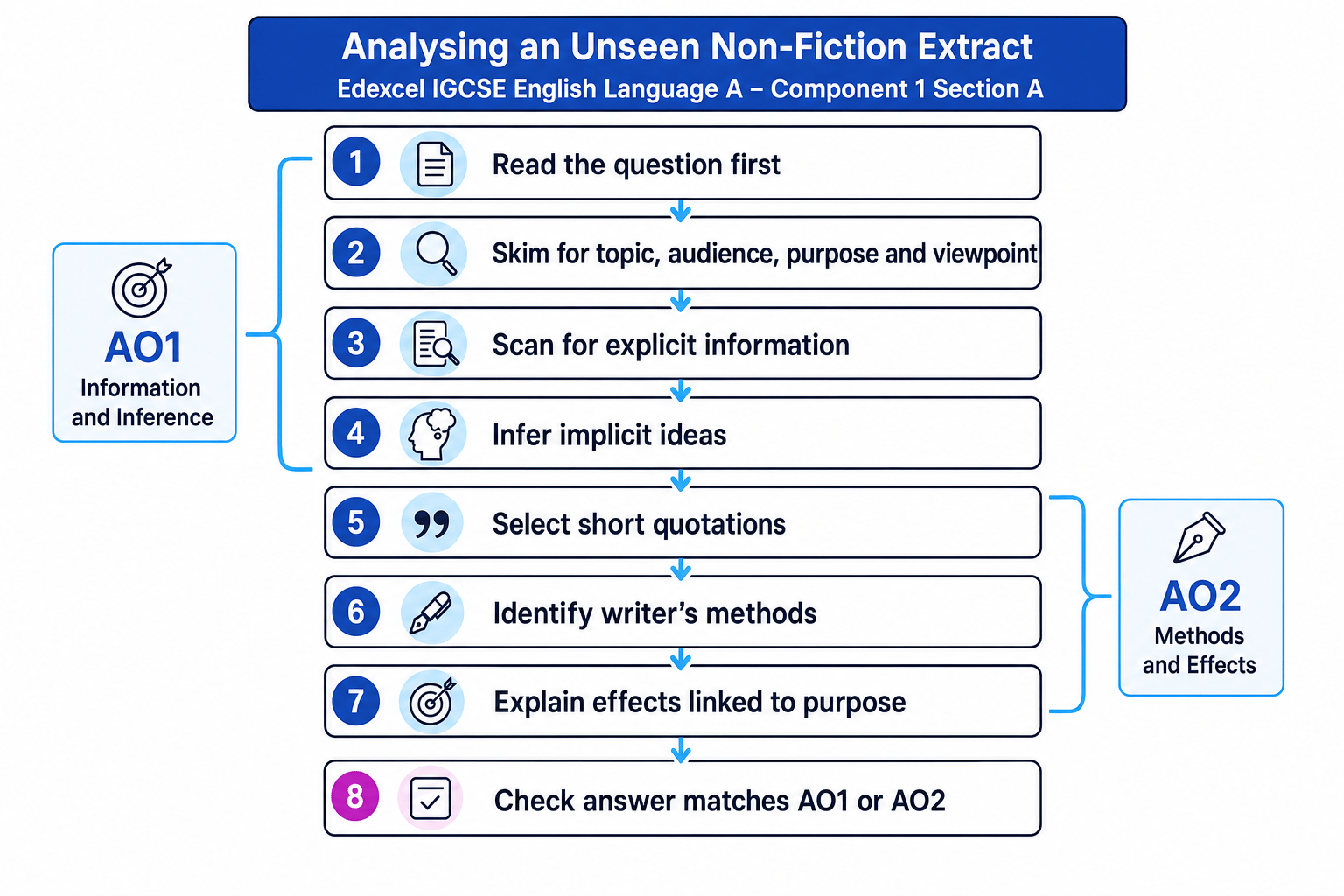
The two jobs: understand first, analyse second
AO1
AO1 rewards your ability to read and understand: selecting relevant information, interpreting ideas, and explaining the writer’s viewpoint or perspective.
AO2
AO2 rewards your ability to analyse how the writer uses language and structure to create meanings and effects.
The key difference is simple:
- AO1 asks: What does the text say, suggest or reveal?
- AO2 asks: How has the writer made it say that?
AO1 before AO2
You cannot analyse effectively until you understand the text. First work out the writer’s ideas and viewpoint; then explain how language and structure help to present them.
Deciding whether a question is AO1 or AO2
- If the question asks you to identify, give, find or explain what you learn, treat it mainly as AO1. Your job is to select relevant information and interpret it accurately.
- If the question asks how the writer uses language, structure or methods, treat it as AO2. Your job is to explain the writer’s choices and their effects.
- If the question asks about impressions, feelings or attitudes, check the wording carefully: it may need AO1 inference, AO2 analysis, or both. The safest approach is to support every idea with a precise reference to the text.
First reading: get the basic situation
Before analysing individual words, get the “big picture”.
The form is the type of text: for example, article, speech, letter or review. The audience is the person or group the text is aimed at. The purpose is what the writer is trying to do, such as inform, persuade, entertain, criticise, advise or reflect.
The viewpoint is the writer’s attitude or position on the subject. The tone is the mood or voice of the writing, such as angry, amused, reflective, sarcastic, anxious or admiring.
Use a quick TAP check
TAP stands for:
- Topic: What is the extract mainly about?
- Audience: Who seems to be addressed or interested?
- Purpose: Why has the writer written this?
Using TAP quickly
- Use the title, source information and opening paragraph to identify the topic. This prevents you from over-focusing on one small detail too early.
- Look at the form and address to infer the audience. A public speech, a newspaper column and a personal memoir usually create different relationships with the reader.
- Choose a purpose verb that fits the whole extract: for example, criticise, warn, celebrate, question, explain or persuade. If the tone changes, adjust your purpose statement so it covers the shift.
Purpose verbs beat vague comments
Instead of writing “the writer wants to tell us about the issue”, choose a sharper verb: warns, challenges, mocks, questions, condemns, reassures, celebrates or persuades.
AO1: selecting and interpreting information
Explicit information is information stated directly in the text. Implicit information is suggested but not directly stated. An inference is a sensible conclusion you draw from evidence in the text.
For AO1, you need to avoid two extremes:
- copying lots of text without explaining what it means;
- making guesses that are not supported by the extract.
Good AO1 answers stay close to the wording but explain what it suggests.
Turning a detail into an inference
- Select a detail that directly answers the question, not just an interesting detail nearby. A relevant detail should connect clearly to the person, place, issue or attitude being asked about.
- Decide what the detail suggests beyond its literal meaning. Ask: does it imply confidence, fear, frustration, admiration, pressure, unfairness, danger or change?
- Turn this into a sentence using both evidence and interpretation: The writer suggests that… because the detail about… implies…
- Check that your inference is not too extreme. If the text only suggests mild concern, do not claim the writer is terrified unless the evidence supports that.
Retelling instead of interpreting
A weak AO1 answer simply repeats events or facts. A stronger answer explains what those details show, suggest or reveal about the writer’s ideas, feelings or perspective.
Identifying viewpoint and shifts in viewpoint
A writer’s viewpoint is not always fixed from start to finish. In non-fiction, writers often begin with uncertainty, surprise or personal experience, then move towards a clearer judgement.
A shift is a noticeable change in focus, tone or attitude. For example, a text might move from description to criticism, from humour to seriousness, or from personal anecdote to wider argument.
Tracking a shifting viewpoint
- Divide the extract mentally into beginning, middle and end. Ask what the writer seems to think or feel in each section.
- Compare the emotional direction. Is the tone becoming more positive, more critical, more urgent, more reflective or more doubtful?
- Write the viewpoint as a movement, not a single label: The writer begins by presenting…, but later shifts towards…, which suggests that overall they want the reader to…
Notice contrast words
Words such as but, however, yet, although, nevertheless and instead often signal a change in argument or attitude. They are useful signposts for viewpoint.
AO2: analysing language
Language means the writer’s word choices and sentence-level methods. A linguistic device is a deliberate language choice that helps create meaning or effect.
Useful language features include:
| Method | What it means | What to analyse |
|---|---|---|
| Word class | A grammatical category, such as noun, verb, adjective or adverb | Why that type of word shapes the impression |
| Connotation | The ideas or feelings associated with a word | Whether the word suggests danger, beauty, control, chaos, unfairness, etc. |
| Imagery | Descriptive language that creates a mental picture | What picture is created and why it matters |
| Metaphor | Describing one thing as if it is another | What comparison is implied |
| Simile | Comparing using “like” or “as” | What similarity is being highlighted |
| Repetition | Reusing a word, phrase or pattern | What idea is emphasised |
| Rhetorical question | A question asked for effect, not because an answer is needed | How it challenges, involves or pressures the reader |
| Direct address | Speaking to the reader using “you” or an implied “you” | How it creates involvement or responsibility |
Do not use terminology just to sound clever. The examiner rewards analysis of meaning and effect, not a list of devices.
Method plus meaning
For AO2, naming a technique is only the start. You need to explain how the method shapes the reader’s understanding of the subject, the writer or the issue.
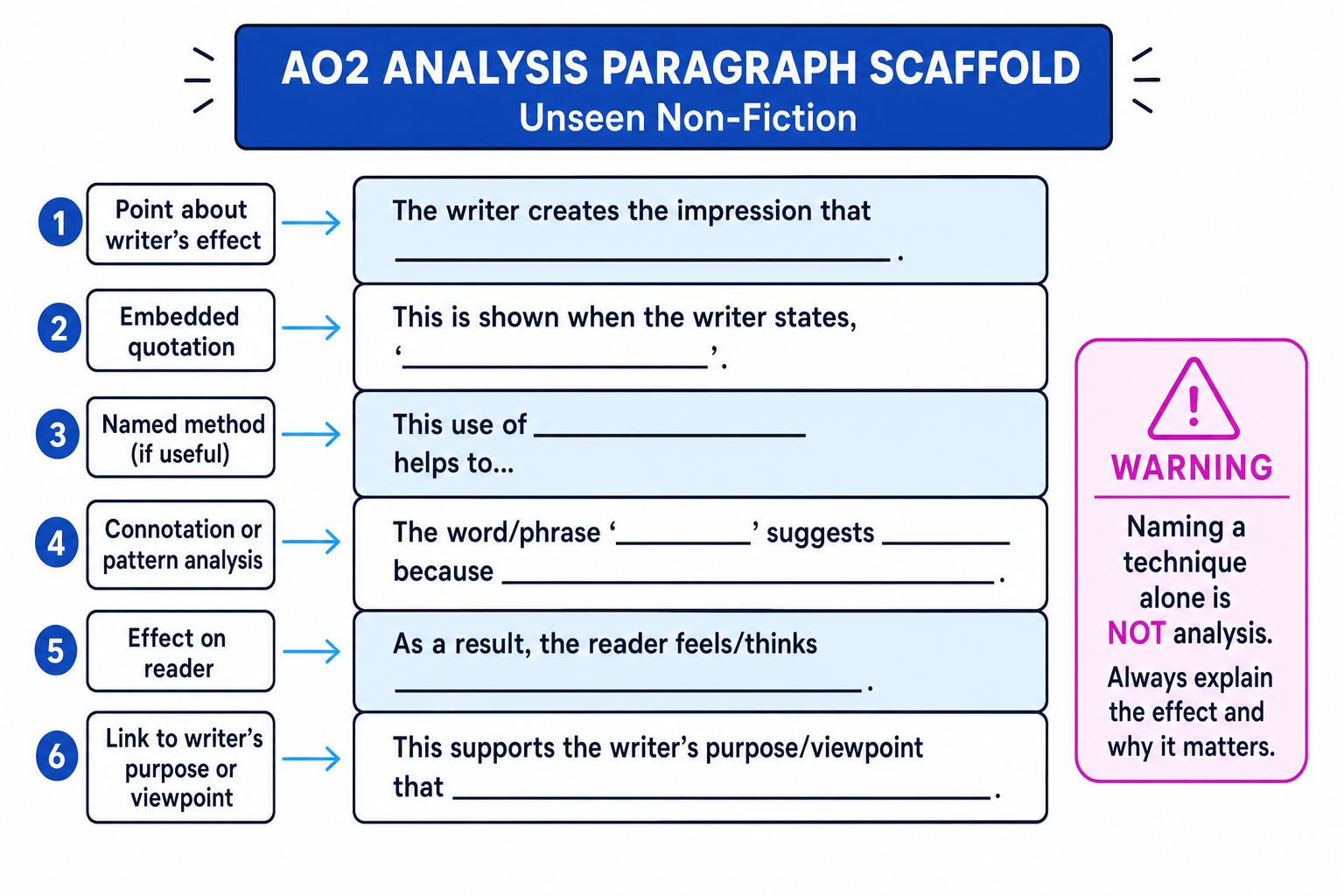
Building an AO2 analytical paragraph
- Start with the effect, not the technique: The writer presents the situation as… This keeps your paragraph focused on meaning.
- Choose a short quotation from the extract, ideally one phrase or one loaded word. Short evidence is easier to analyse closely than a whole sentence.
- Identify the method only if it helps your explanation: for example, adjective, verb, metaphor, list, repetition, rhetorical question or contrast.
- Zoom in on one word or pattern and explain its connotations. Ask what feelings, associations or judgement the word creates.
- Link back to the writer’s purpose or viewpoint: This encourages the reader to see… because…
AO2: analysing structure
Structure means how the text is organised. This includes the order of ideas, paragraphing, openings and endings, shifts in tone, contrasts, repetition across the whole text, and changes in focus.
Structural analysis is often about movement:
- Where does the writer begin?
- What do they focus on next?
- Where does the tone or argument change?
- How does the ending leave the reader thinking or feeling?
A contrast is a difference placed deliberately side by side. A pattern is a repeated feature, such as repeated examples, repeated questions, or a movement from personal detail to public issue.
Analysing a structural shift
- Identify the two parts being compared: for example, the opening focus and the later focus, or the first attitude and the final attitude.
- Explain the movement using precise verbs: shifts, widens, narrows, intensifies, contrasts, returns to or builds towards.
- Link the movement to meaning: explain why this order affects the reader’s understanding of the writer’s argument or feelings.
Forgetting structure
Many students analyse individual words well but ignore the way the whole extract develops. In longer AO2 answers, try to include at least one comment on order, contrast, shift or ending.
Using quotations well
A quotation is a copied word or phrase from the text. To embed a quotation means to fit it smoothly into your own sentence.
Good quotation habits:
- use brief quotations;
- choose words with something to say about them;
- avoid copying whole lines when one phrase would do;
- explain the quotation rather than leaving it to “speak for itself”.
The best quotation is often tiny
One powerful word can be more useful than a long sentence. If you can analyse the connotations of a single verb or adjective, you are doing close AO2 work.
Answering different question lengths
Short-answer questions usually reward concise AO1 selection. Longer questions usually need developed paragraphs with evidence and explanation. Do not write the same amount for every question: let the marks guide your depth.
For a short AO1 question, you might only need two or three clear points. For a longer AO2 question, aim for developed paragraphs that move from point → evidence → method → effect → purpose.
Do not force terminology
If you cannot name the method accurately, describe what the writer is doing instead. “The writer repeats the idea of pressure” is better than wrongly calling something a metaphor.
A simple paragraph shape for AO2
Use this when a question asks how the writer uses language or structure:
- Point: The writer creates the impression that…
- Evidence: This is shown in the phrase…
- Method: The use of…
- Analysis: This suggests… because…
- Effect/purpose: This makes the reader… and supports the writer’s viewpoint that…
You do not need to use these exact words every time, but the thinking should be there.
In the exam
- Read the question before reading the extract, so you know whether you are hunting for AO1 information or AO2 methods.
- Spend your first reading on topic, purpose, audience, viewpoint and tone; annotate only the details that answer the questions.
- For AO1, select and interpret. For AO2, name methods only when useful, then explain connotations, patterns, shifts and effects.
- Keep quotations short and precise. Aim to analyse words and structures, not copy large chunks.
- Watch the marks: short questions need focused answers; longer questions need developed paragraphs linked to the writer’s purpose.
Check yourself
- Can you explain the difference between explicit information, implicit information and inference?
- When looking at an unseen extract, can you identify topic, audience, purpose, viewpoint and tone?
- In an AO2 paragraph, can you move beyond naming a technique to explaining its effect?
