What you'll learn
- How to identify a writer’s ideas, perspective, and methods.
- How to compare what two texts say and how they say it.
- How to build developed comparative paragraphs for Component 1 Section A.
- How to avoid the common trap of writing two separate mini-essays.
Where AO3 fits in your exam
In Pearson Edexcel International GCSE English Language A, Component 1 is worth 60% of the qualification. It includes Section A: Non-fiction Reading, worth 45 marks, and Section B: Transactional Writing, worth 45 marks.
In Section A, you read a non-fiction text from Anthology Part 1 alongside an unseen non-fiction extract. AO3 rewards your ability to explore links and connections between writers’ ideas and perspectives, and how these are conveyed.
AO3
AO3 means comparing the two writers’ ideas, perspectives, and methods. You are not just saying “both texts are about travel” or “both writers describe a difficult experience”; you are explaining how the writers’ viewpoints are similar or different, and how their language, tone, structure, or rhetorical choices communicate those viewpoints.
The three basics: idea, perspective, method
Before you can compare well, you need to separate three things.
Idea: what the text is about
An idea is a main thought, topic, argument, or concern in the text. For example, a text might explore danger, childhood, education, travel, ambition, injustice, memory, or survival.
Ideas are usually broad. They answer: What is the writer discussing?
Perspective: what the writer thinks or feels
A perspective is the writer’s viewpoint, attitude, or position. It answers: What does the writer believe, feel, or want the reader to understand?
Two texts can share the same idea but have very different perspectives. For example, two writers might both write about adventure, but one presents it as exciting and life-changing, while the other presents it as reckless and dangerous.
Method: how the perspective is conveyed
A method is a writer’s deliberate choice. In AO3, useful methods include:
- Language: word choice, imagery, verbs, adjectives, pronouns, contrasts.
- Tone: the writer’s attitude in the voice, such as angry, reflective, humorous, critical, admiring, anxious.
- Structure: order of ideas, shifts in mood, openings and endings, contrast, repetition, development.
- Rhetorical methods: direct address, questions, lists, anecdotes, statistics, emotive language.
The AO3 chain
For strong comparison, move through this chain: idea → perspective → method → effect. First identify the shared or contrasting idea, then explain each writer’s viewpoint, then analyse how each writer conveys it.
A visual scaffold for comparison
Use the diagram below as a reminder that AO3 comparison has two sides: you compare the writers’ viewpoints and the methods used to express those viewpoints.
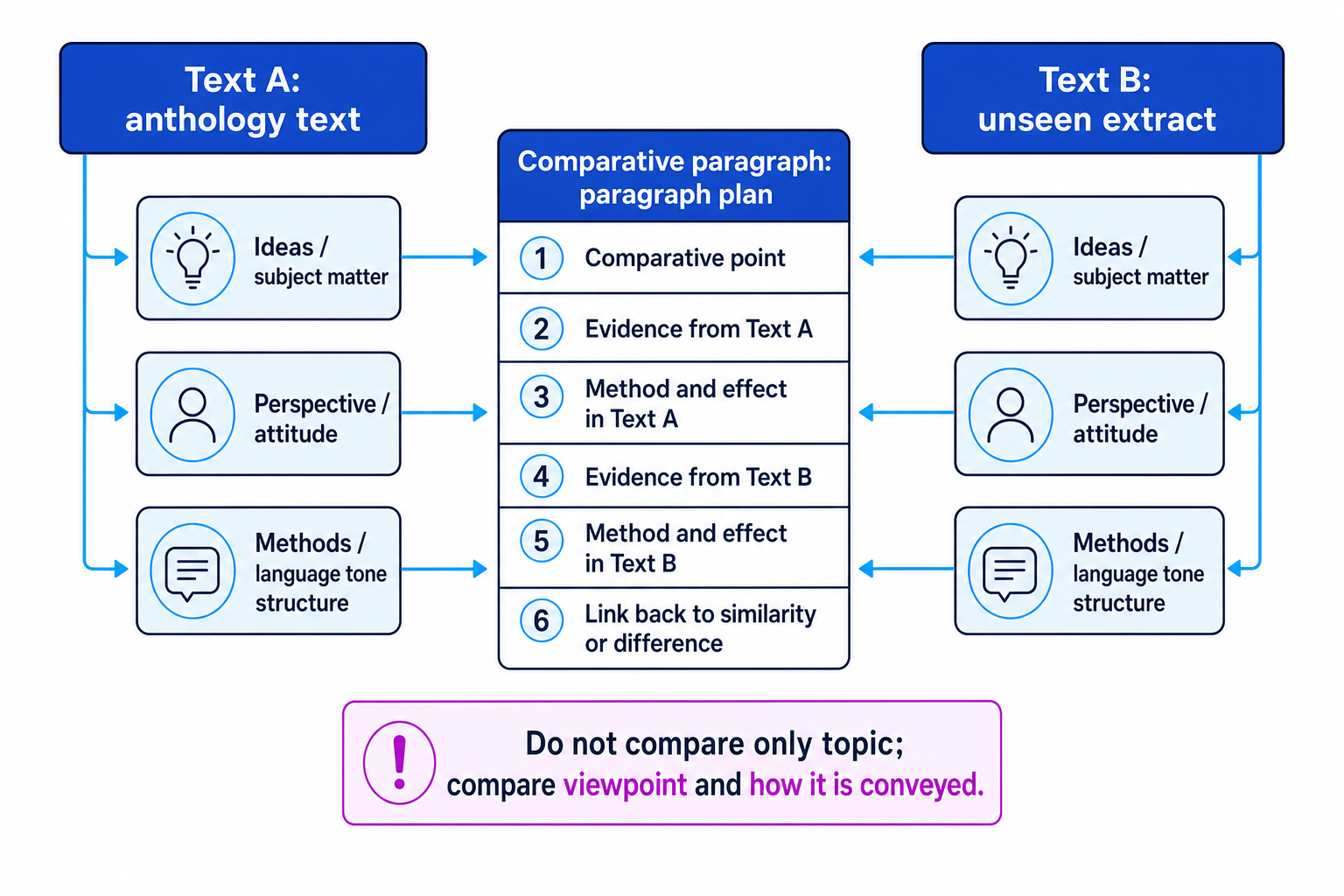
Comparing content versus comparing method
A common early-stage answer compares only content. Content means the subject matter: what happens, what is described, or what topic is discussed.
That is a start, but AO3 asks for more. You also need to compare perspectives and how those perspectives are conveyed.
Weak comparison: only content
Both texts are about difficult journeys.
This is true, but thin. It does not tell us what either writer thinks or how either writer communicates that view.
Stronger comparison: content, perspective, method
Both writers present journeys as challenging, but they respond to that challenge differently. The writer of Text A presents difficulty as something that creates admiration and wonder, while the writer of Text B presents it as frustrating and exhausting. This difference is conveyed through Text A’s more reflective tone, whereas Text B uses sharper, more negative language to emphasise discomfort.
This is better because it compares:
- the shared idea: challenging journeys
- the different perspectives: admiration versus frustration
- the methods: reflective tone versus negative language
Moving from content to AO3 comparison
-
Start with the basic link: both texts focus on a similar subject, such as a difficult experience, a journey, childhood, education, or danger.
-
Add each writer’s perspective by asking: Does the writer admire, criticise, fear, celebrate, question, or regret this subject? This turns “both are about journeys” into “both write about journeys, but one sees the experience as enriching while the other sees it as threatening.”
-
Add method by asking: What choice shows that perspective? You might compare tone, emotive language, imagery, contrast, sentence length, or the order in which ideas are revealed.
-
Combine the points into one comparative sentence: “While both writers present the journey as physically demanding, Text A conveys a sense of wonder through its reflective tone, whereas Text B creates a more anxious perspective through negative description and a focus on discomfort.”
How to find the writer’s perspective
When you first read each text, do not rush straight to techniques. First, work out the writer’s attitude.
Ask yourself:
- What does the writer seem to value?
- What do they criticise or question?
- Are they certain, doubtful, angry, amused, shocked, nostalgic, respectful, afraid?
- Does their attitude change from the beginning to the end?
- What do they want the reader to feel or understand?
Use attitude verbs
Good AO3 writing often uses precise attitude verbs. Try: celebrates, criticises, questions, condemns, admires, warns, mourns, challenges, defends, exposes, reflects on.
Comparing similarity and difference
Comparison does not mean you must find only similarities. In fact, the best responses often show a balance of similarity and difference.
You can compare:
| Type of link | What it does | Useful phrasing |
|---|---|---|
| Similarity | Shows both writers share an idea, attitude, or method | “Similarly…” / “Both writers…” |
| Difference | Shows the writers diverge | “However…” / “In contrast…” |
| Partial similarity | Shows they begin similarly but develop differently | “Although both…, Text A…, while Text B…” |
| Shift | Shows one writer’s view changes | “At first…, but later…” |
Comparison connectives that actually compare
Avoid using “also” again and again. It can become vague.
Better comparative phrases include:
- Whereas Text A suggests…, Text B implies…
- While both writers explore…, they differ in…
- Unlike Text A, Text B presents…
- Both writers convey…, but through different methods
- This contrasts with…
- A similar concern appears in Text B, although…
Feature-spotting instead of comparing
Do not simply write, “Text A uses adjectives. Text B uses a metaphor.” That names methods but does not compare perspectives. Always connect the method to the writer’s viewpoint and the reader’s response.
Building a comparative paragraph
A strong AO3 paragraph should handle both texts together. Do not write a full paragraph on Text A, then a full paragraph on Text B, with no connection until the end.
Use this structure:
- Comparative point: make a clear link or contrast between the writers’ ideas or perspectives.
- Text A evidence: use a short, relevant quotation or precise reference.
- Text A method and effect: explain how the writer conveys their perspective.
- Text B evidence: use a short, relevant quotation or precise reference.
- Text B method and effect: explain how this is similar or different.
- Link back: sum up what the comparison reveals about the writers’ perspectives.
Planning a comparative paragraph
-
Choose one shared idea. For example, your notes might show that both texts deal with pressure in a challenging situation.
-
Decide the comparison angle. One writer might present pressure as motivating, while the other presents it as overwhelming. This gives you a clear contrast.
-
Select one method from each text that proves the attitude. For Text A, you might choose uplifting verbs or a determined tone. For Text B, you might choose negative imagery or a tense structure.
-
Turn the plan into a topic sentence: “Both writers present pressure as intense, but Text A suggests it can produce determination, whereas Text B presents it as emotionally draining.”
-
Add evidence and analysis from both texts, making sure each quotation is short and directly linked to the comparison.
Comparing how perspectives are conveyed
AO3 is not only about what the writers think. It also asks how their ideas and perspectives are conveyed, which means communicated or presented to the reader.
Here are useful method comparisons.
Tone
Tone is the attitude created by the writer’s voice.
You might write:
Text A’s tone is admiring and reflective, suggesting the writer has gained respect for the experience. In contrast, Text B’s tone is more critical, making the reader question the behaviour being described.
Language
Language comparison focuses on word choice.
You might compare:
- positive versus negative adjectives
- violent versus gentle verbs
- personal pronouns such as “I”, “we”, or “you”
- imagery that makes something seem beautiful, threatening, chaotic, or controlled
Structure
Structure is how the text is organised.
You might compare:
- an opening that immediately creates tension
- a gradual shift from confidence to doubt
- a final sentence that leaves the reader with a warning
- repeated contrasts between past and present
- a chronological structure versus a reflective structure
Compare methods with purpose
A useful sentence frame is: “Both writers use [method], but for different purposes: Text A uses it to…, whereas Text B uses it to…” This stops you merely naming techniques.
A model paragraph shape
Here is a flexible paragraph model. Replace the bracketed sections with details from the anthology text and unseen extract in front of you.
Both writers explore [shared idea], but they present it from different perspectives. In Text A, the writer suggests [attitude/viewpoint], shown when they describe [brief evidence]. The use of [method] conveys [effect on reader / meaning]. However, Text B presents [same idea] as more [different attitude], particularly through [brief evidence]. Here, the writer’s [method] makes the experience seem [effect]. Therefore, although both texts deal with [shared idea], Text A encourages the reader to see it as [interpretation], while Text B makes it appear [interpretation].
Do not force identical methods
You do not need to find the same technique in both texts. It is perfectly valid to compare a tone in Text A with a structural shift in Text B, as long as both methods help explain the writers’ perspectives.
What examiners want to see
For AO3, examiners reward developed links. That means your answer should not sound like two separate lists.
Aim for:
- clear comparison from the start of the paragraph
- precise references to both texts
- explanation of each writer’s perspective
- comments on how methods convey those perspectives
- thoughtful links between similarities and differences
Bolt-on comparison
A bolt-on comparison happens when you analyse Text A for several sentences, then add “Similarly, Text B…” at the end. To avoid this, make the comparison the main idea of the paragraph from the first sentence.
Quick planning method: three columns
Before writing, draw three quick columns:
| Text A | Link / contrast | Text B |
|---|---|---|
| Writer’s idea and perspective | Similar or different? | Writer’s idea and perspective |
| Best short evidence | Why does it connect? | Best short evidence |
| Method used | What does each method reveal? | Method used |
This helps you keep both texts active in your mind.
In the exam
-
Start by identifying each writer’s perspective, not just the topic. Ask what each writer thinks, feels, criticises, or values.
-
Build each paragraph around a clear comparison: both writers… but… or whereas Text A…, Text B….
-
Analyse methods only when they support the comparison. Link language, tone, structure, or rhetoric to the writer’s viewpoint and the reader’s response.
Check yourself
- Can you explain the difference between an idea and a perspective?
- Does your comparison paragraph discuss both texts throughout, rather than one after the other?
- Have you compared at least one method used to convey each writer’s viewpoint?
