What you'll learn
- What happens in the Chinese Cinderella anthology extract and why it matters.
- How Yen Mah uses autobiographical voice, contrast, emotive detail, structure and tone.
- How to write about the extract for AO1, AO2 and AO3 in Component 1 Section A.
1. Where this text fits in the exam
Chinese Cinderella is in Anthology Part 1, so it belongs to Component 1: Non-fiction Reading and Transactional Writing. Component 1 is worth 60% of the qualification. In Component 1, Section A is Non-fiction Reading and is worth 45 marks; Section B is Transactional Writing and is also worth 45 marks. Component 2 or 3 makes up the remaining 40%.
In Section A, you may need to write about this anthology extract alongside an unseen non-fiction text. Your reading marks come from AO1 — understanding and selecting evidence, AO2 — analysing language and structure, and AO3 — comparing writers’ ideas and perspectives.
Memoir
A memoir is a form of non-fiction in which a writer looks back at important experiences from their own life. It is autobiographical, meaning it is based on the writer’s own life, but it usually focuses on selected memories rather than every event.
2. Quick summary of the extract
Adeline Yen Mah writes about her childhood in a family where she feels unwanted. Her mother died after giving birth to her, and her family’s belief that she brought “bad luck” shapes how she is treated.
In the extract, Adeline experiences success at school by winning an award. This should be a joyful moment. Instead, when she returns home, the response she receives is cold and rejecting. The emotional centre of the extract is the painful gap between public achievement and private neglect.
Aunt Baba offers warmth and encouragement, but this does not remove the deeper hurt caused by Adeline’s father, stepmother Niang, and the wider family atmosphere. The extract shows a child trying to earn approval in a place where love feels conditional.
The central tension
The extract is not just about winning an award. It is about how that achievement exposes what Adeline most longs for: recognition, affection and a secure place in her own family.
3. AO1: understanding what happens and why
For AO1, you need to show that you understand the text and can choose relevant evidence. Strong AO1 is not just plot summary. It explains the significance of events.
Key moments to remember
- Adeline wins an award at school, giving her a rare moment of pride.
- She hopes this success will make her family value her.
- The reaction at home is emotionally cold, which makes the achievement feel bittersweet.
- Aunt Baba’s kindness contrasts with the rejection Adeline experiences elsewhere.
- The memory reveals how Adeline’s resilience grows from pain, not from an easy childhood.
Moving from event to interpretation
-
Start with the event: Adeline wins an award, which shows she is talented and hardworking.
-
Add the emotional expectation: because she is a child, she naturally hopes the award will bring praise and belonging at home.
-
Interpret the disappointment: the cold response shows that her problem is not lack of achievement, but lack of unconditional love.
4. Themes in the extract
Theme
A theme is a central idea explored in a text. It is not usually one word on its own; it is what the writer suggests about that idea.
Family and emotional neglect
Yen Mah presents family as something that should provide safety, but in Adeline’s life it often creates pain. The home should be a place of celebration after her success, yet it becomes a place where she feels rejected.
Rejection and belonging
Adeline’s deepest need is to belong. The label “bad luck” is especially cruel because it makes her feel blamed for circumstances she could not control. This helps the reader understand why praise matters so much to her.
Resilience
Adeline’s success at school shows resilience. Resilience means the ability to keep going after difficulty. However, Yen Mah does not present resilience as simple happiness. Her strength is impressive because it develops in an emotionally harsh environment.
The longing for approval
The award matters because it seems like a possible route to love. Adeline’s desire for approval makes the extract emotionally powerful: the reader sees both her hope and her vulnerability.
5. Writer’s methods: language and voice
A method is a deliberate choice the writer makes, such as a word, image, contrast, sentence pattern, narrative viewpoint or structural decision. For AO2, you need to explain how these choices create meaning.
Autobiographical voice
Yen Mah writes in the first person, using an autobiographical voice. This means the story is told from her own viewpoint as she remembers childhood experiences. The voice often combines the child’s emotional immediacy with the adult writer’s reflection.
The result is powerful: we feel close to the young Adeline, but we also sense the adult writer shaping the memory to show its lasting significance.
Contrast
Contrast
Contrast is when a writer places two different things side by side so that the difference between them becomes more striking.
The most important contrast is between school and home. School gives Adeline achievement, recognition and possibility. Home gives her coldness, rejection and insecurity. This contrast makes the family’s treatment seem even harsher because it appears immediately after her success.
Aunt Baba also creates contrast. Her care shows what Adeline is missing from others. This makes the emotional neglect more obvious, not less serious.
Analysing contrast
-
Identify the two sides of the contrast: Adeline’s award at school suggests pride and success, while the home response suggests rejection and emotional coldness.
-
Explain why the contrast matters: a reader expects a child’s family to celebrate her achievement, so the lack of warmth feels especially unjust.
-
Link the method to the writer’s purpose: Yen Mah uses the contrast to show that Adeline’s pain comes from being denied ordinary love, not from failing to deserve it.
Emotive detail
Emotive detail means detail chosen to stir the reader’s feelings. Yen Mah’s writing encourages sympathy by focusing on a child’s hope, disappointment and need for love.
The phrase “bad luck” is particularly emotive because it reduces Adeline to a superstition or blame label. It suggests that the family’s rejection is irrational and unfair, which makes the reader feel protective towards her.
The title’s allusion
Allusion
An allusion is a reference to another story, person, event or idea. It relies on the reader recognising the connection.
The title Chinese Cinderella alludes to the fairy tale of Cinderella: an unwanted girl, a cruel family environment, and the hope of being recognised. But Yen Mah’s memoir is not a magical fairy tale. The allusion makes the real-life rejection feel even more painful because the reader recognises the pattern but knows this is non-fiction.
6. Structure: the emotional journey of the extract
Structure means how a text is organised: the order of events, shifts in focus, beginnings and endings, contrasts, pacing and changes in mood.
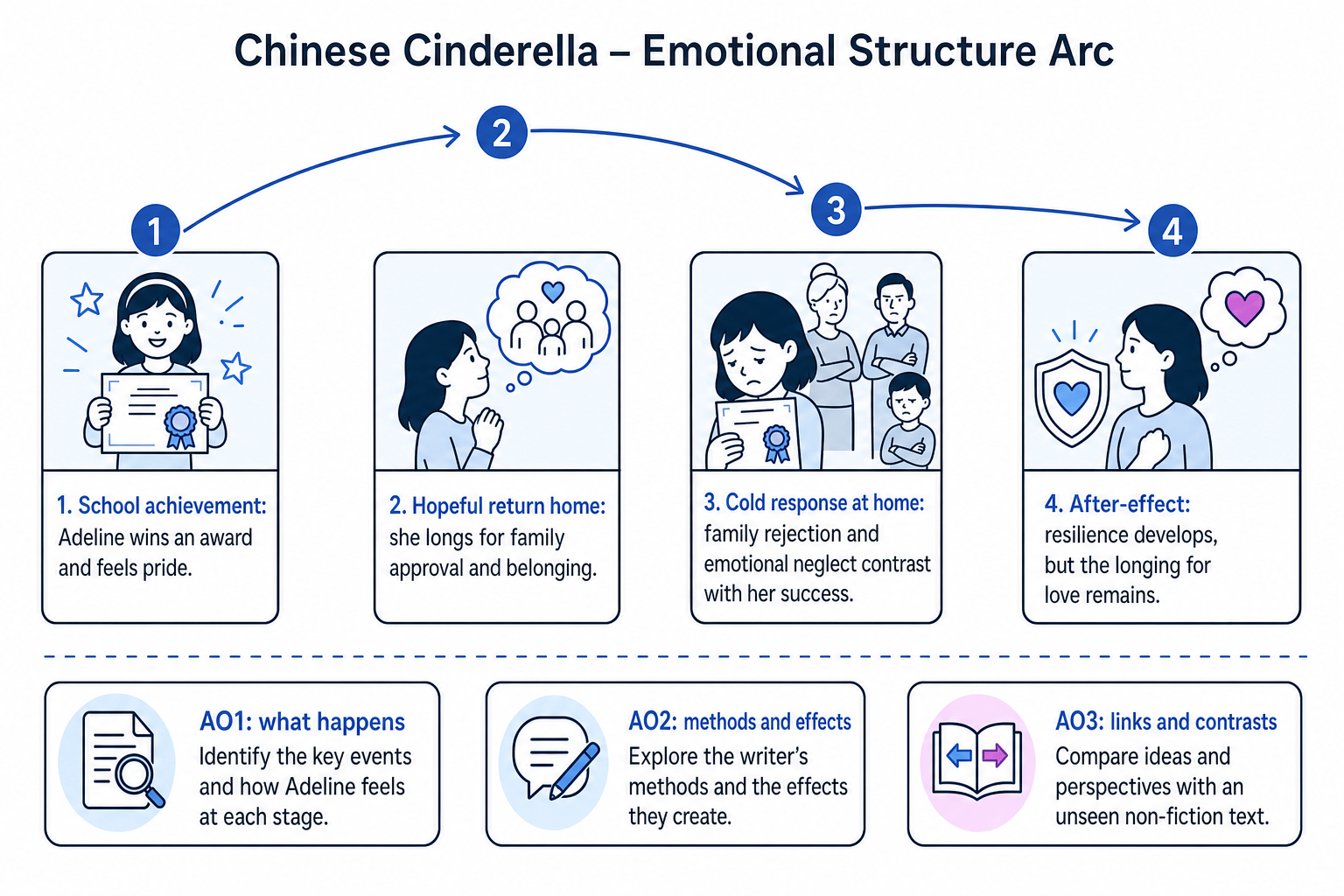
Yen Mah structures the extract as a narrative of a day or memory with emotional weight. It moves from achievement, to hope, to rejection, to the lasting impact of that rejection. This structure helps the reader experience the disappointment almost as Adeline experiences it.
How the structure works
- The award comes first, creating expectation and optimism.
- The return home raises emotional tension because Adeline wants approval.
- The cold response reverses the expected celebration.
- The memory leaves a lasting impression of resilience mixed with hurt.
Tracking the tone shift
-
At the start of the memory, the tone is more hopeful because the award gives Adeline a reason to feel proud.
-
When the family response becomes clear, the tone shifts towards disappointment and isolation.
-
By the end, the tone becomes reflective: the adult writer shows how one childhood moment reveals a larger pattern of rejection.
7. Tone: how the extract feels
Tone
Tone is the writer’s attitude or emotional colouring in a piece of writing.
The tone of Chinese Cinderella is often restrained rather than melodramatic. Yen Mah does not need to exaggerate. The unfairness of the situation is clear because she presents the child’s hope alongside the family’s coldness.
You might describe the tone as:
- hopeful when Adeline focuses on the award;
- vulnerable when she longs for approval;
- hurt or isolated when home fails to provide comfort;
- reflective because the adult writer understands the deeper meaning of the memory.
Use tone words carefully
Do not just write “the tone is sad.” Choose a more precise word, such as wounded, lonely, restrained, hopeful or reflective, then connect it to a specific moment in the extract.
8. AO3: comparing with an unseen text
For AO3, you compare ideas and perspectives. A perspective is the writer’s viewpoint or attitude towards a subject.
In an exam, the unseen text might also be about childhood, family, education, success, hardship or identity. Your job is not to force the texts to be identical. You should explain both similarities and differences.
For example, another writer might present family as supportive, while Yen Mah presents family as emotionally damaging. Or another writer might describe achievement as joyful, while Yen Mah shows that achievement can still feel empty without love.
Linking the anthology text to an unseen extract
-
Establish Yen Mah’s perspective: she presents childhood achievement as emotionally complicated because success does not guarantee family approval.
-
Establish the unseen writer’s perspective: decide whether the unseen text presents family, childhood or achievement as comforting, pressurising, joyful or painful.
-
Compare methods as well as ideas: Yen Mah uses memoir, first-person memory and contrast; the unseen writer may use humour, argument, description or a different structure.
Making vague cultural claims
Avoid generalisations such as “Chinese families are strict.” Instead, write about this specific family, this narrator and this extract. If you mention context, connect it carefully to Yen Mah’s presentation of rejection, achievement and belonging.
9. A strong paragraph shape
A useful analytical paragraph can follow this pattern:
- Make a clear point about what Yen Mah presents.
- Add brief evidence from the extract.
- Name a method only if it helps your analysis.
- Zoom in on the effect of a word, contrast or structural choice.
- Link back to the writer’s wider message.
For example, you might argue that Yen Mah uses contrast to make Adeline’s rejection more painful. The school award represents value and recognition, but the family’s coldness makes that recognition feel incomplete. This helps the reader see that Adeline is not simply ambitious; she is searching for love and belonging.
Quotation control
Use short quotations rather than long copied chunks. A single phrase such as “bad luck” can be more powerful than a whole sentence if you analyse its connotations closely.
In the exam
-
Begin by anchoring your answer in the extract’s main emotional conflict: achievement at school versus rejection at home.
-
For AO2, analyse methods such as first-person memoir voice, contrast, emotive detail, the title’s allusion and the structure of hope followed by disappointment.
-
For AO3, compare perspectives clearly: ask whether the unseen writer presents family, childhood or success as more supportive, more damaging or more complex than Yen Mah does.
Check yourself
- How does the award change the reader’s expectations of what should happen when Adeline gets home?
- Which contrast is more important: school versus home, or Aunt Baba versus the rest of the family?
- How could you compare Yen Mah’s perspective on childhood with an unseen writer’s perspective?
