What you'll learn
- What happens in the H is for Hawk anthology extract and why it matters.
- How Macdonald presents the goshawk as both real animal and emotional symbol.
- How to analyse her language, structure and tone for AO2.
- How to connect this text to an unseen non-fiction extract for AO3 in Component 1 Section A.
Where this text fits in the course
H is for Hawk is one of the Part 1 non-fiction anthology texts for Pearson Edexcel International GCSE English Language A. In Component 1, Section A is worth 45 marks and asks you to read an anthology text alongside an unseen non-fiction text. Section B is transactional writing, also 45 marks.
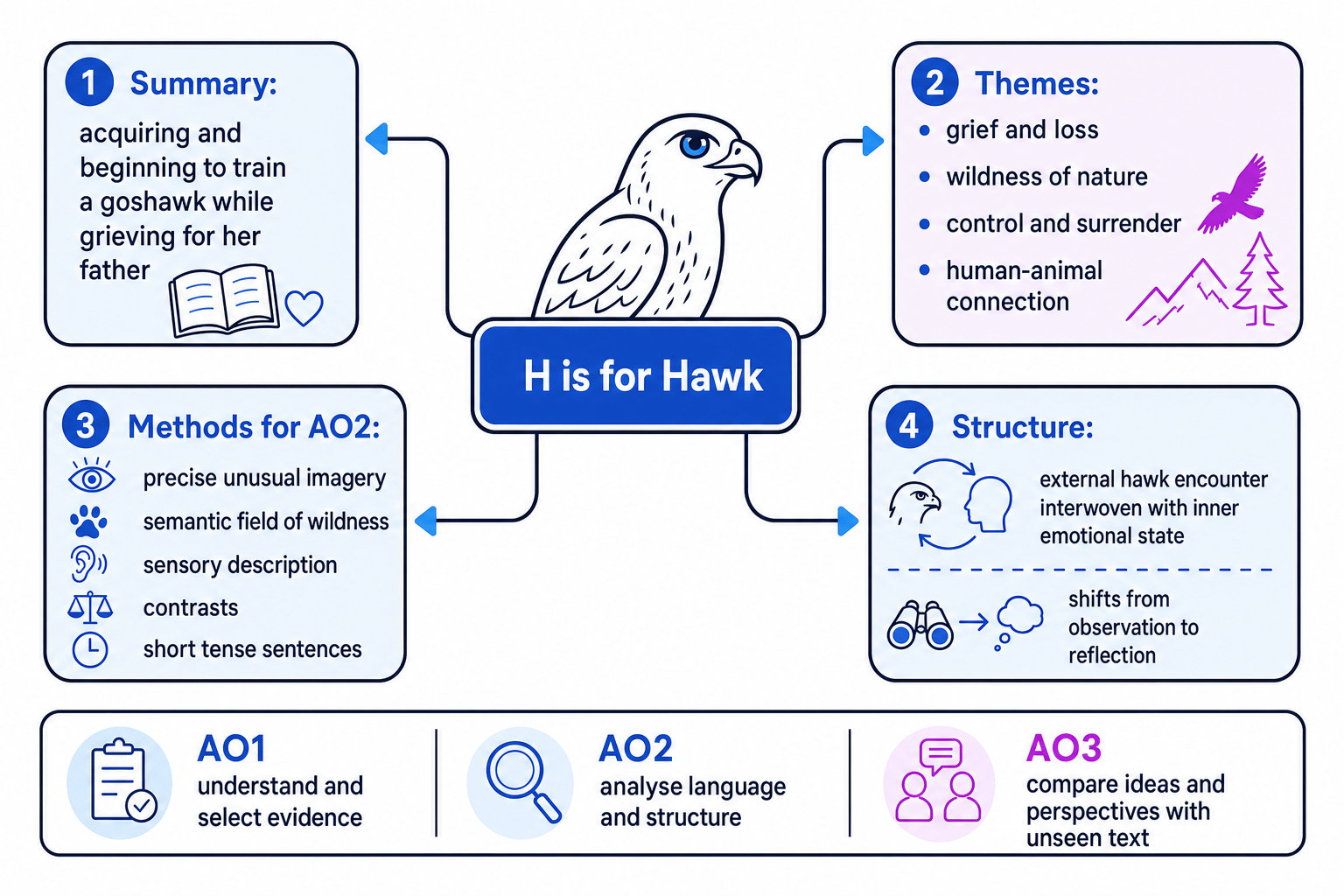
For this text, the key reading skills are AO1 — understanding and selecting evidence, AO2 — analysing language and structure, and AO3 — comparing writers’ ideas and perspectives.
What happens in the extract?
Helen Macdonald describes acquiring a young goshawk, a powerful bird of prey, and beginning the intense process of training it. This is not just a practical account of falconry. The experience is bound up with her grief after the death of her father.
Memoir
A memoir is a type of autobiographical non-fiction in which a writer explores memories and personal experiences, often shaping them to reveal a larger emotional or reflective meaning.
The extract moves between the physical details of the hawk — its body, movement, eyes, fear and force — and Macdonald’s inner emotional state. The hawk is wild, unpredictable and difficult to control. At the same time, Macdonald is trying to manage her own grief, fear and need for focus.
Core idea
Macdonald’s hawk is not a simple “pet”. It becomes a living focus for her grief: something wild, dangerous and absorbing enough to pull her away from ordinary human pain.
The central relationship: human and animal
The extract is powerful because Macdonald does not make the hawk cute or sentimental. She stresses its otherness — how unlike a human it is. It is beautiful, but also frightening.
Otherness
Otherness means the quality of being strange, separate or unlike what we know. In this extract, the hawk’s otherness makes it seem both fascinating and threatening.
Macdonald’s descriptions often make the hawk seem almost mythical. Phrases such as “brilliance and fury” suggest dazzling beauty and violent energy at the same time. The hawk is not calm or obedient; it seems full of force.
This matters because the relationship is not based on easy affection. It is based on attention, patience, control and surrender. Macdonald wants to train the hawk, but she must also accept that the bird has its own instincts.
Theme: grief and loss
The death of Macdonald’s father shapes the whole extract, even when she is describing the hawk. Her grief is not always stated directly. Instead, it appears through atmosphere, tension and the need to focus on the bird.
Theme
A theme is a major idea or concern running through a text, such as grief, power, nature, memory or identity.
Macdonald’s grief helps explain why the hawk matters so much. Training the bird gives her a task that is immediate and demanding. The hawk lives in the present: it needs food, calm handling and careful attention. That intensity offers Macdonald a temporary escape from emotional pain.
The hawk also reflects grief because grief itself can feel wild and uncontrollable. Just as the hawk cannot be easily tamed, Macdonald’s feelings cannot be neatly solved.
Link theme to method
Do not just write “the theme is grief”. Ask: how does Macdonald make grief felt? Look at tense imagery, short sentences, sensory detail and the contrast between external action and internal emotion.
Theme: wildness, control and surrender
The extract repeatedly shows the tension between control and wildness. Falconry involves discipline: the handler must be precise, calm and patient. But the goshawk is a predator, not a machine.
Macdonald’s language often belongs to a semantic field of wildness and danger.
Semantic field
A semantic field is a group of words or phrases linked by meaning. For example, words connected with violence, fear, light or nature can build a repeated pattern of ideas.
Words and images connected with force, fear, sharpness, speed and brightness make the hawk seem untameable. Macdonald’s task is not to destroy that wildness, but to work with it. This creates a deeper idea: real connection sometimes requires respect rather than domination.
Making the hawk symbolic only
Avoid treating the hawk as if it is only a metaphor for grief. Macdonald also presents it as a real animal with its own body, instincts and behaviour. Strong analysis balances both.
Language: precise and unusual imagery
Macdonald’s description is highly visual and sensory. She uses imagery, which means language that creates a vivid impression in the reader’s mind, often through sight, sound, touch or movement.
Imagery
Imagery is descriptive language that appeals to the senses or creates a strong mental picture. It can include metaphor, simile and carefully chosen sensory detail.
One striking phrase is “Daylight irrigating the box”. The verb “irrigating” usually suggests water being channelled into dry land. Applying it to light is unusual. It makes the opening of the hawk’s box feel slow, deliberate and life-giving, as if the hawk is being revealed from darkness into a charged new world.
Macdonald also uses compressed phrases such as “Concentration. Infinite caution.” The sentence fragments slow the moment down and show the care needed around the hawk. The style mirrors the handler’s mental state: focused, tense and alert.
Analysing “Daylight irrigating the box”
-
Start with the literal moment: the box is being opened, so light enters the dark space where the hawk is contained.
-
Notice the unusual verb “irrigating”. It normally belongs to water and farming, so it makes the light seem like a physical substance flowing into the box.
-
Connect the image to meaning: the hawk’s appearance becomes dramatic and almost ritual-like, as if nature itself is being released rather than merely unpacked.
-
Link to the writer’s emotional state: the careful, slowed-down description suggests Macdonald’s intense concentration and nervous anticipation.
Language: emotionally charged description
The hawk is described in ways that mix awe with fear. “Brilliance and fury” is a compact phrase because it joins two powerful nouns. “Brilliance” suggests beauty, light and splendour. “Fury” suggests anger, violence and uncontrollable energy.
This kind of pairing is effective because it prevents the reader from having a simple response. We are invited to admire the hawk, but also to feel its danger.
Macdonald also uses precise natural detail. This makes the writing convincing as non-fiction: she knows the bird’s body and behaviour. At the same time, her descriptions often rise into something more poetic and emotional.
Best AO2 angle
For AO2, the strongest answers explain how Macdonald’s precise description of the hawk also reveals her inner emotional condition.
Structure: external action and inner state
Structure
Structure means how a text is organised: the order of events, shifts in focus, sentence patterns, paragraphing, openings, endings and changes in pace.
The extract’s structure interweaves two strands:
- the external event: acquiring and beginning to train the goshawk;
- the internal experience: grief, fear, fascination and the need for control.
Macdonald often focuses closely on a physical detail, such as the box opening or the hawk’s movement. Then the writing widens into emotional or reflective meaning. This creates a pattern: observation becomes self-revelation.
Short sentences and fragments increase tension at key moments. Longer descriptive sentences can make the reader feel overwhelmed by the hawk’s energy and beauty. The shifting sentence lengths help control pace.
Tracking structure in a paragraph
-
Identify the starting focus: Macdonald may begin with a concrete action, such as the hawk being revealed or handled.
-
Look for a shift: the description often moves from physical detail into emotional intensity, showing that the hawk affects her mentally as well as practically.
-
Connect the shift to the whole extract: the structure mirrors the main conflict between outward control and inward disorder.
-
Turn this into analysis: rather than saying “the structure changes”, explain that Macdonald uses the movement from observation to reflection to show how training the hawk becomes a way of confronting grief.
Tone: awe, tension and vulnerability
Tone
Tone is the writer’s attitude or emotional position in the writing. It might be admiring, anxious, reflective, angry, humorous, intimate or detached.
The tone of the extract is mixed. At times, it is tense and almost breathless, because the hawk is unpredictable. At other times, it is full of awe, because Macdonald sees the bird as extraordinary. There is also vulnerability: the reader senses that her emotional life is fragile after her father’s death.
This mixed tone is one reason the extract feels sophisticated. Macdonald does not simply say, “I was sad” or “the hawk was beautiful”. Instead, she makes the reader experience conflicting feelings at once.
Key moments to remember
A few moments are especially useful for revision:
- the opening or revealing of the hawk’s box, where tension is built through fragments and sensory detail;
- the description of the hawk’s beauty and danger, especially phrases such as “brilliance and fury”;
- the way Macdonald’s grief sits beneath the practical process of training;
- the contrast between the hawk’s wild instincts and the human desire to control or understand it.
Do not overdo context
This is a Language exam, not a Literature essay. You can mention grief for her father because it is central to the extract, but your marks mainly come from analysing the words, methods and effects on the reader.
Comparing this text for AO3
In Component 1 Section A, you may need to compare H is for Hawk with an unseen non-fiction text. AO3 rewards links and connections between writers’ ideas and perspectives.
Useful comparison angles might include:
- how two writers present nature as powerful or threatening;
- how personal experience shapes a writer’s view of the world;
- how control, fear or survival is presented;
- how each writer uses description to create atmosphere;
- whether the writer’s tone is reflective, urgent, admiring or anxious.
A strong comparison does not just say “both texts are about nature”. It explains how the writers’ attitudes are similar or different.
Building an AO3 comparison point
-
Choose a clear shared idea: both writers may present nature as powerful and beyond full human control.
-
Pin down Macdonald’s perspective: in H is for Hawk, the goshawk’s “brilliance and fury” makes nature seem beautiful but dangerous.
-
Contrast or connect the unseen writer’s perspective: the other writer might present nature as comforting, hostile, mysterious or fragile.
-
Explain the significance: this shows that non-fiction writers can use real experiences of nature to explore deeper human emotions, such as grief, fear or wonder.
A simple paragraph shape for this text
When writing about H is for Hawk, you can use this structure:
- Make a clear point about Macdonald’s presentation of the hawk or her grief.
- Add a short quotation.
- Analyse a word, image or structural choice.
- Link the method to the emotional effect.
- If comparing, connect to the other text’s idea or perspective.
For example, you might argue that Macdonald presents the hawk as both magnificent and threatening. The phrase “brilliance and fury” combines beauty with violence, suggesting that the bird cannot be reduced to a simple object of admiration. This reflects the wider tension of the extract: Macdonald wants closeness and control, but the hawk’s wildness resists easy human possession.
In the exam
-
Use short quotations from H is for Hawk and analyse individual words or images closely.
-
For AO2, keep linking language and structure to Macdonald’s grief, tension and fascination with the hawk.
-
For AO3, compare perspectives, not just topics: ask what each writer feels or believes about nature, control or personal experience.
Check yourself
-
How does Macdonald make the goshawk seem both beautiful and dangerous?
-
Why is grief important to the way we understand the extract?
-
What comparison could you make between H is for Hawk and another text about nature or survival?
