What you'll learn
- What happens in Zeppa’s anthology extract and why it matters.
- How Zeppa presents culture shock, displacement and adaptation.
- How to analyse her methods: sensory description, first-person reflection, contrast, tone and structure.
- How to connect this text to AO1, AO2 and AO3 in Component 1 Section A.
Where this text fits
Jamie Zeppa’s Beyond the Sky and Earth: A Journey into Bhutan is in Part 1 of the Pearson Edexcel International GCSE English Anthology, so it belongs to Component 1: Non-fiction Reading and Transactional Writing.
In Component 1, Section A is worth 45 marks and tests non-fiction reading. You may be asked about this anthology extract, an unseen non-fiction text, or both. Component 1 overall is worth 60% of the qualification.
For this text, you mainly need:
- AO1: understand Zeppa’s experiences and select relevant evidence.
- AO2: analyse how her language and structure create effects.
- AO3: compare her ideas and perspective with another writer’s.
The big picture: what the extract is about
Zeppa writes about travelling from Canada to Bhutan, where she is going to teach. The extract focuses on her first impressions: she arrives with expectations, but the real place is more complex, overwhelming and unfamiliar than she imagined.
She is not just describing scenery. She is also describing what it feels like to have your normal rules and assumptions suddenly stop working.
Culture shock
Culture shock means the confusion, anxiety or disorientation someone feels when they enter a culture very different from their own.
Displacement
Displacement means feeling out of place, physically or emotionally. In this extract, Zeppa is displaced because she has left Canada and entered an environment where landscape, customs, language and daily life feel unfamiliar.
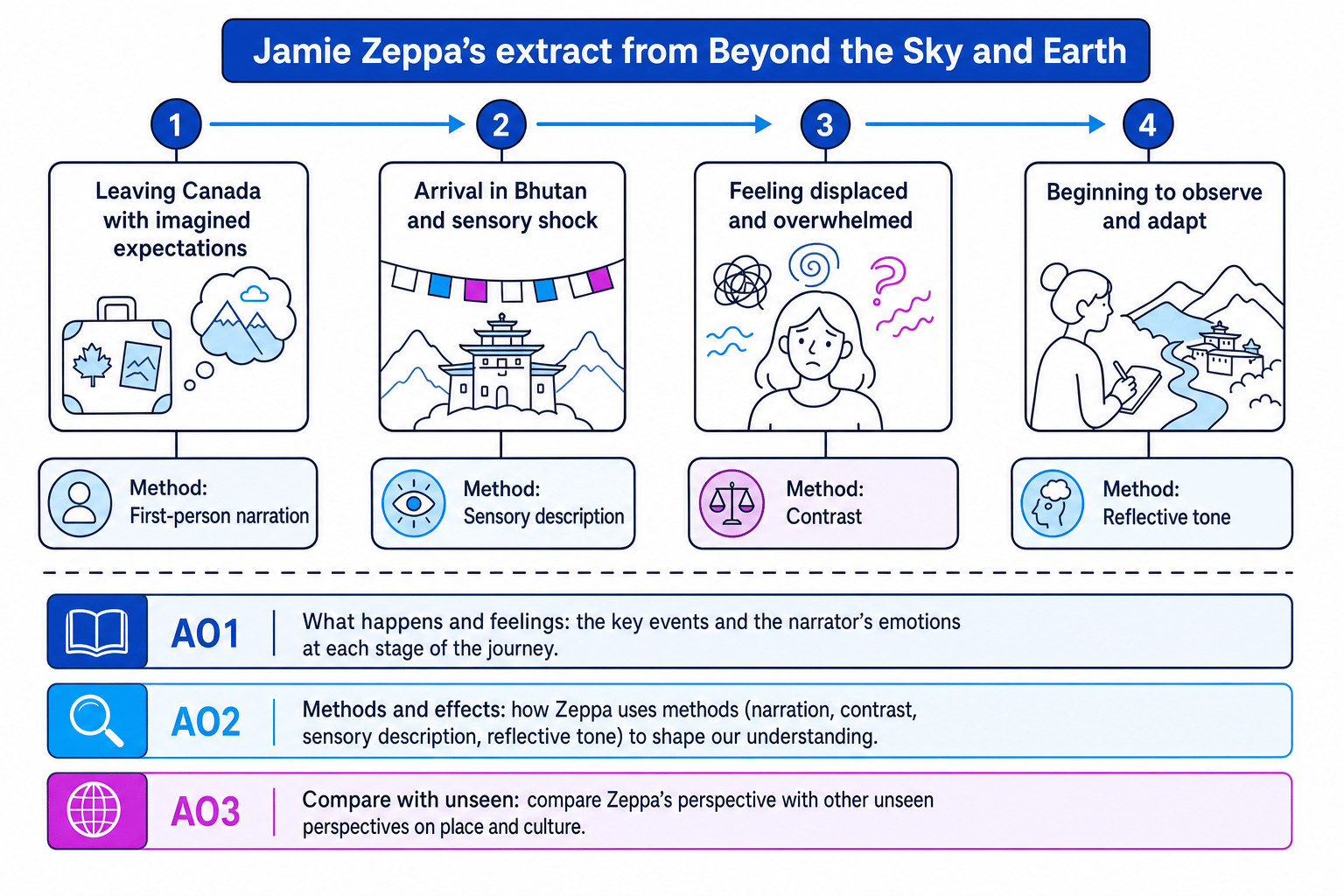
Summary of the extract
1. Zeppa begins with expectation
Zeppa has chosen to leave Canada for Bhutan. At first, Bhutan exists partly in her imagination: it is remote, unusual and exciting. The journey therefore begins with a gap between what she thinks she is going to experience and what she actually finds.
The contrast between Canada and Bhutan is central. Canada represents what is familiar to her; Bhutan represents a world she cannot fully understand yet.
2. Arrival creates shock
When she arrives, the unfamiliar environment overwhelms her. The landscape, buildings, weather, sounds and customs all make her realise that she is very far from home.
This is where the extract becomes more than a travel description. Zeppa’s reaction shows emotional vulnerability: she is curious, but also unsettled.
3. She begins to observe and adapt
As the extract develops, Zeppa starts to look more carefully. The unfamiliar world does not become instantly easy, but she begins the process of noticing, learning and adjusting.
This shift is important because the text is a memoir, not just a diary entry written in the moment.
Memoir
A memoir is a piece of autobiographical writing in which a writer looks back on important experiences from their life, often reflecting on what those experiences taught them.
The main idea
Zeppa presents travel as a psychological journey: she does not simply move from Canada to Bhutan; she moves from confidence into uncertainty, and then towards observation and adaptation.
Themes to revise
Displacement
Zeppa’s physical journey creates emotional displacement. She is separated from the people, routines and cultural knowledge that normally make her feel secure.
A useful point to make is that Zeppa does not present herself as a heroic explorer who instantly understands everything. Instead, she allows the reader to see her confusion.
Why this matters
This makes her narration more honest. The reader trusts her because she admits uncertainty rather than pretending to be in control.
The unfamiliar
Bhutan is presented through details that feel new to Zeppa. The unfamiliar is not only visual; it affects her whole sense of self. She has to learn how to read a place where ordinary signs, behaviours and expectations are different.
A strong theme sentence
Instead of writing, “The theme is culture shock,” write: Zeppa presents culture shock as a loss of certainty, where the narrator has to accept that her usual ways of understanding the world no longer work.
Expectation versus reality
Before arriving, Zeppa has ideas about Bhutan. But once she is there, real experience replaces imagination. This is a common theme in travel writing: the place refuses to fit the traveller’s expectations.
Travel writing
Travel writing is non-fiction writing about places, journeys and cultures. It often combines description of the external world with reflection on the writer’s inner response.
Adaptation
The extract does not suggest that adaptation is instant. Zeppa’s changing perspective is gradual. She must become comfortable with not understanding everything straight away.
This is important for AO3 comparisons: another writer might present unfamiliar places as threatening, exciting, beautiful, confusing or transformative. Zeppa’s perspective is mixed.
Writer’s methods: language
First-person narration
Zeppa writes using the first person, with the pronoun “I” placing us inside her experience. This makes the extract personal and immediate.
First-person narration
First-person narration means a text is told from the speaker’s own point of view, using pronouns such as “I”, “me” and “my”.
Because we see Bhutan through Zeppa’s eyes, the reader shares her limited understanding. This is crucial: the text is not an objective guide to Bhutan. It is a record of one person’s first encounter with a new culture.
Treating the narrator as an expert
Do not write as if Zeppa fully understands Bhutan from the start. A stronger answer recognises that she is learning, misreading, adjusting and reflecting.
Sensory description
Zeppa uses sensory description to make the unfamiliar world feel immediate.
Sensory description
Sensory description is writing that appeals to the senses: sight, sound, smell, taste and touch.
In this extract, sensory details help the reader experience the shock of arrival. Landscape and atmosphere are not just background; they help create the emotional pressure of being somewhere new.
For AO2, do not just say “this creates imagery”. Explain what the imagery does. For example, it might make Bhutan seem vast, intense, beautiful, confusing or overwhelming.
Contrast
Zeppa repeatedly creates contrast between her old world and the new one. The contrast between “Canada” and “Bhutan” is not only geographical; it represents different assumptions, routines and ways of living.
Contrast
Contrast is when a writer places two different ideas, places, feelings or images next to each other so that their differences stand out.
Contrast helps Zeppa show the gap between expectation and reality. The familiar world of home makes the unfamiliarity of Bhutan more powerful.
Reflective language
Because this is memoir, Zeppa is not only describing what she saw then; she is also shaping the experience from a later point of view.
Reflective tone
A reflective tone means the writer sounds thoughtful, looking back on events and considering their meaning rather than simply reporting them.
This reflective quality helps the reader see that the experience changed her. The extract is about learning how little she knows, which becomes part of her development.
Building an AO2 paragraph
-
Start with a precise idea: Zeppa presents arrival in Bhutan as both fascinating and unsettling, because the place does not match the comfortable expectations she brings from Canada.
-
Link the idea to method: first-person narration keeps the focus on her personal uncertainty, while sensory description makes the new environment feel immediate and difficult to process.
-
Use brief evidence: choose a short exact quotation from your anthology, such as a first-person phrase using “I” or a sensory image of the landscape, rather than copying a long sentence.
-
Analyse the effect: explain how the method makes the reader experience the arrival through Zeppa’s limited perspective, so we feel her disorientation as well as her curiosity.
-
Connect to the wider meaning: finish by linking the moment to the theme of culture shock, showing that travel changes Zeppa’s understanding of herself as much as her understanding of Bhutan.
Writer’s methods: structure
An arrival narrative
The extract is structured like an arrival narrative: it follows the movement from leaving a known place to entering an unknown one.
Arrival narrative
An arrival narrative is a structure where a writer describes entering a new place, often showing first impressions, confusion, observation and adjustment.
This structure matters because Zeppa’s feelings shift as the journey develops. She does not stay in one emotional state.
A simple way to track the structure is:
- Before arrival: expectation and imagination.
- During arrival: shock, intensity and disorientation.
- After arrival: observation and the beginning of adaptation.
Shifting feelings
Zeppa’s feelings are mixed. She can be excited, anxious, curious and overwhelmed. Good analysis should avoid flattening her response into one emotion.
Track the emotional movement
The best answers notice change. Zeppa’s perspective shifts from imagined certainty to real uncertainty, and then towards reflective understanding.
Tone
The tone of the extract is thoughtful, personal and sometimes vulnerable. Zeppa is open about how strange and difficult the experience feels.
Tone
Tone is the attitude or mood created by the writer’s choice of words, details and sentence structures.
You might describe the tone as:
- reflective, because she looks back and thinks about meaning;
- uncertain, because she does not fully understand the new culture;
- awed, because the landscape and experience feel powerful;
- honest, because she admits discomfort and confusion.
Using tone words without proof
Do not write, “The tone is reflective,” and stop there. Add how you know: link tone to first-person narration, changing feelings, or reflective comments.
Key moments to remember
The move away from home
The journey begins by separating Zeppa from the familiar. This matters because “home” is not just a place; it is a system of knowledge. Away from home, she loses that system.
The first encounter with Bhutan
Her first impressions are intense because everything has to be processed at once. This supports the theme of culture shock.
The beginning of adaptation
The extract’s movement towards observation suggests that learning begins when Zeppa accepts uncertainty. She has to stop expecting Bhutan to fit her old categories.
Comparing this text with an unseen text
AO3 rewards you for exploring links and connections between writers’ ideas and perspectives. You might compare Zeppa with another writer who also describes travel, identity, unfamiliar places or cultural difference.
Do not just list similarities and differences. Compare attitudes and methods.
Comparing perspectives on unfamiliar places
-
Identify Zeppa’s perspective: she presents the unfamiliar place as overwhelming but also meaningful, because her confusion becomes part of her learning.
-
Identify the other writer’s perspective: decide whether the unseen writer sees the unfamiliar place as exciting, threatening, beautiful, disappointing or transformative.
-
Compare methods: Zeppa’s first-person reflection might be compared with another writer’s use of humour, facts, dramatic description, dialogue or persuasive language.
-
Compare effects: explain how each writer positions the reader. Zeppa invites us to share uncertainty; another writer might encourage admiration, fear, sympathy or criticism.
Useful sentence starters
- Zeppa presents Bhutan as unfamiliar by focusing on…
- The first-person narration makes the reader feel…
- The contrast between Canada and Bhutan suggests…
- The sensory description creates an impression of…
- Structurally, the extract moves from… to…
- Zeppa’s reflective tone implies that the journey…
- Compared with the unseen writer, Zeppa’s perspective is more…
In the exam
-
For AO1, begin by showing you understand the situation: Zeppa is arriving in Bhutan and experiencing culture shock, not simply describing scenery.
-
For AO2, analyse methods precisely: first-person narration, sensory description, contrast, structure and tone. Always link the method to Zeppa’s feelings and the reader’s response.
-
For AO3, compare perspectives as well as topics. Ask: does each writer feel confident, unsettled, admiring, critical, confused or changed by the experience?
Check yourself
- How does Zeppa show the difference between expectation and reality?
- Which method is most important in presenting culture shock: first-person narration, sensory description or contrast?
- How could you compare Zeppa’s perspective with another writer describing an unfamiliar place?
