What you'll learn
- How a speech works as a transactional writing form in Edexcel IGCSE English Language A.
- The key speech conventions: greeting, direct address, rhetorical questions, repetition, rule of three, anecdote and memorable endings.
- How to adapt tone, register and content to suit the audience and purpose in the task.
- How to plan and write for AO4 and AO5 in Component 1 Section B.
Where speeches fit in the course
In Component 1: Non-fiction Reading and Transactional Writing, Section B is worth 45 marks and assesses your writing. Component 1 as a whole is worth 60% of the qualification.
A speech is one of the named transactional writing forms. “Transactional” means writing designed to achieve a practical purpose: to inform, persuade, advise, argue, review, explain or entertain a specific audience.
Speech
A speech is a piece of writing intended to be spoken aloud to an audience. In the exam, you still write it on the page, but it should sound like something a real speaker could deliver.
In Section B, the main writing objectives are AO4 and AO5. AO4 rewards how well you communicate, organise your ideas, adapt the form and engage the audience. AO5 rewards accurate spelling, punctuation, grammar, vocabulary, sentence control and paragraphing.
The big idea
A successful speech is not just an article with “Good morning” added at the start. It must sound spoken, directly address the audience, and build momentum towards a clear final message.
Start with audience, purpose and tone
Before you choose techniques, work out the situation.
Audience means who you are speaking to: classmates, parents, teachers, local residents, young people, adults, a council, a school assembly.
Purpose means what you are trying to do: persuade, argue, inform, advise, inspire, entertain or explain.
Tone means the speaker’s attitude or mood: serious, passionate, friendly, humorous, urgent, reflective. Register means the level of formality: formal, semi-formal or informal.
For example, a speech to Year 7 students about settling into school should sound supportive and reassuring. A speech to local councillors about road safety should sound more formal, evidence-based and urgent.
Adapting to audience and purpose
Task: Write a speech for your school assembly persuading students to reduce food waste.
- Identify the audience: students in a school assembly. This means you can use direct address such as “we” and “you”, and examples from school life.
- Identify the purpose: to persuade. This means you need clear arguments, emotional appeal and a call to action, not just information.
- Choose the tone: serious but encouraging. You want students to feel responsible, not attacked.
- Select fitting content: mention lunch queues, packed lunches, bins, wasted money and the impact on the environment because these connect directly to school experience.
The basic structure of a speech
A speech needs a clear shape. You do not have to label the sections, but your writing should move logically from opening to ending.
A strong structure is:
- Greeting and direct address
- Hook: a striking opening idea
- Main point one
- Main point two
- Main point three, if needed
- Memorable ending with a final appeal or call to action
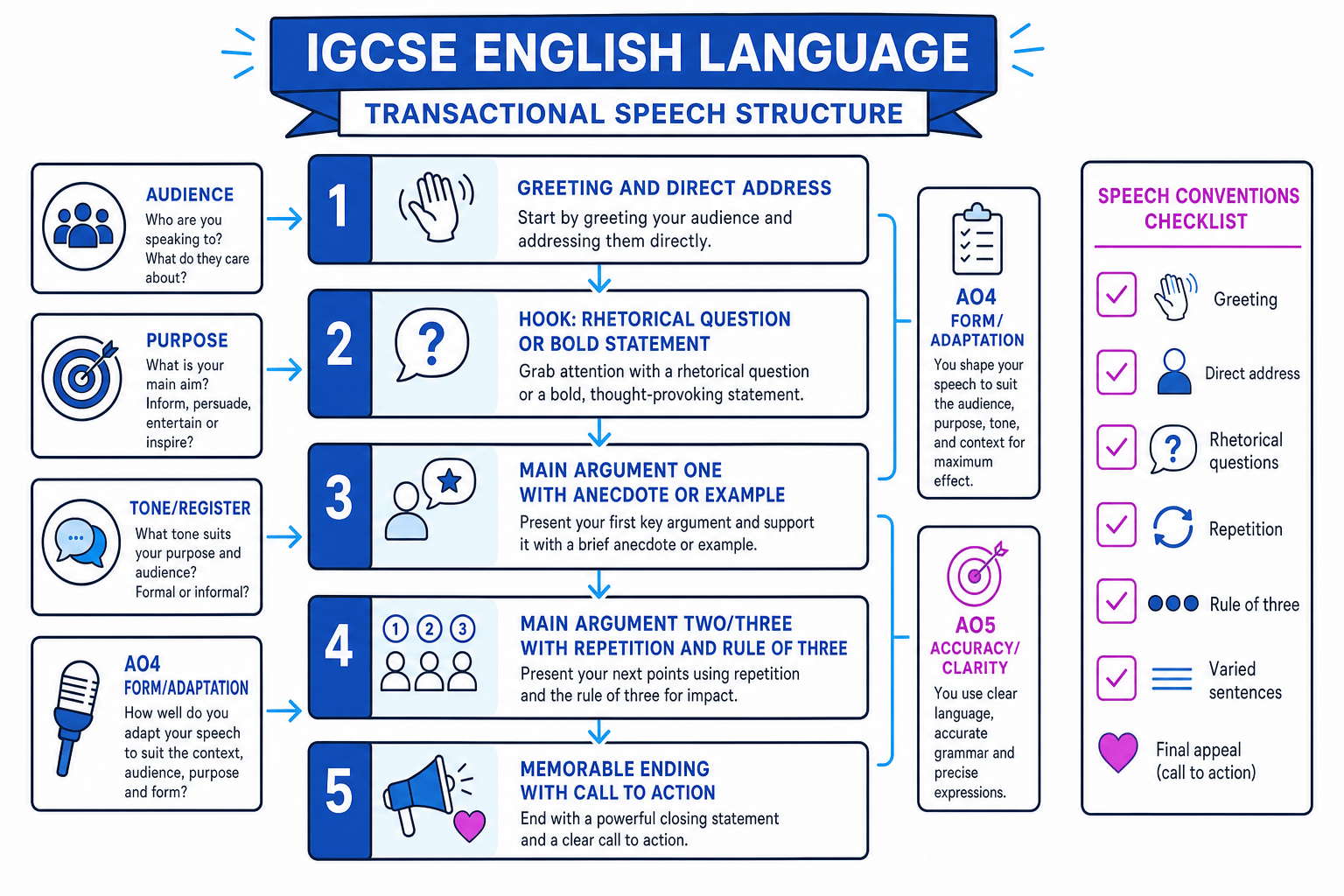
Greeting and direct address
A greeting is the opening address to the audience, such as “Good morning, everyone” or “Ladies and gentlemen”. Direct address means speaking straight to the audience using words such as “you”, “we”, “our” and “us”.
Use direct address throughout, not only in the first line. It helps the speech feel live and audience-focused.
Examples:
- “Good morning, everyone.”
- “I want you to imagine…”
- “We all know what it feels like to…”
- “Our school has a choice.”
The one-line speech disguise
Do not write a whole article and simply add “Good morning” at the beginning. Examiners reward adaptation to form, so the speech needs direct address, spoken rhythm and audience engagement throughout.
Opening with a hook
A hook is an opening that grabs attention. In a speech, the hook should quickly make the audience listen.
Common hooks include:
- a rhetorical question: a question asked for effect, not because you expect an answer
- a surprising fact or claim
- a short anecdote
- a bold statement
- a vivid imagined scenario
Rhetorical question
A rhetorical question is a question used to make the audience think or agree, rather than to receive a spoken answer.
For example: “How many of us threw food away yesterday without even thinking about it?” This invites the audience to reflect and creates a shared issue.
Use questions carefully
One strong rhetorical question is useful. Five questions in a row can feel repetitive and empty. After asking a question, develop the idea.
Building persuasive rhythm
A speech is heard as well as read, so rhythm matters. Rhythm means the pattern and pace created by sentence length, repetition and punctuation.
Repetition
Repetition means deliberately repeating a word, phrase or structure for emphasis. It helps the audience remember your message.
Example:
“We waste food in our lunchboxes. We waste food in the canteen. We waste food because it has become invisible to us.”
The repeated “We waste food” creates a firm, persuasive rhythm and keeps the audience focused on shared responsibility.
Rule of three
The rule of three is a technique where three words, phrases or ideas are grouped together for impact. Three-part patterns often sound complete and memorable.
Examples:
- “It is wasteful, expensive and unnecessary.”
- “We can plan better, buy smarter and waste less.”
- “For our school, our community and our future.”
Why rhythm works
Repetition and the rule of three make your argument sound confident and memorable. They are most effective when they strengthen meaning, not when they are added randomly.
Turning a plain point into a speech paragraph
Plain point: Students should waste less food.
- Add direct address so the audience is involved: “We need to waste less food.”
- Add a concrete school-based example: “Every lunchtime, half-eaten sandwiches and untouched fruit end up in the bin.”
- Add repetition to build pressure: “That is wasted food, wasted money and wasted effort.”
- Add a persuasive turn towards action: “If we choose only what we need, we can make a real difference by tomorrow.”
Using anecdotes and examples
An anecdote is a short personal story used to make a point. In a speech, anecdotes can make your argument feel human and believable.
For example, if you are speaking about kindness in school, you might describe a new student sitting alone on their first day. Keep it brief: the anecdote should support the argument, not take over the whole speech.
A good anecdote usually does three things:
- gives a specific moment
- creates an emotional connection
- links back clearly to your main message
Do not invent statistics carelessly
You can use general claims, but avoid making up precise statistics such as “87% of students…” unless the task gives you data. Invented statistics can sound unconvincing. If you need evidence, use realistic examples instead.
Keeping the audience engaged
Audience engagement means using features that make listeners feel included and involved. In a speech, you are not writing into the void: you are speaking to people in a room.
Useful methods include:
- inclusive pronouns: “we”, “us”, “our”
- direct challenges: “Ask yourself…”
- shared experiences: “We have all seen…”
- short sentences for emphasis
- pauses created by punctuation
- questions that guide the audience’s thinking
A speech can also use moments that sound performative, such as “Look around this room” or “Think about what that really means.” These phrases remind the examiner that the writing is designed to be spoken aloud.
Overdoing dramatic punctuation
Exclamation marks can show energy, but too many can make your writing seem uncontrolled. Usually, strong vocabulary and sentence structure are more persuasive than repeated exclamation marks.
Ending memorably
The ending should not fade away. It should leave the audience with a clear final thought.
A call to action is a direct instruction or encouragement telling the audience what to do next. It is especially useful in persuasive or argumentative speeches.
Examples:
- “So, tomorrow, choose carefully, waste less and encourage one friend to do the same.”
- “Let us be the year group that stopped complaining and started changing things.”
- “The question is no longer whether we can act. The question is whether we will.”
A strong ending often links back to the opening. This creates a satisfying structure and makes the speech feel planned.
Creating a memorable ending
Opening idea: “How many of us threw food away yesterday without even thinking about it?”
- Return to the same idea at the end so the speech feels complete: “Tomorrow, when you stand by the bin, think again.”
- Add a direct call to action: “Take only what you need, finish what you take, and remind others to do the same.”
- Finish with a short final sentence for impact: “Small choices matter.”
Tone and register: matching the task
Your language choices must fit the person you are meant to be.
For a school assembly, you might write in a semi-formal register: clear and respectful, but still personal.
For a council meeting, use a more formal register: controlled vocabulary, developed reasoning and fewer chatty phrases.
For younger students, use a warmer and simpler style: encouraging, clear and supportive.
Compare these openings:
- Too informal for a council: “Hi guys, this traffic situation is honestly a total nightmare.”
- Better for a council: “Good evening, councillors. I am speaking today because the traffic outside our school has become dangerous, disruptive and impossible to ignore.”
The second version sounds more appropriate because it respects the setting while still using persuasive emphasis.
Quick tone test
Ask yourself: “Would this sound natural from this speaker to this audience?” If not, adjust the vocabulary, level of formality and examples.
A simple planning method
Before you write, spend a few minutes planning. You can use this quick structure:
- Audience: who am I addressing?
- Purpose: what do I want them to think, feel or do?
- Main message: what is my central argument?
- Three points: what reasons or examples will support it?
- Speech features: where will I use direct address, rhetorical question, repetition and a memorable ending?
Do not plan every sentence. Plan the direction, then write fluently.
In the exam
- Read the task carefully and underline the audience, purpose and form before you begin.
- Make the speech form obvious from the start: use a greeting, direct address and a clear spoken voice.
- Build your argument in paragraphs, using repetition, rule of three and examples only where they strengthen your message.
- Save time to check AO5: sentence boundaries, punctuation, spelling, paragraphing and any awkward phrasing.
- End with a clear final appeal or call to action so your speech feels complete.
Check yourself
- Can you explain the difference between a speech and an article with a greeting added?
- Which speech techniques would you use to persuade a school audience, and why?
- How would your tone change if you were speaking to local councillors rather than classmates?
