What you'll learn
- How an article fits Component 1 Section B of Edexcel IGCSE English Language A.
- How to adapt an article for audience, purpose, tone and register.
- How to build a headline, opening, body paragraphs and final statement.
- How to balance lively style with accurate, controlled writing for AO4 and AO5.
Where articles fit in the exam
In Pearson Edexcel International GCSE English Language A, Component 1 is worth 60% of the qualification. It has Section A: Non-fiction Reading and Section B: Transactional Writing, each worth 45 marks.
In Component 1 Section B, you are advised to spend about 45 minutes on one piece of transactional writing. This could be an article, speech, letter, report, review or guide. This note focuses only on the article form.
Transactional writing
Transactional writing is writing that has a practical purpose: it aims to communicate with a specific audience in a specific form, such as an article, letter or speech.
This task assesses AO4 and AO5. AO4 rewards how effectively you communicate, adapt your form and organise your ideas. AO5 rewards accuracy: vocabulary, sentence structures, paragraphing, spelling, grammar and punctuation.
Article
An article is a piece of writing for a newspaper, magazine or website that informs, explains, argues, advises or entertains a reader on a topic. It normally has a headline, an engaging opening, developed paragraphs and a strong ending.
Start with audience, purpose and form
Before you write, work out the audience, purpose and form.
The audience is the group of people you are writing for. The purpose is what your writing is trying to achieve, such as to inform, persuade, argue, explain or advise. The form is the type of writing — here, an article.
You also need to control register, which means the level of formality, and tone, which means your attitude or voice. For example, your tone might be serious, lively, humorous, urgent, reflective or critical.
The article must fit the task
A strong article does not just “sound like an article”. It sounds like the right article for the right readers, with the right level of formality and a clear reason for being written.
Planning audience, purpose and angle
Suppose the task is: Write an article for your school magazine giving your views on whether students should have more opportunities to learn outside the classroom.
-
Identify the audience: the article is for a school magazine, so the readers are likely to be students, teachers and possibly parents. A friendly but thoughtful voice would fit.
-
Identify the purpose: “giving your views” means you should argue a clear opinion, not just describe outdoor learning. You might argue that it makes learning more memorable and practical.
-
Choose the angle: an angle is the particular viewpoint or slant you take. A focused angle could be: learning outside the classroom is not a treat; it is a serious way to make education more active and meaningful.
-
Match your language to that angle: use inclusive phrases such as “we”, “our lessons” and “our school” to make the article feel relevant to its readers.
Headline or title
A newspaper or magazine article should begin with a headline or title. The headline should be clear, relevant and interesting. It does not need to be a joke or a pun, but it should give the reader a reason to continue.
Good headlines often do one or more of these things:
- state the issue clearly
- suggest a strong viewpoint
- use a memorable phrase
- create curiosity without being misleading
For example, “Why Learning Should Not Stop at the Classroom Door” is stronger than “Outdoor Learning” because it already suggests an opinion.
Headline sanity check
If your headline could fit almost any topic, it is probably too vague. Make sure it contains a key word or idea from the task.
The opening: hook the reader and set your angle
The opening paragraph should hook the reader. A hook is a technique that catches attention at the start. You might use a rhetorical question, a bold statement, a short anecdote, a contrast or direct address.
A rhetorical question is a question asked for effect rather than because the writer expects an answer. For example: “When did learning become something that only happens under fluorescent lights?”
Your opening should also establish your angle. Do not spend too long warming up. By the end of the first paragraph, the examiner should know what you are writing about and roughly where you stand.
Improving an article opening
Weak opening: “This article is about outdoor learning and I will discuss the advantages and disadvantages.”
-
Remove the mechanical announcement. An article should not sound like an essay plan, so “This article is about…” feels flat and unconvincing.
-
Add a hook that suits the topic. A contrast works well here: “Some of the best lessons do not begin with a worksheet.”
-
Establish the angle. Continue with a clear viewpoint: “They begin with muddy shoes, real problems and the chance to connect ideas with the world beyond the classroom.”
-
Shape it into an opening: “Some of the best lessons do not begin with a worksheet. They begin with muddy shoes, real problems and the chance to connect ideas with the world beyond the classroom. If schools want students to think independently, outdoor learning should become part of normal school life — not an occasional reward.”
Building the body of the article
The middle paragraphs should develop your ideas in a logical order. A topic sentence is the sentence that introduces the main idea of a paragraph. After that, you should add detail, examples and methods that support your point.
The skeleton below shows how to organise an article under timed conditions, while keeping AO4 and AO5 in mind.
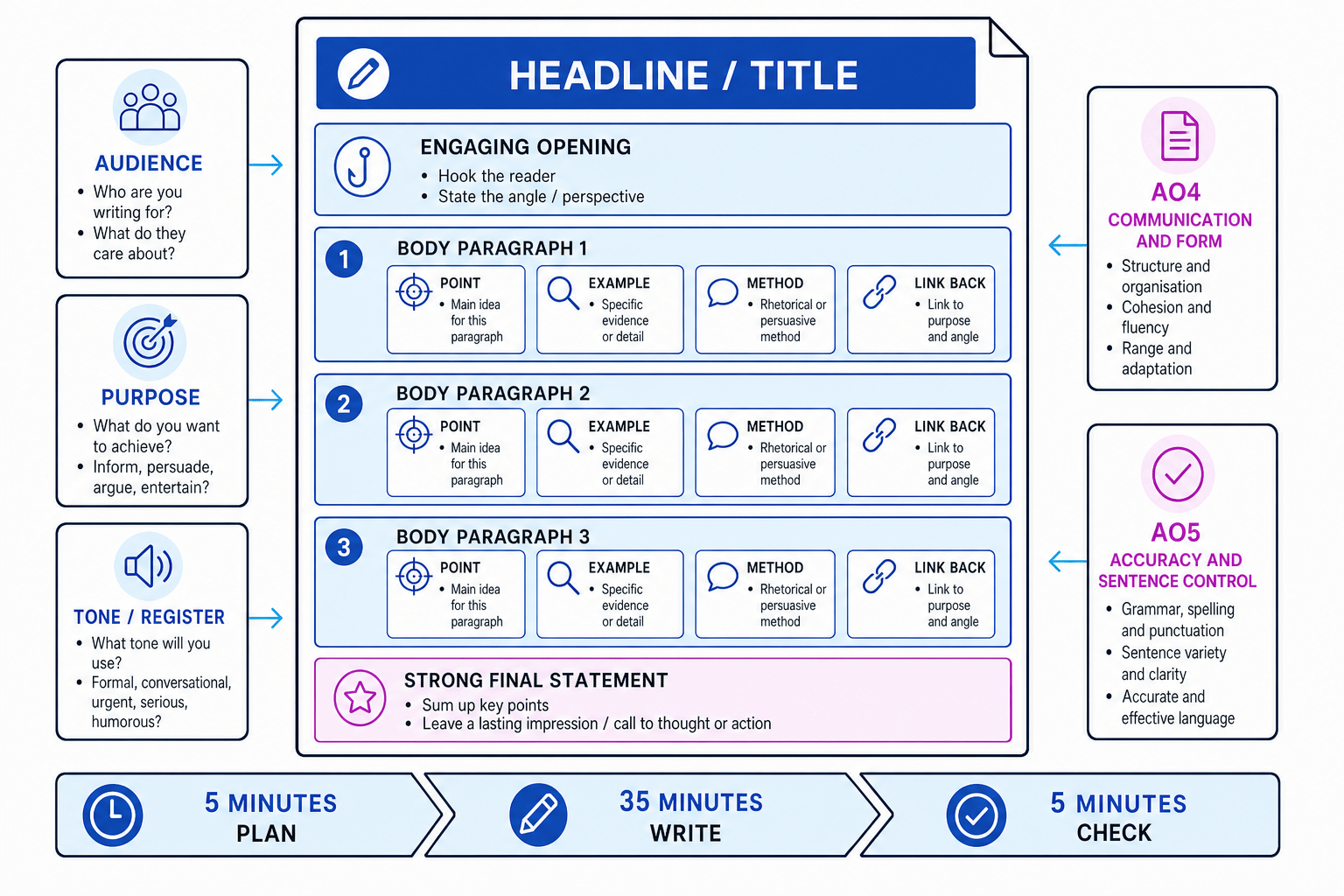
A useful paragraph pattern is:
- make a clear point
- develop it with an example or explanation
- use a rhetorical or persuasive method
- link back to your overall angle
Cohesion means the way ideas connect smoothly across sentences and paragraphs. You can create cohesion with linking phrases such as “More importantly”, “For some students”, “However”, “This matters because” and “The result is”.
Rhetorical devices
Rhetorical devices are language techniques used to influence the reader’s response. In articles, common examples include rhetorical questions, direct address, triples, contrast, repetition and emotive language.
A triple is a group of three words or phrases used for rhythm and emphasis, such as “healthier, happier and more confident”. Emotive language uses words that stir feelings, such as “wasted”, “hopeful”, “pressured” or “transformative”.
Developing one article paragraph
Point to develop: Outdoor learning can help students who struggle with ordinary classroom routines.
-
Start with a topic sentence that makes a clear claim: “Outdoor learning can also reach students who feel trapped by the routine of desks, bells and worksheets.”
-
Add a specific example without inventing a suspiciously precise statistic: “A geography lesson in a local park, for instance, can turn map skills from an abstract exercise into a real investigation.”
-
Use a rhetorical method to strengthen the point. A triple could emphasise the benefits: “Students move, observe and question.”
-
Link back to the angle: “That kind of learning is not a break from education; it is education made visible.”
Inventing fake evidence
Do not rely on unbelievable statistics such as “97.6% of students learn better outdoors” unless the task gives you that information. It is usually safer to use plausible examples, observations or cautious phrases such as “many students” or “in some schools”.
Newspaper article or magazine article?
Both newspaper and magazine articles need a headline, paragraphs and a clear angle, but the style may differ.
A newspaper article often feels more formal, topical and public-facing. It may discuss community issues, national debates or current concerns. A magazine article can be more personal, lively and targeted to a particular group, such as teenagers, parents, travellers or sports fans.
However, do not stereotype the form. A newspaper article can still be opinionated and engaging. A magazine article can still be serious and thoughtful. The task’s audience and purpose matter more than the label.
Voice: controlled but opinionated where appropriate
Many article tasks ask for “your views”, so you are allowed to have a clear opinion. That does not mean ranting. A controlled article sounds confident, not chaotic.
A strong voice might:
- use direct address, such as “you” or “we”
- include carefully chosen rhetorical questions
- vary sentence length for emphasis
- use precise vocabulary rather than vague exaggeration
- acknowledge another viewpoint briefly, then respond to it
For example: “Of course, not every lesson can happen outdoors. No one is suggesting algebra in a thunderstorm. But that is not an argument against outdoor learning; it is an argument for planning it properly.”
Turning the article into a speech
An article can use direct address, but it should not sound like a speech. Avoid speech-only features such as “Good morning everyone” or repeated instructions to “listen”. Articles are read, not performed.
Ending strongly
The final paragraph should not simply stop. It should give the reader a sense that the article has reached a clear conclusion.
You might end by:
- returning to an image or phrase from the opening
- summarising your strongest idea
- making a call to action
- leaving the reader with a memorable final sentence
A call to action is a direct encouragement for the reader or community to do something. For example: “If we want curious students, we need to give them a world worth being curious about.”
Final sentence test
Your final sentence should feel like the article’s last word, not just the last thing you happened to write before time ran out.
Accuracy and style for AO5
AO5 rewards clear, accurate writing. In an article, sentence variety matters because it helps control pace and emphasis.
Try mixing:
- short sentences for impact: “That matters.”
- longer sentences for explanation
- questions for engagement
- colons to introduce explanations or lists
- semi-colons only when both sides could stand as complete sentences
Paragraphing also matters. Avoid one giant block of writing. Each paragraph should have a job: opening, first main point, second main point, possible counterpoint, final statement.
In the exam
-
Spend about 5 minutes planning the audience, purpose, angle and 4–5 paragraph structure before you start writing.
-
Make the form obvious immediately: use a headline, an engaging opening and article-style paragraphs.
-
Check the final 5 minutes for sentence boundaries, paragraphing, spelling of key words from the task and whether your tone suits the audience.
Check yourself
-
Can you explain the difference between an article’s audience, purpose, tone and register?
-
Does your article opening hook the reader and reveal your angle quickly?
-
Have you used examples and rhetorical devices to develop ideas, rather than simply listing points?
