What you'll learn
- How the letter form works in Edexcel IGCSE English Language A Component 1 Section B.
- How to choose the right opening, tone, structure and sign-off.
- How to adapt your writing for a formal or informal recipient.
- How to develop paragraphs so your letter earns marks for AO4 and AO5.
Where letter writing fits in the exam
In Pearson Edexcel International GCSE English Language A, letters can appear in Component 1: Non-fiction Reading and Transactional Writing. Component 1 is worth 60% of the qualification. Section A is reading, worth 45 marks, and Section B is transactional writing, also worth 45 marks.
Section B assesses AO4 and AO5. AO4 rewards how well you communicate, adapt your writing to the form, audience and purpose, and create the right tone. AO5 rewards technical accuracy: vocabulary, sentence structures, paragraphing, spelling, grammar and punctuation.
Form
In English Language, form means the type of text you have been asked to write, such as a letter, article, speech, report or review. Each form has its own conventions: the features readers expect.
A letter is a common transactional form because it has a clear writer, a clear recipient, and usually a practical purpose: to complain, request, persuade, advise, inform, thank or explain.
The main idea
A successful exam letter is not just an essay with “Dear…” at the top. It must feel as if one person is writing to a specific recipient for a clear reason.
The basic job of a letter
A recipient is the person or organisation receiving the letter. Your audience is the reader or group of readers you are trying to affect. In a letter, these are often the same, but not always: for example, a letter to a newspaper editor may also be aimed at the newspaper’s wider readership.
Your purpose is what the writing is trying to do. A letter might aim to persuade, complain, advise, request, explain, argue, inform or reassure.
Your tone is the attitude your writing creates, such as respectful, urgent, friendly, disappointed, enthusiastic or concerned. Your register is the level of formality: formal, semi-formal or informal.
Decoding the task
Before you write, work out four things:
- Who are you writing to?
- Why are you writing?
- How formal should the tone be?
- What response do you want from the recipient?
Decoding audience, purpose and tone
Suppose the task is: Write a letter to your headteacher persuading them to improve the school’s outdoor spaces.
-
The recipient is the headteacher, so the letter needs a respectful, formal tone. You can still sound passionate, but not rude or over-familiar.
-
The purpose is persuasion, so your ideas should not just describe the problem. They should push the headteacher towards action by giving reasons, benefits and possible solutions.
-
The audience has authority in the school, so the details should focus on school life: wellbeing, behaviour, lunch breaks, the environment and student voice.
-
A strong plan could use three developed points: outdoor seating, shaded areas, and student involvement in maintaining the space. Each point should explain why the change matters and how it could work.
Letter structure: what goes where
A letter is easiest to control if you think of it as a sequence: greeting → purpose → developed points → closing action → sign-off. The diagram below shows the main parts you need in an exam answer.
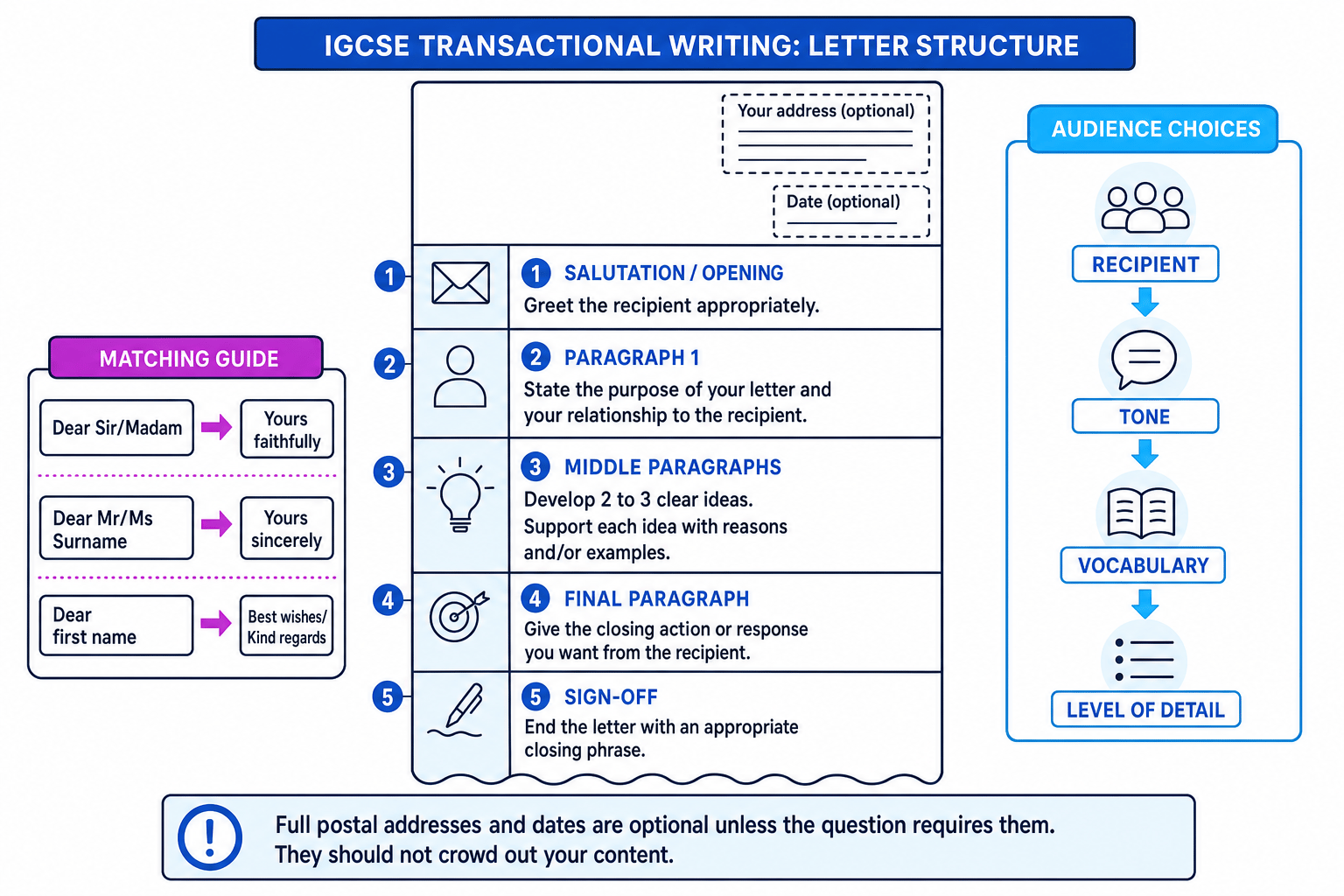
1. Salutation
The salutation is the greeting at the start of a letter.
Common choices include:
- Dear Sir/Madam — when you do not know the recipient’s name.
- Dear Mr Patel / Dear Ms Ahmed — when you know the surname.
- Dear Jamie — when the letter is informal or semi-formal.
In exam writing, do not spend lots of time inventing addresses. A date and address are usually optional unless the task specifically asks for them. The marks are mainly for the quality of the communication.
2. Opening paragraph
Your opening should establish the reason for writing quickly. It should also create the correct relationship with the recipient.
Formal examples:
- I am writing to express my concern about…
- I am writing to request your support for…
- I would like to draw your attention to…
Informal examples:
- I hope you’re well. I wanted to tell you about…
- I’ve been meaning to write because…
- You’ll never guess what happened…
3. Middle paragraphs
The middle paragraphs are where you earn most of your marks. Each paragraph should develop one main idea.
A strong paragraph often includes:
- a clear point
- explanation or detail
- an example, reason or consequence
- a link back to the recipient or purpose
4. Final paragraph
The final paragraph should bring the letter to a purposeful close. Depending on the task, you might:
- ask for a response
- suggest action
- thank the recipient
- summarise your main request
- end warmly or firmly
5. Sign-off
The sign-off is the closing phrase at the end of the letter.
Use these standard pairings:
| Opening | Suitable sign-off |
|---|---|
| Dear Sir/Madam | Yours faithfully |
| Dear Mr/Ms Surname | Yours sincerely |
| Dear first name | Best wishes / Kind regards / Yours sincerely |
Mismatched sign-off
Do not write Dear Sir/Madam and then end with Yours sincerely. The conventional formal pairing is Dear Sir/Madam → Yours faithfully.
Formal, semi-formal and informal letters
A formal letter is written to someone you do not know well, or someone in an official role: a council officer, headteacher, employer, company manager or newspaper editor.
An informal letter is written to someone you know personally: a friend, cousin or close family member.
A semi-formal letter sits in the middle. You might know the person, but still need a polite and controlled tone: for example, a letter to a neighbour, coach, club organiser or teacher you know well.
| Feature | Formal letter | Informal letter |
|---|---|---|
| Vocabulary | precise, polite, controlled | relaxed, natural, personal |
| Sentences | mostly complete and carefully structured | may include shorter, more conversational sentences |
| Address | title and surname, or Sir/Madam | first name |
| Tone | respectful, measured | friendly, warm, lively |
| Contractions | usually avoid: I am, do not | acceptable: I’m, don’t |
Think relationship first
Before choosing vocabulary, ask: How well do I know this person, and what power do they have in this situation? That will usually tell you the right register.
Adapting the same idea for different recipients
Imagine you want to ask for more recycling bins.
-
If writing to the local council, the relationship is formal. You need respectful phrasing and a clear civic reason: I am writing to request additional recycling bins in our area, as the current provision is insufficient for the number of residents.
-
If writing to a friend, the relationship is informal. You can sound more personal: I really think we should push for more recycling bins near our flats because the current ones are always overflowing.
-
The idea is the same, but the register changes. The formal version sounds public, controlled and solution-focused; the informal version sounds personal and conversational.
Developing paragraphs properly
In Section B, short undeveloped paragraphs can make your letter feel thin. A developed paragraph explores an idea rather than just naming it.
A useful structure is:
- Point — what is your main idea?
- Reason — why does it matter?
- Detail — what example, consequence or explanation proves it?
- Link — how does this support your purpose?
For example, if you are persuading a council to improve a park, do not simply write: The park needs more lighting. Develop it by explaining safety, community use and the practical result you want.
Building a developed paragraph
Suppose your point is that a local park needs better lighting.
-
Start with a precise main point: the problem is not just “the park is bad”; it is that poor lighting limits safe use of the park.
-
Add a reason connected to the recipient’s responsibility: the council should care because public spaces need to be safe and accessible.
-
Develop the consequence: families, elderly residents and students may avoid the park after late afternoon in winter.
-
Turn the point into a letter paragraph: One of the most urgent improvements would be better lighting along the main paths. At present, many residents avoid the park after dark, particularly during winter, because the entrances and central walkway feel unsafe. Installing brighter, well-placed lights would make the park more accessible for families, students returning from clubs and older residents, while also showing that the council takes community safety seriously.
Language choices that suit letters
Good letter writing sounds directed. You are writing to someone, not floating ideas into the air.
Direct address
Direct address means speaking straight to the reader using words such as you or your. It can make your letter feel personal and purposeful.
Example: You have the opportunity to make a decision that would benefit hundreds of local families.
Use it carefully in formal letters. Too much direct address can sound aggressive.
Modal verbs
A modal verb is a verb such as could, should, must, might or would. Modal verbs help you control pressure and politeness.
- You could consider… sounds polite and tentative.
- You should act now… sounds firmer.
- The council must address this issue… sounds urgent and forceful.
Rhetorical questions
A rhetorical question is a question asked for effect rather than because you expect an answer.
Example: Should young people really have to travel across town just to find a safe place to meet?
Rhetorical questions can be persuasive, but do not overuse them. One strong question is usually better than several dramatic ones.
Emotive language
Emotive language is vocabulary chosen to create an emotional response.
Example: It is disappointing that a space with such potential has been allowed to become neglected.
In formal letters, keep emotive language controlled. You can sound concerned without becoming exaggerated.
Sounding like a speech
A letter can be persuasive, but it should still feel like correspondence. If every sentence sounds like a slogan, speech or dramatic rant, the form becomes less convincing.
Openings that work
Your opening should do three jobs: greet the reader, state the purpose, and set the tone.
Formal opening
Dear Ms Khan,
I am writing to express my concern about the lack of affordable activities for young people in our area. As a student who lives locally, I believe this issue is affecting both wellbeing and community life.
This works because it identifies the issue, the writer’s connection to it, and the reason the recipient should keep reading.
Informal opening
Dear Sam,
I hope you’re doing well. I wanted to tell you about the volunteering project I’ve joined because I think you’d genuinely enjoy being part of it too.
This works because it feels personal and friendly, but it still has a clear purpose.
Closings that work
Your ending should not simply stop. It should leave the recipient with a final impression or a clear next step.
Formal closings might include:
- I hope you will consider this suggestion carefully and I would welcome the opportunity to discuss it further.
- Thank you for taking the time to read my concerns. I look forward to your response.
- I urge you to take action so that the situation can improve for everyone affected.
Informal closings might include:
- Let me know what you think — I’d love to hear your ideas.
- Write back when you can.
- I really hope you’ll come along.
Planning a letter quickly
A strong plan does not need to be long. Before writing, jot down:
- Recipient: who receives the letter?
- Purpose: what are you trying to achieve?
- Tone: formal, semi-formal or informal?
- Three main points: what will your middle paragraphs cover?
- Ending: what action, response or feeling should the reader be left with?
Plan around the reader
Every decision in a letter should be shaped by the recipient: what they know, what they care about, and what you want them to do or understand.
Accuracy and presentation
AO5 rewards clear, accurate writing. For letters, focus especially on:
- paragraphing: new idea, new paragraph
- sentence control: avoid long, rambling sentences
- accurate commas and full stops
- consistent tense
- correct apostrophes
- vocabulary that suits the level of formality
You can use ambitious vocabulary, but clarity matters more than showing off. A precise phrase such as a practical and affordable solution is often better than a vague dramatic phrase such as an unbelievably catastrophic disaster.
In the exam
-
Identify the recipient, purpose and register before you start; this protects your AO4 marks.
-
Use a clear letter shape: salutation, purposeful opening, developed middle paragraphs, focused closing and suitable sign-off.
-
Spend most of your time developing ideas, not inventing addresses or decorative layout details.
-
Match your tone to the task: polite and controlled for formal letters, warm and personal for informal ones.
-
Leave a few minutes to check paragraphing, sentence boundaries, spelling and punctuation for AO5.
Check yourself
-
Can you explain the difference between a formal, semi-formal and informal letter?
-
Which sign-off should you use after Dear Sir/Madam?
-
In your next practice letter, does each middle paragraph develop one clear idea with reasons or detail?
