What you'll learn
- What Assignment B is actually assessed on in Edexcel IGCSE English Language A.
- How AO4 rewards imaginative craft: purpose, audience, form, tone and register.
- How AO5 rewards technical control: vocabulary, sentences, paragraphs, spelling, grammar and punctuation.
- How to make your creative writing feel deliberate rather than just “interesting”.
Where Assignment B fits
Assignment B is the Imaginative Writing task in Component 3, the coursework alternative for Edexcel International GCSE English Language A. Component 3 is worth 40% of the qualification and contains two assignments: Assignment A for Poetry and Prose, and Assignment B for Imaginative Writing. Assignment B is worth 30 marks.
In Assignment B, the examiner is not marking your reading of a text. They are marking the quality of your own writing through AO4 and AO5.
Assessment objective
An assessment objective, often shortened to AO, is the skill the mark scheme is designed to reward. For Assignment B, the two relevant objectives are AO4, which is about communication and imaginative effect, and AO5, which is about clarity, accuracy and technical control.
The big picture: craft plus control
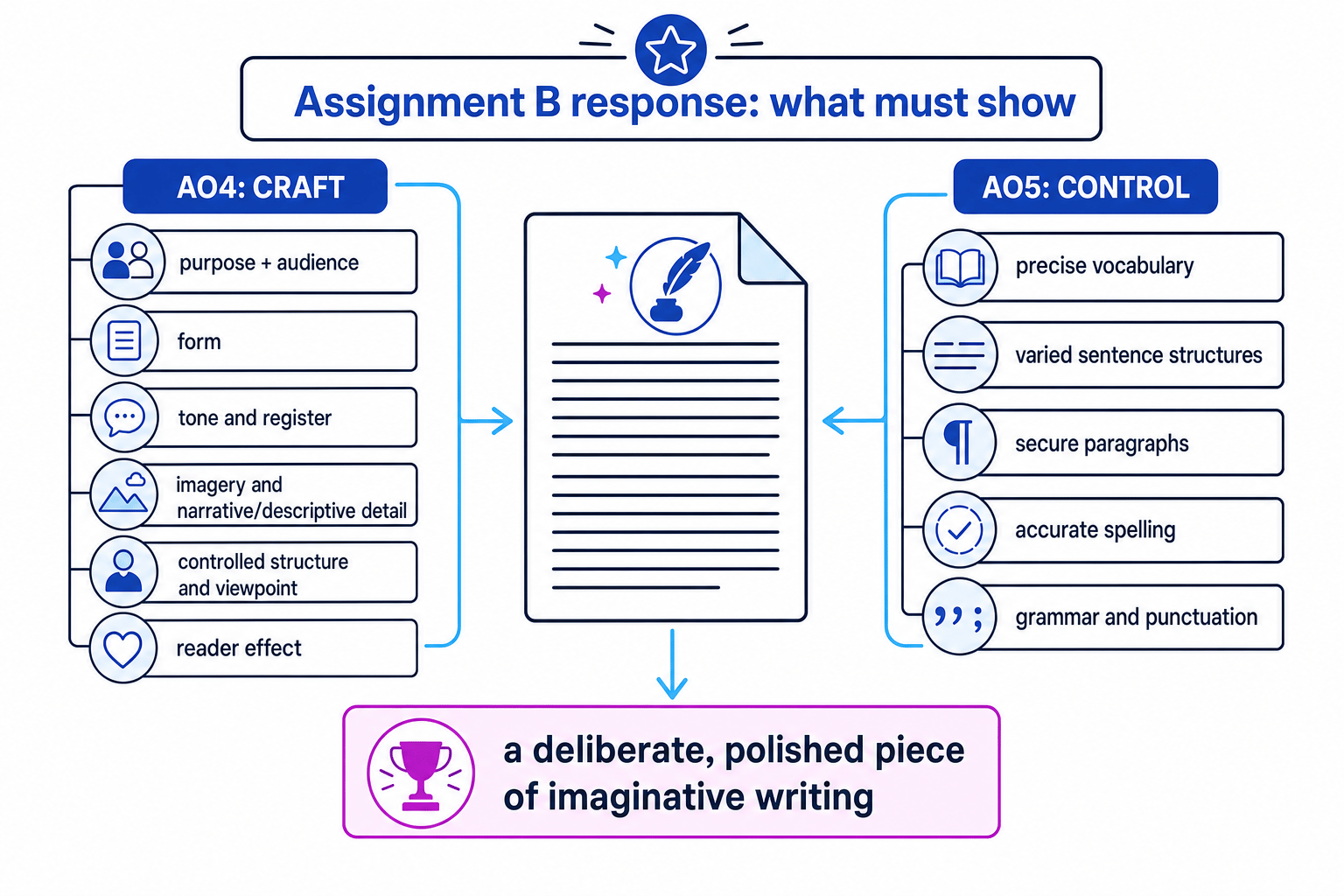
A strong Assignment B response must show two things at the same time:
- AO4: you can write imaginatively for a clear purpose, audience and form.
- AO5: you can control vocabulary, sentence structures, paragraphs, spelling, grammar and punctuation.
Think of AO4 as the creative design of the piece, and AO5 as the technical finish that makes the design work.
The main target
Your response should not feel like a first draft of “a story idea”. It should feel like a deliberately shaped piece of imaginative writing, where every choice helps the reader experience something.
AO4: communicating effectively and imaginatively
AO4 rewards your ability to communicate effectively and imaginatively, adapting form, tone and register for specific purposes and audiences.
That means your writing must do more than describe events. It needs to create an effect on the reader.
Purpose
Purpose
Purpose means what your writing is trying to do to the reader. In imaginative writing, your purpose might be to entertain, unsettle, move, surprise, build tension, create sympathy or make the reader reflect.
A piece with a clear purpose feels focused. For example, if your purpose is to create unease, your details, sentence choices and structure should all help build that unease.
Audience
Audience
Audience means the intended reader of your writing. In coursework, your practical audience is the examiner, but your imagined audience may be readers of a short story, a descriptive piece, a monologue or another creative form.
You do not need to write “Dear Examiner”. Instead, you show awareness of audience by making your writing engaging, controlled and easy to follow.
Form
Form
Form means the type or shape of writing you are producing, such as a short story opening, a complete short narrative, a description, a monologue, a diary-style voice or another imaginative form approved by your teacher.
Your form affects your choices. A short story usually needs development, tension and some kind of resolution or shift. A description may focus more on atmosphere, movement, perspective and detail.
Tone and register
Tone and register
Tone is the attitude or mood of the writing, such as tense, nostalgic, bitter, playful or reflective. Register is the level of language, from informal and conversational to formal and literary.
For Assignment B, tone and register should be controlled. If your piece begins in a serious, reflective voice, random slang or comedy can weaken the effect unless you use it deliberately.
Shaping a simple idea for AO4
Basic idea: Someone waits outside a closed door.
-
Choose the purpose: if the aim is to create tension, the writing should make the reader feel that waiting is uncomfortable and significant, not just boring.
-
Choose the viewpoint and tone: first person can make the moment feel immediate and personal; a tense, restricted viewpoint means the reader only knows what the narrator knows.
-
Select details that support the purpose: focus on the handle, the silence behind the door, the narrator’s breathing and the passing of time. Avoid unrelated details that do not build tension.
-
Shape the moment into a controlled paragraph:
The handle did not move. I watched it anyway, counting each shallow breath as if the number might matter. Behind the door, the house held itself still. Even the clock in the hallway seemed to hesitate before each tick.
Imaginative techniques: useful only when purposeful
Your writing can use techniques such as imagery, symbolism, pathetic fallacy, contrast, foreshadowing and motifs.
Imagery
Imagery is language that creates a sensory impression, helping the reader imagine what can be seen, heard, touched, tasted or smelt.
Foreshadowing
Foreshadowing is an early hint that something important may happen later.
Motif
A motif is a repeated image, idea or object that gains meaning as the piece develops.
These techniques are not a checklist. The examiner is not impressed by a simile simply because it is a simile. They are impressed when a method helps communicate meaning, mood or character.
Technique shopping list
Do not add metaphors, similes, rhetorical questions or dramatic punctuation just to “include techniques”. AO4 rewards controlled effect, not decoration.
Structure: how the response is shaped
Structure
Structure means how the whole piece is organised, including openings, endings, shifts in focus, paragraph order, pace and viewpoint.
In imaginative coursework, structure is one of the clearest ways to show control. A high-quality response often has a deliberate movement, such as:
- calm to chaos
- confidence to doubt
- outside description to inner thought
- present moment to memory and back again
- ordinary detail to unsettling discovery
Pace
Pace
Pace is the speed at which the writing feels as if it moves. Short sentences, sentence fragments and quick shifts can speed writing up; longer sentences and detailed description can slow it down.
Good writers vary pace. Too much action can become confusing. Too much description can become static. The best responses usually balance movement with carefully chosen detail.
A simple structure check
Ask yourself: What changes from the beginning to the end? If nothing changes in situation, mood, understanding or perspective, the piece may feel flat.
AO5: writing clearly and accurately
AO5 rewards your ability to write clearly, using a range of vocabulary and sentence structures, with appropriate paragraphing and accurate spelling, grammar and punctuation.
This does not mean writing in the most complicated way possible. It means writing with control.
Vocabulary: precise, varied and appropriate
Vocabulary
Vocabulary means your choice of words. In AO5, strong vocabulary is precise and appropriate to the tone, rather than just long or unusual.
Aim for accurate nouns and verbs before adding lots of adjectives. For example, “the dog moved” is weaker than “the dog skulked”, because skulked suggests movement, mood and character at once.
A strong Assignment B response often uses a connected pattern of words, sometimes called a semantic field.
Semantic field
A semantic field is a group of words linked by meaning, such as words connected to coldness, decay, childhood, violence or silence.
If your piece is about isolation, a semantic field of distance, emptiness and silence can quietly reinforce the mood.
Sentence structures: range with purpose
Sentence structure
Sentence structure means how sentences are built, including their length, order and complexity.
You should show a range of sentence types:
- Simple sentence: one main idea, often useful for impact.
- Compound sentence: two linked main ideas, often joined by words like “and”, “but” or “so”.
- Complex sentence: a main idea plus extra information, often useful for layering detail or thought.
Sentence fragment
A sentence fragment is an intentionally incomplete sentence used for effect, such as No sound. No movement. It can create impact, but it must look deliberate.
Deliberate rule-breaking
Fragments can work in imaginative writing, but only if the rest of your writing proves you understand sentence control. If many sentences are accidentally incomplete, AO5 will suffer.
Improving technical control
Basic version: The street was quiet and it was dark and I felt scared.
-
Replace vague vocabulary with more precise choices: “quiet” can become “emptied”, and “dark” can become “under the failing lamp” to create a clearer image.
-
Vary the sentence structures: use a short sentence for impact, followed by a longer sentence that develops atmosphere.
-
Use punctuation to control pace and clarity: a comma can separate opening detail, while a semicolon or dash can show a controlled relationship between ideas.
-
Improved version:
The street had emptied. Under the failing lamp, the shopfronts stared back at me, blind and black, while my footsteps clipped too loudly along the pavement.
Paragraphing: not just pressing Enter
Paragraphing
Paragraphing means organising writing into separate sections so the reader can follow shifts in time, place, focus, speaker, mood or action.
In Assignment B, paragraphing helps both AO4 and AO5. It shapes the reader’s experience and makes the writing clear.
Start a new paragraph when:
- the time changes
- the place changes
- a new character speaks or acts
- the focus shifts from outside description to inner thought
- the mood changes
- you want to create emphasis or suspense
Very long paragraphs can feel uncontrolled. Very short paragraphs can feel jumpy if overused. Use both deliberately.
Accuracy: spelling, grammar and punctuation
Accuracy matters because errors distract the reader and weaken control. AO5 includes:
- spelling, especially common words and ambitious vocabulary
- grammar, including tense consistency and agreement
- punctuation, including commas, full stops, apostrophes, speech marks, colons, semicolons and dashes where appropriate
Grammar
Grammar means the rules and patterns that make sentences work, such as verb tense, word order and subject-verb agreement.
Punctuation
Punctuation means marks such as full stops, commas, apostrophes and speech marks that clarify meaning and control rhythm.
A technically accurate piece does not have to use every type of punctuation. It is better to use a smaller range securely than to scatter semicolons everywhere incorrectly.
Ambition without control
Very long sentences, obscure vocabulary and experimental punctuation can lower AO5 if they create confusion. Ambitious writing still needs to be readable.
What the level descriptors are really looking for
Level descriptors
Level descriptors are the mark-scheme descriptions that explain what writing looks like at different levels of quality.
For AO4, the higher levels reward writing that is effective, imaginative and adapted confidently to purpose, audience and form. This means the examiner can see that your choices are deliberate.
For AO5, the higher levels reward a wide and controlled range of vocabulary and sentence structures, secure paragraphing and a high level of accuracy in spelling, grammar and punctuation.
So, if you want to move up the levels, do not just make the plot more dramatic. Improve the control of the writing.
A quick drafting checklist
Before you submit Assignment B, check whether your response shows:
AO4 craft
- A clear purpose: the reader is meant to feel or think something.
- A suitable form: the piece behaves like the type of writing it is meant to be.
- A controlled tone and register.
- Engaging detail, not random description.
- A structure that creates development, contrast or a shift.
- A deliberate ending, not just a stop.
AO5 control
- Precise vocabulary choices.
- Varied sentence lengths and sentence types.
- Paragraphs used for shifts and emphasis.
- Secure punctuation, especially full stops and commas.
- Accurate spelling of common and ambitious words.
- Consistent grammar and tense.
In the exam
-
Decide the intended effect before you write: tension, sympathy, mystery, humour, sadness or reflection. Let that choice guide AO4.
-
Control the shape of the whole piece: opening, development, shift and ending. Do not rely only on exciting events.
-
Leave time to check AO5: sentence boundaries, paragraphing, spelling, tense consistency and punctuation accuracy.
Check yourself
- Can you explain the difference between AO4 and AO5 in your own words?
- What changes between the beginning and end of your imaginative response?
- Which three technical accuracy issues do you personally need to check before submission?
