Structural formulae
Definition
Structural formula
An unambiguous description of the way the atoms in a molecule are arranged.
Definition
Molecular formula
A formula that shows the actual number of atoms of each different element in one molecule of a substance.
- A structural formula is an unambiguous description of the way the atoms in a molecule are arranged.
- It lists the atoms carbon by carbon along the chain, with each carbon written next to the atoms joined to it.
- A molecular formula only counts the atoms, so it cannot tell you how they are joined.
- Ethanol has the molecular formula C2H6O\text{C}_2\text{H}_6\text{O}C2H6O, which does not show where the oxygen sits.
- Its structural formula, CH3CH2OH\text{CH}_3\text{CH}_2\text{OH}CH3CH2OH, shows a CH3\text{CH}_3CH3 group joined to a CH2\text{CH}_2CH2 group, which is joined to an OH\text{OH}OH group.
- A structural formula is shorter to write than a displayed formula, but it carries the same information about which atom is bonded to which.
- Learn how to read three standard examples.
- CH2=CH2\text{CH}_2=\text{CH}_2CH2=CH2 is ethene, and the === sign must be written, because the double bond is the part that makes it an alkene.
- CH3CH2OH\text{CH}_3\text{CH}_2\text{OH}CH3CH2OH is ethanol, with the OH\text{OH}OH group on the end carbon.
- CH3COOCH3\text{CH}_3\text{COOCH}_3CH3COOCH3 is methyl ethanoate, an ester, in which the COO\text{COO}COO group links a CH3\text{CH}_3CH3 group on each side.
- In CH3COOCH3\text{CH}_3\text{COOCH}_3CH3COOCH3 the carbon of the COO\text{COO}COO group has a double bond to one oxygen and a single bond to the other, and that second oxygen is bonded to the right-hand CH3\text{CH}_3CH3.
- A branch on a chain is written in brackets after the carbon it is attached to, so CH3CH(CH3)CH3\text{CH}_3\text{CH}(\text{CH}_3)\text{CH}_3CH3CH(CH3)CH3 has a CH3\text{CH}_3CH3 branch on the second carbon.
Example
From displayed to structural formula
- The displayed formula of methyl ethanoate shows every bond in the molecule.
- Reading from the left, the first carbon carries three hydrogen atoms, which gives CH3\text{CH}_3CH3.
- The next carbon has a double bond to oxygen and a single bond to a second oxygen, which gives COO\text{COO}COO.
- The last carbon carries three hydrogen atoms, which gives CH3\text{CH}_3CH3.
- Writing the groups in order gives the structural formula.
- Counting the atoms gives the molecular formula C3H6O2\text{C}_3\text{H}_6\text{O}_2C3H6O2, which on its own could fit more than one structure.
Structural isomers
Definition
Structural isomers
Compounds with the same molecular formula but different structural formulae.
- Structural isomers are compounds with the same molecular formula but different structural formulae.
- Isomers contain exactly the same atoms, but the atoms are joined in a different order, so they are different compounds.
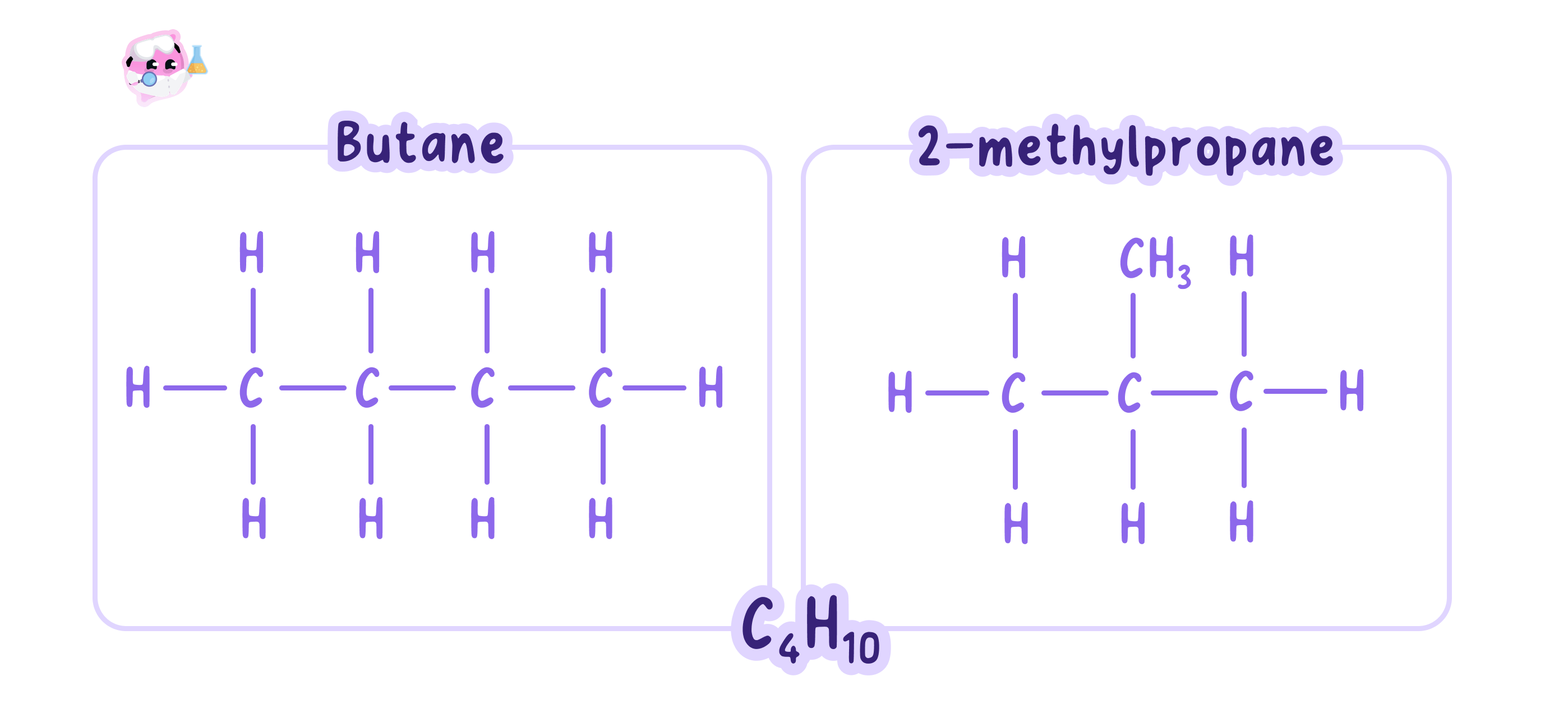
- C4H10\text{C}_4\text{H}_{10}C4H10 has two structural isomers.
- Butane, CH3CH2CH2CH3\text{CH}_3\text{CH}_2\text{CH}_2\text{CH}_3CH3CH2CH2CH3, has all four carbon atoms in one unbranched chain.
- 2-methylpropane, CH3CH(CH3)CH3\text{CH}_3\text{CH}(\text{CH}_3)\text{CH}_3CH3CH(CH3)CH3, has a chain of three carbon atoms with a CH3\text{CH}_3CH3 branch on the middle carbon.
- C4H8\text{C}_4\text{H}_8C4H8 also has structural isomers, which differ in the position of the double bond.
- But-1-ene, CH3CH2CH=CH2\text{CH}_3\text{CH}_2\text{CH}=\text{CH}_2CH3CH2CH=CH2, has the C=C\text{C}=\text{C}C=C bond at the end of the chain.
- But-2-ene, CH3CH=CHCH3\text{CH}_3\text{CH}=\text{CHCH}_3CH3CH=CHCH3, has the C=C\text{C}=\text{C}C=C bond in the middle of the chain.
- To decide whether two structures are isomers, carry out two checks in order.
- Count each type of atom in both structures and confirm that the molecular formulae are the same.
- Trace the longest carbon chain and the positions of any branches or double bonds to confirm that the atoms are joined differently.
- A chain drawn with a bend in it is still the same compound, because bending the drawing does not change which atoms are bonded to each other.
- To draw an isomer of a given compound, shorten the main chain and move one carbon into a branch, or move a double bond to a new position.
Example
Isomers of C4H8\text{C}_4\text{H}_8C4H8
- Both structures below contain four carbon atoms and eight hydrogen atoms, so both have the molecular formula C4H8\text{C}_4\text{H}_8C4H8.
- In but-1-ene the double bond is between the first and second carbon atoms.
- In but-2-ene the double bond is between the second and third carbon atoms.
- The atoms are joined in a different order, so the two compounds are structural isomers.
- Flipping but-1-ene from left to right puts the double bond on the right-hand end, but it is still but-1-ene and not a new isomer.
Features of a homologous series
Definition
Homologous series
A family of similar compounds with similar chemical properties due to the presence of the same functional group.
- A homologous series is a family of similar compounds with similar chemical properties due to the presence of the same functional group.
- Every homologous series has five general characteristics.
- Same functional group
- All members carry the same reactive atom or group, such as C=C\text{C}=\text{C}C=C in the alkenes or −OH-\text{OH}−OH in the alcohols.
- Same general formula
- All members fit one formula in nnn, such as CnH2n+2\text{C}_n\text{H}_{2n+2}CnH2n+2 for the alkanes.
- Differ by a −CH2−-\text{CH}_2-−CH2− unit
- Each member has one more carbon atom and two more hydrogen atoms than the member before it.
- Methane, CH4\text{CH}_4CH4, ethane, C2H6\text{C}_2\text{H}_6C2H6, and propane, C3H8\text{C}_3\text{H}_8C3H8, each differ from the next by CH2\text{CH}_2CH2.
- The relative molecular mass therefore goes up by 14 from one member to the next.
- Trend in physical properties
- Physical properties such as boiling point change gradually as the chain gets longer.
- Similar chemical properties
- All members react in the same kinds of way, because the reactions happen at the shared functional group.
The boiling point trend
- Along a homologous series, boiling point increases as the number of carbon atoms increases.
- The explanation follows a chain of reasoning.
- A longer chain means a larger molecule with more atoms.
- Larger molecules have stronger intermolecular forces, the weak forces of attraction between neighbouring molecules.
- More energy is needed to overcome these stronger forces when the liquid boils.
- So the liquid must be heated to a higher temperature before it boils.
- Boiling separates whole molecules from each other, so the covalent bonds inside each molecule are not broken.
- The trend also shows up as a change of state, since the smallest alkanes are gases at room temperature, the middle members are liquids and the longest are solids.
Example
Boiling points of the first six alkanes
- The first six alkanes show the trend clearly, with each extra CH2\text{CH}_2CH2 unit raising the boiling point.
- Methane, CH4\text{CH}_4CH4, boils at −162 ∘C-162\ ^\circ\text{C}−162 ∘C.
- Ethane, C2H6\text{C}_2\text{H}_6C2H6, boils at −89 ∘C-89\ ^\circ\text{C}−89 ∘C.
- Propane, C3H8\text{C}_3\text{H}_8C3H8, boils at −42 ∘C-42\ ^\circ\text{C}−42 ∘C.
- Butane, C4H10\text{C}_4\text{H}_{10}C4H10, boils at −1 ∘C-1\ ^\circ\text{C}−1 ∘C.
- Pentane, C5H12\text{C}_5\text{H}_{12}C5H12, boils at 36 ∘C36\ ^\circ\text{C}36 ∘C.
- Hexane, C6H14\text{C}_6\text{H}_{14}C6H14, boils at 69 ∘C69\ ^\circ\text{C}69 ∘C.
- Room temperature is about 25 ∘C25\ ^\circ\text{C}25 ∘C, so the first four are gases and pentane and hexane are liquids.
- The chemical reactions of all six are alike, because they belong to the same series.
Common Mistake
- Do not call two compounds isomers when their molecular formulae differ, so C4H8\text{C}_4\text{H}_8C4H8 and C4H10\text{C}_4\text{H}_{10}C4H10 are not isomers.
- Do not count the same molecule drawn with a bent chain, or drawn back to front, as a new isomer.
- Do not explain a higher boiling point by saying covalent bonds break, because boiling only overcomes the forces between molecules.
- Do not leave the === sign out of CH2=CH2\text{CH}_2=\text{CH}_2CH2=CH2, because without it the formula no longer describes ethene.
Exam technique
Earning the definition marks
- Define structural isomers with both parts, the same molecular formula and a different structural formula, because each part usually carries a mark.
- Write "same molecular formula" rather than "same formula", because a vague answer does not separate molecular from structural formulae.
- When you list characteristics of a homologous series, give the exact features, such as "differ by CH2\text{CH}_2CH2" and "same general formula".
- In a boiling point answer, link chain length to stronger forces between molecules and to more energy needed to separate them.
Self review
- What is a structural formula?
- Define structural isomers.
- Give the structural formulae of the two isomers of C4H10\text{C}_4\text{H}_{10}C4H10.
- By which unit do neighbouring members of a homologous series differ?
- Why does boiling point increase as an alkane chain gets longer?
