Building a name
- The name of a simple organic compound has two parts, a stem at the start and an ending at the finish.
- The stem tells you how many carbon atoms are in the chain.
- Meth- means one carbon atom.
- Eth- means two carbon atoms.
- Prop- means three carbon atoms.
- But- means four carbon atoms.
- The ending tells you which homologous series the compound belongs to.
- -ane means an alkane, with only single bonds.
- -ene means an alkene, with a C=C\text{C}=\text{C}C=C double bond.
- -ol means an alcohol, with an −OH-\text{OH}−OH group.
- -oic acid means a carboxylic acid, with a −COOH-\text{COOH}−COOH group.
- Putting the two parts together gives the name, so a two-carbon alkane is eth + ane = ethane.
Reading the name ethanoic acid
- The stem eth- shows that the molecule has two carbon atoms.
- The ending -oic acid shows that it is a carboxylic acid with a −COOH-\text{COOH}−COOH group.
- The carbon atom inside the −COOH-\text{COOH}−COOH group is one of the two carbons, so the other carbon is a CH3\text{CH}_3CH3 group.
Methane and ethane
-
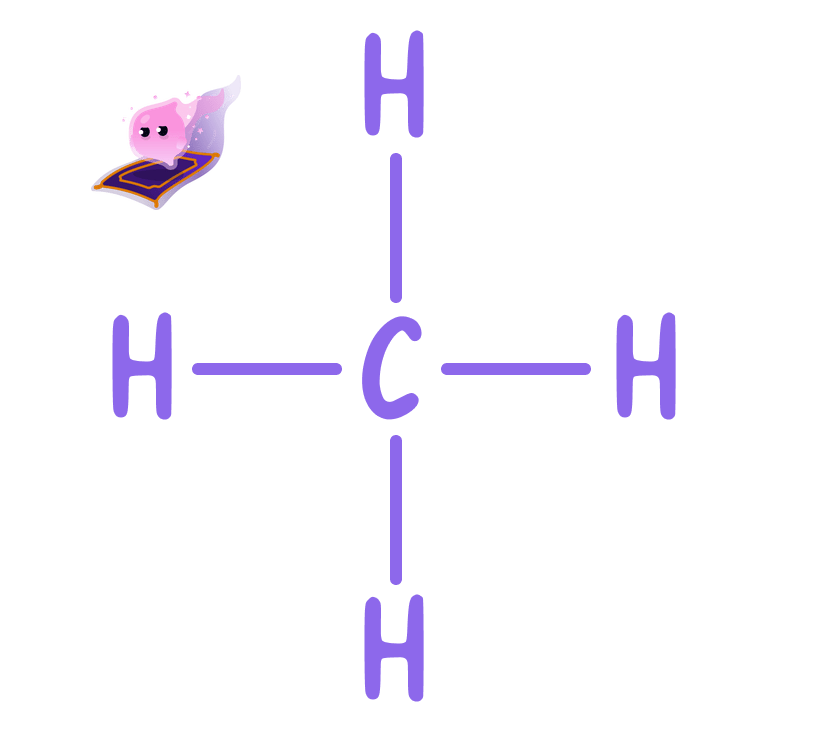
Methane is the alkane with one carbon atom, and its molecular formula is CH4\text{CH}_4CH4.
-
Its displayed formula has a carbon atom in the centre joined by four single bonds to four hydrogen atoms.
-
Ethane is the alkane with two carbon atoms, and its molecular formula is C2H6\text{C}_2\text{H}_6C2H6.
-
The two carbon atoms are joined by a single bond, and each carbon uses its other three bonds for hydrogen atoms.
HH∣∣H−C−C−H∣∣HH \begin{array}{ccccccc} & & \text{H} & & \text{H} & & \\ & & | & & | & & \\ \text{H} & - & \text{C} & - & \text{C} & - & \text{H} \\ & & | & & | & & \\ & & \text{H} & & \text{H} & & \end{array} H−H∣C∣H−H∣C∣H−H
Ethene
-
Ethene is the alkene with two carbon atoms, and its molecular formula is C2H4\text{C}_2\text{H}_4C2H4.
-
The two carbon atoms are joined by a double bond, drawn as two parallel lines.
-
The double bond uses two of each carbon's four bonds, so each carbon is joined to only two hydrogen atoms.
HH∣∣C=C∣∣HH \begin{array}{ccc}\text{H} & & \text{H} \\ | & & | \\ \text{C} & = & \text{C} \\ | & & | \\ \text{H} & & \text{H}\end{array} H∣C∣H=H∣C∣H -
Ethene has two fewer hydrogen atoms than ethane, and that difference comes from the double bond.
Ethanol
Alcohol
An organic compound whose molecules contain the hydroxyl functional group, OH, bonded to a carbon atom.
-
Ethanol is the alcohol with two carbon atoms, and its formula is written C2H5OH\text{C}_2\text{H}_5\text{OH}C2H5OH.
- Its molecular formula can also be written C2H6O\text{C}_2\text{H}_6\text{O}C2H6O, but C2H5OH\text{C}_2\text{H}_5\text{OH}C2H5OH keeps the functional group visible.
-
The displayed formula is an ethane-like chain in which one hydrogen atom has been swapped for an O−H\text{O}-\text{H}O−H group.
-
The oxygen atom sits between the carbon and the hydrogen, so the bonds run C−O−H\text{C}-\text{O}-\text{H}C−O−H.
HH∣∣H−C−C−O−H∣∣HH \begin{array}{ccccccccc} & & \text{H} & & \text{H} & & & & \\ & & | & & | & & & & \\ \text{H} & - & \text{C} & - & \text{C} & - & \text{O} & - & \text{H} \\ & & | & & | & & & & \\ & & \text{H} & & \text{H} & & & & \end{array} H−H∣C∣H−H∣C∣H−O−H -
Check the drawing by counting bonds, with four on each carbon, two on the oxygen and one on each hydrogen.
Ethanoic acid
Carboxylic acid
An organic compound whose molecules contain the carboxyl functional group, COOH.
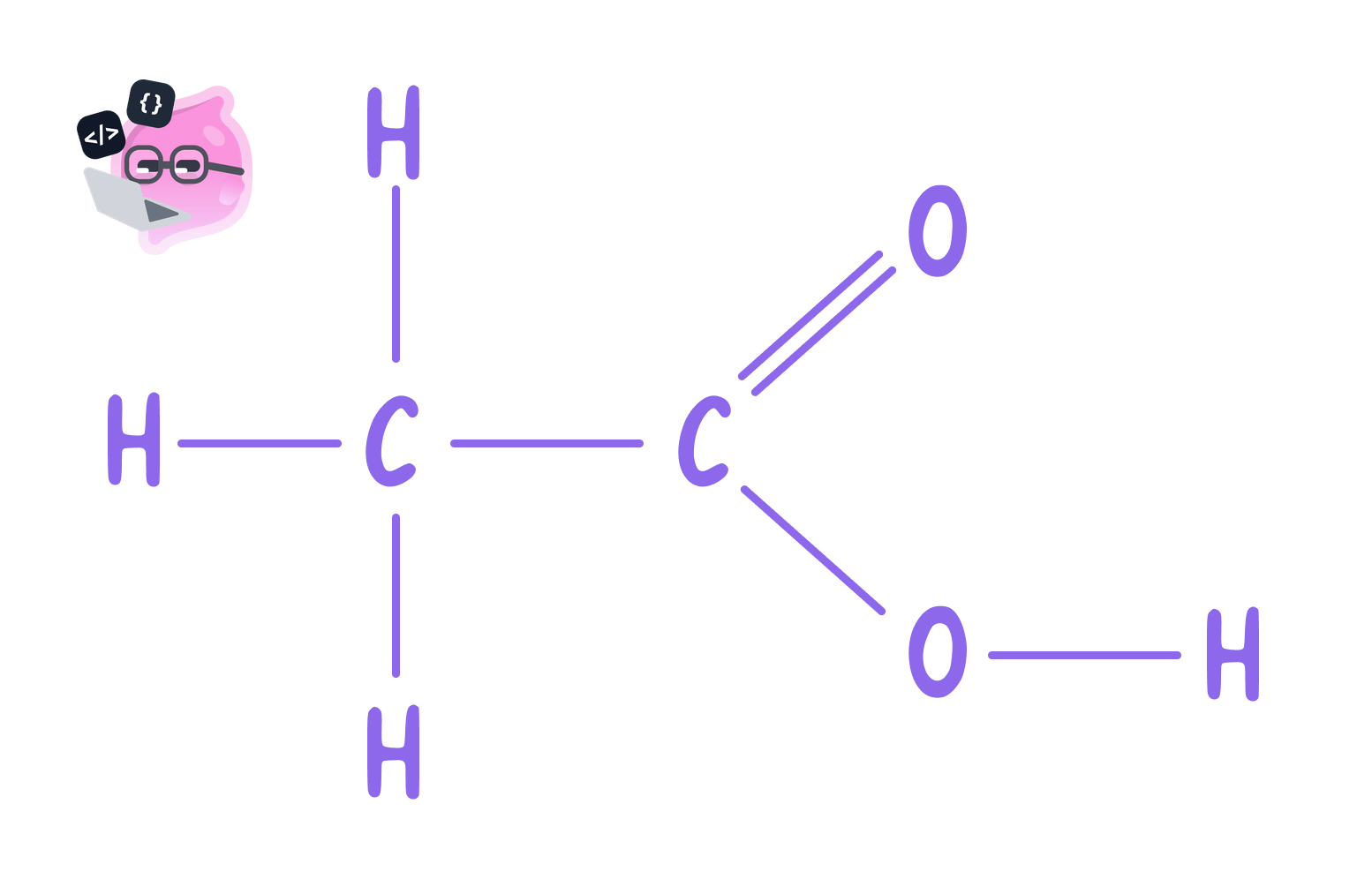
- Ethanoic acid is the carboxylic acid with two carbon atoms, and its formula is written CH3COOH\text{CH}_3\text{COOH}CH3COOH.
- Its molecular formula can also be written C2H4O2\text{C}_2\text{H}_4\text{O}_2C2H4O2.
- One carbon atom is a CH3\text{CH}_3CH3 group, and the other is the carbon of the carboxyl group.
- The carboxyl carbon has a double bond to one oxygen atom and a single bond to a second oxygen atom, which carries the hydrogen.
- The carboxyl carbon has no hydrogen atom of its own, because its four bonds are used by the other carbon, the double-bonded oxygen and the single-bonded oxygen.
Telling the oxygen groups apart
- In ethanol the single oxygen atom is joined to a carbon that also carries hydrogen atoms, giving C−O−H\text{C}-\text{O}-\text{H}C−O−H.
- In ethanoic acid there are two oxygen atoms on the same carbon, one double bonded and one in an O−H\text{O}-\text{H}O−H group.
- An O−H\text{O}-\text{H}O−H on a carbon that also has a C=O\text{C}=\text{O}C=O belongs to a carboxylic acid, not an alcohol.
Identifying the compound type
- You can work out the type of compound from its name, its molecular formula or its displayed formula.
- From a name, read the ending.
- A name ending in -ane is an alkane, -ene an alkene, -ol an alcohol and -oic acid a carboxylic acid.
- From a molecular formula, look at the elements and the numbers.
- A formula with only carbon and hydrogen that fits CnH2n+2\text{C}_n\text{H}_{2n+2}CnH2n+2 is an alkane, such as C2H6\text{C}_2\text{H}_6C2H6.
- A formula with only carbon and hydrogen that fits CnH2n\text{C}_n\text{H}_{2n}CnH2n is an alkene, such as C2H4\text{C}_2\text{H}_4C2H4.
- A formula ending in OH\text{OH}OH, such as C2H5OH\text{C}_2\text{H}_5\text{OH}C2H5OH, is an alcohol.
- A formula ending in COOH\text{COOH}COOH, such as CH3COOH\text{CH}_3\text{COOH}CH3COOH, is a carboxylic acid.
- From a displayed formula, look for the functional group.
- Only C−C\text{C}-\text{C}C−C and C−H\text{C}-\text{H}C−H single bonds means an alkane.
- A C=C\text{C}=\text{C}C=C double bond means an alkene.
- A C−O−H\text{C}-\text{O}-\text{H}C−O−H arrangement on its own means an alcohol.
- A carbon with both =O=\text{O}=O and −O−H-\text{O}-\text{H}−O−H means a carboxylic acid.
Three ways to classify a compound
- The name propane ends in -ane, so propane is an alkane with three carbon atoms.
- The molecular formula C3H6\text{C}_3\text{H}_6C3H6 has only carbon and hydrogen, and 6=2×36 = 2 \times 36=2×3, so it fits CnH2n\text{C}_n\text{H}_{2n}CnH2n and is an alkene.
- A displayed formula with a carbon atom bonded to a double-bonded oxygen and to an O−H\text{O}-\text{H}O−H group shows a carboxylic acid.
Naming reaction products
- Later reactions in organic chemistry make products that you must be able to name and draw, using the same rules.
- Chloromethane, CH3Cl\text{CH}_3\text{Cl}CH3Cl, forms when methane reacts with chlorine.
-
One hydrogen atom of methane has been replaced by a chlorine atom, and chlorine forms one bond, like hydrogen.
-
Its displayed formula is the methane shape with one Cl\text{Cl}Cl in place of one H\text{H}H.
H∣H−C−Cl∣H \begin{array}{ccccc} & & \text{H} & & \\ & & | & & \\ \text{H} & - & \text{C} & - & \text{Cl} \\ & & | & & \\ & & \text{H} & & \end{array} H−H∣C∣H−Cl
-
- 1,2-dibromoethane, CH2BrCH2Br\text{CH}_2\text{BrCH}_2\text{Br}CH2BrCH2Br, forms when ethene reacts with bromine.
-
The numbers 1 and 2 show that there is one bromine atom on carbon 1 and one on carbon 2.
-
The carbon-carbon bond in the product is single, so the name ends in -ane.
BrBr∣∣H−C−C−H∣∣HH \begin{array}{ccccccc} & & \text{Br} & & \text{Br} & & \\ & & | & & | & & \\ \text{H} & - & \text{C} & - & \text{C} & - & \text{H} \\ & & | & & | & & \\ & & \text{H} & & \text{H} & & \end{array} H−Br∣C∣H−Br∣C∣H−H
-
- Ethane forms when ethene reacts with hydrogen, and ethanol forms when ethene reacts with steam or when sugar is fermented.
- Ethanoic acid reacts with metals, bases and carbonates to form ethanoate salts.
- The salt is named with the metal first and ethanoate second, such as sodium ethanoate, CH3COONa\text{CH}_3\text{COONa}CH3COONa.
- Do not write CH3CH2OH\text{CH}_3\text{CH}_2\text{OH}CH3CH2OH when a question asks for a displayed formula, because it does not show every bond.
- Do not join the hydrogen of ethanol straight to carbon, because the oxygen must sit between them as C−O−H\text{C}-\text{O}-\text{H}C−O−H.
- Do not confuse ethane and ethene, because one letter changes the compound from an alkane to an alkene.
- Do not forget that the carbon in −COOH-\text{COOH}−COOH counts towards the stem, so CH3COOH\text{CH}_3\text{COOH}CH3COOH is ethanoic acid, not methanoic acid.
Drawing for the marks
- Draw every bond as a line, including each C−H\text{C}-\text{H}C−H bond and the O−H\text{O}-\text{H}O−H bond, because a missing bond loses the mark.
- Show the C=C\text{C}=\text{C}C=C in ethene and the C=O\text{C}=\text{O}C=O in ethanoic acid as two clear lines.
- Count the bonds round every atom before you move on, with four for carbon, two for oxygen and one for hydrogen or a halogen.
- Spell ethane, ethene and ethanol carefully, because the mark scheme only accepts a spelling that clearly names the right compound.
- What does the stem prop- tell you about a molecule?
- Which ending is used for a carboxylic acid?
- How many hydrogen atoms are bonded to each carbon atom in ethene?
- What type of compound has the molecular formula C2H6\text{C}_2\text{H}_6C2H6?
- Which atom sits between the carbon and the hydrogen in the −OH-\text{OH}−OH group of ethanol?
