6.3.1 Reversible reactions
Reversible reactions
Reversible reaction
A reaction in which the products can react to re-form the original reactants, shown by the symbol ⇌\rightleftharpoons⇌.
- Most reactions go in one direction only, turning reactants into products.
- In a reversible reaction, the products can also react together to turn back into the original reactants.
- The symbol ⇌\rightleftharpoons⇌, made of two half-arrows, shows that a reaction is reversible.
- A general reversible reaction is written as A+B⇌C+D\text{A} + \text{B} \rightleftharpoons \text{C} + \text{D}A+B⇌C+D.
- The reaction from left to right is the forward reaction, and the reaction from right to left is the reverse reaction.
- Changing the conditions, such as heating a substance or adding water to it, can change the direction in which a reversible reaction goes.
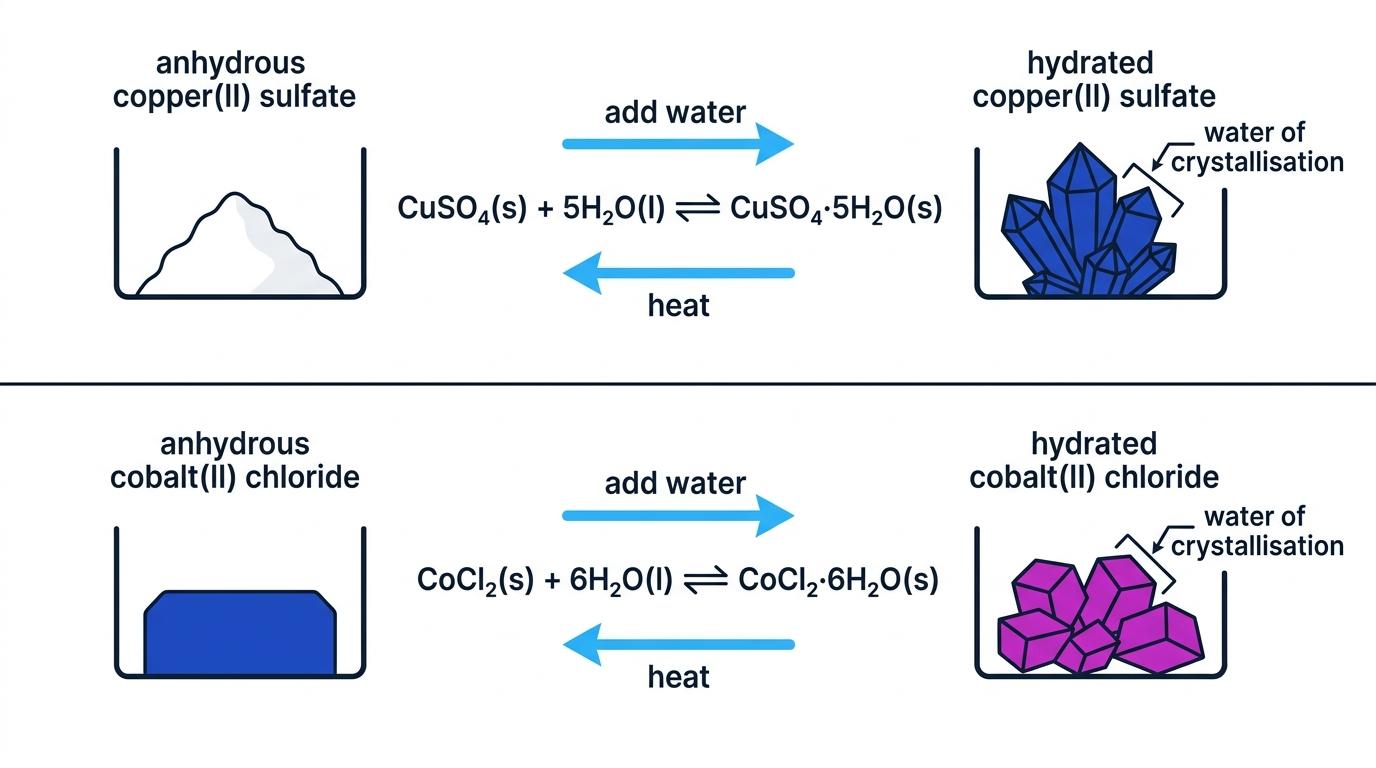
- Two compounds show this especially clearly, because they change colour as the reaction changes direction: copper(II) sulfate and cobalt(II) chloride.
Hydrated and anhydrous compounds
Hydrated substance
A substance whose crystals contain water chemically combined within them, called water of crystallisation.
Anhydrous substance
A substance that contains no water of crystallisation.
- Many salts form crystals with water molecules chemically combined inside the crystal structure.
- This water is called water of crystallisation, and it is shown after a dot in the formula, as in CuSO4⋅5H2O\mathrm{CuSO_{4} \cdot 5H_{2}O}CuSO4⋅5H2O.
- Heating a hydrated salt drives off its water of crystallisation as steam and leaves the anhydrous salt.
- Adding water to the anhydrous salt turns it back into the hydrated salt.
- The hydrated and anhydrous forms of a salt often have different colours, so you can see the reaction change direction.
- Removing the water of crystallisation is a chemical change, because the water is chemically combined and a substance with a different formula is formed.
Copper(II) sulfate
- Hydrated copper(II) sulfate, CuSO4⋅5H2O\mathrm{CuSO_{4} \cdot 5H_{2}O}CuSO4⋅5H2O, forms blue crystals.
- Heating the blue crystals removes the water of crystallisation and leaves a white powder of anhydrous copper(II) sulfate, CuSO4\mathrm{CuSO_{4}}CuSO4.
- Adding water to the white anhydrous copper(II) sulfate turns it blue again.
- The reversible reaction is CuSO4⋅5H2O⇌CuSO4+5H2O\mathrm{CuSO_{4} \cdot 5H_{2}O \rightleftharpoons CuSO_{4} + 5H_{2}O}CuSO4⋅5H2O⇌CuSO4+5H2O.
- Heating makes the reaction go in the forward direction, from blue to white.
- Adding water makes the reaction go in the reverse direction, from white to blue.
- The reverse reaction releases thermal energy, so the white powder becomes noticeably hot when water is dripped onto it.
- Because anhydrous copper(II) sulfate turns blue with water, it is also used to test whether a liquid contains water.
Cobalt(II) chloride
- Hydrated cobalt(II) chloride, CoCl2⋅6H2O\mathrm{CoCl_{2} \cdot 6H_{2}O}CoCl2⋅6H2O, is pink.
- Heating it removes the water of crystallisation and leaves blue anhydrous cobalt(II) chloride, CoCl2\mathrm{CoCl_{2}}CoCl2.
- Adding water to the blue anhydrous cobalt(II) chloride turns it pink again.
- The reversible reaction is CoCl2⋅6H2O⇌CoCl2+6H2O\mathrm{CoCl_{2} \cdot 6H_{2}O \rightleftharpoons CoCl_{2} + 6H_{2}O}CoCl2⋅6H2O⇌CoCl2+6H2O.
- Cobalt(II) chloride paper is blue when it is dry and turns pink when it touches water, so it is also used to detect water.
- For both compounds, heating favours the anhydrous form and adding water favours the hydrated form.
Following the colour changes
- A strip of blue cobalt(II) chloride paper is left on a damp windowsill and slowly turns pink as it takes up water.
- The pink paper is then warmed gently in front of a heater and turns blue again as the water is driven off.
- The same substance changes back and forth because the reaction is reversible, and the conditions decide which direction it goes.
Reversing the dehydration of copper(II) sulfate
- Aim: to show that the dehydration of hydrated copper(II) sulfate is reversible by heating the blue crystals and then adding water back to the white powder.
- Apparatus: boiling tube, bung fitted with a delivery tube, clamp and stand, Bunsen burner, heat-resistant mat, spatula, test tube standing in a beaker of ice-cold water, dropping pipette, thermometer, hydrated copper(II) sulfate crystals and eye protection.
- Method, heating the crystals:
- Place about two spatulas of blue hydrated copper(II) sulfate in a clean, dry boiling tube.
- Clamp the boiling tube near its mouth so that it slopes slightly downwards towards the bung, which stops condensed water running back onto the hot glass and cracking it.
- Fit the bung and lead the delivery tube into the test tube standing in ice-cold water, so that the steam condenses there.
- Heat the crystals gently at first, then more strongly, moving the flame along the tube until no blue colour remains.
- Watch drops of colourless liquid collect in the cooled test tube.
- Lift the delivery tube out of the collecting tube before you stop heating, so that cold liquid cannot be sucked back into the hot boiling tube.
- Method, adding the water back:
- Leave the boiling tube to cool completely on the heat-resistant mat.
- Push a thermometer into the white powder and note the temperature.
- Use a dropping pipette to add the collected liquid to the white powder a few drops at a time.
- Record the colour change and the highest temperature reached.
- Results: the blue crystals turn into a white powder as water is driven off, and adding the water back turns the powder blue again and makes it hot.
- Watch out: a powder that still has blue patches has not been fully dehydrated, so keep heating until it is white all the way through.
- Safety: wear eye protection, take care to avoid suck-back, point the boiling tube away from everyone, and wash your hands after the practical because copper(II) sulfate is harmful if swallowed and irritates the eyes.
Describing the direction of change
- When you describe a reversible reaction, state the condition that is changed and the direction in which the reaction then goes.
- Heating hydrated copper(II) sulfate makes the reaction go forwards, giving white anhydrous copper(II) sulfate and water.
- Adding water to anhydrous cobalt(II) chloride makes the reaction go backwards, giving pink hydrated cobalt(II) chloride.
- The colour change is the evidence for the direction of the reaction.
Describing hydrated and anhydrous compounds
- Give both the starting colour and the final colour, for example “blue to white” when hydrated copper(II) sulfate is heated.
- Use the terms hydrated and anhydrous accurately, and include the Roman numeral in each name.
- When you write the equation, use ⇌\rightleftharpoons⇌ and not a single arrow.
- When you are asked how to reverse the change, state the condition precisely, such as “add water” or “heat”.
- Do not mix up the colours, because copper(II) sulfate is blue when hydrated but cobalt(II) chloride is blue when anhydrous.
- Do not describe dehydration as melting or drying, because the water is chemically combined in the crystals.
- Do not say that adding water to anhydrous copper(II) sulfate dissolves it, because the colour change shows water combining with it to form the hydrated salt.
- What does the symbol ⇌\rightleftharpoons⇌ show?
- What is the colour change when hydrated copper(II) sulfate is heated?
- What is the colour of anhydrous cobalt(II) chloride?
- What happens to the temperature when water is added to anhydrous copper(II) sulfate?
- Which condition makes the reaction for cobalt(II) chloride go in the reverse direction?
6.3.2 Dynamic equilibrium and its position
Dynamic equilibrium
Dynamic equilibrium
The state of a reversible reaction in a closed system in which the forward and reverse reactions continue at equal rates, so the concentrations of reactants and products no longer change.
Closed system
A system that no substances can enter or leave, although energy can still be transferred to or from the surroundings.
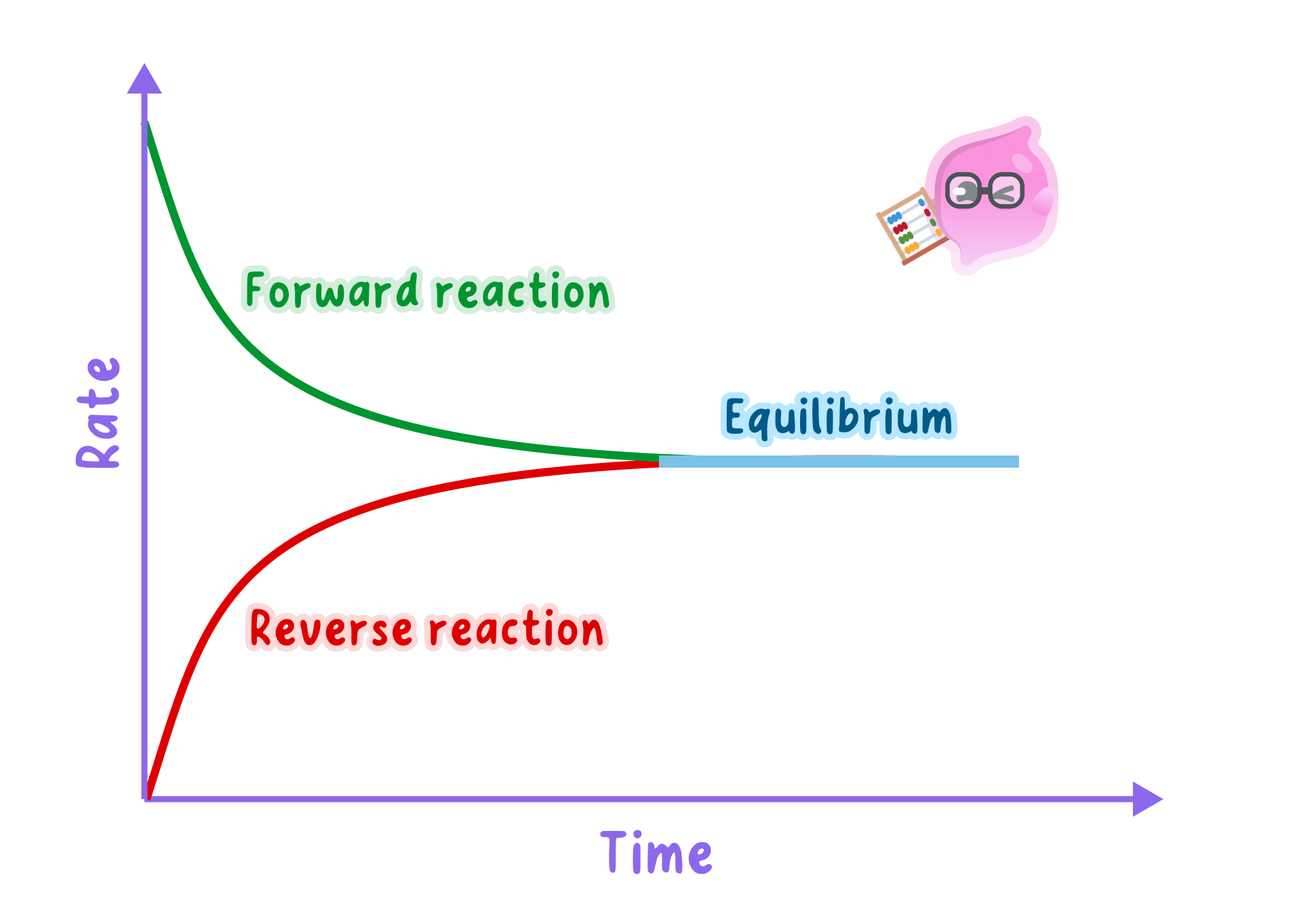
- When a reversible reaction starts with only reactants, the forward reaction is fast and the reverse reaction cannot yet happen.
- As the reactants are used up, their concentrations fall, so the forward reaction slows down.
- As the products build up, their concentrations rise, so the reverse reaction speeds up.
- Eventually the rate of the forward reaction becomes equal to the rate of the reverse reaction.
- From this point, products are made at exactly the same rate as they are turned back into reactants.
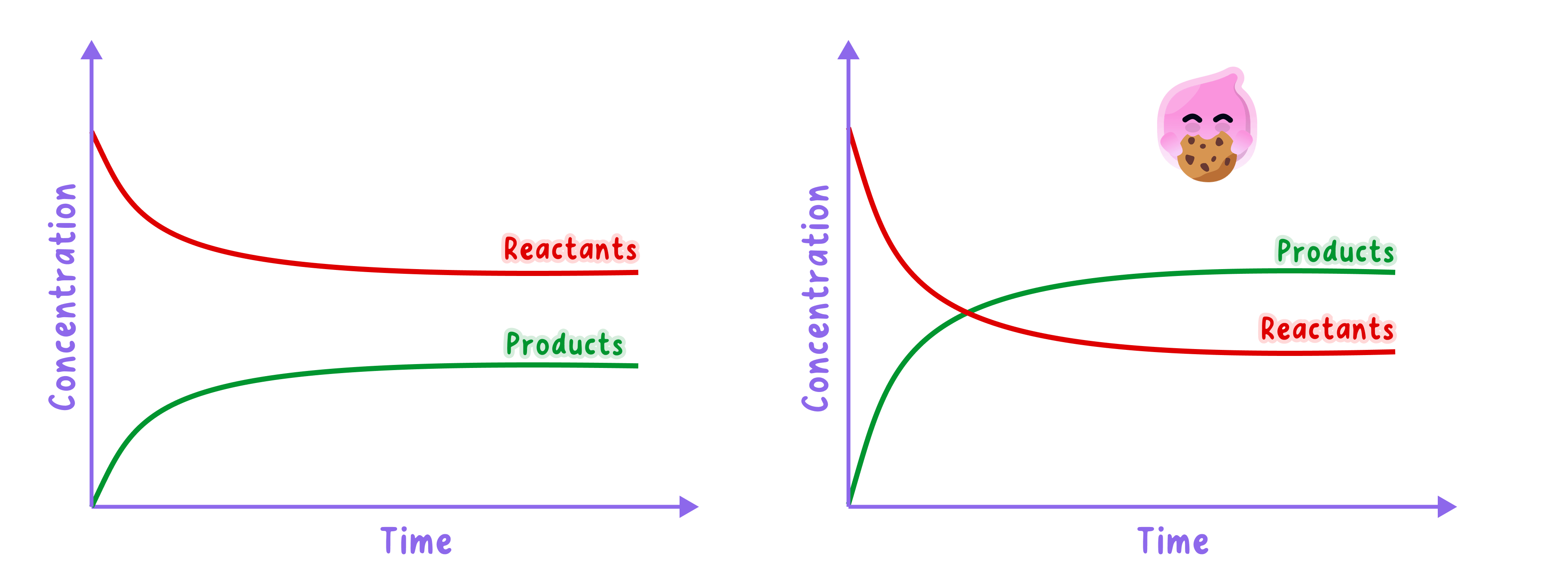
- The concentrations of the reactants and products therefore stop changing, even though both reactions carry on.
- The equilibrium is called dynamic because the reactions have not stopped, they are happening at the same rate.
- Constant concentrations are not the same as equal concentrations, because an equilibrium mixture can contain far more products than reactants, or far more reactants than products.
- Equilibrium can only be reached in a closed system, because in an open system a gaseous product could escape and the reverse reaction could not keep pace.
Nitrogen dioxide in a sealed syringe
- Brown nitrogen dioxide gas, NO2\mathrm{NO_{2}}NO2, is sealed in a gas syringe.
- Pairs of nitrogen dioxide molecules join to form colourless dinitrogen tetroxide, N2O4\mathrm{N_{2}O_{4}}N2O4, and dinitrogen tetroxide molecules also split back into nitrogen dioxide.
- At first the brown colour fades, because the forward reaction is faster than the reverse reaction.
- After a short time the colour stops changing, because the two reactions are now going at the same rate.
- Molecules are still reacting in both directions, so the mixture is in dynamic equilibrium.
Position of equilibrium
Position of equilibrium
The relative amounts of reactants and products present in a reaction mixture once it has reached equilibrium.
- If an equilibrium mixture contains mainly products, the position of equilibrium lies to the right.
- If an equilibrium mixture contains mainly reactants, the position of equilibrium lies to the left.
- Changing the conditions can make the position of equilibrium shift.
- When a condition is changed, the position of equilibrium shifts in the direction that opposes the change.
- A shift to the right increases the amount of products at equilibrium, and a shift to the left increases the amount of reactants.
- To make a prediction, you use the information given about the reaction, such as the sign of ΔH\Delta HΔH or the number of moles of gas on each side of the equation.
Changing temperature
- Increasing the temperature shifts the position of equilibrium in the direction of the endothermic reaction, which takes in thermal energy and so opposes the rise.
- Decreasing the temperature shifts the position of equilibrium in the direction of the exothermic reaction, which releases thermal energy.
- If ΔH\Delta HΔH for the forward reaction is negative, the forward reaction is exothermic and the reverse reaction is endothermic.
- For an exothermic forward reaction, increasing the temperature shifts the equilibrium to the left and decreases the amount of product.
- For an endothermic forward reaction, increasing the temperature shifts the equilibrium to the right and increases the amount of product.
Heating the nitrogen dioxide mixture
2NO2(g)⇌N2O4(g) \mathrm{2NO_{2}(g) \rightleftharpoons N_{2}O_{4}(g)} 2NO2(g)⇌N2O4(g) ΔH=−58 kJ/mol \Delta H = -58\ \text{kJ/mol} ΔH=−58 kJ/mol- The negative ΔH\Delta HΔH shows that the forward reaction is exothermic, so the reverse reaction is endothermic.
- Placing the syringe in hot water shifts the equilibrium to the left, in the endothermic direction.
- More brown nitrogen dioxide forms, so the mixture turns a darker brown.
- Placing the syringe in iced water shifts the equilibrium to the right, so the mixture becomes paler.
Changing pressure
- Pressure only affects the position of equilibrium for reactions involving gases.
- To predict the effect, count the moles of gas on each side of the balanced equation.
- Increasing the pressure shifts the position of equilibrium towards the side with fewer moles of gas, which lowers the pressure.
- Decreasing the pressure shifts the position of equilibrium towards the side with more moles of gas.
- If both sides have the same number of moles of gas, changing the pressure does not change the position of equilibrium.
Counting moles of gas
2NO2(g)⇌N2O4(g) \mathrm{2NO_{2}(g) \rightleftharpoons N_{2}O_{4}(g)} 2NO2(g)⇌N2O4(g)- There are 222 moles of gas on the left and 111 mole of gas on the right.
- Increasing the pressure shifts the equilibrium to the right, towards fewer moles of gas, so the proportion of colourless dinitrogen tetroxide increases.
- There are 222 moles of gas on each side, so changing the pressure has no effect on the position of this equilibrium.
Changing concentration
- Increasing the concentration of a reactant shifts the equilibrium to the right, using up some of the added reactant and forming more product.
- Decreasing the concentration of a reactant shifts the equilibrium to the left.
- Increasing the concentration of a product shifts the equilibrium to the left.
- Removing a product as it forms shifts the equilibrium to the right, so more product keeps being made.
Chromate and dichromate ions
2CrO42−(aq)+2H+(aq)⇌Cr2O72−(aq)+H2O(l) \mathrm{2CrO_{4}^{2-}(aq) + 2H^{+}(aq) \rightleftharpoons Cr_{2}O_{7}^{2-}(aq) + H_{2}O(l)} 2CrO42−(aq)+2H+(aq)⇌Cr2O72−(aq)+H2O(l)- Chromate ions are yellow and dichromate ions are orange.
- Adding dilute acid increases the concentration of H+\mathrm{H^+}H+ ions, so the equilibrium shifts to the right and the solution turns orange.
- Adding aqueous sodium hydroxide removes H+\mathrm{H^+}H+ ions by neutralising them, so the equilibrium shifts to the left and the solution turns yellow.
Adding a catalyst
- A catalyst increases the rates of the forward and reverse reactions equally.
- The position of equilibrium therefore does not change, so the amount of product at equilibrium stays the same.
- The catalyst makes the system reach equilibrium more quickly.
Predicting and explaining a shift
- Mark schemes usually give one mark for the direction of the shift and one mark for the reason, so always give both.
- State the direction precisely, such as “the position of equilibrium shifts to the right” or “shifts towards the products”.
- For temperature, use the information given to say which direction is exothermic or endothermic before you state the shift.
- For pressure, quote the moles of gas, such as “333 moles of gas on the left and 222 on the right”.
- When a question asks about a colour, link the shift to the substance that causes that colour.
- For a catalyst, write that it has no effect on the position of equilibrium and that equilibrium is reached faster.
- Do not write that the reactions stop at equilibrium.
- Do not write that the concentrations of reactants and products are equal at equilibrium.
- Do not write that a catalyst increases the amount of product at equilibrium.
- What two statements describe a reversible reaction at equilibrium?
- Why must a system be closed for equilibrium to be reached?
- Which way does the equilibrium shift when the temperature is increased for a reaction with an exothermic forward reaction?
- What effect does increasing pressure have on an equilibrium with fewer moles of gas on the right?
- Why does a catalyst not change the position of equilibrium?
6.3.3 The Haber and Contact processes
The Haber process
Haber process
The industrial process that makes ammonia by reacting nitrogen with hydrogen in a reversible reaction over an iron catalyst.
- The Haber process is used to make ammonia, NH3\mathrm{NH_{3}}NH3, which is mostly used to make fertilisers.
- Nitrogen and hydrogen react in a reversible reaction: N2(g)+3H2(g)⇌2NH3(g)\mathrm{N_{2}(g) + 3H_{2}(g) \rightleftharpoons 2NH_{3}(g)}N2(g)+3H2(g)⇌2NH3(g).
- One mole of nitrogen reacts with three moles of hydrogen to form two moles of ammonia.
- Because the reaction is reversible, the gases never react completely and some ammonia always breaks down again into nitrogen and hydrogen.
Raw materials for ammonia
- Nitrogen comes from the air, which is about 78%78\%78% nitrogen.
- The nitrogen is separated from the other gases in air by fractional distillation of liquid air.
- Hydrogen comes from methane, CH4\mathrm{CH_{4}}CH4, the main substance in natural gas.
- Methane is reacted with steam to release the hydrogen it contains.
- The nitrogen and hydrogen are mixed in a ratio of 1:31 : 31:3 by volume, matching the ratio in the equation.
Haber process conditions
- Temperature: 450 ∘C450\ ^\circ\text{C}450 ∘C.
- Pressure: 20 000 kPa20\,000\ \text{kPa}20000 kPa, which is 200 atm200\ \text{atm}200 atm.
- Catalyst: iron.
- Under these conditions only a fraction of the nitrogen and hydrogen, around 15%15\%15%, is converted into ammonia each time the gases pass over the catalyst.
- The gas mixture leaving the reactor is cooled, so the ammonia condenses to a liquid and is removed.
- The unreacted nitrogen and hydrogen are recycled back into the reactor.
Following the gases through the plant
- Nitrogen from the air and hydrogen from methane are purified and mixed in a 1:31 : 31:3 ratio.
- The mixture is compressed to 20 000 kPa20\,000\ \text{kPa}20000 kPa and heated to 450 ∘C450\ ^\circ\text{C}450 ∘C.
- The hot gases pass over beds of iron catalyst, where some of them react.
- The mixture is cooled, liquid ammonia is drained off, and the unreacted gases are pumped back to the start.
The Contact process
Contact process
The industrial process for making sulfuric acid in which sulfur dioxide reacts with oxygen over a vanadium(V) oxide catalyst to form sulfur trioxide.
- The Contact process is used to make sulfuric acid, H2SO4\mathrm{H_{2}SO_{4}}H2SO4.
- Its key step converts sulfur dioxide into sulfur trioxide in a reversible reaction: 2SO2(g)+O2(g)⇌2SO3(g)\mathrm{2SO_{2}(g) + O_{2}(g) \rightleftharpoons 2SO_{3}(g)}2SO2(g)+O2(g)⇌2SO3(g).
- Two moles of sulfur dioxide react with one mole of oxygen to form two moles of sulfur trioxide.
- Like the Haber process, this step never goes to completion because the reaction is reversible.
Raw materials for sulfur trioxide
- Sulfur dioxide is made by burning sulfur in air: S(s)+O2(g)→SO2(g)\mathrm{S(s) + O_{2}(g) \rightarrow SO_{2}(g)}S(s)+O2(g)→SO2(g).
- Sulfur dioxide is also made by roasting sulfide ores, which means heating them strongly in air, such as 2ZnS(s)+3O2(g)→2ZnO(s)+2SO2(g)\mathrm{2ZnS(s) + 3O_{2}(g) \rightarrow 2ZnO(s) + 2SO_{2}(g)}2ZnS(s)+3O2(g)→2ZnO(s)+2SO2(g).
- Oxygen comes from the air.
Contact process conditions
- Temperature: 450 ∘C450\ ^\circ\text{C}450 ∘C.
- Pressure: 200 kPa200\ \text{kPa}200 kPa, which is 2 atm2\ \text{atm}2 atm.
- Catalyst: vanadium(V) oxide, V2O5\mathrm{V_{2}O_{5}}V2O5.
- The sulfur trioxide formed is then used to make sulfuric acid.
Making sulfur trioxide from sulfur
- Molten sulfur is sprayed into a furnace and burned in dry air to make sulfur dioxide.
- The sulfur dioxide is mixed with more air and passed over vanadium(V) oxide at 450 ∘C450\ ^\circ\text{C}450 ∘C and 200 kPa200\ \text{kPa}200 kPa.
- The sulfur trioxide leaves the converter and goes on to be turned into sulfuric acid.
Comparing the two processes
- Product: the Haber process makes ammonia, whereas the Contact process step makes sulfur trioxide for sulfuric acid.
- Raw materials: the Haber process uses nitrogen from air and hydrogen from methane, whereas the Contact process uses sulfur dioxide from burning sulfur or roasting sulfide ores, and oxygen from air.
- Temperature: both processes use 450 ∘C450\ ^\circ\text{C}450 ∘C.
- Pressure: the Haber process uses 20 000 kPa20\,000\ \text{kPa}20000 kPa (200 atm200\ \text{atm}200 atm), whereas the Contact process uses only 200 kPa200\ \text{kPa}200 kPa (2 atm2\ \text{atm}2 atm).
- Catalyst: the Haber process uses iron, whereas the Contact process uses vanadium(V) oxide.
Recalling industrial processes
- Learn each condition as a number with its unit, because an answer without a unit does not score.
- Either unit of pressure is accepted, so 200 atm200\ \text{atm}200 atm or 20 000 kPa20\,000\ \text{kPa}20000 kPa for the Haber process and 2 atm2\ \text{atm}2 atm or 200 kPa200\ \text{kPa}200 kPa for the Contact process.
- Both processes use the same temperature, so the pressure and the catalyst are the details that tell them apart.
- Give the sources exactly: methane for hydrogen, air for nitrogen and oxygen, and burning sulfur or roasting sulfide ores for sulfur dioxide.
- When you write either equation, include ⇌\rightleftharpoons⇌ and the state symbols.
- Do not swap the pressures, because 200 kPa200\ \text{kPa}200 kPa belongs to the Contact process while the Haber process uses 200 atm200\ \text{atm}200 atm.
- Do not give water or the air as the source of hydrogen in the Haber process, because the hydrogen comes from methane.
- Do not leave the Roman numeral out of vanadium(V) oxide.
- Write the symbol equation for the Haber process.
- What are the sources of nitrogen and hydrogen in the Haber process?
- State the temperature, pressure and catalyst used in the Haber process.
- Give two ways of producing sulfur dioxide for the Contact process.
- State the temperature, pressure and catalyst used to convert sulfur dioxide into sulfur trioxide.
6.3.4 Explaining industrial conditions
Balancing rate and yield
Yield
The amount of the desired product obtained from a reaction.
Compromise conditions
Operating conditions chosen to balance an acceptable rate, an acceptable yield, cost and safety, rather than to make any one of these as large as possible.
- Industrial chemists want to make a high yield of product at a fast rate, as cheaply and as safely as possible.
- For a reversible reaction, the conditions that give the highest yield at equilibrium are not always the conditions that give the fastest rate.
- Each condition is judged by asking how it affects the position of equilibrium and how it affects the rate of reaction.
- Cost and safety then limit how far each condition can be pushed.
- The conditions actually used are therefore compromise conditions.
Haber process temperature
- The forward reaction in the Haber process is exothermic: N2(g)+3H2(g)⇌2NH3(g)\mathrm{N_{2}(g) + 3H_{2}(g) \rightleftharpoons 2NH_{3}(g)}N2(g)+3H2(g)⇌2NH3(g), ΔH=−92 kJ/mol\Delta H = -92\ \text{kJ/mol}ΔH=−92 kJ/mol.
- A low temperature would shift the position of equilibrium to the right, in the exothermic direction, and give a higher yield of ammonia.
- At a low temperature, however, the particles have less kinetic energy, so the rate would be too slow, even with a catalyst.
- A high temperature would give a fast rate but would shift the equilibrium to the left and give a low yield.
- A higher temperature would also need more fuel for heating, which increases the cost.
- 450 ∘C450\ ^\circ\text{C}450 ∘C is a compromise temperature that gives an acceptable yield at an acceptable rate.
Haber process pressure
- There are 444 moles of gas on the left of the equation and 222 moles of gas on the right.
- A high pressure shifts the position of equilibrium to the right, towards fewer moles of gas, so the yield of ammonia increases.
- A high pressure also increases the rate, because the gas particles are closer together and collide more frequently.
- Very high pressures need thick-walled reaction vessels and pipes and powerful compressors, which are expensive to build and to run.
- Very high pressures also increase the risk of leaks and explosions, which is a safety hazard.
- 20 000 kPa20\,000\ \text{kPa}20000 kPa (200 atm200\ \text{atm}200 atm) is a compromise between a good yield and rate on one side, and cost and safety on the other.
Haber process catalyst and recycling
- The iron catalyst increases the rates of the forward and reverse reactions equally.
- It does not change the position of equilibrium, so it does not change the yield.
- It means equilibrium is reached more quickly, so ammonia is made at an acceptable rate without raising the temperature further.
- Using the catalyst therefore saves energy and money.
- Although only about 15%15\%15% of the gases react on each pass, recycling the unreacted nitrogen and hydrogen means that almost all of them are eventually converted into ammonia.
Linking each Haber condition to rate and yield
- Temperature: the forward reaction is exothermic, so a lower temperature would give more ammonia, but 450 ∘C450\ ^\circ\text{C}450 ∘C is used because a lower temperature would make the rate too slow.
- Pressure: there are fewer moles of gas on the right, so a high pressure gives more ammonia and a faster rate, but 200 atm200\ \text{atm}200 atm is used because higher pressures cost too much and are too dangerous.
- Catalyst: iron increases the rate so that equilibrium is reached quickly, but it has no effect on the yield.
- Recycling: unreacted gases are returned to the reactor, so the low yield on each pass does not waste raw materials.
Contact process conditions
- The forward reaction in the Contact process is also exothermic: 2SO2(g)+O2(g)⇌2SO3(g)\mathrm{2SO_{2}(g) + O_{2}(g) \rightleftharpoons 2SO_{3}(g)}2SO2(g)+O2(g)⇌2SO3(g), ΔH=−197 kJ/mol\Delta H = -197\ \text{kJ/mol}ΔH=−197 kJ/mol.
- A lower temperature would increase the yield of sulfur trioxide but make the rate too slow, so 450 ∘C450\ ^\circ\text{C}450 ∘C is used as a compromise.
- There are 333 moles of gas on the left and 222 moles of gas on the right, so a high pressure would shift the equilibrium to the right.
- Even at 200 kPa200\ \text{kPa}200 kPa (2 atm2\ \text{atm}2 atm), the position of equilibrium already lies far to the right, and almost all of the sulfur dioxide is converted.
- A higher pressure would only increase the yield slightly, which would not justify the extra cost of high-pressure equipment.
- Keeping the pressure low also reduces the risk of toxic sulfur dioxide and corrosive sulfur trioxide leaking from the plant.
- The vanadium(V) oxide catalyst increases the rate so that equilibrium is reached quickly at 450 ∘C450\ ^\circ\text{C}450 ∘C, without affecting the yield.
Safety and cost
- Heating to a high temperature uses a lot of fuel, so energy costs rise with temperature.
- High pressures need stronger equipment and more energy to run the compressors.
- Hydrogen is flammable and ammonia is toxic, so a leak from a high-pressure Haber plant is especially dangerous.
- A lower yield on each pass is acceptable when unreacted gases are recycled, because the raw materials are not wasted.
- A catalyst lets a plant run at a lower temperature than would otherwise be needed for the same rate, which lowers the energy cost.
Explaining a chosen condition
- A question about a single condition usually needs a point about the position of equilibrium and a point about the rate, so cover both.
- For temperature, state that the forward reaction is exothermic, so a lower temperature gives a higher yield, but the rate would be too slow.
- For pressure, state the moles of gas on each side, give the effect on the yield and the rate, then give the cost or safety reason for not going higher.
- Make cost points specific, such as “high pressure needs expensive, strong vessels and pipes”, rather than writing “it is expensive”.
- For the Contact process pressure, explain that the yield is already very high at 2 atm2\ \text{atm}2 atm, so a higher pressure is not worth the cost.
- For a catalyst, write that it increases the rate but has no effect on the yield or the position of equilibrium.
- Do not write that 450 ∘C450\ ^\circ\text{C}450 ∘C gives the highest yield, because a lower temperature would give a higher yield.
- Do not write that the catalyst increases the yield of ammonia or sulfur trioxide.
- Do not leave out safety when you explain why a higher pressure is not used in the Haber process.
- Why would a low temperature give a high yield of ammonia?
- Why is a temperature lower than 450 ∘C450\ ^\circ\text{C}450 ∘C not used in the Haber process?
- Give two effects of increasing the pressure in the Haber process.
- Why is a pressure of only 2 atm2\ \text{atm}2 atm used in the Contact process?
- Why is the unreacted nitrogen and hydrogen recycled?