11.8.1 Polymers, poly(ethene) and plastics
Polymers and monomers
Polymer
A large molecule built up from many smaller molecules called monomers.
Monomer
A small molecule that joins with many other small molecules to build up a polymer.
- A polymer is a very large molecule, built up from many smaller molecules called monomers.
- The monomers join end to end by forming covalent bonds with each other, giving a long chain.
- A single polymer chain can contain thousands of monomer units, so its relative molecular mass is very large.
- The process of joining monomers to make a polymer is called polymerisation.
- The name of a polymer usually comes from the name of its monomer.
- The prefix poly means "many", so poly(ethene) means "many ethene units joined together".
- The monomer name goes in brackets after "poly", so propene gives poly(propene) and chloroethene gives poly(chloroethene).
- A useful picture is a paper chain: each paper loop is a monomer, and the whole chain of linked loops is the polymer.
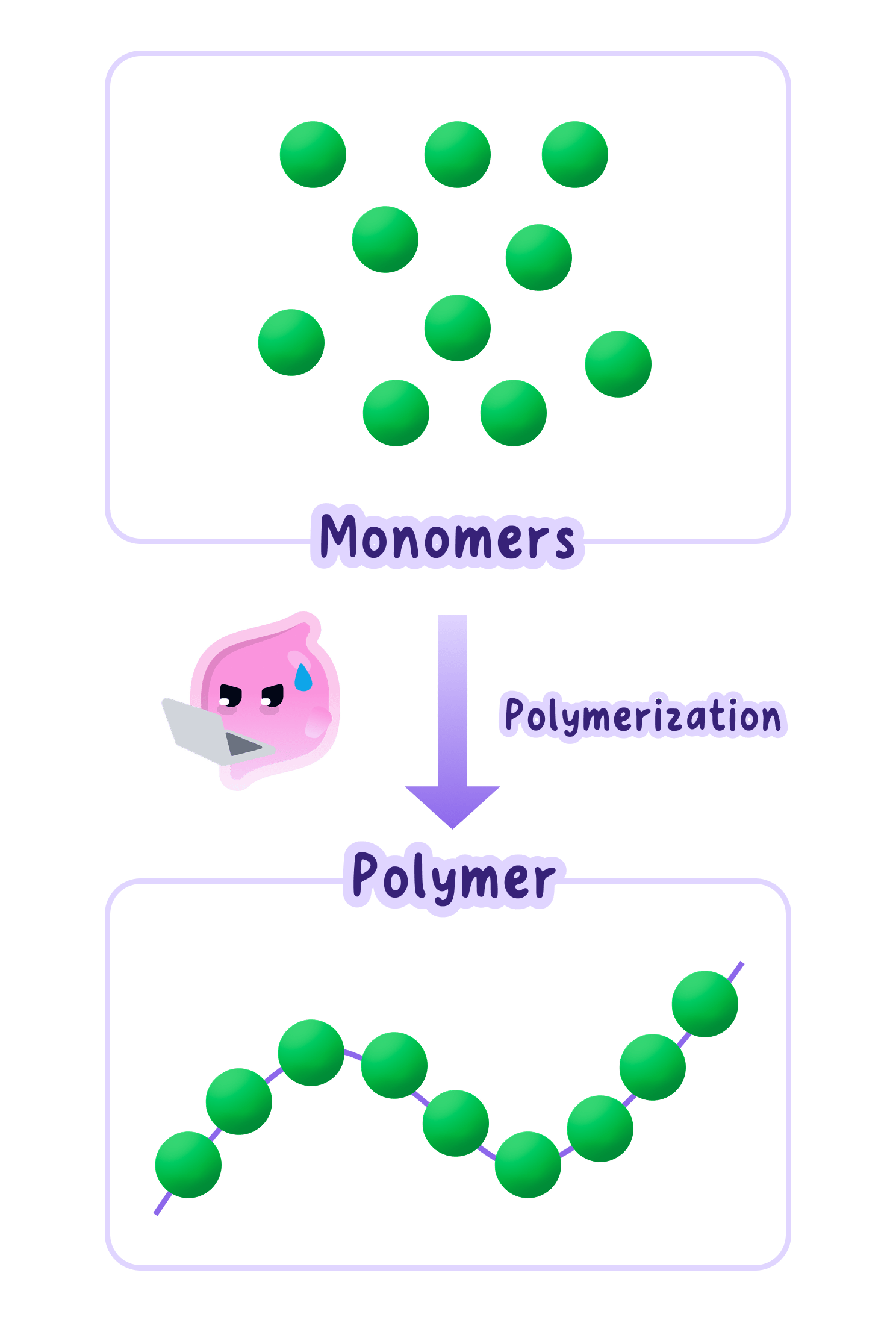
Making poly(ethene)
Addition polymerisation
A reaction in which many unsaturated monomers join together, by opening their carbon-carbon double bonds, to form a polymer as the only product.
- Ethene, C2H4\text{C}_2\text{H}_4C2H4, is the monomer used to make the polymer poly(ethene), which is often called polythene.
- Ethene is an unsaturated molecule because it contains a carbon-carbon double bond, C=C\text{C=C}C=C.
- When ethene polymerises, one of the two bonds in each C=C\text{C=C}C=C double bond breaks.
- Each carbon atom then forms a new single bond to a carbon atom in the next ethene molecule.
- Repeating this many times links the ethene molecules into one long chain of carbon atoms joined by C-C\text{C-C}C-C single bonds, with two hydrogen atoms on every carbon.
- This type of reaction is called addition polymerisation, because the monomers add on to each other.
- Poly(ethene) is the only product, so every atom from the ethene molecules ends up in the polymer.
- The polymer has no C=C\text{C=C}C=C double bonds left, so poly(ethene) is saturated even though ethene is unsaturated.
- A short section of a poly(ethene) chain, made from three ethene molecules, looks like this.
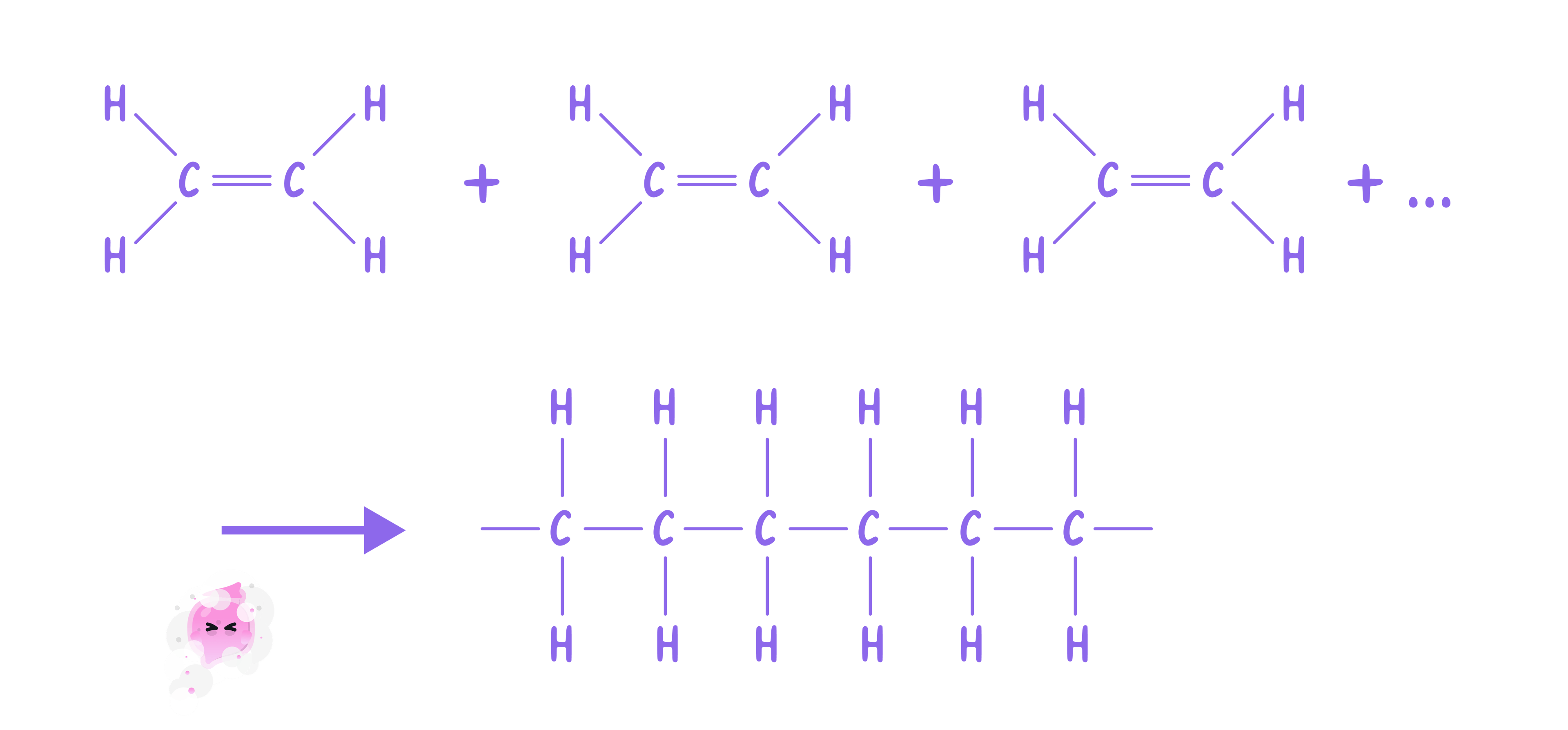
The poly(ethene) equation
-
Because a polymer chain contains a huge but variable number of monomers, the equation uses the letter nnn to stand for a large number.
-
The equation for making poly(ethene) is shown below with displayed formulae.
n HH∣∣C=C∣∣HH→[HH∣∣−C−C−∣∣HH]n n\ \begin{array}{ccc} \text{H} & & \text{H} \\ | & & | \\ \text{C} & = & \text{C} \\ | & & | \\ \text{H} & & \text{H} \end{array} \rightarrow \left[ \begin{array}{ccccc} & \text{H} & & \text{H} & \\ & | & & | & \\ - & \text{C} & - & \text{C} & - \\ & | & & | & \\ & \text{H} & & \text{H} & \end{array} \right]_n n H∣C∣H=H∣C∣H→−H∣C∣H−H∣C∣H−n -
The same equation can be written more compactly with structural formulae.
n CH2=CH2→[−CH2−CH2−]n n\,\text{CH}_2\text{=CH}_2 \rightarrow \left[-\text{CH}_2-\text{CH}_2-\right]_n nCH2=CH2→[−CH2−CH2−]n -
Each part of the equation tells you something about the reaction.
- The nnn in front of ethene shows that a large number of ethene molecules react.
- The square brackets enclose the section made from one ethene molecule, and this section is repeated along the whole chain.
- The bonds on each side cross through the brackets to show that the chain carries on in both directions.
- The subscript nnn outside the brackets shows that the bracketed section appears nnn times in one polymer molecule.
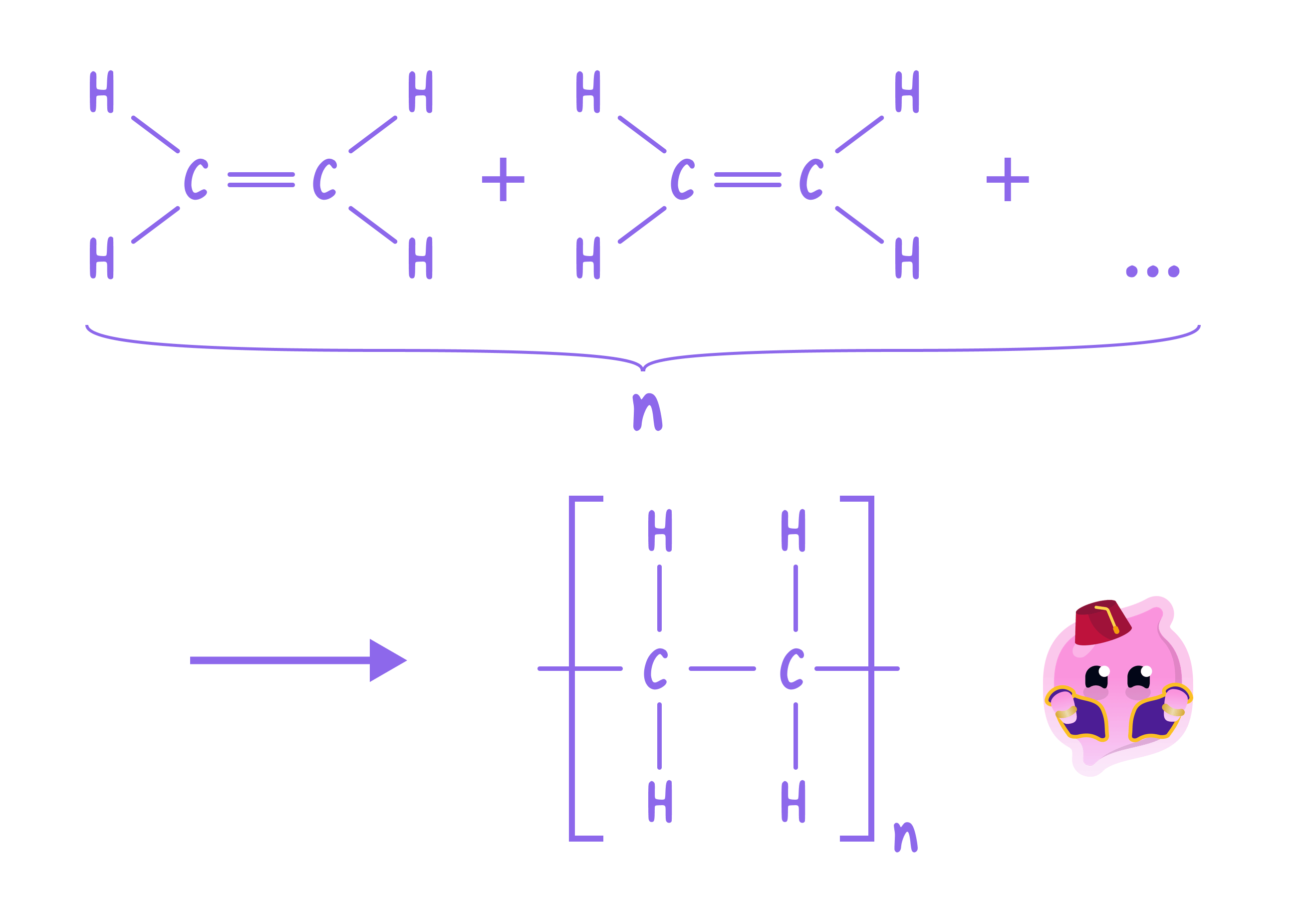
Building the poly(ethene) equation
- Start with ethene drawn as a displayed formula, with the C=C\text{C=C}C=C double bond horizontal and the four hydrogen atoms above and below.
- Write nnn in front of the ethene to show that many molecules take part.
- On the right, keep the same two carbon atoms and four hydrogen atoms, but change the double bond into a single bond.
- Add a single bond sticking out from each carbon atom, because these are the bonds that join on to the next units.
- Draw square brackets so that the outer bonds pass through them, then write nnn at the bottom right.
- Both sides contain 2n2n2n carbon atoms and 4n4n4n hydrogen atoms, which confirms that no other product is formed.
Plastics
Plastic
A material made from polymers that can be moulded into many different shapes.
- Plastics are materials made from polymers.
- The long polymer chains make plastics strong and flexible, and most plastics can be moulded into shape when warm.
- Poly(ethene) is one of the most widely used plastics.
- It is used to make plastic bags, cling film, food packaging and plastic bottles.
- It is cheap to make, light, waterproof and does not react with most foods or drinks.
- Most plastics are made from chemicals obtained from crude oil (petroleum).
- Large alkane molecules from petroleum are cracked to produce alkenes such as ethene, and the alkenes are then polymerised.
- The chain of substances for a poly(ethene) bag runs: ethene (the monomer) forms poly(ethene) (the polymer), and the polymer is shaped into the plastic product.
- Do not call ethene a polymer, because ethene is the monomer and poly(ethene) is the polymer.
- Do not draw a C=C\text{C=C}C=C double bond inside the brackets of poly(ethene), because the double bond opens during polymerisation.
- Do not leave off the bonds that cross the brackets, because without them the drawing shows a separate molecule, not part of a chain.
- Check your spelling of ethene and ethane, because only ethene, the alkene, can form an addition polymer.
- Do not say that plastics are made directly from monomers, because plastics are made from polymers.
Writing about polymers
- Define a polymer as a large molecule built from many smaller molecules called monomers, because answers that leave out "many" or "monomers" lose the mark.
- When asked how poly(ethene) forms, name the monomer ethene and the process addition polymerisation, and say that the C=C\text{C=C}C=C double bond breaks or opens.
- In the equation, put nnn in front of the monomer and as a subscript after the brackets, and make the bonds extend through the brackets.
- If a question asks what plastics are made from, the answer is polymers, not crude oil or monomers.
- What is a polymer?
- Which monomer is used to make poly(ethene)?
- What happens to the carbon-carbon double bond when ethene molecules polymerise?
- Why is poly(ethene) the only product of the reaction?
- What are plastics made from?
11.8.2 Properties, disposal and environmental impact of plastics
Properties of plastics
Biodegradable
Able to be broken down naturally by microorganisms such as bacteria and fungi.
Non-biodegradable
Not able to be broken down by microorganisms, so the material stays in the environment for a very long time.
- Plastics are used for packaging, bottles, bags and toys because of a set of very useful properties.
- Unreactive: most plastics do not react with water, air, acids or the food and drink they hold.
- Durable: plastics are strong, hard-wearing and do not rot or rust, so they last for a very long time.
- Low density: plastics are light for their size, and many plastic items float on water.
- Non-biodegradable: bacteria and fungi cannot break plastics down, so plastics do not decay in the environment.
- Plastics are non-biodegradable because their long chains of carbon atoms, held together by strong covalent bonds, cannot be digested by microorganisms.
- Cheap: plastics are cheap to make in huge amounts, so many items, such as drinks bottles and carrier bags, are used once and thrown away.
An apple core and a plastic bottle
- Picture an apple core and a plastic drinks bottle dropped in the same hedge in the same week.
- The apple core is biodegradable, so bacteria and fungi break it down within a few weeks.
- The bottle is non-biodegradable, so it can still be there, almost unchanged, hundreds of years later.
- The bottle also stays whole because it is unreactive, so rain and air do not attack it.
Why disposal is a problem
- The same properties that make plastics useful make plastic waste hard to get rid of.
- Because plastics are unreactive and non-biodegradable, discarded plastic does not rot away, so it persists in the environment for hundreds of years.
- Because plastics are durable, every item ever thrown away is still waste, so the total amount of plastic waste keeps building up.
- Because plastics have a low density, light waste such as bags and wrappers is easily blown by the wind or carried by water, spreading litter far from where it was dropped.
- Because plastics are cheap and often used only once, very large amounts of plastic waste are produced every day.
- Most plastic waste ends up in one of three places, and each one causes its own environmental challenge.
- It is buried in a landfill site.
- It escapes as litter and accumulates in the oceans.
- It is burned, which can release toxic gases.
Landfill sites
- A landfill site is a large hole in the ground where waste is tipped and then buried.
- Plastic waste in landfill does not biodegrade, so it takes up space for hundreds of years instead of breaking down.
- Plastic items are bulky for their mass, because of their low density, so they fill landfill sites quickly.
- As existing sites fill up, new land has to be found for more landfill sites.
- This land can no longer be used for farming, housing or wildlife habitats.
- Digging new sites destroys the habitats of plants and animals.
- Some of the chemicals added to plastics can slowly leak out of buried waste into the soil and groundwater.
Plastics in the oceans
- Plastic litter that is not collected is washed into drains and rivers, or blown by the wind, and much of it ends up in the sea.
- Because many plastics have a low density, they float and are carried long distances by ocean currents.
- Currents sweep the floating waste together, so huge amounts accumulate in certain areas of the oceans.
- The plastic does not biodegrade, so the amount in the oceans keeps increasing year after year.
- Sunlight and waves break large items into smaller and smaller pieces called microplastics, but these pieces do not disappear.
- Ocean plastic harms marine animals in several ways.
- Animals such as seals, turtles and seabirds become trapped or tangled in plastic nets, rings and bags, which can injure or drown them.
- Animals mistake plastic for food, for example turtles swallow floating bags that look like jellyfish.
- Swallowed plastic fills an animal's stomach but cannot be digested, so the animal may starve.
- Microplastics are eaten by small sea creatures and pass along food chains, including into fish that people eat.
Burning plastics
- Burning plastic waste, called incineration, reduces the amount of solid waste that has to go to landfill.
- The thermal energy released by burning can be used to generate electricity.
- However, burning plastics produces toxic gases that pollute the air.
- Carbon monoxide forms when plastics burn in a limited supply of air, by incomplete combustion.
- Carbon monoxide is toxic because it combines with haemoglobin in red blood cells and stops the blood carrying oxygen.
- Plastics that contain chlorine, such as PVC, release hydrogen chloride, a toxic and acidic gas.
- Burning also releases soot (carbon particles), which damages the lungs.
- Burning plastics also releases large amounts of carbon dioxide, a greenhouse gas that adds to climate change.
Burning poly(ethene)
- Poly(ethene) is made only of carbon and hydrogen, so it burns like a large alkane.
- Each section made from one ethene unit, -CH2-CH2-\text{-CH}_2\text{-CH}_2\text{-}-CH2-CH2-, contains two carbon atoms and four hydrogen atoms.
- In plenty of air, complete combustion gives carbon dioxide and water.
- In a limited supply of air, incomplete combustion gives the toxic gas carbon monoxide instead.
- Both equations balance: 2n2n2n carbon atoms and 4n4n4n hydrogen atoms appear on each side, and the oxygen atoms match the products.
- Do not write that plastics "break down eventually" in landfill, because they are non-biodegradable and stay there for hundreds of years.
- Do not describe carbon dioxide as a toxic gas, because its problem is that it is a greenhouse gas.
- Do not write only "burning plastics causes pollution", because you need to name a toxic gas such as carbon monoxide or hydrogen chloride.
- Do not confuse biodegradable with recyclable, because a plastic can be recycled even though it is not biodegradable.
Linking properties to problems
- For "describe how the properties of plastics affect their disposal", state the property and then its consequence, joined by "so" or "because".
- A strong answer reads: "plastics are non-biodegradable, so they are not broken down by microorganisms and remain in landfill sites for a very long time".
- For ocean pollution, give the harm to living things, such as animals swallowing plastic or becoming trapped in it.
- For burning, name the gas and say it is toxic, rather than just writing "fumes" or "smoke".
- What does non-biodegradable mean?
- Why does plastic waste in landfill take up space for a very long time?
- Why does so much plastic waste float and build up in the oceans?
- Give two ways that ocean plastic harms marine animals.
- Name two toxic gases that can form when plastics are burned.
11.8.3 Addition and condensation polymers
Repeat units and linkages
Repeat unit
The smallest section of a polymer chain that is repeated over and over to build up the whole molecule.
- Every polymer chain is built from one short section that appears again and again, called the repeat unit.
- When you draw a polymer, you draw just the repeat unit inside square brackets.
- A bond sticks out from each end of the repeat unit and passes through the brackets, showing where it joins the next unit.
- A subscript nnn after the closing bracket shows that the unit is repeated a large number of times.
- The bond or group of atoms that joins one repeat unit to the next is called the linkage.
- The type of linkage tells you how the polymer was made.
- In an addition polymer, the units are joined by carbon-carbon single bonds, C-C\text{C-C}C-C.
- In a polyamide, the units are joined by amide linkages, -CONH-\text{-CONH-}-CONH-.
- In a polyester, the units are joined by ester linkages, -COO-\text{-COO-}-COO-.
Addition polymers from alkenes
Addition polymerisation
A reaction in which many unsaturated monomers join together, by opening their carbon-carbon double bonds, to form a polymer as the only product.
- Any alkene can act as a monomer for addition polymerisation, because every alkene has a C=C\text{C=C}C=C double bond that can open.
- To deduce the repeat unit from a given alkene, follow the same steps every time.
- Draw the alkene with the two carbon atoms of the C=C\text{C=C}C=C bond side by side and every other group above or below them.
- Change the C=C\text{C=C}C=C double bond into a C-C\text{C-C}C-C single bond.
- Keep every other atom or group, such as H\text{H}H, CH3\text{CH}_3CH3 or Cl\text{Cl}Cl, attached to the same carbon as before.
- Add a bond out of each side, then draw the brackets and nnn.
- Only the two carbon atoms of the double bond become part of the main chain, so the repeat unit of an addition polymer always has a two-carbon backbone.
- Any other carbon atoms, such as the CH3\text{CH}_3CH3 group in propene, form side groups that hang off the chain.
- The repeat unit contains exactly the same atoms as the monomer, because addition polymerisation forms no other product.
- To deduce the monomer from an addition polymer, reverse the steps.
- Pick out the two backbone carbon atoms of one repeat unit, together with their side groups.
- Remove the two bonds that cross the brackets.
- Change the C-C\text{C-C}C-C single bond between the two carbons into a C=C\text{C=C}C=C double bond.
Poly(propene) from propene
- Propene, CH2=CHCH3\text{CH}_2\text{=CHCH}_3CH2=CHCH3, has a CH3\text{CH}_3CH3 group on one carbon of its double bond.
- Opening the double bond and keeping each group on its own carbon gives the repeat unit of poly(propene).
- In structural formulae the same equation is written as shown below.
- A longer section of the chain shows a CH3\text{CH}_3CH3 group on every second carbon atom, so the repeat unit is any two neighbouring backbone carbons.
Chloroethene from its polymer
- The repeat unit of poly(chloroethene) has a two-carbon backbone with three hydrogen atoms and one chlorine atom.
- Removing the two outer bonds and turning the C-C\text{C-C}C-C bond into C=C\text{C=C}C=C gives the monomer, chloroethene.
- The monomer has the formula CH2=CHCl\text{CH}_2\text{=CHCl}CH2=CHCl, which contains the same atoms as the repeat unit.
Condensation polymerisation
Condensation polymerisation
A reaction in which many monomers, each with two functional groups, join together to form a polymer and a small molecule such as water.
-
In condensation polymerisation, each monomer has two functional groups, one at each end of the molecule.
-
A functional group on one monomer reacts with a functional group on another monomer to form a linkage.
-
Each time a linkage forms, a small molecule is given off, and for the polymers you need this small molecule is water.
-
Because each monomer has a reactive group at both ends, the chain can keep growing in both directions.
-
The usual monomers come in three types.
- A dicarboxylic acid has a carboxylic acid group, -COOH\text{-COOH}-COOH, at each end.
- A diamine has an amine group, -NH2\text{-NH}_2-NH2, at each end.
- A diol has an alcohol group, -OH\text{-OH}-OH, at each end.
-
The carbon chain between the two functional groups does not take part in the reaction, so it is often drawn as a block (a box).
- Here, an empty box A\boxed{\phantom{A}}A stands for the carbon chain of the dicarboxylic acid.
- A shaded box ■\boxed{\blacksquare}■ stands for the carbon chain of the diamine or the diol.
-
The monomers are drawn with block diagrams like this.
HOOC−A−COOHH2N−■−NH2HO−■−OH \text{HOOC}-\boxed{\phantom{A}}-\text{COOH} \qquad \text{H}_2\text{N}-\boxed{\blacksquare}-\text{NH}_2 \qquad \text{HO}-\boxed{\blacksquare}-\text{OH} HOOC−A−COOHH2N−■−NH2HO−■−OH
Polyamides
Polyamide
A condensation polymer in which the monomer units are joined together by amide linkages.
Amide linkage
The -CONH- group, formed when a carboxylic acid group reacts with an amine group, that joins neighbouring units in a polyamide.
-
A polyamide forms when a dicarboxylic acid reacts with a diamine.
-
The -COOH\text{-COOH}-COOH group of the acid reacts with the -NH2\text{-NH}_2-NH2 group of the amine.
- The -OH\text{-OH}-OH from the acid group and one H\text{H}H from the amine group leave together as a molecule of water.
- The carbon and nitrogen atoms then bond to each other, forming an amide linkage.
-
The reaction at one linkage is shown below.
−COOH+H2N−→−CONH−+H2O -\text{COOH} + \text{H}_2\text{N}- \rightarrow -\text{CONH}- + \text{H}_2\text{O} −COOH+H2N−→−CONH−+H2O -
Drawn out fully, the amide linkage contains a C=O\text{C=O}C=O group bonded to an N-H\text{N-H}N-H group.
OH∥∣−C−N− \begin{array}{ccccc} & \text{O} & & \text{H} & \\ & \| & & | & \\ - & \text{C} & - & \text{N} & - \end{array} −O∥C−H∣N− -
Using block diagrams, the equation for making a polyamide is shown below.
n HOOC−A−COOH+n H2N−■−NH2→[−CO−A−CO−NH−■−NH−]n+2n H2O n\,\text{HOOC}-\boxed{\phantom{A}}-\text{COOH} + n\,\text{H}_2\text{N}-\boxed{\blacksquare}-\text{NH}_2 \rightarrow \left[-\text{CO}-\boxed{\phantom{A}}-\text{CO}-\text{NH}-\boxed{\blacksquare}-\text{NH}-\right]_n + 2n\,\text{H}_2\text{O} nHOOC−A−COOH+nH2N−■−NH2→[−CO−A−CO−NH−■−NH−]n+2nH2O -
Each repeat unit contains one acid block and one amine block, and two water molecules are lost for every repeat unit formed.
Polyesters
Polyester
A condensation polymer in which the monomer units are joined together by ester linkages.
Ester linkage
The -COO- group, formed when a carboxylic acid group reacts with an alcohol group, that joins neighbouring units in a polyester.
-
A polyester forms when a dicarboxylic acid reacts with a diol.
-
The -COOH\text{-COOH}-COOH group of the acid reacts with the -OH\text{-OH}-OH group of the diol.
- The -OH\text{-OH}-OH from the acid group and the H\text{H}H from the alcohol group leave together as water.
- The carbon atom of the acid then bonds to the oxygen atom of the diol, forming an ester linkage.
-
The reaction at one linkage is shown below.
−COOH+HO−→−COO−+H2O -\text{COOH} + \text{HO}- \rightarrow -\text{COO}- + \text{H}_2\text{O} −COOH+HO−→−COO−+H2O -
Drawn out fully, the ester linkage contains a C=O\text{C=O}C=O group with a single-bonded O\text{O}O next to it.
O∥−C−O− \begin{array}{ccccc} & \text{O} & & & \\ & \| & & & \\ - & \text{C} & - & \text{O} & - \end{array} −O∥C−O− -
Using block diagrams, the equation for making a polyester is shown below.
n HOOC−A−COOH+n HO−■−OH→[−CO−A−CO−O−■−O−]n+2n H2O n\,\text{HOOC}-\boxed{\phantom{A}}-\text{COOH} + n\,\text{HO}-\boxed{\blacksquare}-\text{OH} \rightarrow \left[-\text{CO}-\boxed{\phantom{A}}-\text{CO}-\text{O}-\boxed{\blacksquare}-\text{O}-\right]_n + 2n\,\text{H}_2\text{O} nHOOC−A−COOH+nHO−■−OH→[−CO−A−CO−O−■−O−]n+2nH2O -
Polyamides and polyesters are made in the same way, and the only difference is the linkage: -CONH-\text{-CONH-}-CONH- in a polyamide and -COO-\text{-COO-}-COO- in a polyester.
A polyester from butanedioic acid and ethane-1,2-diol
- Butanedioic acid, HOOC-CH2CH2-COOH\text{HOOC-CH}_2\text{CH}_2\text{-COOH}HOOC-CH2CH2-COOH, is a dicarboxylic acid.
- Ethane-1,2-diol, HO-CH2CH2-OH\text{HO-CH}_2\text{CH}_2\text{-OH}HO-CH2CH2-OH, is a diol.
- Each -COOH\text{-COOH}-COOH group loses -OH\text{-OH}-OH and each -OH\text{-OH}-OH group of the diol loses H\text{H}H, so water forms at every linkage.
- The acid section and the diol section then join through ester linkages.
- The repeat unit contains one acid section and one diol section, with an ester linkage between them and another at the end where the next unit joins.
Working back to the monomers
- To find the monomers of a condensation polymer, first find the linkages in the repeat unit.
- A -CONH-\text{-CONH-}-CONH- linkage means the polymer is a polyamide, so the monomers are a dicarboxylic acid and a diamine.
- A -COO-\text{-COO-}-COO- linkage means the polymer is a polyester, so the monomers are a dicarboxylic acid and a diol.
- Break each linkage between the C\text{C}C of the C=O\text{C=O}C=O group and the N\text{N}N or O\text{O}O next to it.
- Put back the atoms that were lost as water.
- Add -OH\text{-OH}-OH to each C=O\text{C=O}C=O end, which turns it back into -COOH\text{-COOH}-COOH.
- Add H\text{H}H to each -NH-\text{-NH-}-NH- end to make -NH2\text{-NH}_2-NH2, or to each -O-\text{-O-}-O- end to make -OH\text{-OH}-OH.
- Check that each monomer now has the same functional group at both ends.
Monomers of a polyamide
- The repeat unit below contains -CONH-\text{-CONH-}-CONH- linkages, so the polymer is a polyamide.
- Breaking the bonds between each C=O\text{C=O}C=O carbon and its neighbouring N\text{N}N separates a section with two NH\text{NH}NH ends from a section with two CO\text{CO}CO ends.
- Adding H\text{H}H to each NH\text{NH}NH end gives the diamine.
- Adding OH\text{OH}OH to each CO\text{CO}CO end gives the dicarboxylic acid.
- Both monomers have the same functional group at each end, which confirms the answer.
Addition versus condensation
- Monomers: addition polymerisation uses monomers with a C=C\text{C=C}C=C double bond, while condensation polymerisation uses monomers with two functional groups.
- Products: addition polymerisation forms the polymer as the only product, while condensation polymerisation also forms a small molecule, such as water.
- Number of monomer types: an addition polymer is usually made from one type of monomer, while the condensation polymers here are made from two different monomers.
- Repeat unit: an addition polymer repeat unit has the same atoms as its monomer, while a condensation polymer repeat unit has fewer atoms than the monomers that made it, because water has been lost.
- Linkage: an addition polymer has a backbone of C-C\text{C-C}C-C bonds, while a condensation polymer contains amide or ester linkages.
- Do not leave a C=C\text{C=C}C=C double bond inside the brackets of an addition polymer, because the double bond opens during the reaction.
- Do not put a side group such as CH3\text{CH}_3CH3 into the main chain, because only the two carbons of the double bond form the backbone.
- Do not forget the water when you write a condensation polymerisation equation, because a condensation reaction always gives a small molecule as well as the polymer.
- Do not show an -OH\text{-OH}-OH or -NH2\text{-NH}_2-NH2 group inside the repeat unit of a condensation polymer, because these groups have been used up in the linkages.
- Do not draw an ester linkage with two oxygen atoms in a row, -O-O-\text{-O-O-}-O-O-, because the correct linkage is -CO-O-\text{-CO-O-}-CO-O-.
Drawing polymer structures
- Draw the linkage in full, showing the C=O\text{C=O}C=O and the N-H\text{N-H}N-H in an amide linkage, because a squashed formula in the middle of a chain is easy to misread.
- Mark schemes often give one mark for the correct linkage and another for the continuation bonds, so make sure both ends of the repeat unit have a bond crossing the bracket.
- When asked for one difference between addition and condensation polymerisation, the most reliable answer is that condensation polymerisation also produces a small molecule such as water.
- If you are given a long chain, count along to find where the pattern starts again, then draw only one repeat unit.
- What is a repeat unit?
- Draw the repeat unit of the addition polymer made from propene.
- Which two types of monomer react to form a polyamide?
- What is the formula of an ester linkage?
- Give two differences between addition and condensation polymerisation.
11.8.4 Nylon, PET and recycling
Nylon
Nylon
A synthetic polyamide made by condensation polymerisation of a dicarboxylic acid with a diamine.
-
Nylon is a synthetic polyamide, made in factories rather than by living things.
-
It is made by condensation polymerisation of a dicarboxylic acid with a diamine.
- Each -COOH\text{-COOH}-COOH group reacts with an -NH2\text{-NH}_2-NH2 group to form an amide linkage, -CONH-\text{-CONH-}-CONH-.
- A molecule of water is given off each time an amide linkage forms.
-
In the block diagram of nylon, the empty box stands for the carbon chain of the acid and the shaded box stands for the carbon chain of the amine.
-
The structure of nylon is drawn as the repeat unit below.
[OOHH∥∥∣∣−C−A−C−N−■−N−]n \left[ \begin{array}{ccccccccccccc} & \text{O} & & & & \text{O} & & \text{H} & & & & \text{H} & \\ & \| & & & & \| & & | & & & & | & \\ - & \text{C} & - & \boxed{\phantom{A}} & - & \text{C} & - & \text{N} & - & \boxed{\blacksquare} & - & \text{N} & - \end{array} \right]_n −O∥C−A−O∥C−H∣N−■−H∣N−n -
Every repeat unit contains two amide linkages, each with a C=O\text{C=O}C=O group bonded to an N-H\text{N-H}N-H group.
- The acid block sits between two C=O\text{C=O}C=O groups, and the amine block sits between two N-H\text{N-H}N-H groups.
-
A common form of nylon is made from a dicarboxylic acid and a diamine that each have six carbon atoms.
-
Nylon chains are long and strong and can be pulled into fibres, so nylon is used for clothing, tights, ropes, fishing nets and carpets.
Forming nylon
- The two monomers are a dicarboxylic acid and a diamine, each drawn with a block for its carbon chain.
- The -OH\text{-OH}-OH from each acid group and an H\text{H}H from each amine group are lost as water.
- The carbon of each C=O\text{C=O}C=O group bonds to the nitrogen of the amine, making the amide linkages.
PET
PET
A synthetic polyester made by condensation polymerisation of a dicarboxylic acid with a diol.
-
PET is a synthetic polyester.
-
It is made by condensation polymerisation of a dicarboxylic acid with a diol.
- Each -COOH\text{-COOH}-COOH group reacts with an -OH\text{-OH}-OH group to form an ester linkage, -COO-\text{-COO-}-COO-.
- A molecule of water is given off each time an ester linkage forms.
-
The acid used to make PET contains a benzene ring, a ring of six carbon atoms, so here the empty box stands for that ring.
-
The structure of PET is drawn as the repeat unit below.
[OO∥∥−C−A−C−O−■−O−]n \left[ \begin{array}{ccccccccccccc} & \text{O} & & & & \text{O} & & & & & & & \\ & \| & & & & \| & & & & & & & \\ - & \text{C} & - & \boxed{\phantom{A}} & - & \text{C} & - & \text{O} & - & \boxed{\blacksquare} & - & \text{O} & - \end{array} \right]_n −O∥C−A−O∥C−O−■−O−n -
Every repeat unit contains two ester linkages, each with a C=O\text{C=O}C=O group bonded to an oxygen atom in the chain.
- The acid block sits between two C=O\text{C=O}C=O groups, and the diol block sits between two O\text{O}O atoms.
-
PET is strong, light, clear and does not let gases through easily, so it is used for plastic drinks bottles and food trays.
-
PET can also be spun into fibres, which are sold as polyester for clothing and fleeces.
Forming PET
- The two monomers are a dicarboxylic acid and a diol.
- The -OH\text{-OH}-OH from each acid group and the H\text{H}H from each alcohol group are lost as water.
- The carbon of each C=O\text{C=O}C=O group bonds to the oxygen of the diol, making the ester linkages.
Recycling PET
- Used PET can be converted back into its monomers, the dicarboxylic acid and the diol.
- The ester linkages are broken, which reverses the condensation reaction.
- This can be done by heating the PET with water or another small molecule such as methanol, often with a catalyst.
- The monomers are separated and purified, then re-polymerised by condensation polymerisation to make new PET.
- The new PET is as good as PET made from fresh monomers, so a bottle can be turned into new bottles again and again.
- Recycling PET in this way has clear benefits.
- Fewer raw materials from crude oil are needed to make new monomers.
- Less plastic waste goes to landfill or ends up in the oceans.
- Less plastic is burned, so fewer toxic gases are released.
Breaking PET into its monomers
- Adding water across each ester linkage puts back the -OH\text{-OH}-OH on the acid end and the H\text{H}H on the diol end.
- This is the reverse of the equation for making PET, so the same monomers come out.
- The recovered monomers are then polymerised again to make new PET.
Telling nylon and PET apart
- Both nylon and PET are condensation polymers made from two different monomers, with water lost as each linkage forms.
- Look at the atom next to each C=O\text{C=O}C=O group in the chain.
- If it is N-H\text{N-H}N-H, the linkage is an amide linkage and the polymer is a polyamide such as nylon.
- If it is an oxygen atom, the linkage is an ester linkage and the polymer is a polyester such as PET.
- The monomers follow from the linkage: nylon needs a dicarboxylic acid and a diamine, while PET needs a dicarboxylic acid and a diol.
- Do not draw the N-H\text{N-H}N-H groups in PET, because PET is a polyester and contains no nitrogen.
- Do not miss the H\text{H}H on each nitrogen atom in nylon, because each nitrogen in an amide linkage has three bonds.
- Do not draw the C=O\text{C=O}C=O as C-O\text{C-O}C-O, because the double bond to oxygen is part of both linkages.
- Do not say PET is recycled by melting it down into monomers, because melting only softens the polymer and the ester linkages have to be broken chemically.
Drawing nylon and PET
- Show at least one complete linkage with the C=O\text{C=O}C=O drawn as a double bond and, for nylon, the H\text{H}H on the nitrogen.
- Use boxes for the carbon chains unless the question gives you the monomers in full, and keep the two kinds of box different.
- Finish with continuation bonds at both ends, because a structure with closed ends is a single molecule, not a polymer.
- For recycling, write that PET is converted back into monomers and then re-polymerised, since both steps are needed for the mark.
- Which two types of monomer are used to make nylon?
- What type of linkage is found in PET?
- Which small molecule is given off when nylon and PET are made?
- Describe how PET can be recycled into new PET.
11.8.5 Proteins as natural polyamides
Amino acids
Amino acid
A molecule with an amine group and a carboxylic acid group on the same carbon atom that acts as a monomer for proteins.
-
Amino acids are the monomers that living things use to build proteins.
-
Every amino acid has the same general structure, written as H2N-CHR-COOH\text{H}_2\text{N-CHR-COOH}H2N-CHR-COOH.
RO∣∥H2N−C−C−OH∣H \begin{array}{ccccccc} & & \text{R} & & \text{O} & & \\ & & | & & \| & & \\ \text{H}_2\text{N} & - & \text{C} & - & \text{C} & - & \text{OH} \\ & & | & & & & \\ & & \text{H} & & & & \end{array} H2N−R∣C∣H−O∥C−OH -
Each amino acid contains two different functional groups.
- An amine group, -NH2\text{-NH}_2-NH2, at one end.
- A carboxylic acid group, -COOH\text{-COOH}-COOH, at the other end.
-
Both groups are attached to the same carbon atom, which also carries a hydrogen atom and a group labelled R.
-
R stands for the side-chain, and it is the only part that differs from one amino acid to another.
- There are about 20 different amino acids in the proteins of living things, each with its own R group.
-
Because an amino acid has a reactive group at each end, it can join to other amino acids on both sides and act as a monomer for condensation polymerisation.
Glycine and alanine
- In the simplest amino acid, glycine, the side-chain R is a hydrogen atom.
- In alanine, the side-chain R is a methyl group, CH3\text{CH}_3CH3.
- Both share the same H2N-CH-COOH\text{H}_2\text{N-CH-COOH}H2N-CH-COOH framework, so only the R group tells them apart.
Proteins as natural polyamides
Protein
A natural polyamide made from many amino acid monomers joined together by amide linkages.
-
Proteins are natural polyamides made in living cells from many amino acid monomers.
-
When two amino acids join, the amine group of one reacts with the carboxylic acid group of the next.
- The -OH\text{-OH}-OH from the acid group and one H\text{H}H from the amine group are lost as a molecule of water.
- The carbon and nitrogen atoms bond together, forming an amide linkage, -CONH-\text{-CONH-}-CONH-.
-
Repeating this reaction joins hundreds or thousands of amino acids into one long chain, so protein formation is an example of condensation polymerisation.
-
The overall equation for making a protein from amino acids is shown below.
n H2N−CHR−COOH→[−NH−CHR−CO−]n+n H2O n\,\text{H}_2\text{N}-\text{CHR}-\text{COOH} \rightarrow \left[-\text{NH}-\text{CHR}-\text{CO}-\right]_n + n\,\text{H}_2\text{O} nH2N−CHR−COOH→[−NH−CHR−CO−]n+nH2O -
Proteins are called polyamides because their units are held together by amide linkages, the same linkage found in nylon.
-
Proteins differ from nylon in two ways.
- Nylon is made from two different monomers, a dicarboxylic acid and a diamine, while each amino acid carries both an amine group and a carboxylic acid group.
- A protein is made from many different amino acids, so the R groups change along the chain.
-
The order of the amino acids along the chain decides which protein is made.
Joining two amino acids
- Two amino acids with side-chains R1\text{R}_1R1 and R2\text{R}_2R2 react, with the amine group of the second meeting the acid group of the first.
- The product still has a free amine group at one end and a free acid group at the other.
- A third amino acid can therefore join at either end, and the chain keeps growing.
Drawing a protein chain
-
A section of a protein is drawn as a chain of amino acid units joined by amide linkages.
- The backbone repeats the pattern N\text{N}N, then C\text{C}C, then C=O\text{C=O}C=O, over and over.
- Each nitrogen atom in the chain carries one hydrogen atom.
- Each carbon atom between a nitrogen and a C=O\text{C=O}C=O carries a hydrogen atom and a side-chain, labelled R1\text{R}_1R1, R2\text{R}_2R2, R3\text{R}_3R3 to show they can differ.
- A bond is left open at each end to show that the chain continues.
-
A section of protein made from three amino acids is drawn like this.
HR1OHR2OHR3O∣∣∥∣∣∥∣∣∥−N−C−C−N−C−C−N−C−C−∣∣∣HHH \begin{array}{ccccccccccccccccccc} & \text{H} & & \text{R}_1 & & \text{O} & & \text{H} & & \text{R}_2 & & \text{O} & & \text{H} & & \text{R}_3 & & \text{O} & \\ & | & & | & & \| & & | & & | & & \| & & | & & | & & \| & \\ - & \text{N} & - & \text{C} & - & \text{C} & - & \text{N} & - & \text{C} & - & \text{C} & - & \text{N} & - & \text{C} & - & \text{C} & - \\ & & & | & & & & & & | & & & & & & | & & & \\ & & & \text{H} & & & & & & \text{H} & & & & & & \text{H} & & & \end{array} −H∣N−R1∣C∣H−O∥C−H∣N−R2∣C∣H−O∥C−H∣N−R3∣C∣H−O∥C− -
The general structure of a protein can also be written with one amino acid unit in brackets.
[HRO∣∣∥−N−C−C−∣H]n \left[ \begin{array}{ccccccc} & \text{H} & & \text{R} & & \text{O} & \\ & | & & | & & \| & \\ - & \text{N} & - & \text{C} & - & \text{C} & - \\ & & & | & & & \\ & & & \text{H} & & & \end{array} \right]_n −H∣N−R∣C∣H−O∥C−n- In this bracketed form, R stands for whichever side-chain each unit happens to have, so the units are not all identical.
- Do not draw a protein with -COO-\text{-COO-}-COO- ester linkages, because proteins contain -CONH-\text{-CONH-}-CONH- amide linkages.
- Do not leave the H\text{H}H off the nitrogen atoms in the chain, because each nitrogen needs three bonds.
- Do not keep -NH2\text{-NH}_2-NH2 and -COOH\text{-COOH}-COOH groups inside the chain, because these groups are used up when the amide linkages form.
- Do not call proteins addition polymers, because water is lost as each linkage forms, which makes them condensation polymers.
Writing about proteins
- When asked what type of polymer a protein is, write polyamide or natural polyamide, and name the monomers as amino acids.
- To explain why proteins are polyamides, say that the amino acid units are joined by amide linkages.
- When drawing a protein section, show at least two complete linkages with the C=O\text{C=O}C=O and the N-H\text{N-H}N-H drawn in, and different R labels on different units.
- If you are given a protein structure and asked for the monomer, split it at the bond between the C=O\text{C=O}C=O carbon and the nitrogen, then add OH\text{OH}OH and H\text{H}H to restore H2N-CHR-COOH\text{H}_2\text{N-CHR-COOH}H2N-CHR-COOH.
- What is the general structure of an amino acid?
- What does R represent in an amino acid?
- Which two groups react when two amino acids join?
- Why are proteins described as polyamides?
- Which small molecule is lost when amino acids join to form a protein?
