2.3.1 Isotopes and atomic symbols
Isotopes
Definition
Isotopes
Atoms of the same element that contain the same number of protons but a different number of neutrons.
- Every atom of a particular element has the same number of protons, but not every atom of that element has the same number of neutrons.
- Atoms of the same element that have different numbers of neutrons are called isotopes.
- Isotopes of an element have the same proton number but different mass numbers, because the mass number includes the neutrons.
- An isotope is named by writing the name of the element followed by its mass number, such as carbon-12 or chlorine-37.
- Carbon has three naturally occurring isotopes.
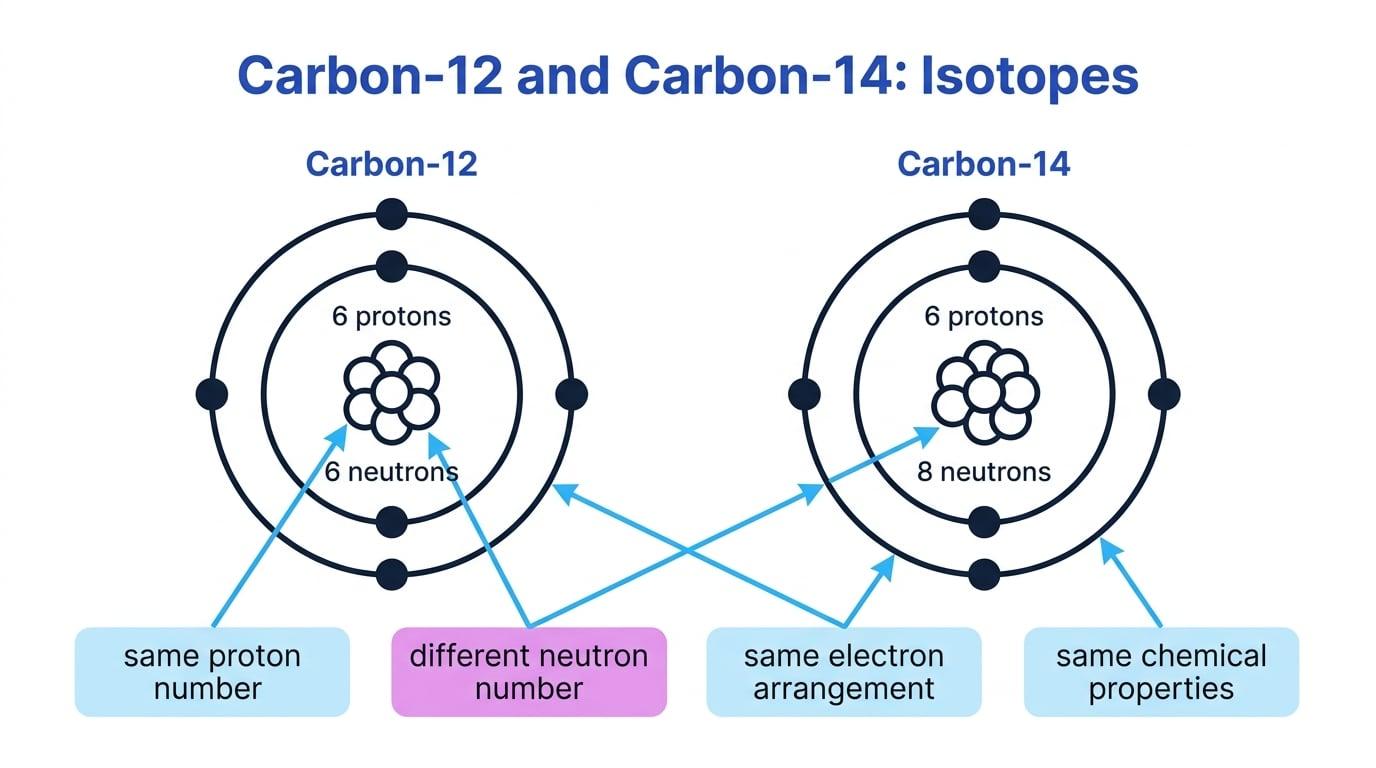
- Carbon-12 has 6 protons and 6 neutrons.
- Carbon-13 has 6 protons and 7 neutrons.
- Carbon-14 has 6 protons and 8 neutrons.
- Hydrogen also has three isotopes, containing 0, 1 and 2 neutrons, but every hydrogen atom has just 1 proton.
- Most elements exist naturally as a mixture of isotopes, so a sample of chlorine gas contains both chlorine-35 atoms and chlorine-37 atoms.
- Neutral atoms of different isotopes of an element have the same number of electrons, because they have the same number of protons.
Atomic symbols
- An atom can be shown in a short form called an atomic symbol, written as ZAX{}^{A}_{Z}\text{X}ZAX, where X\text{X}X is the chemical symbol of the element.
- The mass number, AAA, is written at the top left of the chemical symbol.
- The proton number, ZZZ, is written at the bottom left of the chemical symbol.
- The mass number is always the larger of the two numbers, because it counts the neutrons as well as the protons.
- The number of neutrons is found from the atomic symbol by subtracting the bottom number from the top number, A−ZA-ZA−Z.
- A neutral atom has the same number of electrons as protons, so the bottom number also gives the number of electrons.
- For the atomic symbol 612C{}^{12}_{6}\text{C}612C, the atom has 6 protons, 6 electrons and 12−6=612-6=612−6=6 neutrons.
- Isotopes of the same element have atomic symbols with the same bottom number but different top numbers, as in 1735Cl{}^{35}_{17}\text{Cl}1735Cl and 1737Cl{}^{37}_{17}\text{Cl}1737Cl.
Example
Reading atomic symbols
- The atomic symbol 1123Na{}^{23}_{11}\text{Na}1123Na shows a sodium atom with 11 protons and 11 electrons.
- The atomic symbol 1737Cl{}^{37}_{17}\text{Cl}1737Cl shows a chlorine atom with 17 protons and 17 electrons.
- The atomic symbol 1735Cl{}^{35}_{17}\text{Cl}1735Cl shows an isotope of chlorine with the same 17 protons but two fewer neutrons.
Symbols for ions
Definition
Ion
An atom or group of atoms that carries an electrical charge because it has lost or gained one or more electrons.
- The atomic symbol of an ion has its charge written at the top right, as in 1735Cl−{}^{35}_{17}\text{Cl}^{-}1735Cl− or 1224Mg2+{}^{24}_{12}\text{Mg}^{2+}1224Mg2+.
- Forming an ion changes only the number of electrons, so the proton number and mass number of the ion are the same as those of the atom.
- The number of neutrons in an ion is still found using A−ZA-ZA−Z.
- A positive charge shows that electrons have been lost, so you subtract the size of the charge from the proton number to find the number of electrons.
- A negative charge shows that electrons have been gained, so you add the size of the charge to the proton number to find the number of electrons.
- A single +++ or −-− sign with no number means a charge of one.
Example
Counting the particles in ions
- The ion 1735Cl−{}^{35}_{17}\text{Cl}^{-}1735Cl− has 17 protons and 35−17=1835-17=1835−17=18 neutrons, and its single negative charge means it has gained one electron.
- The ion 1224Mg2+{}^{24}_{12}\text{Mg}^{2+}1224Mg2+ has 12 protons and 24−12=1224-12=1224−12=12 neutrons, and its 2+2+2+ charge means it has lost two electrons.
- The ion 816O2−{}^{16}_{8}\text{O}^{2-}816O2− has 8 protons and 16−8=816-8=816−8=8 neutrons, and its 2−2-2− charge means it has gained two electrons.
Common Mistake
- Do not mix up the two numbers in an atomic symbol, because the larger top number is the mass number and the smaller bottom number is the proton number.
- Do not change the number of protons when you work out the particles in an ion, because only the electrons change.
- Do not describe isotopes as having different numbers of protons or electrons, because isotopes differ only in their number of neutrons.
Exam technique
Defining isotopes
- A full definition of isotopes needs three ideas: atoms of the same element, the same number of protons and different numbers of neutrons.
- Saying that isotopes have different masses is not enough, because the mark is for naming the neutrons as the particles that differ.
- When you fill in a table of particles for atoms and ions, check every row by confirming that protons plus neutrons equals the mass number.
Self review
- What is the same and what is different in two isotopes of the same element?
- What do the top-left and bottom-left numbers in an atomic symbol show?
- How many neutrons are in an atom of 1737Cl{}^{37}_{17}\text{Cl}1737Cl?
- How many protons, neutrons and electrons are in 1224Mg2+{}^{24}_{12}\text{Mg}^{2+}1224Mg2+?
- Why does forming an ion not change the mass number?
2.3.2 Isotopes and relative atomic mass
Chemical properties of isotopes
Definition
Chemical property
A description of how a substance reacts and changes into new substances in chemical reactions.
- Isotopes of the same element have the same number of protons, so their neutral atoms also have the same number of electrons.
- The same number of electrons means the isotopes have the same electronic configuration, including the same number of outer-shell electrons.
- Chemical reactions involve the electrons of atoms, especially the outer-shell electrons, being transferred or shared, while the nucleus takes no part.
- Isotopes of the same element therefore have the same chemical properties, because they have the same number of electrons and the same electronic configuration.
- Chlorine-35 and chlorine-37 both have the configuration 2,8,72,8,72,8,7, so both gain one electron to form a Cl−\text{Cl}^{-}Cl− ion and both react with sodium to form sodium chloride.
- The extra neutrons change only the mass of the atom, so isotopes can differ slightly in physical properties that depend on mass, such as density.
Relative atomic mass
Definition
Relative atomic mass
The weighted mean mass of the atoms of an element, taking into account the abundance of each isotope, compared with one-twelfth of the mass of a carbon-12 atom, given the symbol ArA_rAr.
Definition
Isotopic abundance
The percentage of the atoms in a natural sample of an element that are a particular isotope.
- Most elements exist naturally as a mixture of isotopes, so a sample of an element contains atoms with different masses.
- The relative atomic mass, ArA_rAr, gives the mass of an average atom of the element, taking every isotope into account.
- Masses of atoms are compared with the carbon-12 atom, which is given a mass of exactly 12, so ArA_rAr has no units.
- The abundance of an isotope is the percentage of the atoms of the element that are that isotope.
- The average is a weighted mean, so the more abundant an isotope is, the more it pulls the value of ArA_rAr towards its own mass.
- Chlorine contains three times as many chlorine-35 atoms as chlorine-37 atoms, so its ArA_rAr of 35.535.535.5 is much closer to 35 than to 37.
- Relative atomic masses are often not whole numbers, while the mass number of a single isotope is always a whole number.
- A calculated ArA_rAr must always lie between the masses of the lightest and the heaviest isotopes of the element.
Calculating relative atomic mass
- The relative atomic mass is calculated from the mass and abundance of each isotope using Ar=sum of (isotope mass×abundance)total abundanceA_r=\dfrac{\text{sum of (isotope mass}\times\text{abundance)}}{\text{total abundance}}Ar=total abundancesum of (isotope mass×abundance).
- Multiply the mass of each isotope by its abundance.
- Add these products together.
- Divide the total by the sum of the abundances, which is 100100100 when the abundances are given as percentages.
- Give the answer to the number of decimal places asked for, which is usually one decimal place.
Example
Relative atomic mass of chlorine
- Chlorine contains 75.0%75.0\%75.0% chlorine-35 and 25.0%25.0\%25.0% chlorine-37.
Example
Relative atomic mass of magnesium
- Magnesium contains 79.0%79.0\%79.0% magnesium-24, 10.0%10.0\%10.0% magnesium-25 and 11.0%11.0\%11.0% magnesium-26.
- The value is closest to 24 because magnesium-24 is by far the most abundant isotope.
Example
Abundances given as a ratio
- Boron contains boron-10 and boron-11 atoms in the ratio 1:41:41:4, so the total abundance is 1+4=51+4=51+4=5 rather than 100100100.
Common Mistake
- Do not find a simple average by adding the isotope masses and dividing by the number of isotopes, because this ignores how abundant each isotope is.
- Do not give ArA_rAr a unit such as grams, because it is a relative value.
- Do not say that isotopes react differently because they have different masses, because chemical reactions depend on electrons and not on neutrons.
Exam technique
Calculations and explanations
- Write out the full expression with every isotope before you work it out, because the method can earn credit even if the arithmetic slips.
- Check that your answer lies between the lightest and heaviest isotope masses and sits closest to the most abundant isotope.
- To explain why isotopes have the same chemical properties, state that they have the same number of electrons and the same electronic configuration, because saying they have the same number of protons is not enough on its own.
Self review
- Why do isotopes of the same element have the same chemical properties?
- What does the abundance of an isotope mean?
- Why is the relative atomic mass of chlorine closer to 35 than to 37?
- Calculate the relative atomic mass of an element with 60.0%60.0\%60.0% of mass 69 and 40.0%40.0\%40.0% of mass 71.
- Why does relative atomic mass have no units?