2.4.1 Ions, ionic bonds and the properties of ionic compounds
Forming ions
Definition
Cation
A positively charged ion, formed when an atom loses one or more electrons.
Definition
Anion
A negatively charged ion, formed when an atom gains one or more electrons.
- Atoms have no overall charge, but they can lose or gain electrons during reactions to form charged particles called ions.
- Metal atoms have only a few outer-shell electrons, so they tend to lose electrons and form positive ions, called cations.
- Non-metal atoms have nearly full outer shells, so they tend to gain electrons and form negative ions, called anions.
- Losing or gaining electrons in this way leaves the ion with a full outer shell, the same electronic configuration as a noble gas.
- A Group I atom loses its single outer-shell electron to form an ion with a charge of 1+1+1+.
- A sodium atom, 2,8,12,8,12,8,1, loses one electron to become a sodium ion, Na+\text{Na}^{+}Na+, with the configuration 2,82,82,8.
- A Group VII atom gains one electron to fill its outer shell and form an ion with a charge of 1−1-1−.
- A chlorine atom, 2,8,72,8,72,8,7, gains one electron to become a chloride ion, Cl−\text{Cl}^{-}Cl−, with the configuration 2,8,82,8,82,8,8.
- A negative ion made from a single non-metal atom has a name ending in -ide, so chlorine forms chloride, bromine forms bromide and fluorine forms fluoride.
- The nucleus does not change when an ion forms, so a sodium ion still has 11 protons and is still sodium.
Ionic bonds
Definition
Ionic bond
The strong electrostatic attraction between ions of opposite charge.
- When a Group I metal reacts with a Group VII non-metal, one electron is transferred from each metal atom to a non-metal atom.
- The transfer produces cations and anions, which have opposite charges.
- Oppositely charged ions attract each other strongly, and this strong electrostatic attraction between them is the ionic bond.
- A substance held together by ionic bonds is called an ionic compound.
- Sodium chloride, NaCl\text{NaCl}NaCl, lithium fluoride, LiF\text{LiF}LiF, and potassium bromide, KBr\text{KBr}KBr, are all ionic compounds formed from Group I and Group VII elements.
- Electron transfer creates the ions, but it is the attraction between the ions afterwards that forms the bond.
Dot-and-cross diagrams
Definition
Dot-and-cross diagram
A diagram showing the outer-shell electrons of bonded atoms or ions, using dots for the electrons from one atom and crosses for the electrons from the other.
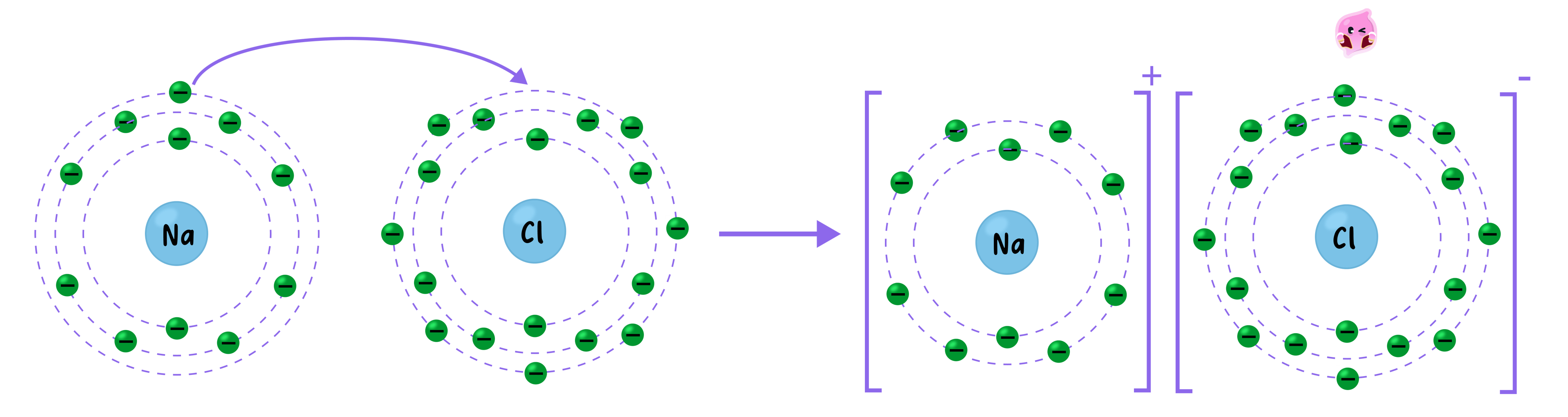
- A dot-and-cross diagram shows how electrons are transferred when an ionic bond forms.
- The electrons from one atom are drawn as dots and the electrons from the other atom are drawn as crosses, so you can see where each electron came from.
- To draw the bonding between a Group I and a Group VII element, follow four steps.
- Draw the Group I atom with one electron in its outer shell and the Group VII atom with seven electrons in its outer shell.
- Show the single outer electron of the Group I atom moving across to the outer shell of the Group VII atom, often with a curved arrow.
- Draw the Group VII ion with eight electrons in its outer shell, made up of seven of its own electrons and the one electron it gained.
- Put each ion in square brackets and write its charge at the top right outside the brackets.
- In sodium chloride, the sodium ion is left with the configuration 2,82,82,8 and the chloride ion has the configuration 2,8,82,8,82,8,8, so both ions have full outer shells.
- One electron is transferred from each sodium atom to each chlorine atom, so the ions combine in a 1:11:11:1 ratio and the formula is NaCl\text{NaCl}NaCl.
- The charges in the formula balance, because the +1+1+1 charge on each sodium ion cancels the −1-1−1 charge on each chloride ion.
Example
Dot-and-cross diagram for lithium fluoride
- Lithium has the configuration 2,12,12,1, so its single outer-shell electron is drawn as a cross.
- Fluorine has the configuration 2,72,72,7, so its seven outer-shell electrons are drawn as dots.
- The lithium atom transfers its one cross to the outer shell of the fluorine atom.
- The lithium ion is drawn as [Li]+[\text{Li}]^{+}[Li]+ with the configuration 222, because its outer shell is now empty and only the full first shell remains.
- The fluoride ion is drawn as [F]−[\text{F}]^{-}[F]− with seven dots and one cross in its outer shell, giving the configuration 2,82,82,8.
- One electron is transferred, so the formula of lithium fluoride is LiF\text{LiF}LiF.
Properties of ionic compounds
- Ionic compounds have high melting points and high boiling points, so they are solids at room temperature.
- Sodium chloride melts at 801 ∘C801\ ^{\circ}\text{C}801 ∘C and boils at 1413 ∘C1413\ ^{\circ}\text{C}1413 ∘C.
- This is because the electrostatic attractions between the oppositely charged ions are strong, so a large amount of energy is needed to overcome them.
- Ionic compounds are poor conductors of electricity when solid, because the ions are held in fixed positions and cannot move.
- Ionic compounds are good conductors of electricity when molten or aqueous, because the ions are then free to move and carry charge.
- Molten means melted into a liquid, and aqueous means dissolved in water, which is shown by the state symbol (aq)(\text{aq})(aq).
Practical
Electrical conductivity of sodium chloride
- Aim: to compare the electrical conductivity of solid sodium chloride with that of aqueous sodium chloride.
- Apparatus: a low-voltage power supply set to about 6 V6\ \text{V}6 V, a small bulb in a holder or an ammeter, three connecting leads with crocodile clips, two graphite rods as electrodes, a 100 cm3100\ \text{cm}^3100 cm3 beaker, dry sodium chloride crystals, distilled water, a spatula, a glass stirring rod and eye protection.
- Method:
- Connect the power supply, the bulb and the two graphite electrodes in a series circuit, leaving a gap between the electrodes.
- Touch the two electrodes together briefly to check that the bulb lights and the circuit works.
- Half-fill the dry beaker with sodium chloride crystals and push both electrodes into the solid without letting them touch.
- Switch on, watch the bulb for about 30 seconds and record whether it lights, then switch off.
- Remove the electrodes, rinse them with distilled water and empty the beaker.
- Pour about 50 cm350\ \text{cm}^350 cm3 of distilled water into the beaker, dip the electrodes in, switch on and record whether the bulb lights, as a control.
- Switch off, add two spatulas of sodium chloride to the water and stir until the crystals have dissolved.
- Switch on again, record whether the bulb lights and look closely at the surfaces of both electrodes.
- Results: the bulb stays off with the solid crystals and with distilled water, but lights brightly with aqueous sodium chloride, and small bubbles of gas form on both electrodes.
- Conclusion: solid sodium chloride does not conduct because its ions cannot move, while aqueous sodium chloride conducts because its ions are free to move through the solution.
- Molten compounds: sodium chloride melts at too high a temperature to test safely in a school laboratory, so your teacher may demonstrate the conductivity of a molten ionic compound with a lower melting point inside a fume cupboard.
- Safety: use only a low voltage, wear eye protection, keep the room well ventilated because a small amount of chlorine gas forms at one electrode, and switch off as soon as each observation is made.
Common Mistake
- Do not say that a solid ionic compound fails to conduct because it has no ions, because the ions are present but cannot move.
- Do not say that electrons move through an aqueous or molten ionic compound to carry the current, because the moving charged particles are ions.
- Do not say that an ion forms by gaining or losing protons, because only electrons are transferred.
Exam technique
Describing ionic bonding
- Describe an ionic bond as a strong electrostatic attraction between oppositely charged ions, because vaguer phrases such as the ions stick together do not earn the mark.
- In a dot-and-cross diagram, examiners look for the correct number of outer-shell electrons on each ion, the correct charges and the square brackets.
- When describing conductivity, name the ions as the particles that carry charge and say clearly whether they can move in each state.
Self review
- What is the difference between a cation and an anion?
- What is an ionic bond?
- Describe what happens to the outer-shell electron of a sodium atom when it reacts with a chlorine atom.
- State the electronic configurations of Na+\text{Na}^{+}Na+ and Cl−\text{Cl}^{-}Cl−.
- Why does sodium chloride conduct electricity when aqueous but not when solid?
2.4.2 Ionic lattices, bonding and properties
Giant ionic lattices
Definition
Giant ionic lattice
A regular three-dimensional arrangement of alternating positive and negative ions held together by ionic bonds.
Definition
Electrostatic attraction
The force of attraction between particles that carry opposite electrical charges.
- Ionic compounds do not exist as separate molecules, because each ion is attracted to every oppositely charged ion around it.
- Instead, the ions pack together into a giant ionic lattice, which is a regular arrangement of alternating positive and negative ions repeated in three dimensions.
- Giant means the lattice contains a huge, unfixed number of ions, so even a single grain of salt contains billions of billions of them.
- In sodium chloride, each Na+\text{Na}^{+}Na+ ion is surrounded by six Cl−\text{Cl}^{-}Cl− ions and each Cl−\text{Cl}^{-}Cl− ion is surrounded by six Na+\text{Na}^{+}Na+ ions.
- Every ion is attracted to all of its oppositely charged neighbours, so the ionic bonds act in all directions throughout the lattice.
- The formula of an ionic compound shows the ratio of ions in the lattice, not the make-up of a molecule, so NaCl\text{NaCl}NaCl means one sodium ion for every chloride ion.
- The regular, repeating arrangement of ions explains why ionic compounds form crystals with flat faces and straight edges, such as the cube-shaped crystals of table salt.
Ionic bonding between metals and non-metals
- Ionic bonds form between any metal and non-metal, not only between Group I and Group VII elements.
- Each metal atom loses all of its outer-shell electrons to form a positive ion with a full outer shell.
- Each non-metal atom gains enough electrons to fill its outer shell and forms a negative ion.
- The charge on each ion equals the number of electrons lost or gained, which you can work out from the electronic configuration of the atom.
- Magnesium, 2,8,22,8,22,8,2, loses two electrons to form Mg2+\text{Mg}^{2+}Mg2+.
- Oxygen, 2,62,62,6, gains two electrons to form O2−\text{O}^{2-}O2−.
- Aluminium, 2,8,32,8,32,8,3, loses three electrons to form Al3+\text{Al}^{3+}Al3+.
- The total number of electrons lost by the metal atoms must equal the total number gained by the non-metal atoms.
- The ions therefore combine in the ratio that makes the total positive charge equal to the total negative charge, so the compound has no overall charge.
Example
Magnesium oxide
- Magnesium, 2,8,22,8,22,8,2, has two outer-shell electrons, drawn as crosses.
- Oxygen, 2,62,62,6, has six outer-shell electrons, drawn as dots.
- The magnesium atom transfers both of its crosses to the outer shell of the oxygen atom.
- The ions formed are [Mg]2+[\text{Mg}]^{2+}[Mg]2+ with the configuration 2,82,82,8 and [O]2−[\text{O}]^{2-}[O]2− with six dots and two crosses, giving the configuration 2,82,82,8.
- One 2+2+2+ ion balances one 2−2-2− ion, so the formula is MgO\text{MgO}MgO.
Example
Calcium chloride
- Calcium, 2,8,8,22,8,8,22,8,8,2, has two outer-shell electrons to lose, but each chlorine atom, 2,8,72,8,72,8,7, needs to gain only one.
- Two chlorine atoms are therefore needed, and each one receives one cross from the calcium atom.
- The ions formed are one [Ca]2+[\text{Ca}]^{2+}[Ca]2+ ion and two [Cl]−[\text{Cl}]^{-}[Cl]− ions, each chloride ion having seven dots and one cross in its outer shell.
- One 2+2+2+ ion balances two 1−1-1− ions, so the formula is CaCl2\text{CaCl}_2CaCl2.
Example
Sodium oxide
- Each sodium atom, 2,8,12,8,12,8,1, has only one electron to lose, but an oxygen atom, 2,62,62,6, needs to gain two.
- Two sodium atoms are therefore needed, each transferring one cross to the same oxygen atom.
- The ions formed are two [Na]+[\text{Na}]^{+}[Na]+ ions and one [O]2−[\text{O}]^{2-}[O]2− ion with six dots and two crosses in its outer shell.
- Two 1+1+1+ ions balance one 2−2-2− ion, so the formula is Na2O\text{Na}_2\text{O}Na2O.
Melting points and boiling points
- To melt an ionic solid, the ions must be freed from their fixed positions in the lattice so that they can move past one another.
- To boil the liquid, the ions must be separated from one another completely.
- Both changes require the strong electrostatic attractions between oppositely charged ions to be overcome.
- The lattice is giant, so there are a very large number of these strong attractions acting in all directions.
- A large amount of energy is needed to overcome so many strong attractions, which is why ionic compounds have high melting points and boiling points.
- Ions with larger charges attract each other more strongly, so magnesium oxide, made of Mg2+\text{Mg}^{2+}Mg2+ and O2−\text{O}^{2-}O2− ions, melts at about 2852 ∘C2852\ ^{\circ}\text{C}2852 ∘C, far higher than sodium chloride at 801 ∘C801\ ^{\circ}\text{C}801 ∘C.
Electrical conductivity
- To conduct electricity, a substance must contain charged particles that are free to move.
- In a solid ionic compound, the ions are held in fixed positions in the lattice by strong electrostatic attractions.
- The ions can vibrate on the spot but cannot move from place to place, and there are no free electrons, so the solid is a poor conductor.
- In a molten ionic compound, the lattice has broken down and the ions are free to move through the liquid, so it is a good conductor.
- In an aqueous solution, the lattice has broken up and the ions are spread among the water molecules where they are free to move, so the solution is a good conductor.
- When a voltage is applied, the positive ions move towards the negative electrode and the negative ions move towards the positive electrode, and this flow of ions is the electric current.
Common Mistake
- Do not talk about molecules or intermolecular forces when explaining the properties of an ionic compound, because it is a giant lattice of ions with no molecules.
- Do not say that electrons carry the current in a molten or aqueous ionic compound, because the charge is carried by moving ions.
- Do not say that the ionic bonds are weak or few, because the high melting point comes from many strong attractions acting throughout the lattice.
Exam technique
Explaining ionic properties
- For a high melting point, include three ideas: a giant lattice, strong electrostatic attractions between oppositely charged ions and a lot of energy needed to overcome them.
- For conductivity, state that ions are present, that they cannot move in the solid, and that they can move when molten or aqueous.
- When you draw a dot-and-cross diagram for an ionic compound, draw the correct number of each ion and check that the charges balance.
Self review
- Describe the structure of a giant ionic lattice.
- What is the formula of the compound formed between calcium and chlorine?
- Why does magnesium oxide have a higher melting point than sodium chloride?
- Why is solid sodium chloride a poor conductor of electricity?
- Why do molten ionic compounds conduct electricity?
