Enthalpy change
Definition
Enthalpy change
The transfer of thermal energy during a reaction, given the symbol ΔH\Delta HΔH and measured in kJ/mol\text{kJ/mol}kJ/mol.
- The transfer of thermal energy between a reaction and its surroundings is called the enthalpy change of the reaction, and it is given the symbol ΔH\Delta HΔH.
- ΔH\Delta HΔH is usually measured in kilojoules per mole, kJ/mol\text{kJ/mol}kJ/mol, for the amounts of substance shown in the balanced equation.
- The sign of ΔH\Delta HΔH shows the direction of the energy transfer, judged from the point of view of the reacting chemicals, not the surroundings.
- Exothermic reactions
- The chemicals lose thermal energy to the surroundings, so the energy stored in the chemicals goes down.
- ΔH\Delta HΔH is negative, such as ΔH=−890 kJ/mol\Delta H = -890\ \text{kJ/mol}ΔH=−890 kJ/mol for the combustion of methane.
- Endothermic reactions
- The chemicals gain thermal energy from the surroundings, so the energy stored in the chemicals goes up.
- ΔH\Delta HΔH is positive, such as ΔH=+178 kJ/mol\Delta H = +178\ \text{kJ/mol}ΔH=+178 kJ/mol for the thermal decomposition of calcium carbonate.
- A value of ΔH\Delta HΔH written beside an equation applies to the whole equation as written, as in CH4(g)+2O2(g)→CO2(g)+2H2O(l)\text{CH}_4(\text{g}) + 2\text{O}_2(\text{g}) \rightarrow \text{CO}_2(\text{g}) + 2\text{H}_2\text{O}(\text{l})CH4(g)+2O2(g)→CO2(g)+2H2O(l), ΔH=−890 kJ/mol\Delta H = -890\ \text{kJ/mol}ΔH=−890 kJ/mol.
- The size of ΔH\Delta HΔH tells you how much energy is transferred, and the sign tells you which way it goes.
Activation energy
Definition
Activation energy
The minimum energy that colliding particles must have to react, given the symbol EaE_aEa.
- Particles have to collide with each other before they can react.
- Not every collision leads to a reaction, because the colliding particles need a minimum amount of energy for a reaction to take place.
- This minimum energy is called the activation energy, and it is given the symbol EaE_aEa.
- A collision between particles with energy less than EaE_aEa does not produce a reaction, and the particles move apart unchanged.
- A collision between particles with energy equal to or greater than EaE_aEa can lead to a reaction.
- Every reaction has an activation energy, including exothermic reactions, which is why the methane from a gas tap does not burn until a spark or a lit match supplies the energy to start it.
- Once an exothermic reaction has started, the energy it releases gives other particles enough energy to react, so the reaction keeps going without further heating.
- An endothermic reaction, such as the thermal decomposition of calcium carbonate, needs a continuous supply of energy, so it stops as soon as the heating stops.
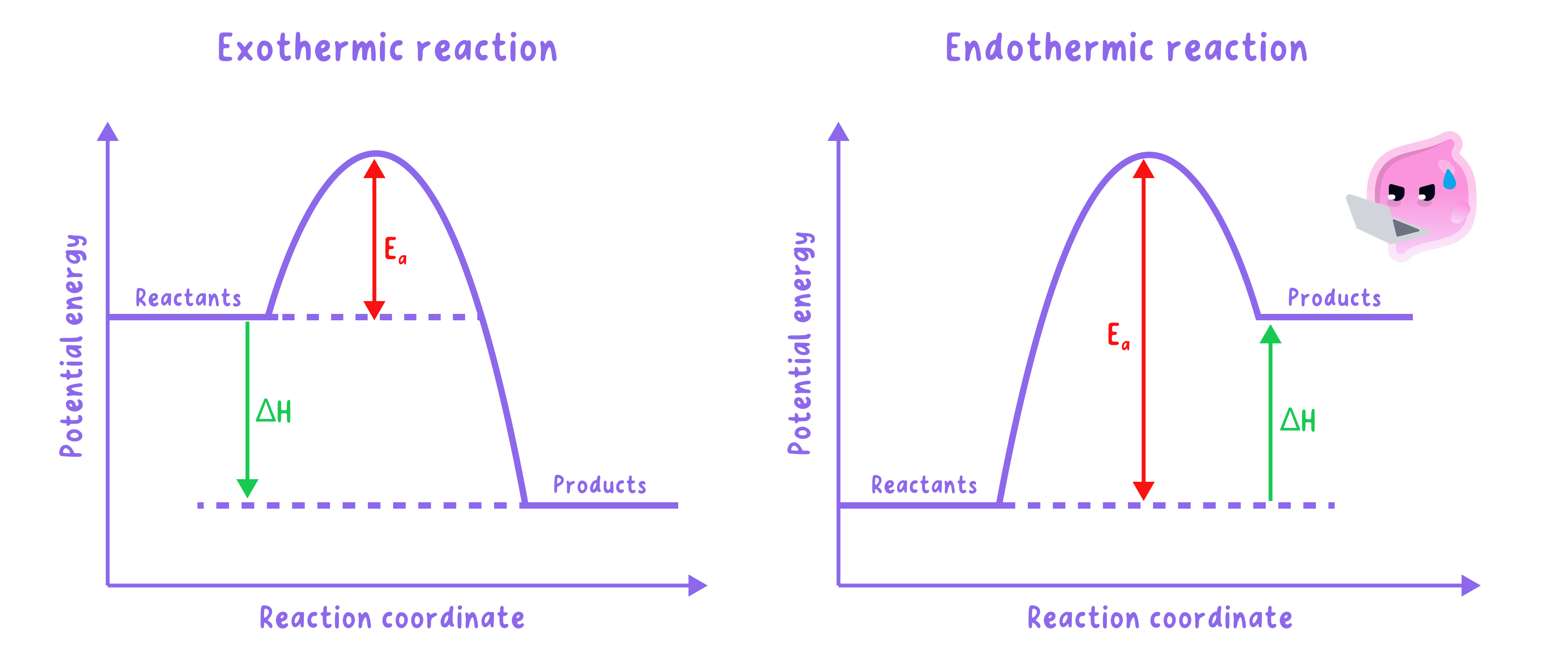
- On a reaction pathway diagram, EaE_aEa is the energy difference between the reactants and the peak of the pathway.
Drawing reaction pathway diagrams
- Draw a vertical axis labelled energy and a horizontal axis labelled progress of reaction.
- Draw a short horizontal line on the left for the reactants, and label it with the word reactants or with their formulae.
- Draw a second horizontal line on the right for the products, placed below the reactants for an exothermic reaction and above them for an endothermic reaction.
- Join the two lines with a smooth curve that rises to a single peak above both levels and then falls to the products.
- Draw a vertical arrow from the reactant line up to the top of the peak and label it EaE_aEa.
- Draw a vertical arrow from the reactant line to the product line and label it ΔH\Delta HΔH.
- For an exothermic reaction this arrow points downwards, showing that ΔH\Delta HΔH is negative.
- For an endothermic reaction this arrow points upwards, showing that ΔH\Delta HΔH is positive.
- Use any values given in the question to set the heights, so that a large ΔH\Delta HΔH appears as a large gap and a small EaE_aEa appears as a low peak.
- In an endothermic reaction the peak must sit above the products, so EaE_aEa is always larger than ΔH\Delta HΔH.
Example
Pathway for an exothermic reaction
- A reaction has ΔH=−120 kJ/mol\Delta H = -120\ \text{kJ/mol}ΔH=−120 kJ/mol and Ea=+50 kJ/molE_a = +50\ \text{kJ/mol}Ea=+50 kJ/mol.
- The negative sign shows that the reaction is exothermic, so the product line is drawn below the reactant line.
- The gap between the reactant line and the product line represents 120 kJ/mol120\ \text{kJ/mol}120 kJ/mol.
- The peak is drawn 50 kJ/mol50\ \text{kJ/mol}50 kJ/mol above the reactant line, which makes the rise to the peak much smaller than the fall to the products.
- The EaE_aEa arrow points upwards from the reactant line to the peak, and the ΔH\Delta HΔH arrow points downwards from the reactant line to the product line.
Example
Pathway for an endothermic reaction
- A reaction has ΔH=+60 kJ/mol\Delta H = +60\ \text{kJ/mol}ΔH=+60 kJ/mol and Ea=+150 kJ/molE_a = +150\ \text{kJ/mol}Ea=+150 kJ/mol.
- The positive sign shows that the reaction is endothermic, so the product line is drawn 60 kJ/mol60\ \text{kJ/mol}60 kJ/mol above the reactant line.
- The peak is drawn 150 kJ/mol150\ \text{kJ/mol}150 kJ/mol above the reactant line, so it sits above the products by the difference between the two values.
- Both arrows start at the reactant line and point upwards, with the ΔH\Delta HΔH arrow ending at the product line and the EaE_aEa arrow ending at the peak.
Common Mistake
- Do not draw EaE_aEa from the products to the peak, because activation energy is always measured from the reactants.
- Do not draw ΔH\Delta HΔH from the peak, because it is the difference between the reactants and the products only.
- Always include the sign of ΔH\Delta HΔH, and remember that an exothermic value is negative even though the surroundings get hotter, because ΔH\Delta HΔH describes the energy of the chemicals.
Exam technique
Drawing and labelling pathway diagrams
- Marks for these diagrams are usually given separately for the reactant and product levels in the correct positions, for the ΔH\Delta HΔH arrow and for the EaE_aEa arrow, so check each part on its own.
- Put an arrowhead on every arrow and make sure each arrow touches the lines it joins, because an arrow that stops short or starts at the wrong line is not credited.
- Label both levels with the words reactants and products or with their formulae, since an unlabelled line cannot earn its mark.
- When you define activation energy, include the words minimum energy and colliding particles, because a definition that misses either one is incomplete.
- When asked for the sign of ΔH\Delta HΔH, link it to the diagram, such as ΔH\Delta HΔH is negative because the products are at a lower energy level than the reactants.
Self review
- State the name and the symbol given to the transfer of thermal energy during a reaction.
- State the sign of ΔH\Delta HΔH for an exothermic reaction and for an endothermic reaction.
- Define activation energy.
- Explain why methane does not burn until a flame or spark is applied.
- Describe where the EaE_aEa arrow and the ΔH\Delta HΔH arrow are drawn on a reaction pathway diagram.
