Definition
Exothermic reaction
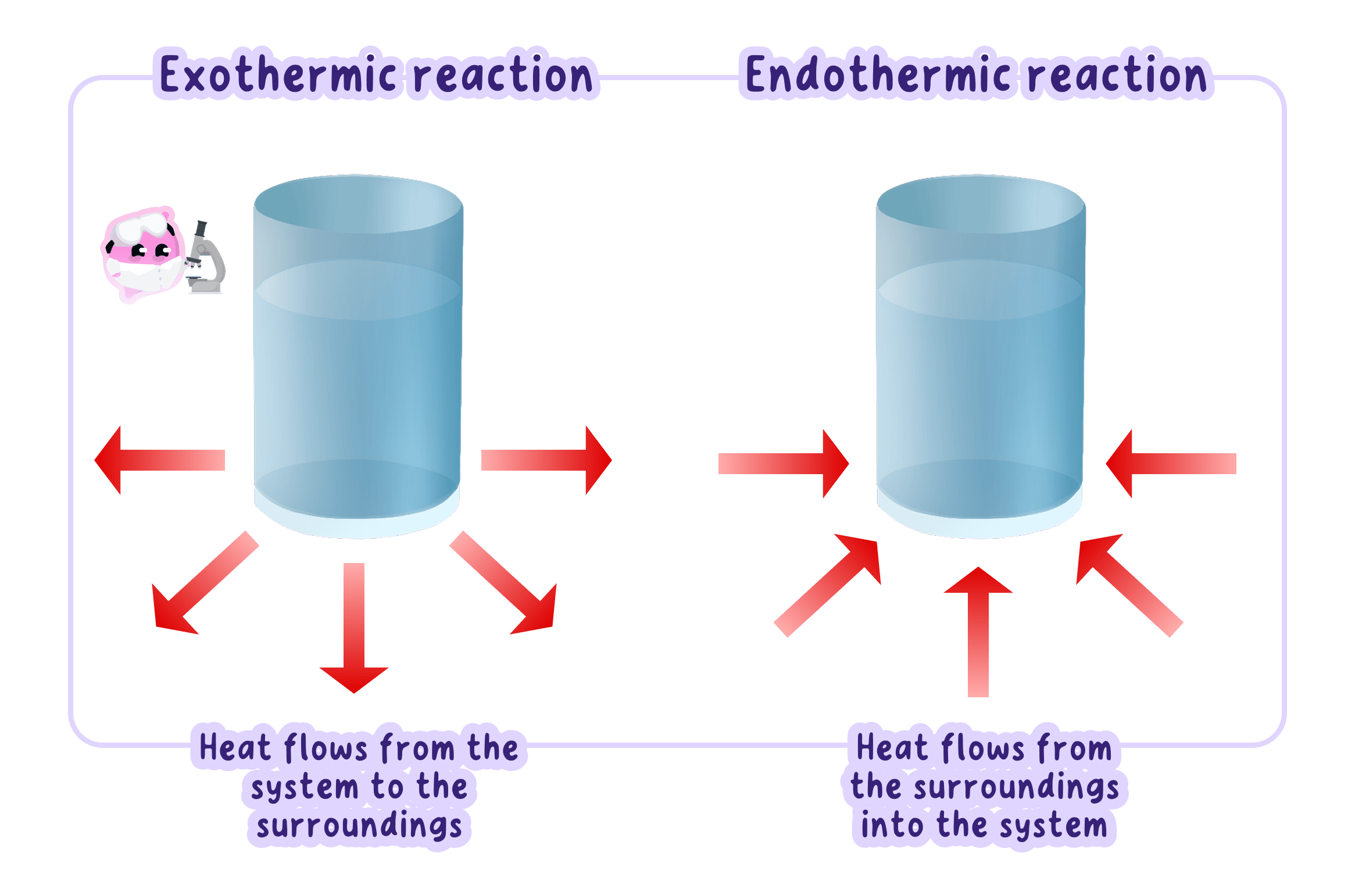
A reaction that transfers thermal energy to the surroundings, so the temperature of the surroundings increases.
Definition
Endothermic reaction
A reaction that takes in thermal energy from the surroundings, so the temperature of the surroundings decreases.
- Every chemical reaction involves a transfer of thermal energy between the reacting chemicals and their surroundings.
- The surroundings are everything outside the reacting particles, including the water the chemicals are dissolved in, the container, the thermometer and the air around them.
- In an exothermic reaction, thermal energy is transferred from the reacting chemicals to the surroundings.
- The surroundings gain thermal energy, so the temperature of the surroundings increases.
- A thermometer in the reaction mixture shows a rise in temperature, and the container feels warm to the touch.
- In an endothermic reaction, the reacting chemicals take in thermal energy from the surroundings.
- The surroundings lose thermal energy, so the temperature of the surroundings decreases.
- A thermometer in the reaction mixture shows a fall in temperature, and the container feels cold to the touch.
- The thermometer measures the temperature of the surroundings, so a rising reading means that energy has left the reacting chemicals, and a falling reading means that energy has entered them.
- Energy is conserved in every reaction, so the thermal energy gained by the surroundings is exactly equal to the energy lost by the reacting chemicals, and the other way round.
Common examples
- Exothermic reactions
- The combustion of fuels, such as methane burning in a gas cooker, transfers large amounts of thermal energy to the surroundings.
- Neutralisation of an acid by an alkali, such as dilute hydrochloric acid with aqueous sodium hydroxide, warms the solution.
- The reaction of a metal with a dilute acid, such as magnesium ribbon with dilute hydrochloric acid, makes the test tube feel warm.
- Displacement reactions of metals, such as zinc powder added to aqueous copper(II) sulfate, raise the temperature of the solution.
- The oxidation of iron powder inside a disposable hand warmer releases thermal energy slowly for several hours.
- Endothermic reactions and processes
- Thermal decomposition, such as heating calcium carbonate to make calcium oxide and carbon dioxide, only continues while thermal energy is supplied by a Bunsen burner or furnace.
- The reaction of citric acid with sodium hydrogencarbonate makes the mixture noticeably colder, which is why sherbet feels cool on the tongue.
- Dissolving ammonium nitrate in water takes in thermal energy, and instant cold packs for sports injuries use this process to cool down within seconds.
Example
Classifying reactions from temperature readings
- Magnesium ribbon was added to dilute hydrochloric acid in a polystyrene cup, and the temperature of the acid rose from 19.5 ∘C19.5\,^\circ\text{C}19.5∘C to 31.0 ∘C31.0\,^\circ\text{C}31.0∘C.
- The temperature of the surroundings increased, so thermal energy was transferred to the surroundings and the reaction is exothermic.
- Sodium hydrogencarbonate was added to citric acid solution in a second cup, and the temperature fell from 20.0 ∘C20.0\,^\circ\text{C}20.0∘C to 14.5 ∘C14.5\,^\circ\text{C}14.5∘C.
- The temperature of the surroundings decreased, so thermal energy was taken in from the surroundings and the reaction is endothermic.
Practical
Measuring temperature changes during reactions
- Aim: to measure the temperature change when pairs of reactants are mixed, and to use it to decide whether each reaction is exothermic or endothermic.
- Apparatus: a polystyrene cup with a lid, a 250 cm3250\ \text{cm}^3250 cm3 beaker to support the cup, a thermometer reading to 0.5 ∘C0.5\,^\circ\text{C}0.5∘C or a digital temperature probe, a 25 cm325\ \text{cm}^325 cm3 measuring cylinder, a balance, a spatula, dilute hydrochloric acid, aqueous sodium hydroxide, magnesium ribbon, citric acid solution, sodium hydrogencarbonate powder and eye protection.
- Variables: the pair of reactants is the independent variable, the temperature change is the dependent variable, and the volume of solution, the mass of solid and the type of cup are kept the same.
- Method:
- Stand the polystyrene cup inside the beaker so that it cannot tip over, because polystyrene is a good thermal insulator and keeps the energy change inside the mixture.
- Measure 25 cm325\ \text{cm}^325 cm3 of the first solution, such as dilute hydrochloric acid, with the measuring cylinder and pour it into the cup.
- Place the thermometer in the solution, wait until the reading stops changing, and record it as the initial temperature.
- Add the second reactant, either 25 cm325\ \text{cm}^325 cm3 of aqueous sodium hydroxide or a weighed mass of solid, and fit the lid straight away with the thermometer passing through the hole.
- Stir the mixture gently and continuously so that the temperature is the same throughout the liquid.
- Watch the reading closely and record the highest temperature reached for a reaction that warms up, or the lowest temperature reached for a reaction that cools down.
- Rinse and dry the cup, then repeat the method with each pair of reactants, using the same volumes and masses every time.
- Results: record the readings in a table with the headings initial temperature / ∘C^\circ\text{C}∘C, highest or lowest temperature / ∘C^\circ\text{C}∘C and temperature change / ∘C^\circ\text{C}∘C, giving every reading to the nearest 0.5 ∘C0.5\,^\circ\text{C}0.5∘C.
- Conclusion: a positive temperature change shows that the reaction transferred thermal energy to the surroundings and is exothermic, while a negative temperature change shows that it took in thermal energy and is endothermic.
- Watch out: thermal energy passes between the mixture and the air during the experiment, so the measured change is smaller than the true change, and the lid and the insulated cup reduce this error.
- Safety: wear eye protection because dilute acids and alkalis irritate the eyes, and wipe up spills straight away.
Reaction pathway diagrams
Definition
Reaction pathway diagram
A diagram that shows the energy levels of the reactants and products and how the energy changes as a reaction progresses.
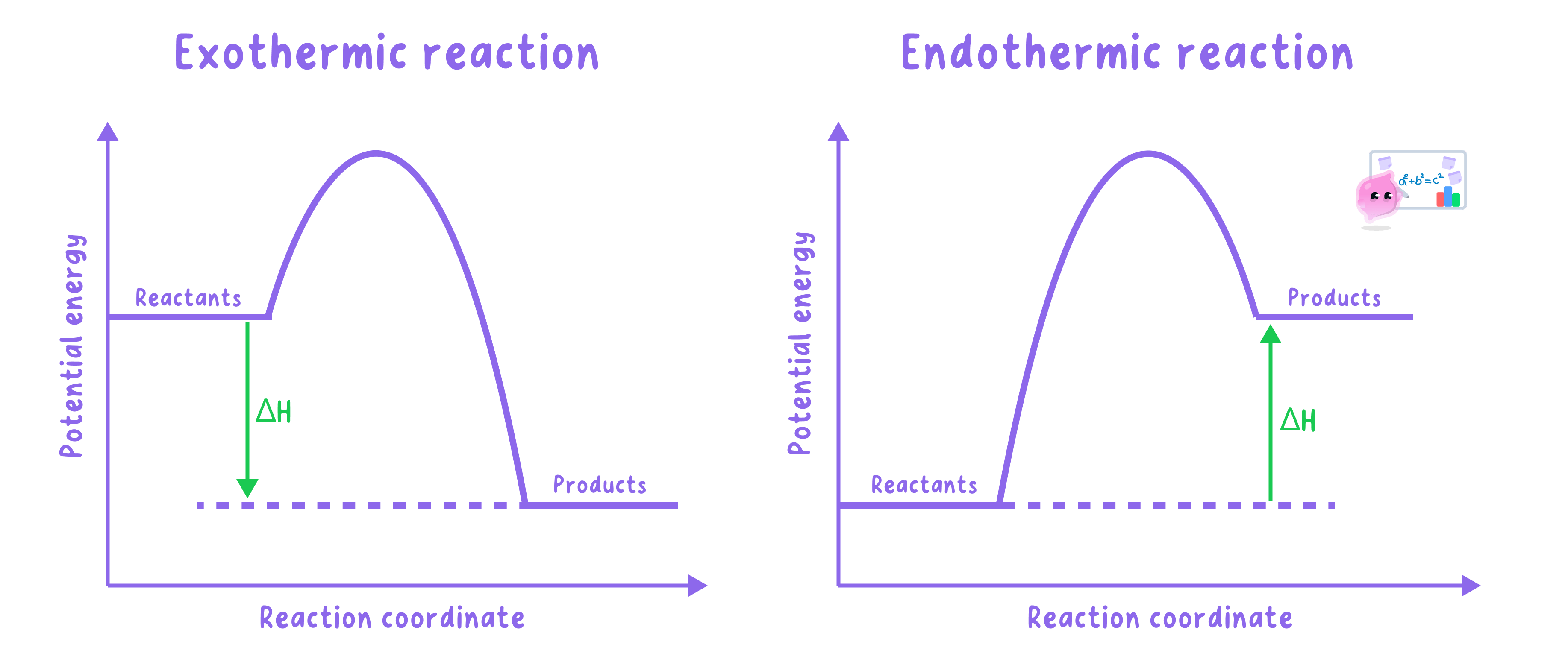
- A reaction pathway diagram compares the energy stored in the reactants with the energy stored in the products.
- The vertical axis is labelled energy and the horizontal axis shows the progress of the reaction.
- The reactants are drawn as a horizontal line on the left, and the products are drawn as a horizontal line on the right.
- Between the two levels, the pathway line usually rises to a peak and then falls to the products.
- The vertical gap between the reactant level and the product level shows how much energy is transferred between the chemicals and the surroundings.
- This gap is often marked with a vertical arrow labelled energy given out or energy taken in.
Interpreting the diagrams
- Exothermic reaction
- The products are at a lower energy level than the reactants.
- The energy difference has been transferred to the surroundings, so the temperature of the surroundings increases.
- An arrow from the reactant level to the product level points downwards.
- Endothermic reaction
- The products are at a higher energy level than the reactants.
- The extra energy stored in the products has been taken in from the surroundings, so the temperature of the surroundings decreases.
- An arrow from the reactant level to the product level points upwards.
- The larger the vertical gap between the two levels, the more thermal energy is transferred and the bigger the temperature change of the surroundings.
Common Mistake
- Do not decide the type of reaction from the peak, because the pathway rises before it falls for both exothermic and endothermic reactions.
- Compare only the starting level of the reactants with the final level of the products.
- Do not say that an endothermic reaction gives out cold, because it takes in thermal energy and the surroundings cool down as a result.
Exam technique
Describing energy changes
- When you describe an exothermic reaction, give both parts of the answer: thermal energy is transferred to the surroundings and the temperature of the surroundings increases.
- For an endothermic reaction, the matching pair is that thermal energy is taken in from the surroundings and the temperature of the surroundings decreases.
- Write thermal energy or heat rather than just energy, and always say which way it moves.
- When you interpret a pathway diagram, back up the reaction type with a comparison, such as the products have less energy than the reactants.
- When a question gives temperature readings, quote the rise or fall in your answer, because the numbers are the evidence for your conclusion.
Self review
- State what happens to thermal energy and to the temperature of the surroundings during an exothermic reaction.
- State what happens to thermal energy and to the temperature of the surroundings during an endothermic reaction.
- Name two exothermic reactions and one endothermic reaction.
- Explain why a polystyrene cup with a lid is used when measuring the temperature change of a reaction.
- A reaction pathway diagram shows the products above the reactants, so state the type of reaction and what happens to the temperature of the surroundings.
