12.3.1 Paper chromatography
How paper chromatography works
Paper chromatography
A method that separates the soluble substances in a mixture as a solvent carries them different distances through paper.
Solvent front
The furthest point reached by the solvent as it moves up the paper during chromatography.
- Paper chromatography separates a mixture of soluble substances, such as the different dyes in an ink or a food colouring.
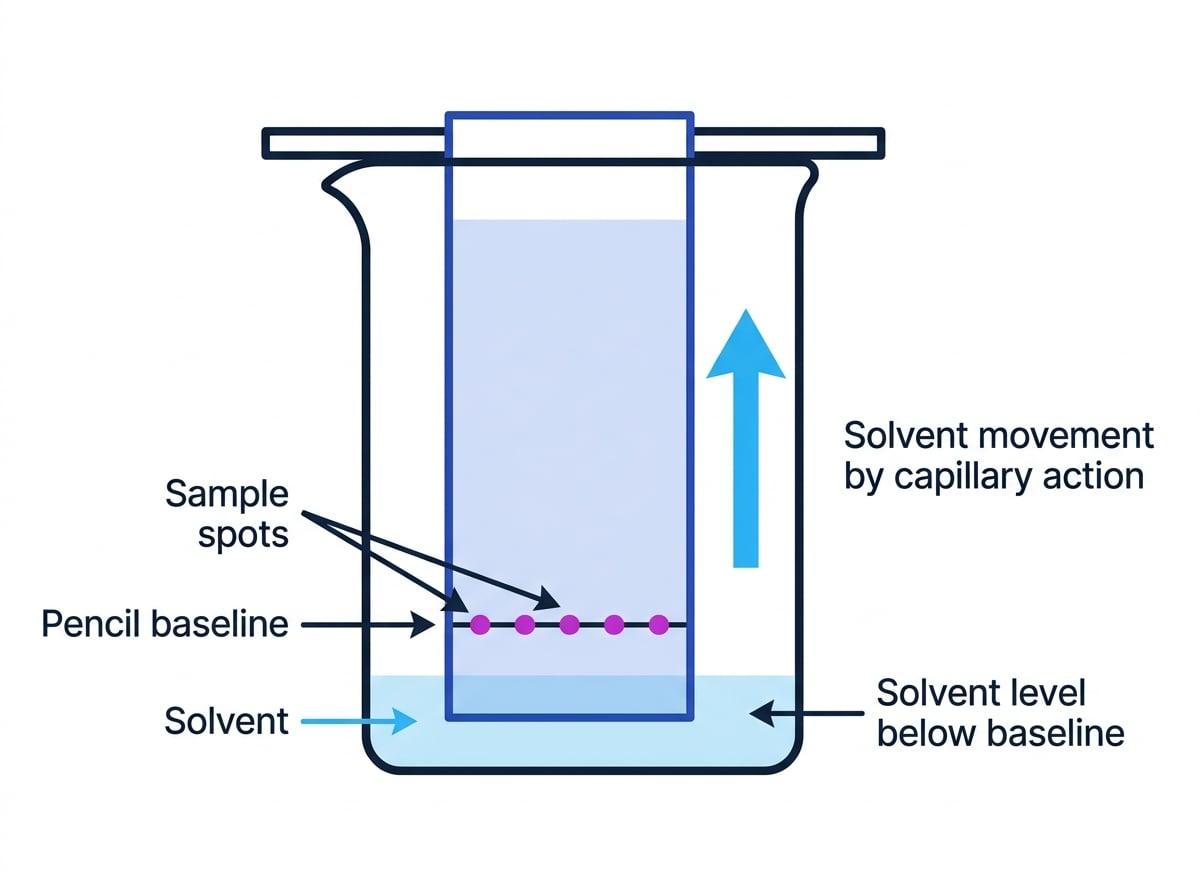
- A small spot of the mixture is placed on a pencil baseline drawn near the bottom of a strip of chromatography paper.
- The bottom edge of the paper is dipped in a suitable solvent, which soaks up through the paper and passes through the spot.
- Each substance in the spot is pulled in two directions: it dissolves in the moving solvent and it is attracted to the paper.
- A substance that is more soluble in the solvent spends more time moving with it, so it travels further up the paper.
- A substance that is less soluble in the solvent, or more strongly attracted to the paper, travels a shorter distance.
- Because the substances move at different speeds, they separate into a column of individual spots.
- A substance that is insoluble in the solvent does not move at all and stays on the baseline.
- A suitable solvent is one in which the substances dissolve to different extents, so water works for many food colourings, while ethanol is used for inks that do not dissolve in water.
- The paper is removed before the solvent reaches the top, and the solvent front is marked in pencil straight away.
Separating the dyes in food colourings
- Aim: to separate the dyes in an unknown food colouring and compare them with known dyes.
- Apparatus: a strip of chromatography paper, a 250 cm3250\ \text{cm}^3250 cm3 beaker, a lid or watch glass, a ruler, a pencil, fine capillary tubes, a paper clip, a glass rod, water, an unknown food colouring and samples of four known dyes.
- Method, setting up the paper:
- Draw a pencil line about 2 cm2\ \text{cm}2 cm from the bottom of the paper.
- Mark five points along the line, at least 1 cm1\ \text{cm}1 cm apart, and label each one in pencil below the line.
- Use a clean capillary tube to put a small, concentrated spot of each sample on its own point.
- Let each spot dry, then add a second drop on top to make it more concentrated without making it wider.
- Method, running the chromatogram:
- Pour water into the beaker to a depth of about 1 cm1\ \text{cm}1 cm, so that the solvent level is below the baseline.
- Clip the top of the paper to the glass rod and rest the rod across the beaker, so that the bottom edge dips into the water without the paper touching the sides.
- Cover the beaker so that the solvent does not evaporate from the paper.
- Leave the paper until the solvent has risen about three quarters of the way up.
- Remove the paper, mark the solvent front in pencil immediately and hang the paper up to dry.
- Results: the dried paper is the chromatogram, with a column of coloured spots above each starting point.
- Conclusion: the unknown food colouring contains each known dye that has a spot at the same height as one of its own spots.
- Watch out: large spots spread into each other and blur the separation, so keep every spot small.
- Safety: if ethanol is used as the solvent instead of water, keep it away from flames, because it is flammable.
Interpreting chromatograms
Chromatogram
The pattern of separated spots left on the paper after chromatography.
Pure substance
A single substance, either one element or one compound, that has no other substances mixed with it.
- A chromatogram is read by counting the spots above each starting point and comparing how far up the paper they have travelled.
- Identifying an unknown substance: the unknown is run on the same paper as known substances, using the same solvent.
- If a spot from the unknown is at the same height as the spot from a known substance, the unknown contains that substance.
- If the unknown has a spot at a height that matches none of the known substances, it contains a substance that was not among those tested.
- Pure substances: a pure substance contains only one substance, so it gives one spot.
- Impure substances: an impure substance or a mixture gives two or more spots, one for each soluble substance present.
- A spot that stays on the baseline belongs to a substance that is insoluble in the solvent used.
- Running the sample again in a different solvent can make such a substance move, which shows whether it is one substance or more.
- Spots can only be compared fairly when the samples were run together on one sheet, because a different solvent or paper changes how far each substance travels.
Reading a food colouring chromatogram
- Four known dyes, A, B, C and D, and an unknown colouring X are spotted on the same baseline and run in water.
- Dyes A, B, C and D each give a single spot, so each of them is a pure substance.
- X gives three spots, so X is a mixture.
- The three spots from X are level with the spots from A, B and C.
- X therefore contains dyes A, B and C, and it does not contain dye D.
Explaining the method
- If asked why the baseline is drawn in pencil, say that pencil does not dissolve in the solvent, whereas ink would dissolve and move up the paper as extra spots.
- If asked why the solvent level must be below the baseline, say that otherwise the samples would dissolve into the solvent in the beaker instead of travelling up the paper.
- When you identify a substance, refer to spots at the same height, not to spots of the same colour.
- Do not judge purity from the colour of a sample, because a single colour can be made of several dyes, so count the spots instead.
- Do not let the solvent cover the spots on the baseline.
- Do not compare spots from chromatograms that were run in different solvents.
- Why does a more soluble substance travel further up the paper?
- Why is the baseline drawn in pencil?
- What does a single spot on a chromatogram show about a sample?
- How can you tell that an unknown ink contains a particular known dye?
- What does a spot that stays on the baseline tell you?
12.3.2 Chromatography of colourless substances and Rf values
Colourless substances
Locating agent
A substance applied to a dried chromatogram that makes the spots of colourless substances visible.
- Many substances, such as amino acids and sugars, are colourless, so their spots cannot be seen on the paper after the solvent has run.
- They are separated in exactly the same way as coloured substances, using a pencil baseline and a suitable solvent whose level is below the baseline.
- After the run, the paper is dried and treated with a locating agent, usually by spraying it evenly over the paper.
- The locating agent reacts with the separated substances to form coloured products, so each substance appears as a visible spot.
- The solvent front is marked in pencil as soon as the paper is removed, before the solvent evaporates and the wet edge disappears.
- Each spot is outlined in pencil as soon as it appears, because some of the coloured spots fade over time.
Separating a mixture of amino acids
- Aim: to separate a colourless mixture of amino acids and identify them using a locating agent.
- Apparatus: chromatography paper, a pencil, a ruler, capillary tubes, a chromatography tank or tall beaker with a lid, a suitable solvent, a spray bottle of locating agent, a fume cupboard, protective gloves, an oven or hairdryer, the unknown mixture and solutions of known amino acids.
- Method, running the chromatogram:
- Wear gloves or hold the paper only by its edges, because amino acids from your fingertips would show up as extra spots.
- Draw a pencil baseline about 2 cm2\ \text{cm}2 cm from the bottom and put small spots of the mixture and of each known amino acid along it.
- Stand the paper in the tank with the solvent level below the baseline, then put the lid on.
- Remove the paper when the solvent is close to the top and mark the solvent front in pencil straight away.
- Method, locating the spots:
- Dry the paper completely in a fume cupboard.
- Still in the fume cupboard, spray the locating agent lightly and evenly over the whole paper.
- Warm the paper gently in an oven or with a hairdryer until coloured spots appear.
- Draw round each spot in pencil and mark its centre.
- Results: measure the distance from the baseline to the centre of each spot, and from the baseline to the solvent front.
- Conclusion: each spot from the mixture that is level with the spot of a known amino acid is that amino acid.
- Watch out: if the solvent front is not marked immediately, the solvent evaporates and the distance it travelled cannot be measured.
- Safety: many locating agents and chromatography solvents are toxic or flammable, so spray only in a fume cupboard, wear gloves and eye protection, and keep solvents away from flames.
RfR_fRf values
Rf value
The distance moved by a substance divided by the distance moved by the solvent in the same chromatogram.
-
An RfR_fRf value compares how far a substance has travelled with how far the solvent has travelled in the same time.
-
It is calculated with the equation:
Rf=distance travelled by substancedistance travelled by solvent R_f = \frac{\text{distance travelled by substance}}{\text{distance travelled by solvent}} Rf=distance travelled by solventdistance travelled by substance -
The distance travelled by the substance is measured from the baseline to the centre of its spot.
-
The distance travelled by the solvent is measured from the baseline to the solvent front.
-
Both distances are in the same unit, so the units cancel and an RfR_fRf value has no unit.
-
A substance can never travel further than the solvent that carries it, so every RfR_fRf value lies between 000 and 111.
- A substance that stays on the baseline has an RfR_fRf value of 000.
-
A given substance always has the same RfR_fRf value when it is run in the same solvent on the same type of paper.
- This means you can identify an unknown substance by comparing its RfR_fRf value with a table of known values, even when no known sample was run on the same paper.
Identifying an amino acid from its RfR_fRf value
- On a chromatogram, the solvent front is 8.0 cm8.0\ \text{cm}8.0 cm above the baseline and the centre of an unknown spot is 5.2 cm5.2\ \text{cm}5.2 cm above the baseline.
- A data table for the same solvent gives RfR_fRf values of 0.300.300.30 for amino acid P, 0.650.650.65 for amino acid Q and 0.800.800.80 for amino acid R.
- The unknown is amino acid Q, because its RfR_fRf value matches.
- The answer is given to two significant figures, matching the two significant figures in the measured distances.
Calculating RfR_fRf values
- Measure from the baseline, never from the bottom edge of the paper.
- Measure to the centre of a spot, not to its top or bottom edge.
- Check that your answer is less than 1, because a value greater than 1 means the distances have been put the wrong way round.
- Give the RfR_fRf value as a decimal with no unit.
- Do not measure the solvent distance to the top of the paper, because the solvent front is usually lower.
- Do not say that the locating agent separates the substances, because the solvent separates them and the locating agent only makes them visible.
- Do not compare an RfR_fRf value with data obtained using a different solvent.
- Why is a locating agent needed for some chromatograms?
- Why must the solvent front be marked as soon as the paper is removed?
- State the equation for RfR_fRf.
- Why can an RfR_fRf value never be greater than 1?
- A spot travels 3.0 cm3.0\ \text{cm}3.0 cm while the solvent travels 7.5 cm7.5\ \text{cm}7.5 cm, so what is its RfR_fRf value?