Span of control and chain of command shape supervision and accountability
- An organisational structure affects how many employees each manager supervises and how authority passes through the business, helping show who must follow instructions and who is responsible for results.
Span of control is the number of people reporting directly to one manager
Span of control: the number of employees for whom a manager has direct responsibility.
- Wide span: advantage: one manager is responsible for many employees, so fewer managers may be needed and employees can have more independence.
- Disadvantage: the manager has less time to supervise, support and monitor each employee closely.
- Narrow span: advantage: one manager is responsible for relatively few employees, making close supervision and individual support easier.
- Disadvantage: the business may need more managers and employees may have less freedom in how they carry out their work.
A wide span is like one coach looking after a large squad, while a narrow span gives each person more individual attention from the manager.
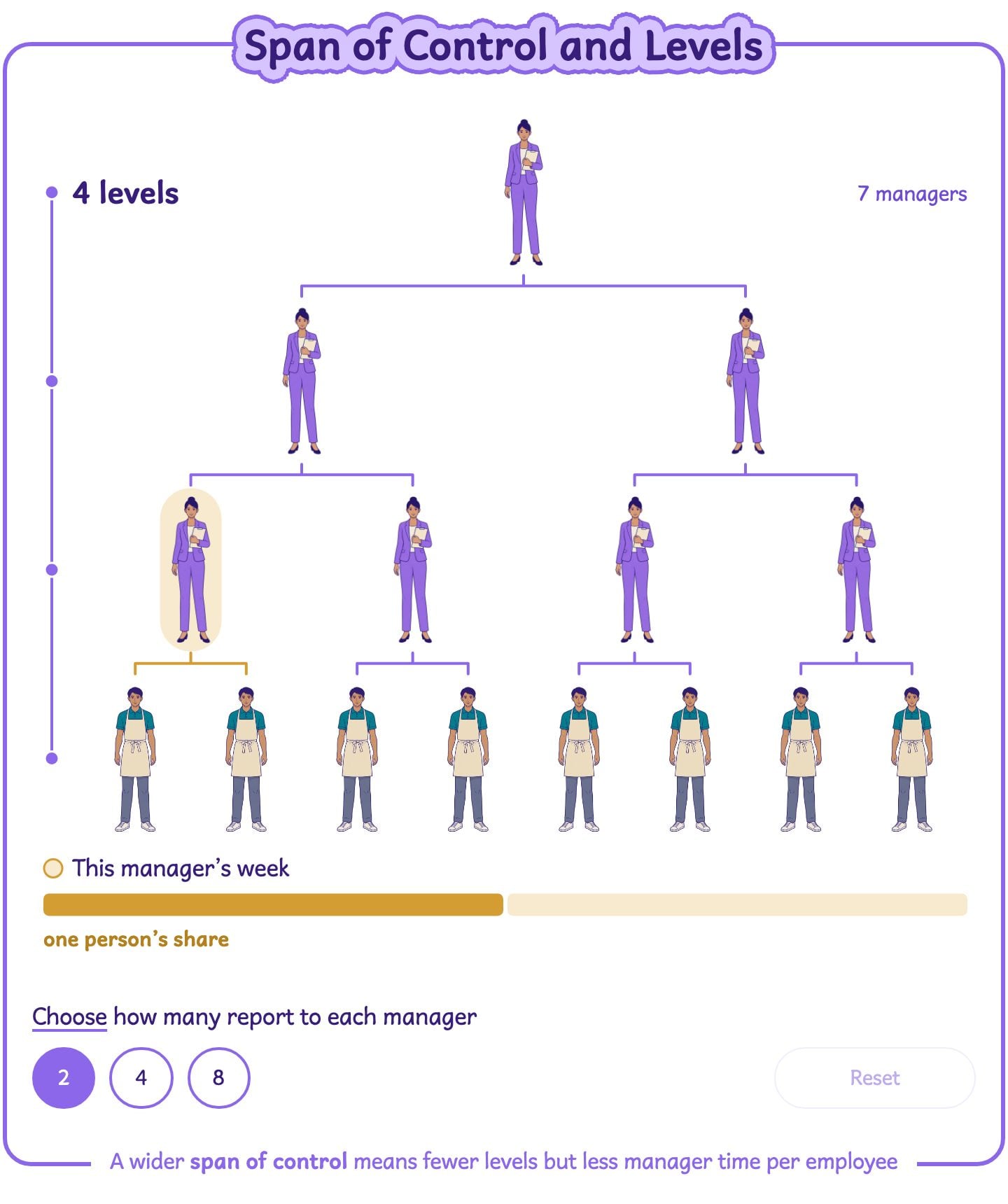
Widen the span of control and watch management levels fall as each manager has less time per employee.
The chain of command shows the line of authority through the business
Chain of command: the line of authority through which instructions pass from senior managers down through the organisation and responsibility passes back upwards.
- Long chain: advantage: several management levels can make authority and responsibility clearer because employees know which level they report through.
- Disadvantage: messages and decisions pass through more people, so communication can be slower and more likely to be changed or delayed.
- Short chain: advantage: fewer management levels can make communication faster and more direct.
- Disadvantage: managers may have to deal directly with a wider range of issues and employees, which can increase the demands on each manager.
Span of control tells you how many people a manager directly supervises; chain of command tells you how authority and responsibility connect different levels of the business.
Compliance and accountability depend on clear responsibility
Compliance: following the rules, procedures and legal requirements that apply to the employee's work.
Accountability: being answerable for decisions, actions or results to someone with authority in the organisation.
- A clear chain of command supports compliance because employees know whose instructions they should follow and which manager is responsible for checking that procedures are followed.
- It also supports accountability because responsibility can be traced through the structure, while the span of control affects how closely a manager can oversee the employees for whom they are accountable.
- Read span of control across from one manager to the employees who report directly to them.
- Read the chain of command vertically through the levels of authority.
- Do not treat the two terms as interchangeable: one is about the number of direct reports and the other is about the line of authority.
- What is span of control?
- Give one advantage and one disadvantage of a wide span of control.
- Give one advantage and one disadvantage of a long chain of command.
- What is the difference between compliance and accountability?
- How can a clear chain of command support accountability?