Primary research collects fresh information for the business's own question
Definition
Primary research: new information collected first-hand by or for a business for a specific research purpose.
- Because the information is collected for the exact decision being made, it can be current and highly relevant. The trade-off is that collecting it takes time and usually costs more than using existing information.
- Edexcel requires five methods: surveys, questionnaires, focus groups, observation and test marketing. The best method depends on whether the business needs numbers, detailed reasons or evidence of actual behaviour.
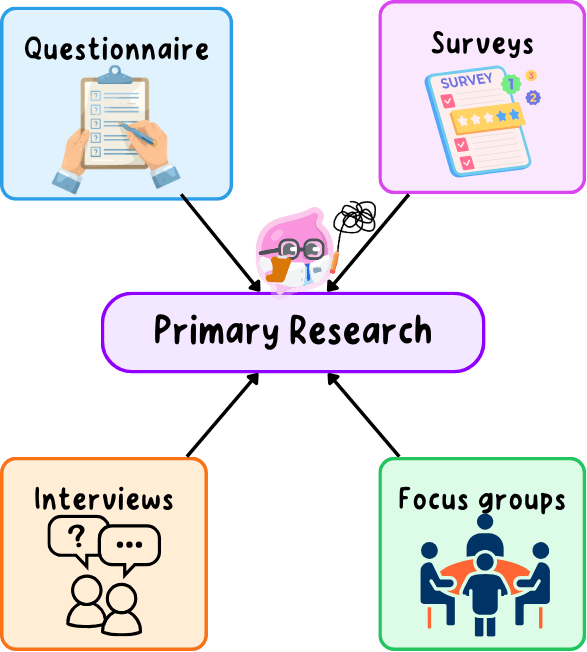
Surveys and questionnaires can collect comparable answers from many people
- Survey: asking a sample of people questions, for example face to face, by phone or online. A questionnaire is a fixed written set of questions, usually completed on paper or online.
- Advantages: both can reach relatively large samples and ask directly about the business's decision. Standard questions also make answers easier to count and compare.
- Disadvantages: response rates can be low, respondents may not answer honestly, and badly worded or leading questions can produce misleading results. Face-to-face surveys can also be slow and expensive.
Example
A gym could send members a short questionnaire asking which evening classes they would attend, then use the results to decide which classes justify paying an instructor.
Focus groups trade sample size for depth
- Focus group: a small group of people discussing a product, idea or marketing decision with a researcher who can explore their reasons in detail.
- Advantages: discussion can reveal why customers react as they do and uncover ideas the business did not think to ask about. Disadvantages: the group is small, dominant participants can influence others, and the findings may not represent the wider market.
Observation and test marketing show what customers actually do
- Observation: watching and recording customer behaviour. It provides evidence of real actions, such as which display attracts shoppers, but it usually cannot explain why the behaviour occurred.
- Test marketing: selling a product in a limited area or a small number of outlets before a full launch. Real sales provide a stronger test of demand and allow problems to be corrected before a large rollout.
- Disadvantages: test marketing delays a full launch, the test area may not represent the wider market, and competitors can see the idea before the business expands it.
Common Mistake
- Do not assume that what customers say they would buy is the same as what they will actually buy.
- Observation and test marketing can help check stated opinions against real behaviour.
The research question should determine the method
- A business wanting a broad measure of demand may favour a survey or questionnaire, while one trying to understand reactions in depth may favour a focus group. If it needs evidence of behaviour, observation or test marketing is stronger.
Exam technique
- Choose the method from the information the business needs, not from a memorised favourite.
- Give a relevant advantage, then link it to the business's decision.
- Balance it with a limitation such as cost, time, sample quality or whether stated answers reflect real behaviour.
Self review
- What is primary research?
- What is the difference between a survey and a questionnaire?
- Give one advantage and one disadvantage of a focus group.
- What can observation show that a questionnaire may not?
- Why might a business test market a product before a full launch?