2.5.1 Organisational charts
Organisational charts show the shape of a business and where decisions are made
Organisational chart: a diagram showing the structure of a business, including its different roles and levels of authority.
- An organisational chart helps you see how many management levels a business has and whether important decisions are kept at the top or shared more widely.
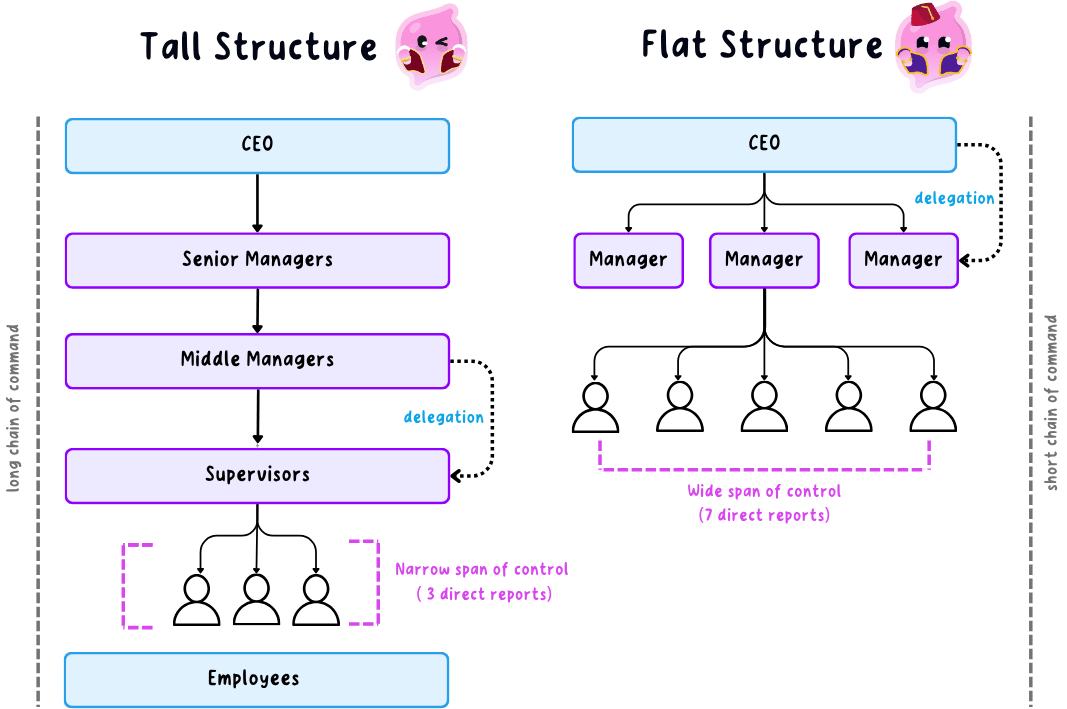
Hierarchical structures have more management levels than flat structures
Hierarchical structure: an organisational structure with several levels of management between senior managers and employees lower in the organisation.
Flat structure: an organisational structure with relatively few levels of management.
- Hierarchical structure: several management levels can create clear authority and more stages for promotion.
- Advantage: employees can see who has authority and may have a clearer route for career progression.
- Disadvantage: information and decisions may take longer to pass through the organisation and extra management layers increase cost.
- Flat structure: fewer management levels can make communication more direct and reduce management costs.
- Advantage: communication can be faster and employees may have more direct access to managers.
- Disadvantage: managers may have more people and issues to deal with and there are fewer management levels available for promotion.
Centralisation and decentralisation describe where decisions are made
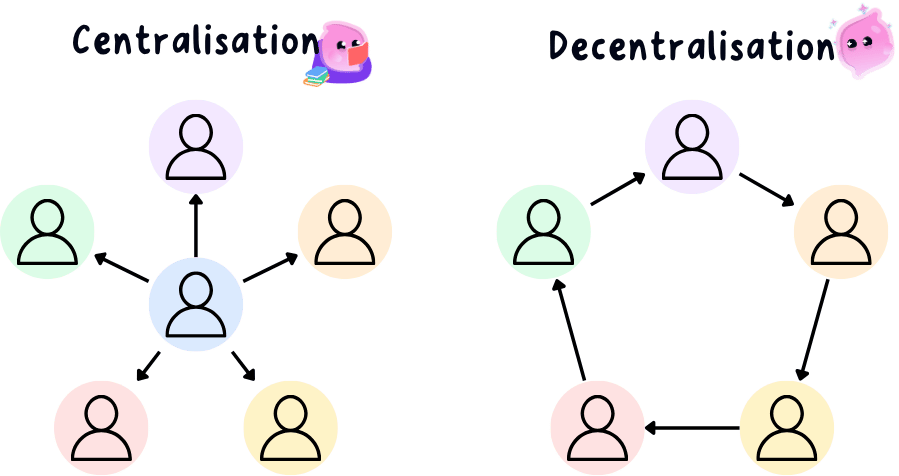
Centralised: important decisions are mainly made by senior managers at the top of the organisation.
Decentralised: decision-making authority is shared with managers or employees lower down or in different parts of the organisation.
- Centralised decision-making: senior managers keep important decisions at the top of the organisation.
- Advantage: the business can keep tighter control and make more consistent decisions across departments or locations.
- Disadvantage: local managers may have to wait for approval and have less freedom to respond quickly to local conditions.
- Decentralised decision-making: decision-making authority is shared with people closer to particular departments, customers or locations.
- Advantage: local decisions can be faster and can use the knowledge of managers closer to customers or operations.
- Disadvantage: different parts of the business may make less consistent decisions and senior managers give up some direct control.
- Use the number of management levels to identify whether the structure is hierarchical or flat.
- Use where important decisions are made to identify whether the business is centralised or decentralised.
- Treat these as separate judgements because the shape of the chart does not by itself tell you where decisions are made.
- What does an organisational chart show?
- Give one advantage and one disadvantage of a hierarchical structure.
- Give one advantage and one disadvantage of a flat structure.
- Give one advantage and one disadvantage of centralised decision-making.
- Why might a business decentralise some decisions to local managers?
2.5.2a Span of control and chain of command
Span of control and chain of command shape supervision and accountability
- An organisational structure affects how many employees each manager supervises and how authority passes through the business, helping show who must follow instructions and who is responsible for results.
Span of control is the number of people reporting directly to one manager
Span of control: the number of employees for whom a manager has direct responsibility.
- Wide span: advantage: one manager is responsible for many employees, so fewer managers may be needed and employees can have more independence.
- Disadvantage: the manager has less time to supervise, support and monitor each employee closely.
- Narrow span: advantage: one manager is responsible for relatively few employees, making close supervision and individual support easier.
- Disadvantage: the business may need more managers and employees may have less freedom in how they carry out their work.
A wide span is like one coach looking after a large squad, while a narrow span gives each person more individual attention from the manager.
The chain of command shows the line of authority through the business
Chain of command: the line of authority through which instructions pass from senior managers down through the organisation and responsibility passes back upwards.
- Long chain: advantage: several management levels can make authority and responsibility clearer because employees know which level they report through.
- Disadvantage: messages and decisions pass through more people, so communication can be slower and more likely to be changed or delayed.
- Short chain: advantage: fewer management levels can make communication faster and more direct.
- Disadvantage: managers may have to deal directly with a wider range of issues and employees, which can increase the demands on each manager.
Span of control tells you how many people a manager directly supervises; chain of command tells you how authority and responsibility connect different levels of the business.
Compliance and accountability depend on clear responsibility
Compliance: following the rules, procedures and legal requirements that apply to the employee's work.
Accountability: being answerable for decisions, actions or results to someone with authority in the organisation.
- A clear chain of command supports compliance because employees know whose instructions they should follow and which manager is responsible for checking that procedures are followed.
- It also supports accountability because responsibility can be traced through the structure, while the span of control affects how closely a manager can oversee the employees for whom they are accountable.
- Read span of control across from one manager to the employees who report directly to them.
- Read the chain of command vertically through the levels of authority.
- Do not treat the two terms as interchangeable: one is about the number of direct reports and the other is about the line of authority.
- What is span of control?
- Give one advantage and one disadvantage of a wide span of control.
- Give one advantage and one disadvantage of a long chain of command.
- What is the difference between compliance and accountability?
- How can a clear chain of command support accountability?
2.5.2b Delegation
Delegation passes work and authority down while accountability remains with the manager
Delegation: passing a task and the authority needed to carry it out from a manager to a more junior employee.
- The employee becomes responsible for carrying out the delegated task and must still follow the business's rules and procedures, but the manager remains accountable for the final result.
A restaurant manager delegates stock ordering to a trusted supervisor, giving the supervisor authority to place the order while remaining accountable if stock is ordered badly.
Delegation can save management time and develop employees
- Delegating suitable tasks frees the manager to concentrate on decisions or work that needs their experience, while the employee can deal with routine issues without waiting for approval.
- Employees can gain skills, confidence and experience from taking responsibility. Feeling trusted can also improve motivation, although this depends on the employee being ready for the task and receiving enough support.
Good delegation gives an employee real authority to complete an appropriate task while the manager keeps overall accountability.
Poor delegation can create mistakes or pressure
- A task can be done badly if it is given to an employee who lacks the skills, information or authority needed to complete it, and the manager still has to answer for the result.
- Delegation can also demotivate if it feels like extra work without support or if the manager keeps interfering and never gives the employee enough authority to make the delegated decisions.
Do not say that delegation transfers the manager's accountability: the task and some authority move down, but the manager remains answerable for the outcome.
Effective delegation matches the task, employee and level of authority
- The manager needs to choose a capable employee, explain the expected result, give enough authority to complete the task and provide support without taking control of the task back.
- Routine work can often be delegated more easily than high-risk decisions, so the amount of supervision needed depends on the difficulty and consequences of the task.
- What is delegation?
- Who remains accountable after a task is delegated?
- Give one benefit of delegation to a manager.
- Give one possible benefit of delegation to an employee.
- What can go wrong if a manager delegates a task without enough authority or support?
2.5.3a Human resources function
Human resources manages people from workforce planning to leaving the business
Human resources (HR): the functional area responsible for planning, recruiting, developing and managing the people who work for a business.
- HR supports the business throughout an employee's working life, from deciding what staff are needed to recruitment, training, welfare, employment issues and the way employment eventually ends.
Recruitment, training and health and safety have already been developed earlier in Unit 2. Here, focus on how these activities fit within the wider HR function, alongside workforce planning, staff welfare, employment issues, industrial relations and the way employment ends.
Workforce planning and recruitment put the right people in the right roles
- Workforce planning: HR estimates how many employees the business needs and which skills will be required now and in the future, helping the firm avoid being short of important skills or paying for more staff than it needs.
- Recruitment and selection: HR helps attract suitable applicants and choose people who match the requirements of the vacancy, using the recruitment processes covered earlier in Unit 2.
Training, health and safety and welfare help employees work effectively
- Training: HR helps employees gain the skills and knowledge needed for their roles and for changes in the business, which can improve performance and help staff work safely.
- Health and safety and staff welfare: HR helps the business meet workplace safety requirements and supports employee wellbeing through suitable procedures, working conditions and support when problems arise.
When a retailer opens a new branch, HR can forecast the number and skills of employees needed, recruit them, arrange induction and training, and make sure workplace procedures support safety and staff welfare.
Employment issues and industrial relations shape the ongoing relationship with staff
- Employment issues: HR deals with matters such as contracts, pay, working hours and holiday entitlement so that the business and employees understand the terms of employment.
- Industrial relations: HR manages relationships between the business and employees, including dealings with trade unions where relevant and discussions about issues such as pay and working conditions.
- Disciplinary and grievance procedures: disciplinary procedures give the business a fair process for dealing with employee conduct or performance problems, while grievance procedures give employees a route for raising complaints about work.
Dismissal and redundancy end employment for different reasons
Dismissal: when an employer ends an employee's employment, for example because of conduct or capability.
Unfair dismissal: a dismissal that is not legally fair because the employer lacks a fair reason or does not follow the required fair process.
Redundancy: when employment ends because the job or role is no longer required rather than because the employee has done something wrong.
- HR needs fair procedures when employment ends. Poorly handled dismissal or redundancy can create legal costs, damage trust among remaining employees and harm the business's reputation.
- The distinction matters because dismissal concerns the employee's employment being ended by the employer, while redundancy arises because the business no longer needs the role itself.
- What is workforce planning?
- How does HR support recruitment, training and staff welfare?
- What is the difference between a disciplinary procedure and a grievance procedure?
- What is industrial relations?
- What is the difference between dismissal, unfair dismissal and redundancy?
2.5.3b Finance function
The finance function manages payments, cash planning, budgets and financial records
Finance function: the functional area responsible for managing a business's money and financial records.
- Finance keeps track of money coming into and leaving the business and provides financial information that managers can use when making decisions.
Cash-flow forecasting, budgets and accounting are developed in greater detail in Unit 3. Here, focus on recognising them as responsibilities of the finance function and understanding the purpose each one serves in managing the business's money.
Wages, salaries and cash-flow forecasts keep payments under control
- Wages and salaries: finance helps make sure employees are paid the correct amount at the correct time and that accurate payroll records are kept.
- Cash-flow forecasting: finance predicts future cash inflows and outflows so the business can identify periods when it may not have enough cash and plan how to deal with the shortage before payments are due.
A cash-flow forecast shows that a retailer will have a temporary cash shortage before a large supplier payment, giving the finance team time to delay another purchase or arrange short-term finance.
Budgets and accounting help managers control and understand the firm's finances
- Budgets: finance sets targets for income or spending and compares actual results with those targets, helping managers control costs and see where performance differs from the plan.
- Accounting: finance records the business's financial transactions and prepares financial information so managers and other users can understand how the business is performing and what its financial position is.
- What is the finance function responsible for?
- Why does a business prepare a cash-flow forecast?
- How can a budget help a manager control spending?
- What does the finance function do with wages and salaries?
- Why does a business need accurate accounting records?
2.5.3c Marketing function
Marketing turns customer needs into products customers can find, value and buy
Marketing function: the functional area responsible for understanding customer needs and helping the business develop, price, promote and distribute products to meet those needs.
- Marketing links the business with its customers. It gathers information about the market, helps shape what is offered and makes sure potential customers know about and can obtain the product.
The marketing activities introduced here are developed in greater detail in Unit 4. Here, focus on recognising each responsibility and seeing how they fit together within the marketing function.
Research, product planning and pricing shape what the business offers
- Market research: marketing gathers information about customer needs, demand and competitors so that decisions are based on evidence rather than guesswork.
- Product planning: marketing helps decide what products to offer and how features, ranges or packaging should change as customer needs and market conditions change.
- Pricing: marketing helps set a price that customers are willing to pay while supporting the objectives and financial needs of the business.
Before launching a new snack, marketing can research what customers want, help choose the product and packaging, and recommend a price that fits the target market.
Sales promotion, advertising and public relations communicate with the market
- Sales promotion: short-term incentives such as discounts or special offers can encourage customers to buy now or try a product.
- Advertising: paid communication can make customers aware of a product, give them information and persuade the target market to consider buying it.
- Public relations: marketing manages communication intended to build or protect the public image of the business, including its response when reputation is at risk.
Sales promotion encourages an immediate response, advertising promotes products through paid messages, and public relations focuses on the wider image and reputation of the business.
Customer service, packaging and distribution affect the buying experience
- Customer service: support before, during and after a sale can solve problems, increase satisfaction and encourage customers to return.
- Packaging: packaging protects the product, carries useful information and helps present the product and brand to customers.
- Distribution: marketing helps decide how the product reaches places where customers can buy it, such as shops, intermediaries or direct delivery.
- Why does the marketing function carry out market research?
- How do product planning and pricing help marketing meet customer needs?
- What is the difference between sales promotion and advertising?
- What is the purpose of public relations?
- How can customer service, packaging or distribution affect whether customers buy again?
2.5.3d Production function
The production function makes products and manages design, quality and stock
Production function: the functional area responsible for making the business's products and managing the resources and processes needed to produce them.
- Production turns inputs such as materials, labour and equipment into the products the business plans to sell, while also helping ensure the product is suitable, available and made to the required standard.
Production methods, quality, stock control and other operational decisions are developed in greater detail in Unit 5. Here, focus on the production function's responsibilities: making products, helping design new ones, controlling quality and managing stock.
Manufacturing and product design determine what is made
- Manufacturing the product: production organises workers, materials and equipment so the required quantity of goods is made at the time the business needs it.
- Designing new products: production helps turn new product ideas into something that can be made reliably, working with other functions so the design meets customer needs and is practical to produce.
A bakery's production team makes the daily bread and tests how a new recipe can be produced consistently before the business adds it to the range.
Quality control and stock control keep production reliable
- Quality control: output is checked against the required standard so faults can be identified before unsuitable products reach customers.
- Stock control: production monitors supplies of materials and finished products so there is enough stock for operations and sales without holding unnecessary amounts.
- What is the production function responsible for?
- What does manufacturing the product involve?
- How can the production function contribute to designing a new product?
- What is quality control?
- Why does the production function need stock control?
