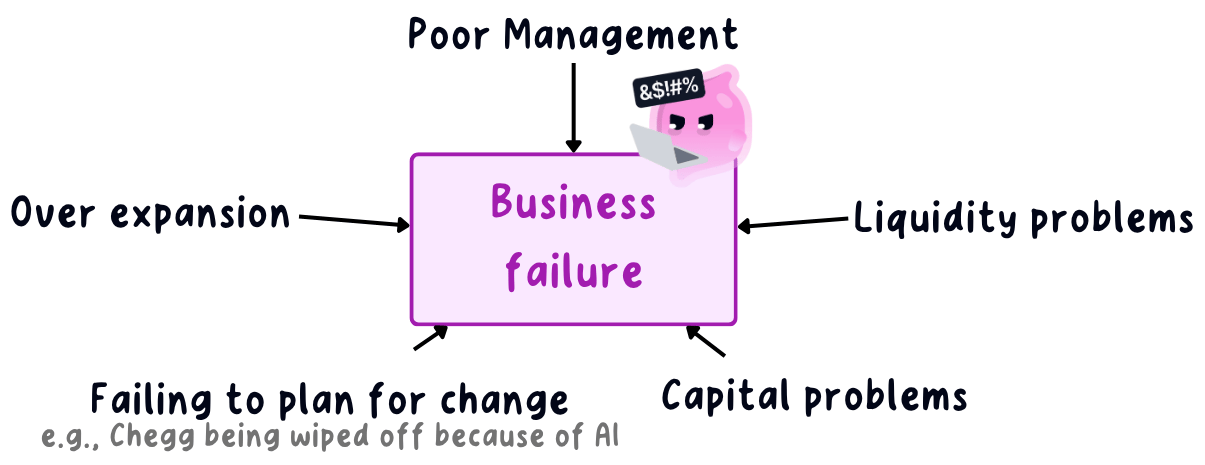
Poor management: the cause that sits behind most of the others
- Most owners start a business because they are good at the trade, not because they can manage, so an excellent chef may have no idea how to read accounts or control inventories.
- Pricing errors: a manager who sets a price of £4 on a meal that costs £4.60 in ingredients, wages and overheads loses money on every extra customer served.
- Weak cost control: costs that are never checked drift upward, and a firm paying £900 a month for a van it barely uses is spending profit it will need later.
- Poor inventory control: holding too many inventories ties up cash in goods sitting on shelves, while holding too few means customers are turned away and go to a rival.
- No records and no monitoring: without figures the owner cannot tell which products lose money, so the loss-making lines are never dropped.
- Poor people management: staff who are untrained and unmotivated give bad service, so customers stop returning and the wage bill buys nothing.
Definition
Liquidity: The ability of a business to pay its short-term debts as they fall due, which depends on having enough cash rather than on making a profit.
Liquidity problems: running out of cash while still making a profit
- The gap opens because money goes out before it comes in: wages are paid weekly and suppliers within 30 days, while the trade receivables, meaning the customers who were given credit, may take 60 days to pay.
- Cash is also locked inside inventories, so a shop holding £30,000 of unsold winter coats has spent the money but earned nothing back yet.
- One large customer paying late, or going bust owing £25,000, can therefore sink a firm whose order book is full.
- The chain to closure is short: the firm misses a payment, the supplier stops delivering, production halts, customers leave, and the bank withdraws the overdraft.
- How the risk is reduced: keep a cash-flow forecast so a shortage is seen months ahead and an overdraft is agreed before it is needed.
- Chase the trade receivables, negotiate longer credit from suppliers, and hold fewer inventories, since cash in the bank is more use than goods in the storeroom.
Common Mistake
- Profit and cash are not the same, and a business that has made £40,000 of profit on credit sales can still be unable to pay Friday's wages.
- Falling sales and unpaid bills are signs that a business is in trouble, while poor management and lack of finance are the causes that produced them.
- Making a loss does not close a business immediately; running out of cash does.
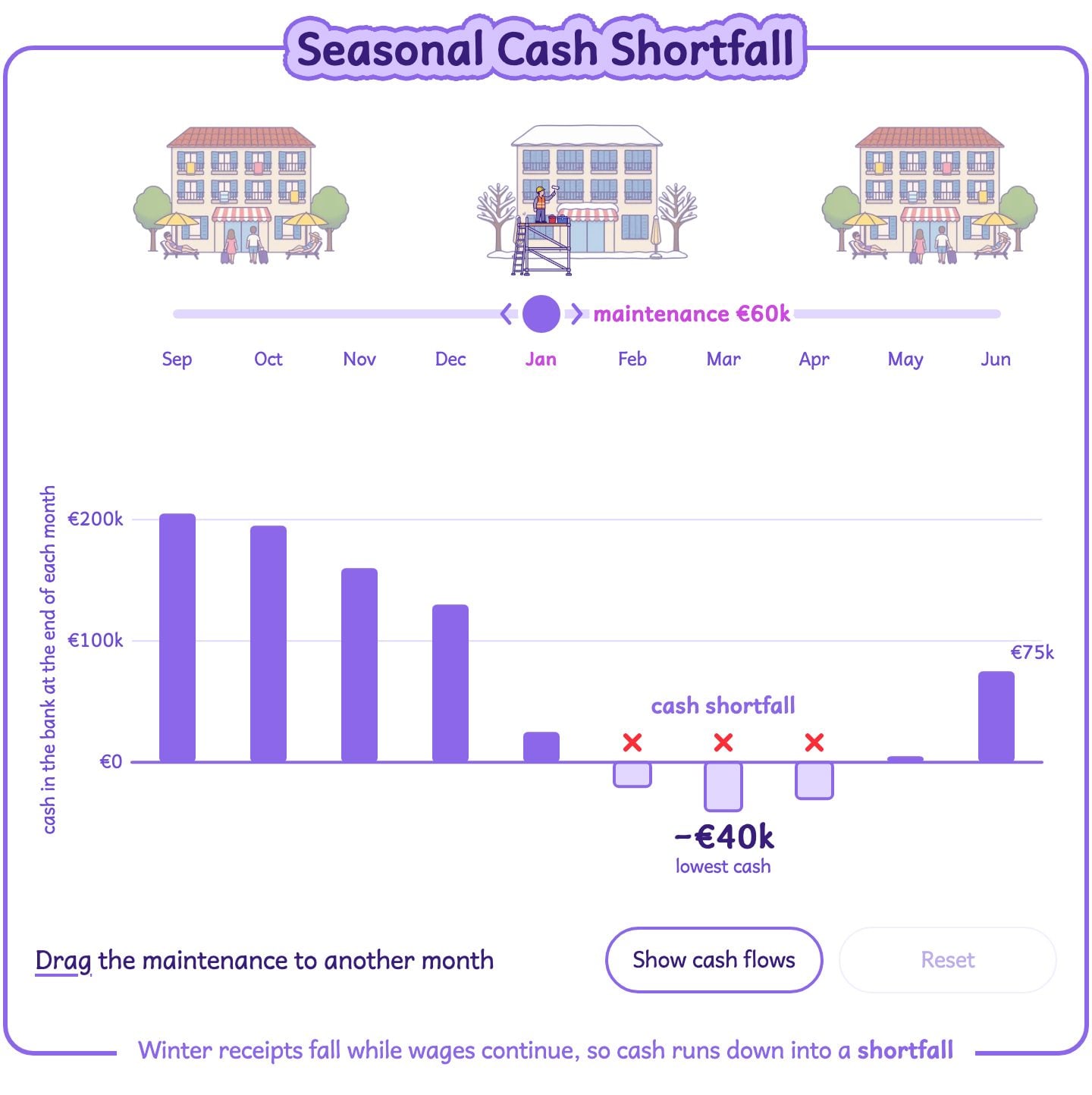
Follow the months as receipts fall and see a business run short of cash while wages are still due.
Lack of finance: too little capital to survive the slow months
- Many owners raise just enough to open the doors and nothing to trade on, so the first quiet month has to be paid for out of takings that are not there.
- Without capital the firm cannot afford the things that would rescue it, such as advertising, a better location or a machine that would cut costs.
- Small firms also have fewer sources to turn to, because a sole trader cannot sell shares to the public and has no assets to offer a bank as security.
- Borrowing too much creates the opposite danger, since interest has to be paid in months when sales are poor, and a rise in interest rates increases the payment on a variable-rate loan.
- How the risk is reduced: build a reserve into the start-up figure to cover several months of costs, and match the source of finance to the purpose, using a long-term loan for equipment and an overdraft only for short gaps.
Failing to plan for change in the business environment
- New technology: a business built around one way of delivering a product is destroyed when a cheaper way appears, and the firms that sold film cameras or DVD rentals had years of warning they did not act on.
- New competition: a discount chain opening nearby takes the price-sensitive customers, and a small shop that neither cuts costs nor offers something different loses the sales permanently.
- Changing tastes: demand moves towards healthier food or online shopping, and a firm still selling what sold well ten years ago watches its market shrink.
- Economic and legal change: in a recession consumers cut spending on non-essentials first, while a rise in the minimum wage or in energy prices adds costs a firm with thin margins cannot pass on.
- The failure is rarely the change itself but the lack of a response, since firms that carry out market research, update the product and control costs survive the same conditions.
Example
- Blockbuster rented DVDs from thousands of rental stores and collapsed as customers moved to postal rental and then to streaming services such as Netflix.
- Its costs were tied to shop leases and staff, so falling visits left it paying for space customers no longer used.
- The technology was visible for years, which makes this a failure to act rather than bad luck.
Over-expansion: growing faster than the business can support
- Opening several sites at once uses up cash on fit-outs, inventories and wages before any of them has built a customer base.
- One weak site can drag down the profitable ones, because the loss it makes is paid for out of the money the others earn.
- Managers are stretched too thin, so quality and service slip at exactly the moment the firm most needs customers to come back.
- How the risk is reduced: keep the commitments reversible for as long as possible, because a short lease and hired equipment can be given up if a new site disappoints, while a twenty-year lease and a large loan cannot.
Why new businesses are at greater risk than established ones
- A new business has no trading record, so lenders and suppliers ask for cash up front or charge a higher rate to cover the risk.
- It has no reserve of past profits, so one bad month has to be paid for out of money the business does not yet have.
- The owner is learning the job while trading, so mistakes in pricing, inventories and staffing are more likely than in a firm that has run for years.
- There is no established customer base, so revenue is unpredictable and the owner cannot forecast takings with any confidence.
Exam technique
- "It ran out of money" is three different causes rolled into one, so say whether the firm lacked capital at the start, lacked cash to pay a bill, or was making a loss on every sale.
- Naming an external event such as a recession is not an explanation on its own, so trace how it reached this firm's sales, costs or cash.
Self review
- Explain how a profitable business can be forced to close.
- Give three management mistakes that can cause a business to fail.
- Name two changes in the business environment and say how each can damage a firm.
- Why can expanding too quickly cause failure?
- Give two ways an owner can reduce the risk of running out of cash.