The six forms at a glance
- The private sector uses six forms of organisation: sole trader, partnership, private limited company (Ltd), public limited company (plc), franchise and joint venture, and the choice turns on who owns the business, whether the owners have limited liability and how much capital the form can raise.
| Form | Owners | Liability | Finance | Main drawback |
|---|---|---|---|---|
| Sole trader | One person | Unlimited | Savings, bank loan | Personal assets at risk |
| Partnership | 2 to 20 partners | Unlimited | Partners' capital, loans | Disputes, shared profit |
| Private limited (Ltd) | Private shareholders | Limited | Shares sold privately | No sales to the public |
| Public limited (plc) | Public shareholders | Limited | Shares on an exchange | Takeover risk, disclosure |
| Franchise | Franchisee owns outlet | Depends on legal form | Own capital plus loan | Royalties, little freedom |
| Joint venture | Two firms, one project | Depends on legal form | Both parents pay in | Shared profit and control |
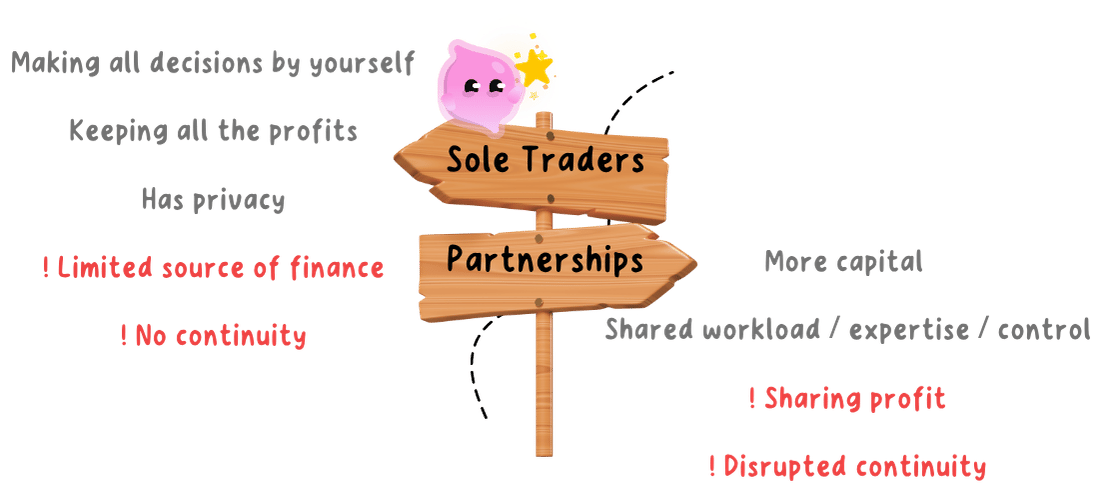
Sole trader: A business owned and controlled by one person, who keeps all the profit and is personally responsible for all the debts.
Sole traders: one owner, one set of shoulders
- Setting up needs almost no formality, because the owner registers as self-employed and can be trading the same week, which is why plumbers, hairdressers and taxi drivers use this form.
- Full control is the main attraction, because the owner sets prices, hours and products alone, can change them the same day and keeps all the profit.
- The business has no separate legal identity, so it ends in law when the owner dies or retires, and illness or a holiday usually stops it trading and earning.
- Finance is the tightest limit on a sole trader, because the only sources are the owner's savings, profit put back into the business and what a bank will lend one individual, so expansion is slow and a large order can be impossible to fund.
Partnership: A business owned by two or more people who share the capital, the decisions, the profits and the debts.
Partnerships: shared capital, shared debts
- A partnership agreement, or deed of partnership, records how much capital each partner put in, how profits are divided and who may make which decisions.
- Without one the law assumes profits are split equally, which causes disputes when one partner has invested £60,000 and another £10,000.
- Each partner can be pursued for the whole firm's debts rather than only their own share, so one partner's mistake can cost the others their personal savings.
- More capital comes in than one owner could raise alone, partners cover each other's holidays and illness, and they can specialise, so one partner handles clients while another handles the accounts.
Private limited company (Ltd): An incorporated business whose shares are sold privately to a chosen group of people and cannot be advertised to the general public.
Private limited companies: shares sold to an invited circle
- Shares are held by a small, known group, often family, friends or senior employees, and they cannot be advertised or sold on a stock exchange without the other shareholders agreeing.
- Limited liability is the reason owners incorporate, because shareholders risk only what they paid for their shares, so a family can borrow £150,000 for a second shop without the family home being at stake.
- The company is a separate legal person, so it carries on trading when a shareholder dies or sells out, though its accounts must be filed publicly for competitors to inspect.
- Do not write that a private limited company cannot sell shares, because it can sell them privately to people the existing shareholders approve, just not to the general public.
- The word limited describes the owners' liability and not the size of the firm, so a private limited company can still employ thousands of people.
Public limited company (plc): An incorporated business whose shares can be advertised and sold to the general public, usually by listing them on a stock exchange.
Public limited companies: shares anyone can buy
- A plc may advertise its shares to the general public, and the first public sale, called flotation, raises a large block of capital in one go.
- Ownership is separated from control, because thousands of shareholders own the company while a board of directors runs it day to day.
- Borrowing is also cheaper, because banks treat a large audited company as lower risk and lend at lower interest rates.
- The price of that access is high, because flotation itself is expensive, the published accounts let rivals read the figures, and anyone can buy shares, so the original owners can be outvoted or the whole company taken over.
- Greggs plc runs more than 2,000 shops and its shares trade on the London Stock Exchange.
- A weak quarter is reported in the press and punished by a falling share price, a pressure the owners of a private limited company never face.
Franchise: An arrangement in which one business pays another for the right to trade under its brand name and use its established business format.
Franchises: renting a business that already works
- The franchisor owns the brand and the business format, while the franchisee pays a large one-off fee and then a royalty on sales for the right to trade under it in one area, which is how most McDonald's restaurants worldwide are run.
- An established brand, central training and national advertising bring customers from the first day, which a single new outlet could never afford alone, though approved supplies often cost more than a local wholesaler would charge.
- For the franchisor it allows fast expansion using other people's money and motivated owner-managers, though the profit is shared and one careless franchisee can damage the brand everywhere.
Joint venture: An agreement in which two or more businesses set up a shared project, pooling the capital, the risk and the profit while staying separate companies.
Joint ventures: two businesses, one shared project
- Each business puts in agreed capital, staff and expertise, and the profits and losses of the project are divided in the same proportions.
- Costs and risk are shared, so a £10m development neither firm would fund alone becomes affordable, and one partner's technology can be joined to the other's manufacturing capacity.
- Local knowledge speeds entry to a foreign market, and some countries require a local partner before a foreign firm may trade there at all.
- Neither partner can overrule the other, so disagreements over pricing or timing stall the project, and sharing designs with a firm that may later compete gives away an advantage that took years to build.
- A common error is writing that a franchisee owns the business, when the franchisee owns only their outlet and pays to use somebody else's brand under somebody else's rules.
- Answer for the party the question names, because faster expansion is an advantage to the franchisor and not to the franchisee.
- Do not describe a joint venture as two firms becoming one, because the firms stay separate and only the project is shared.
- Give two advantages and two drawbacks of being a sole trader.
- What does a deed of partnership set out, and what happens if a partnership has none?
- State two ways a private limited company differs from a public limited company.
- Name two payments a franchisee makes to a franchisor.
- Why might two firms form a joint venture rather than merging?