Sustainable development: using resources at a rate that can continue
Definition
Sustainable development: Meeting the needs of people today without using up the resources that future generations will need.
- The test for a business is whether it could carry on doing what it does for another hundred years, or whether it is using something up that will not come back.
- That makes it a commercial question as well as an environmental one, because a fishing company that empties the sea and a chocolate maker that exhausts its cocoa farms have both destroyed their own future supply.
- A business contributes to sustainable development through the ordinary decisions it already makes: how it powers its sites, what it buys, how it packs and moves goods, and what happens to the product at the end of its life.
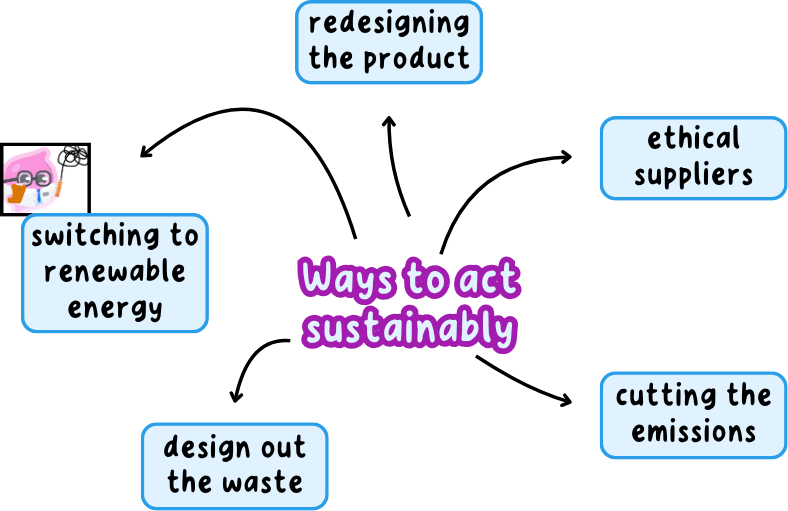
Switching to renewable energy
Definition
Renewable energy: Power generated from sources that do not run out, such as sunlight, wind and moving water.
- A firm can fit solar panels to warehouse and factory roofs, buy electricity on a green tariff, or install heat pumps in place of gas boilers.
- Emissions fall immediately, and once the equipment is paid for the electricity is close to free, which protects the business from future rises in energy prices.
- The cost is the capital outlay: panels, wiring and a roof strong enough to hold them all have to be paid for years before the savings add up to the spending.
- A small firm renting its premises often cannot do this at all, because it will not still be in the building when the savings arrive.
Cutting waste, recycling and reusing
Definition
Recycling: Processing used materials so they can be turned into new products instead of being thrown away.
- The cheapest waste is the waste never created, so firms redesign packaging to use thinner card, less plastic and fewer layers.
- Lighter packaging saves twice, because the business buys less material in the first place and pays less to dispose of it afterwards.
- Sorting card, glass, metal and plastic for recycling keeps material out of landfill and cuts the disposal charges the firm pays per tonne.
- Reuse goes further than recycling, so returnable crates, pallets, kegs and refillable containers do the same job many times over.
- The costs are staff time to sort waste properly, floor space for extra bins and storage, and delivery journeys to collect empties back.
Common Mistake
- Recycling and reusing are not the same thing: a recycled crate is broken down and remade, a reused crate is sent back and filled again.
- Reuse is usually cheaper for the firm, because no energy is bought to turn the material back into a new product.
Sustainable sourcing
Definition
Sustainable sourcing: Buying materials from suppliers who replace what they take and treat land, stocks and workers responsibly.
- Most of a firm's environmental impact sits in its supply chain rather than in its own building, so what it buys matters more than how it sweeps up.
- Sustainable sourcing means timber from replanted forests, fish from managed stocks, cotton grown with less water and palm oil from land that was not cleared rainforest.
- An ethical supplier in this sense is one that replaces what it takes, so the forest, the fishery or the soil is still able to supply the business in ten years' time.
- Unilever, which owns brands sold in around 190 countries, has committed to sourcing its agricultural raw materials this way, which pushes the standard down to thousands of farms.
- Certified materials cost more per tonne, and checking that suppliers really do what they claim takes inspections and management time the firm has to pay for.
Example
- A coffee chain moving to certified beans might pay 8p more per cup and switch to compostable lids costing another 3p.
- On 5,000 cups a day that is £550 more in costs daily, which the chain must either absorb or add to the shelf price.
Designing products to last
- A product that lasts ten years instead of three uses roughly a third of the materials and energy over the same period, so durability is itself a contribution.
- Firms support this by selling spare parts, offering repairs, designing products that can be opened and mended, and running take-back schemes that recover materials from old units.
- There is a commercial tension here, because a product that lasts longer is bought less often, so the firm has to earn from a higher price, from repairs and parts, or from the loyalty durability creates.
Cutting transport emissions
- Route-planning software and fuller loads mean the same goods are delivered in fewer journeys, which cuts emissions and the diesel bill together.
- Electric vans, rail freight for long hauls and sourcing from suppliers closer to the factory all shorten or clean up the distance a product travels.
- Electric vehicles cost more to buy and need charging points installed at the depot, and a nearer supplier may quote a higher price than a distant one.
What sustainability costs the business
- Almost every change needs money spent before any saving appears, so cash flow is tight for months or years even when the decision is sound.
- Greener inputs usually raise the cost per unit, so the firm either accepts a thinner margin or raises its price and risks losing customers to a cheaper rival.
- Changing suppliers, packaging and processes disrupts production and absorbs management time that would otherwise go on selling.
- Against that sit real returns: lower energy, material and disposal bills, customers and staff who prefer a responsible employer, and less exposure to future rules and fines.
- A large firm can spread these costs over millions of units, which is why sustainable change is usually harder for a small business than for Tesco or Unilever.
Exam technique
- Sustainable development is about whether the resource will still be there for the next generation, so a definition that only says being green or caring about the planet has not answered the question.
- Match the contribution to the firm, because water saving belongs to a laundry and route planning belongs to a delivery company.
Self review
- Define sustainable development.
- Why does lighter packaging save a business money twice over?
- What is the difference between recycling and reusing?
- Give two examples of sustainable sourcing.
- State three costs to a firm of becoming more sustainable.