Externalities: effects that land on people outside the deal
- Every business decision has two parties inside it, the firm and its customer, and an externality is an effect that spills out onto everybody else.
- Third party: anyone affected by the decision who neither made it nor bought anything, such as a household living beside a factory or a shop next to a new car park.
- Externalities matter because they do not appear in the firm's accounts: it is not billed for the harm it causes and cannot charge for the good it does, so neither one changes its decision on its own.
- The same decision usually creates costs and benefits for outsiders at once, so a new warehouse can bring jobs to a village and lorries through it in the same week.
Analogy
- An external cost is a bill the business runs up and posts through somebody else's door.
- The dust, the queue of traffic and the broken sleep are all part of what the product really cost to make, but they are paid by neighbours who bought nothing.
- Because that bill never lands on the firm's desk, nothing in its accounts tells it to stop.
External costs of business decisions
Definition
External cost: A cost of a business decision that falls on third parties rather than on the business, such as pollution suffered by nearby residents.
- Fumes from a factory chimney or a diesel fleet worsen the health of residents nearby, who pay for it in medical treatment and days off work rather than in the price of the product.
- Delivery lorries add congestion, so other road users lose time and burn extra fuel sitting in the queue the business created.
- Noise from night shifts and early deliveries breaks neighbours' sleep, which is why houses beside an industrial estate sell for less than identical houses a mile away.
- Waste dumped or sent to landfill leaves the council, and therefore local taxpayers, paying to clear and manage it.
- Chemicals discharged into a river kill fish, so a fishing business downstream loses its catch and a hotel loses guests who came for clean water.
- Closing a plant is an external cost too, because the shops, cafes and taxi drivers who served those workers lose trade even though they were never the firm's customers.
Example
- A quarry pays its owners and its 40 workers, and sells every tonne it digs.
- The village next to it gets dust on the washing, cracked lanes and lorries past the school gate, and receives nothing from the sales.
External benefits of business decisions
Definition
External benefit: A gain from a business decision enjoyed by third parties who did not pay for it, such as new roads or skills other employers can then use.
- Training paid for by one employer becomes a skill the worker keeps, so the next employer gets a trained recruit without paying for the course.
- New jobs put wages into local households, and those wages are then spent in shops, hairdressers and cafes that had nothing to do with the original decision.
- Roads, roundabouts and drainage a firm has to build to get planning permission are then used free by every other driver and business in the area.
- A big store opening on a derelict site brings footfall, so neighbouring independents gain customers and the street becomes busier and safer at night.
- When Nissan built its Sunderland plant, local component suppliers gained orders and workers gained skills that other manufacturers in the region could then hire.
- Infrastructure put in for a business park, such as faster broadband or a new bus route, is enjoyed by households along the route who paid nothing towards it.
Common Mistake
- An externality is not the same as a cost the firm has chosen not to pay.
- An unpaid supplier invoice or a repair the owner keeps putting off still belongs to the business, so it is a private cost that has only been delayed.
- The test is whether somebody outside the transaction is worse off with no way of sending the firm a bill for it.
Private costs and external costs: who actually pays
Definition
Private cost: A cost the business itself pays and records in its accounts, such as wages, materials, rent and fuel.
Private benefit: A gain the business itself receives from a decision, such as the revenue and profit earned from extra sales.
- The test is simple: if the money leaves the firm's bank account it is a private cost, and if somebody else is worse off without being paid it is an external cost.
- For a haulage firm, fuel, drivers' wages, tyres and insurance are private costs, while the delay to other drivers and the fumes along the route are external costs.
- A fine imposed on the firm is a private cost, not an external one, because the firm is the party that pays it.
- Adding the external costs to the private costs gives the full cost of the activity to everyone it touches, which is always larger than the bill the business itself sees.
- The gap between the two explains a lot of business behaviour, because a firm judging a decision only on its private costs and private benefits will happily choose the option that is worst for the people around it.
- Governments respond by turning external costs into private ones through fines, taxes and permits, so the harm finally shows up in the firm's own accounts.
Exam technique
- Name the third party who suffers or gains, because writing that pollution harms the environment does not show who bears the cost.
- Wages, materials and fines are private costs, so offering them as external costs is the single commonest error on this topic.
- An external benefit must go to somebody outside the firm, so extra profit or a better reputation for the business itself does not count.
Self review
- Who is a third party in a business transaction?
- Give two external costs of a distribution centre, naming who bears each one.
- Give two external benefits of a large factory opening in a town.
- Is a fine for polluting a river a private cost or an external cost?
- Why does a firm tend to ignore external costs when it makes a decision?
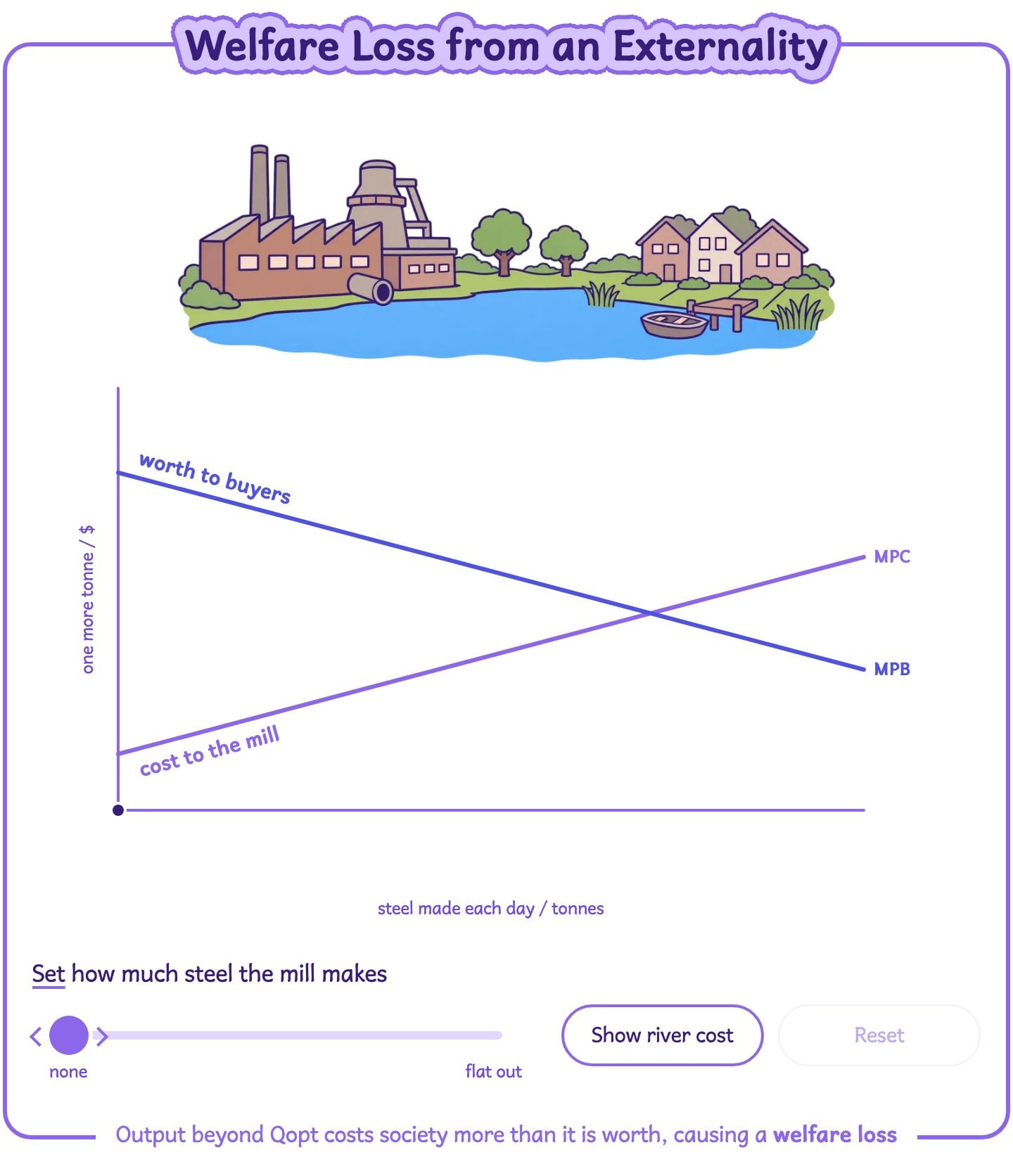
Push output beyond the social optimum and see the cost to society outweigh the benefit.