Organisational charts: who reports to whom
Organisational chart: A diagram showing the job roles in a business, the levels they sit on and who reports to whom.
- A chart is drawn as boxes joined by lines, with the most senior job at the top and the least senior at the bottom.
- Reporting lines: a line joining two boxes means the lower job takes instructions from the higher one and is accountable to it for results.
- Boxes drawn side by side at the same height carry the same rank, and the chart is normally split into functions such as marketing, finance, operations and human resources.
- The chart makes communication routes obvious, so a new employee knows who to ask for a decision instead of guessing.
Do not read a chart as a description of how the business really works, because it shows the formal structure only and hides the long-serving assistant everybody actually asks for advice.
Levels of hierarchy, chain of command and span of control
Level of hierarchy: A layer of the organisational structure containing all the jobs that carry the same rank and authority.
Chain of command: The route that instructions and authority follow from the top of the organisation down to the bottom.
Span of control: The number of subordinates who report directly to one manager.
- Count levels by counting the rows of boxes down the chart, so a business with directors, managers, supervisors and operatives has four levels of hierarchy.
- Authority and responsibility shrink at every step down, from the whole business, to one department, to one team, to one person's own tasks.
- The chain of command is those same levels seen as a route, with instructions travelling down it and sales figures and complaints travelling back up it.
- A long chain: the message is retold at every level, so detail is dropped and the shop floor acts on a version of the instruction the director never gave.
- Decisions also stall, because a supervisor who needs £500 to repair a machine waits while approval climbs four levels and comes back down, and output is lost meanwhile.
- A short chain: fewer retellings means instructions arrive faster and closer to their original wording, so a price or a rota can be changed the same day.
- Span of control is counted sideways, taking only the boxes joined to that manager by a single line and not everybody who sits somewhere below them.
- A wide span, perhaps twelve subordinates, needs fewer managers for the same workforce, so salary costs and overheads fall and more of each sale becomes profit.
- The manager has no time to check twelve people personally and is forced to delegate, which experienced staff enjoy as independence.
- The same thin supervision fails with new recruits, whose mistakes go uncorrected for weeks, so waste and customer complaints rise and the saving on managers is swallowed by the cost of poor quality.
- A narrow span, perhaps three subordinates, allows close supervision, so errors are caught the same hour and quality stays consistent, which suits dangerous or technical work.
- More managers are needed to cover the same workforce, so the wage bill rises, and experienced workers may feel watched and leave.
- There is no single correct span, because the right number depends on how skilled the staff are, how similar their tasks are and how costly a mistake would be.
- Filling shelves is identical repetitive work and can be supervised in large numbers, while designing a new product cannot.
- With 64 operatives supervised in groups of four, 64÷4=1664 \div 4 = 1664÷4=16 supervisors are needed, then four managers, then one director, giving four levels of hierarchy.
- Widening the span to eight gives 64÷8=864 \div 8 = 864÷8=8 supervisors and one director, so the structure loses a level and the chain of command shortens.
Tall and flat structures: the same staff in a different shape
- Tall structure: many levels of hierarchy, narrow spans of control and a long chain of command.
- Flat structure, also described as short: few levels of hierarchy, wide spans of control and a short chain of command.
- Shape is not size, so a 30-person family firm with five levels is taller than a 500-person retailer with three.
- Layers are expensive, because 20 managers paid £40,000 each cost £800,000 a year before the business has sold anything.
- A tall firm buys close supervision with that money, which is why an aircraft maintenance workshop accepts the extra layers when an unchecked error would be dangerous.
- Many levels also create many small promotion steps, so an ambitious employee can see a career path inside the business and stays, which cuts labour turnover.
- A flat firm saves those salaries and reacts within hours, but a manager supervising twenty people has no time left for planning, so problems are missed until they are expensive.
- With few levels there are few promotions to compete for, so ambitious staff leave for taller rivals and recruitment costs rise.
- New employees also get little day-to-day guidance, so training has to be paid for up front rather than picked up from a supervisor standing nearby.
- Aldi runs very few management layers in store, which holds staff costs down and supports its low prices, while Tesco sells a far wider range through larger stores and needs the department and area managers Aldi can do without.
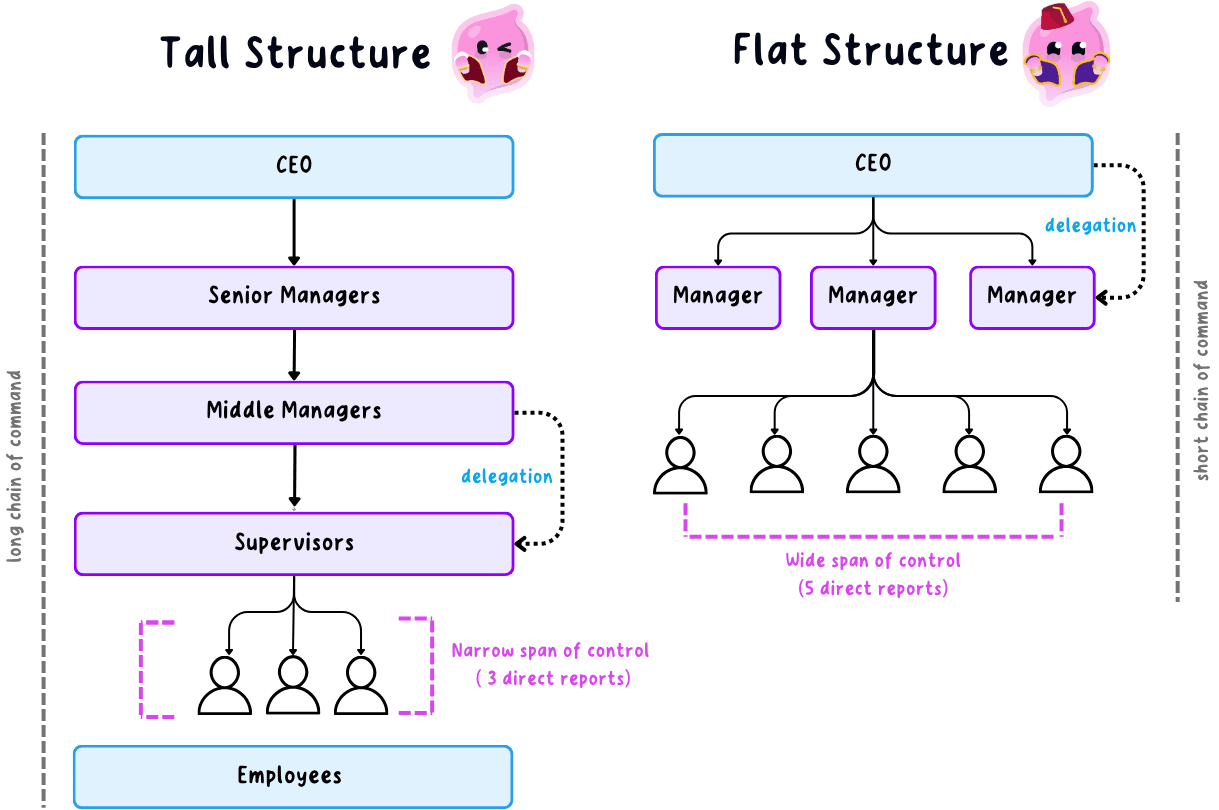
Span of control counts sideways across direct subordinates while chain of command counts downwards through the levels, and there is no such thing as a span of command.
- Name two things you can read off an organisational chart.
- A manager has nine people reporting directly to her and 40 people below her in total, so what is her span of control?
- Why do messages get distorted in a long chain of command?
- Give one benefit and one drawback of a wide span of control.
- State what makes a structure tall rather than flat.
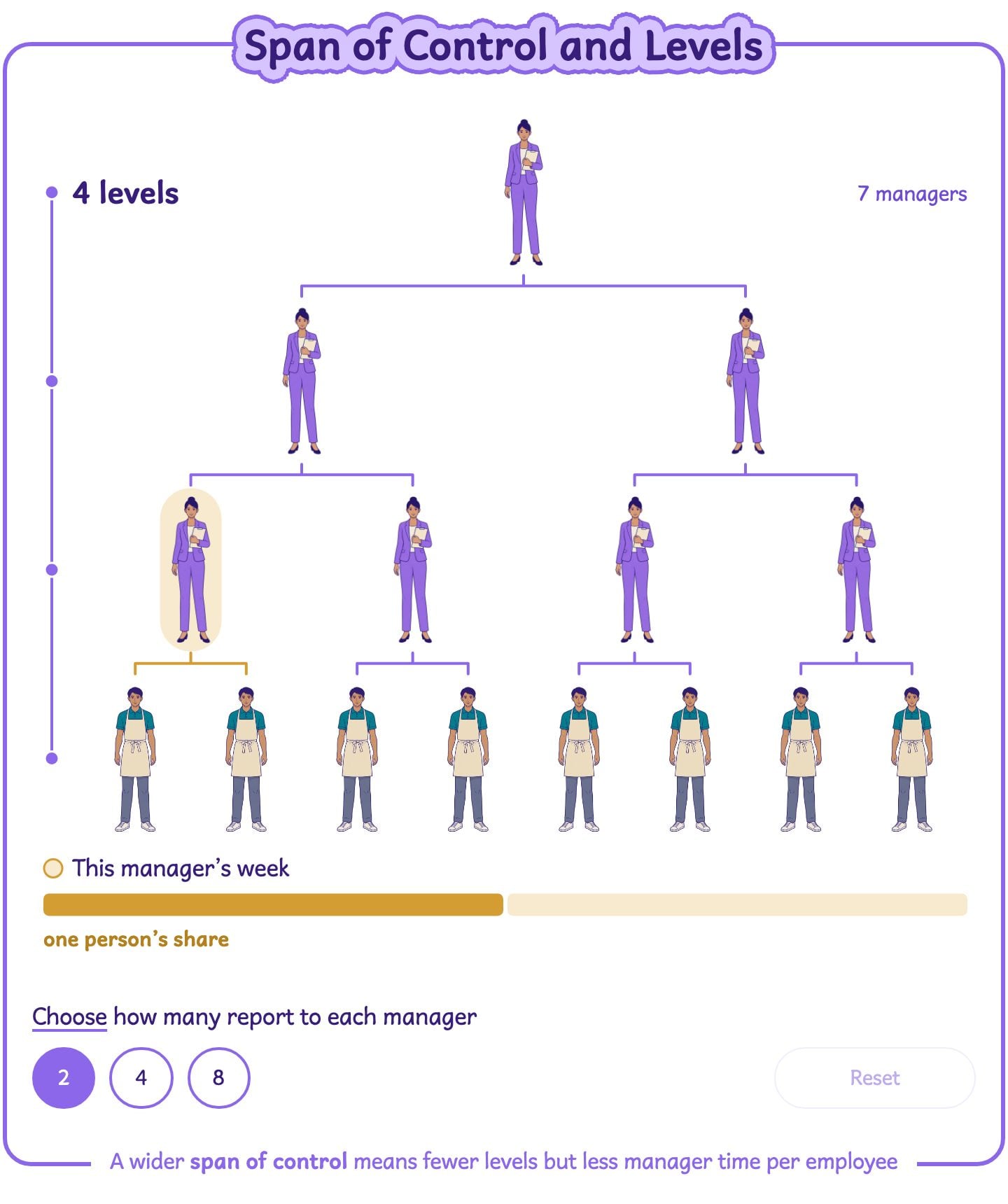
Widen the span of control and notice the levels fall but each manager has less time per employee.