Directors: setting the direction of the whole business
Director: A senior person elected or appointed to set the aims and long-term strategy of the whole business and answerable to its owners.
- In a limited company the shareholders elect a board of directors to run the business on their behalf, so the owners are not the people taking daily decisions.
- Setting aims and objectives: the board decides what the business is trying to achieve, such as raising market share by 5 per cent over three years.
- Strategic decisions: directors take the large, long-term and expensive decisions such as entering an overseas market or borrowing £10m to build a distribution centre.
- Appointing senior managers: the board chooses the managers who will run each function and sets the budgets they may spend.
- Accounting to the owners: directors report results to shareholders at the annual general meeting and can be voted out if profits disappoint, so poor performance costs them their jobs.
- In a sole trader or partnership there is no board, so the owner personally does the director's job alongside the manager's and often the supervisor's.
- Greggs runs more than 2,000 shops, and its directors decide questions such as how many new shops to open in a year and whether to sell through delivery apps.
- A shop manager could not commit money and staff across the whole chain like that, and instead decides how many people to put on the counter at lunchtime.
Manager: An employee responsible for running a department, branch or function by planning, organising and controlling the work of others.
Managers: turning strategy into departmental plans
- Planning and target setting: a sales manager told by the board to raise revenue by 10 per cent decides which products to push and gives each sales team a monthly figure to hit.
- Organising resources: the manager decides how the department's budget, machinery and staff hours are used, which is where a plan becomes something people can actually do.
- Staffing and leading: managers decide when a vacancy is filled, approve training, handle discipline and choose how to motivate the team.
- Monitoring and reporting: the manager compares actual results with the target, takes corrective action such as extra overtime, and reports upwards to a director.
Supervisor: A junior manager who directs a small team of employees day by day and reports to a manager above.
Supervisors: the link between plans and the shop floor
- Allocating daily work: the supervisor writes the rota, decides who works which machine or till and reorganises the team when someone phones in sick.
- Checking quality: because the supervisor is physically present, a fault is caught after ten units rather than after a thousand, which keeps waste and rework costs down.
- Solving immediate problems: a delivery arriving short or a customer complaining at the counter is settled on the spot instead of waiting for a manager.
- Training on the job: supervisors are often promoted from the shop floor, so they know the tasks in detail and can show a new recruit the correct method.
- The role carries limited authority, so a supervisor can move a worker between tasks but cannot set a budget, hire staff or change a price.
- A supervisor and a manager are not the same job, because the supervisor organises today's tasks while the manager plans the next quarter and controls the money.
- Team leader is an acceptable alternative name for a supervisor, but director and manager are never interchangeable.
Other employees: where the work is actually done
- Operatives, assistants, drivers, technicians and administrators sit at the bottom level and carry out the tasks that make the product or serve the customer.
- They are responsible for the quality and speed of their own work and for following the procedures they are given, but hold no authority over other employees.
- Customer-facing staff shape the reputation of the whole firm, because a shopper judges a chain by the assistant who served them and not by the board that set the strategy.
- They are also the best source of improvement ideas, since the person using a machine every day notices the wasted step that a director never sees.
Authority, responsibility and accountability: three separate ideas
Authority: The right that comes with a job to take decisions, spend the firm's money and give instructions to others.
Responsibility: The duty an employee has to complete the tasks their job covers to the standard the business expects.
Accountability: Having to answer to someone higher up for how well the work you are responsible for has been done.
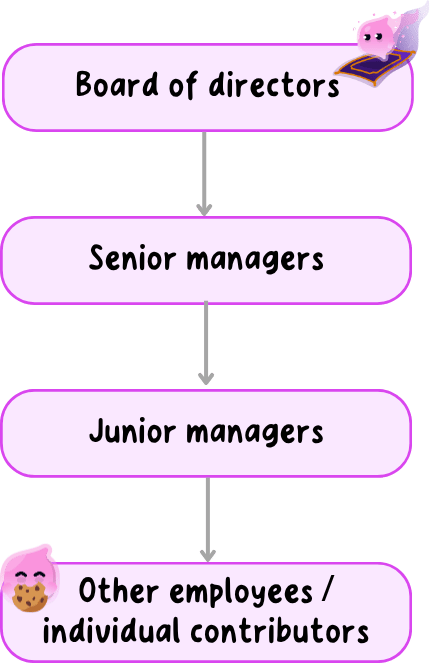
- All three increase at every level up the hierarchy, so a director may commit millions while an operative may commit nothing.
- Giving a supervisor responsibility for on-time delivery without the authority to order an extra van makes the target impossible, so good structures match the two.
- A subordinate is an employee who works directly under a named manager, and authority passed down to a subordinate never removes the manager's own responsibility for the result.
- Accountability runs upwards in an unbroken line, so an operative answers to a supervisor, the supervisor to a manager, the manager to a director and the directors to the shareholders.
- Every employee should have exactly one line manager, because two people giving conflicting instructions wastes time and lets each blame the other when work is not done.
Inter-relationships: instructions down, information up, cooperation across
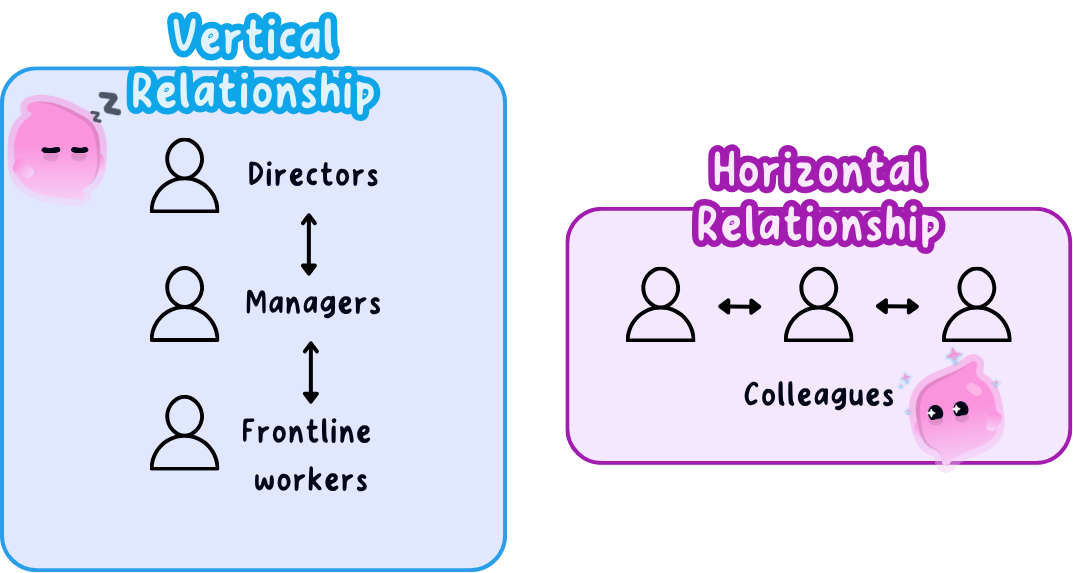
- Vertical relationships join a superior to a subordinate, carrying instructions, targets and budgets down and results, problems and requests up.
- The upward half is the half businesses most often neglect, and a director who never hears bad news from below plans with information that is already wrong.
- Horizontal relationships join people on the same level in different departments, who must cooperate even though neither can give the other orders.
- If the marketing manager launches an advertising campaign without telling the operations manager, demand arrives before the stock does and the business loses the sales it paid to create.
- Levels can pull against each other, since directors may order a cost cut of 5 per cent while supervisors know that removing weekend staff will lengthen queues and lose customers.
- John Lewis calls its employees partners and gives them a formal channel to question senior managers, so bad news reaches the top faster, although a shop assistant still answers to a section manager.
Do not write boss, worker or head of the company as job titles, because only director, manager, supervisor and employee identify the role precisely.
- State two responsibilities of a director that a manager does not have.
- What does a supervisor do on a normal working day?
- Explain the difference between authority and responsibility.
- Why is it a problem for one employee to have two line managers?
- Give one example of a horizontal relationship and say why it matters.