Quality assurance: preventing faults at every stage
Definition
Quality assurance: A system of agreed standards and checks built into every stage of production, so that faults are prevented rather than found at the end.
- Quality assurance is a way of working rather than a final check, so it changes how the product is made instead of deciding which finished units are allowed out.
- The aim is prevention, because a fault stopped where it happens costs only the work done so far, while the same fault found at the end has swallowed the whole unit cost.
- Checks sit at every stage of the process, so the output of each step is confirmed as correct before it is passed to the next one.
- Responsibility moves from a separate inspection team to the people doing the work, who check their own output against an agreed standard.
- The guiding phrase is getting it right first time, since a unit made correctly needs no scrapping, no repair, no refund and no apology.
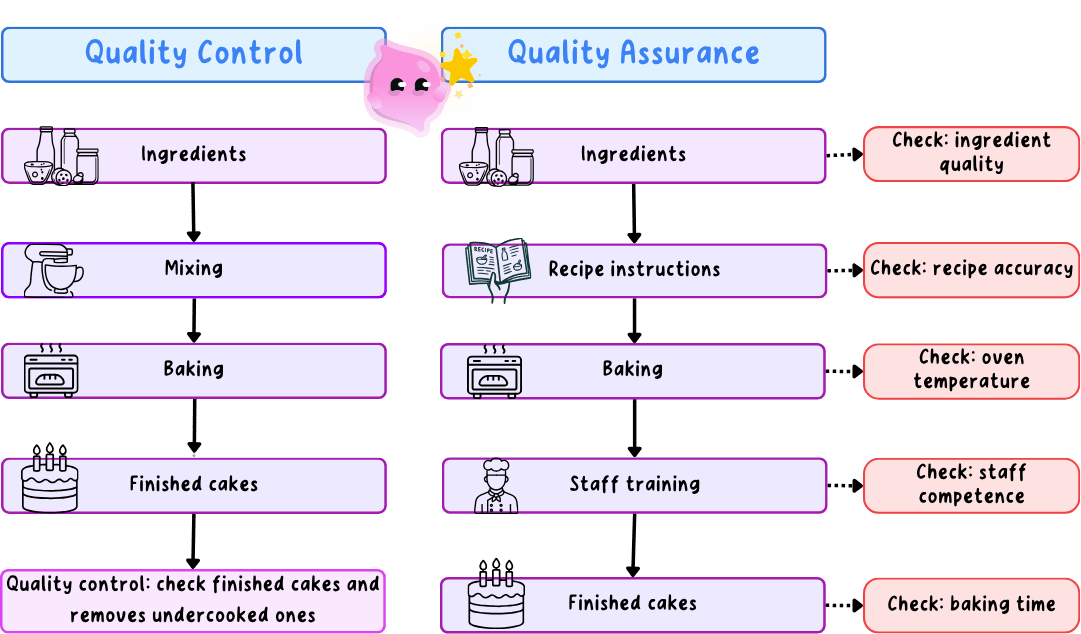
Analogy
- Quality assurance works like tasting a dish as you cook it, adjusting the seasoning at each step.
- Quality control is tasting only the finished plate, when the ingredients and the cooking time have already been used up.
How a business implements quality assurance
- Agree a standard for every stage. The business defines what correct looks like at each step, such as a dough weight, a bolt tightness, an oven temperature or the wording of a reply to a customer.
- Design the process so mistakes are hard to make. A part shaped to fit only one way round, or a machine that will not run until a guard is closed, prevents the error instead of relying on care.
- Train workers in the standard. Staff must know what good looks like and how to test for it before they can be trusted to judge their own work.
- Self-checking at each stage: every worker inspects their own output against the standard and does not pass it on until it is right.
- The right to stop the line: many systems allow any worker who spots a problem to halt production so the cause is fixed rather than repeated.
- Toyota built this into its production system, where a worker can pull a cord to stop the line instead of letting a fault travel down it.
- Check inputs from suppliers. Materials and components are inspected on delivery, or bought only from approved suppliers who work to agreed standards.
- Certification to a recognised standard: an outside assessor audits the firm's procedures against a published standard such as ISO 9001 and certifies that a quality system is in place and being followed.
Example
- A firm making sandwiches for a supermarket checks the chilled lorry temperature on delivery, weighs the filling at the assembly bench and checks the seal and date code before packing.
- A batch made with warm chicken is stopped at the delivery bay, so the business loses one delivery rather than a day of finished sandwiches.
Benefits: cheaper faults and workers who own the standard
- Less waste: a fault caught at the stage it occurs loses only the value added so far, not the full cost of a finished unit.
- If a fault appears at the second of six stages, the firm loses the work of one stage instead of six, so the money lost per fault is far smaller.
- Fewer faults reach the end. With a check at every step, far fewer defective units are completed, so returns, refunds and complaints all fall.
- Workers take responsibility. Being trusted to judge their own work adds interest and recognition to the job, which are motivators, so motivation rises and absenteeism and labour turnover tend to fall.
- Causes are found, not just faults. Because a problem is spotted at the stage that created it, managers know which machine, material or step to correct, so the fault stops recurring.
- Stronger reputation: output that is consistent every time builds trust, which brings repeat custom and lets the firm hold its price instead of discounting to win sales back.
Common Mistake
- Do not write that quality assurance means checking products at the end, because that describes quality control.
- Certification proves the system is followed, not that every single product is perfect, so a poorly designed product made exactly to standard is still poor.
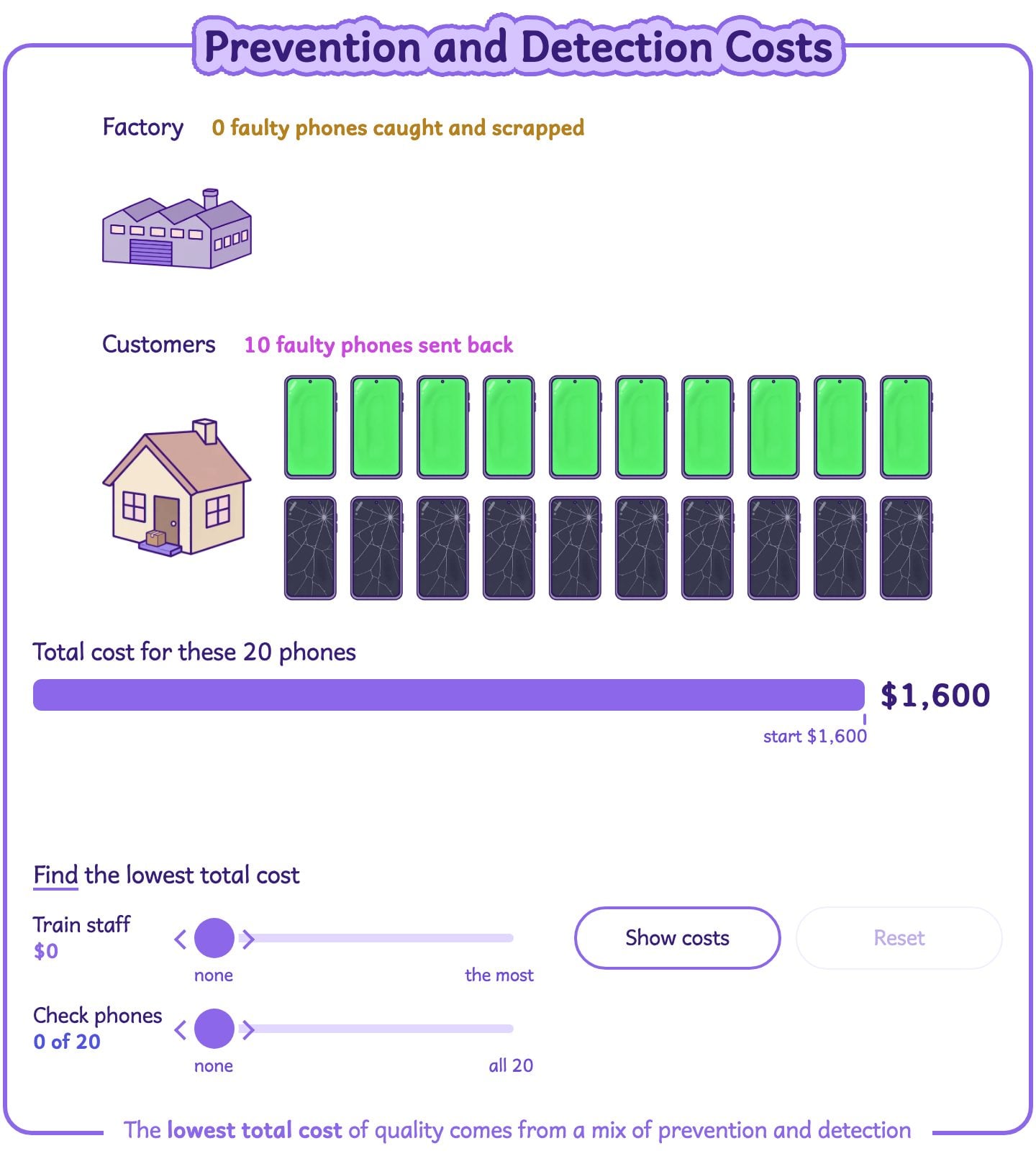
Move spending between prevention and detection and find the mix with the lowest total cost of quality.
Drawbacks: the training and the effort come long before the saving
- Training costs: every worker has to be taught the standards and how to check against them, which costs money and takes staff off production while they learn.
- Slow and expensive to introduce: writing a standard for each stage, setting up records and changing how people work takes management time long before any saving appears.
- It only works if everyone follows it. One worker who ignores the standard or waves a fault through breaks the chain, and the faulty unit carries on down the line as if nothing had happened.
- Checking slows the work. Time spent testing at each stage is time not spent producing, so output per hour can fall until staff are practised at the checks.
- It does not remove the need for good design. The system controls how the product is made, so a product customers do not want will be made consistently and still not sell.
Self review
- What does quality assurance try to do that quality control does not?
- Who carries out the checking under quality assurance?
- Give three ways a business can put quality assurance into practice.
- Explain why a fault caught at stage two costs less than the same fault caught at stage six.
- Give two reasons why quality assurance can be difficult to introduce.