Location: a choice that locks in costs for years
Definition
Location decision: The choice of where a business puts its factory, office or shop, made by weighing the costs of a site against the revenue it can earn there.
- A site fixes rent, transport costs and the pool of workers a business can hire, and those costs are paid every month whether sales are good or bad.
- Moving later is expensive because the business pays for new premises, removals and staff who leave rather than relocate, so most firms try to get the decision right once.
- Cambridge splits location into two separate cases because the two types of business are pulled by different things.
- A manufacturing business makes goods, so it worries about the cost of bringing materials in and sending finished products out.
- A service business sells to customers who come to it, so it worries about how many people can reach the door.
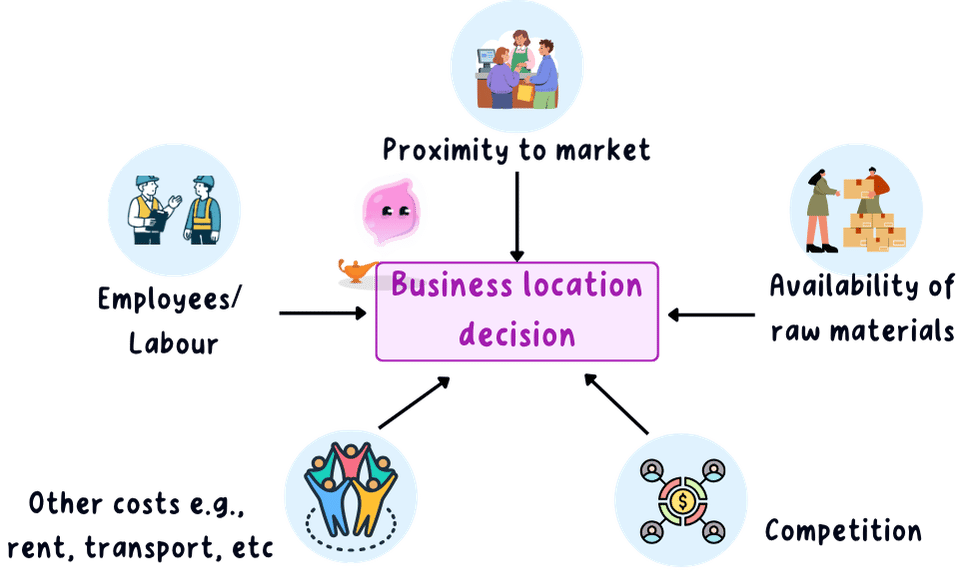
- Five pulls act on almost every location decision: proximity to the market, availability of raw materials, employees and labour, competition, and other costs such as rent and transport. These are the main factors rather than the complete list, since the supply of energy and water and the room to expand can decide the choice as well.
Common Mistake
- Do not learn one list of location factors and use it for every business, because a factory and a shop are pulled by different things.
- Raw materials, land area and energy decide a factory site, while footfall, catchment income and parking decide a shop site.
Manufacturing businesses: getting materials in and goods out cheaply
- Nearness to raw materials: where the inputs weigh more than the finished product, siting the plant beside the supply cuts the tonnage that has to be moved and so cuts transport costs per unit.
- Sawmills sit next to forests and cement works next to quarries, because moving raw timber or stone costs far more than moving the planks or bags that come out.
- Transport links: motorway access, a rail freight line or a nearby port shortens delivery times, which matters most to firms running just-in-time systems that hold almost no spare inventory.
- Nissan's Sunderland plant is a short drive from the Port of Tyne, so exported cars reach a ship without a long inland journey.
- Cost and availability of land: a factory needs a large flat site, and rural or edge-of-town land costs far less per square metre than a city centre, which holds down the fixed cost of rent and rates.
- Space also has to be available for future expansion, because a firm boxed in by housing cannot add a second production line without moving.
- Availability of labour with the right skills: an area with a history of engineering already has welders, machine operators and technicians, so the firm recruits quickly instead of paying to train from scratch.
- Where those skills are scarce the business has to bid wages up against local rivals, which raises variable costs for as long as the plant operates.
- Energy and water supply: steel, glass and chemical plants use huge amounts of power, and brewing, paper and food processing use huge amounts of water, so they need a site with a reliable, cheap supply.
- An interrupted supply stops the whole line, and workers still have to be paid while nothing is produced.
- Proximity to the market: when the finished product is bulky, fragile or perishable it is the output that is costly to move, so the plant is better placed near the customers.
- Bread and fresh dairy are made close to the towns that buy them, because a long journey uses up shelf life the retailer needs.
Example
- A furniture maker compares a rural site with cheap land and a site on an industrial estate beside the motorway.
- Finished sofas are bulky and go to shops all over the country, so delivery costs would rise sharply from the rural site.
- The extra rent on the estate is a fixed cost of a known size, while the extra mileage would be paid on every single order.
Service businesses: being where the customers already are
Definition
Footfall: The number of people who walk past or into a business's premises in a given period of time.
- Footfall and passing trade: a shop on a busy street converts people who were walking past anyway into customers, so it gains sales without spending more on advertising.
- Greggs deliberately takes units by stations, bus routes and busy high streets, because most of its sales are impulse purchases made by people already on the move.
- Closeness to customers: a hairdresser, dentist or gym draws almost all its trade from the few streets around it, so a site ten minutes further away hands those customers to a nearer rival.
- The business also has to check that the people living in that area can afford its prices, since a high-priced salon needs a catchment with the income to match.
- Rent and business rates: prime high-street units cost several times more than a side street, and that rent has to be paid before a single sale is made.
- If the extra footfall does not bring in more profit than the extra rent, the cheaper unit leaves the owner better off.
- Parking and access: customers buying heavy or bulky items need to load a car, so furniture and DIY retailers take retail parks with free parking rather than pedestrianised streets.
- Nearby competitors: rivals split a fixed number of local customers, and a crowded street often forces price cuts that squeeze the profit margin.
- Clustering can still work, because car dealerships and coffee shops group together to attract shoppers who want to compare before buying.
- Availability of staff: shops, cafes and care homes rely on part-time workers who live close enough to travel in for a short shift.
- Where local unemployment is very low, shifts go unfilled and the business has to shorten opening hours, which directly loses revenue.
Exam technique
- Saying that a site has good transport links is not a finished point, so say what is being moved and which cost falls as a result.
- Nearness to materials and nearness to the market pull in opposite directions, so use the weight and shelf life of the product to say which one applies here.
- Cheap rent is only an advantage if you also say what the business gives up by taking the quieter site.
Self review
- Name four factors a manufacturer considers when choosing a site.
- Why does a sawmill locate near forests rather than near its customers?
- What is footfall, and which type of business depends on it most?
- Give one reason a retailer might choose a retail park over a high street.
- Explain one way a shortage of local staff reduces a service business's revenue.