Why training matters: what the business gets back
Definition
Training: The process of teaching employees the skills and knowledge they need to do their job better.
- New employees can do the job in general but not the way this firm does it, and existing staff need retraining whenever technology, products or the law change.
- Output per worker rises, because a trained employee finishes the same task in less time and needs telling less often, so the wage bill buys more work.
- Waste and faults fall, so a trained machine operator scraps fewer components and a trained chef throws away less food, which cuts materials costs and brings fewer customer complaints.
- Accidents fall, because staff who know how to use guards, lifting equipment and chemicals safely are injured less, so lost working days, compensation claims and insurance premiums all drop.
- The workforce becomes flexible, since multi-skilled staff can be moved to whichever department is busy, which is why Toyota trains assembly workers to carry out several jobs on the line.
- Labour turnover falls, because staff who are given skills and a route to promotion are less likely to leave, so the business spends less on advertising vacancies, interviewing and inducting replacements.
What training gives the employee
- Earning power rises, because a qualification such as a forklift licence or an accountancy certificate makes the worker worth more to this employer and to others.
- Promotion becomes realistic, so the employee can move from operator to supervisor rather than staying on the same wage for a decade.
- Work becomes more interesting, and Herzberg treats achievement, responsibility and advancement as motivators, so training raises motivation in a way extra pay alone does not.
- Job security improves, since a multi-skilled worker is harder to replace and is less likely to be selected if the firm has to cut jobs.
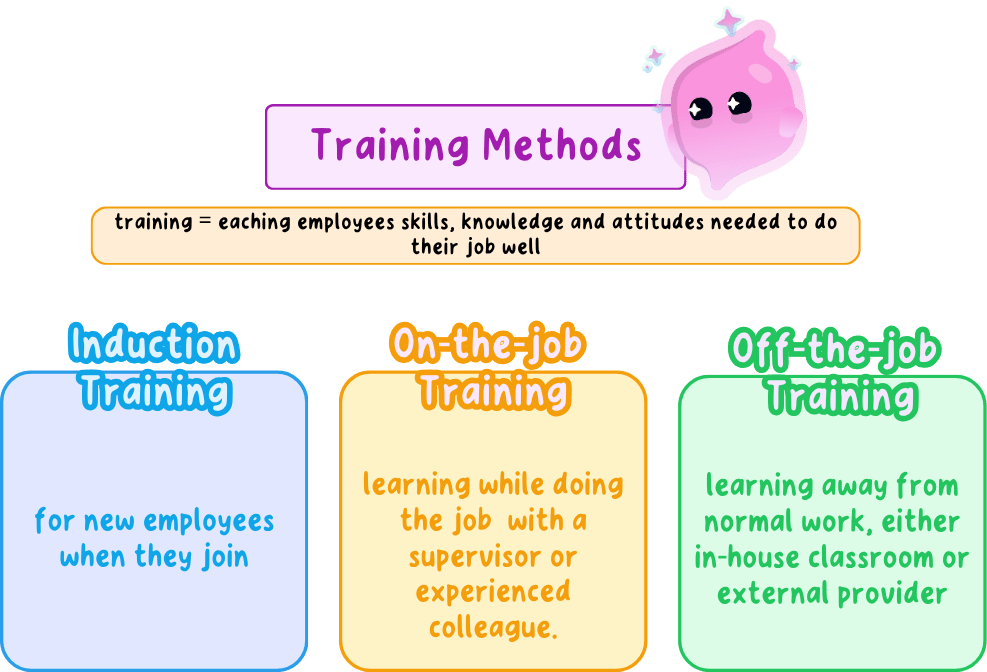
Induction training: the first days in the job
Definition
Induction training: Training given to a new employee when they first join a business, covering the workplace, the people, the rules and the basic tasks.
- It normally covers a tour of the site, introductions to the team, fire exits and safety rules, hours and breaks, who to report to, and a first run through the main tasks.
- New staff become productive sooner, because someone who knows where things are and who to ask stops interrupting colleagues after a few days rather than a few weeks.
- Early leaving falls, since employees who feel welcomed and know what is expected are less likely to resign in the first month and force the firm to recruit again.
- It also protects the business legally, because health and safety law requires employees to be told the risks of their workplace before they start work.
- Against that it is expensive in the short run, as the new employee is paid while producing nothing and an experienced member of staff is taken off their own work to run it.
- It can also be too long or too general, and it does not teach the job itself, so the real skills still have to be trained afterwards.
On-the-job training: learning at the workstation
Definition
On-the-job training: Training carried out at the workplace while the employee does the real job, usually by watching and being guided by an experienced worker.
- It is delivered by shadowing an experienced worker, by demonstration and coaching, by mentoring, by job rotation between departments, or through an apprenticeship.
- It is cheap, because there is no course fee, no travel and no outside trainer to hire, so a small firm can afford it.
- Output continues during training, since the trainee is producing real work, even if more slowly at first.
- It is relevant, because the trainee learns on the firm's own equipment and procedures rather than a generic version, so nothing has to be unlearned afterwards.
- The trainer's own output falls while they teach, and being good at a job does not make someone good at explaining it, so bad habits and shortcuts get copied.
- Mistakes are made on live customers or expensive materials, and no recognised qualification is usually gained at the end.
Off-the-job training: learning away from the workstation
Definition
Off-the-job training: Training that takes place away from the employee's normal workstation, either at a college or specialist trainer or in the firm's own training centre.
- It covers college courses taken by day release, short courses from specialist training companies, online courses, and courses run in the firm's own training centre.
- The teaching is expert and leads to a recognised qualification, so learning is faster than copying a colleague and the standard reached can be shown to customers, insurers or regulators.
- No experienced employee is taken off production to teach, and trainees meet people from other businesses and bring back methods their own firm has not tried.
- It is expensive, because the firm pays a course fee, travel and the trainee's wage while no work is being done, and a plumber on a five-day course is five days of chargeable work not earned.
- A course written for a whole industry may cover equipment this firm does not own, and the portable qualification it awards is exactly what a competitor will pay more for.
Common Mistake
- Off-the-job does not mean outside the company, because training in the firm's own training room away from the workstation still counts as off the job.
- Induction is not a third alternative to the other two, since it is the training given at the start of employment and can itself be delivered on or off the job.
- A question about training is not answered by describing how the person was recruited.
Exam technique
- Do not stop at the point that workers become more motivated, because what a training answer needs is what that motivation then does, such as fewer absences, less waste and higher output.
- Keep the cost of training on the business side and the qualification on the worker side, since questions usually name whose benefits they want.
- Naming the method is not enough, so say why an apprenticeship suits a plumbing firm while an online course suits a chain updating 500 staff on a new till system.
Self review
- Give three benefits to a business of training its employees.
- Name two things covered in induction training and one limitation of it.
- Give one benefit and one limitation of on-the-job training.
- Why does off-the-job training make it easier for a worker to leave?
- State two ways training benefits the employee rather than the employer.